Closed
Serving Third Ward Based in Midtown · 1 mi away
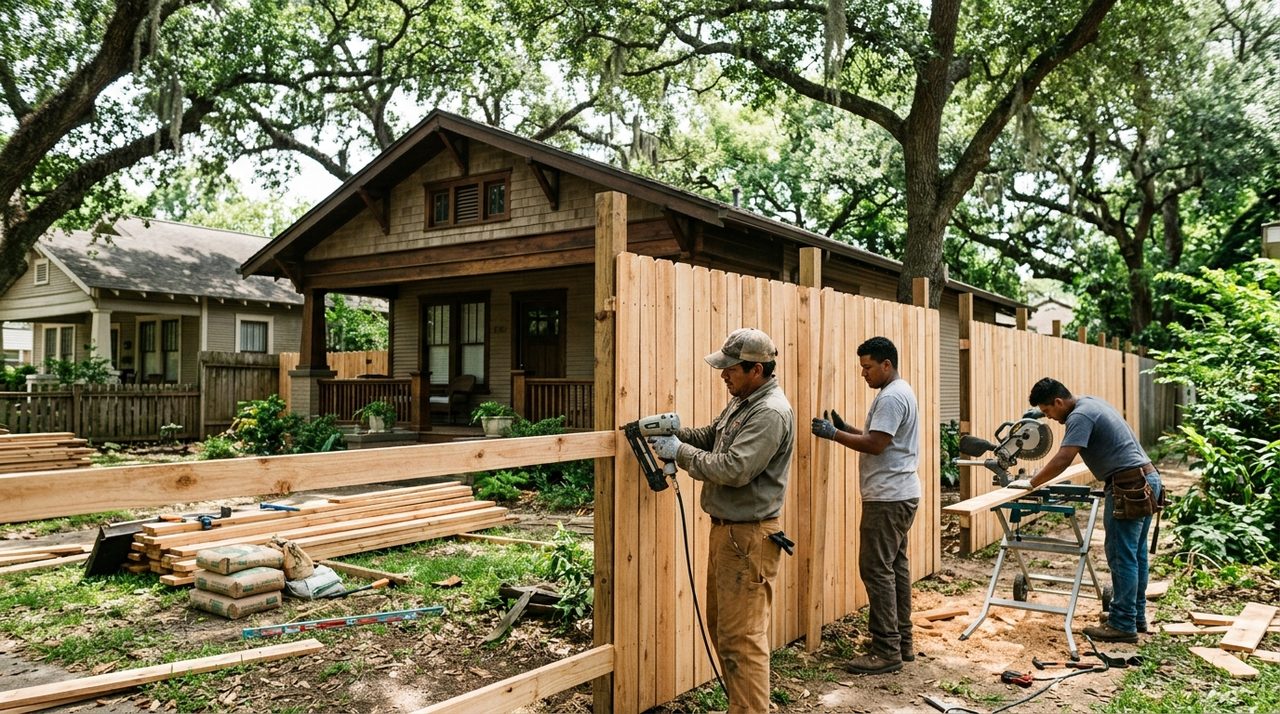
Third Ward's block-by-block contrast between 1920s–1940s pier-and-beam bungalows and post-2000 slab-on-grade townhomes means a fence installer planning a project here faces two completely different site conditions sometimes sitting side by side on the same street. Add Houston's native Beaumont clay soil beneath nearly every lot, City of Houston permit rules that kick in above six feet, and project-specific mandatory HOAs quietly governing many newer townhome clusters, and the permitting and installation picture is more layered than it first appears. This page walks Third Ward homeowners through the real challenges — clay post heave, wind-load history, permit jurisdiction, and wood rot in Gulf humidity — so you can ask the right questions before the first post goes in.
Ranked by verified Google rating × review volume × verification tier. How we rank →
Some highly-rated pros serve Third Ward from nearby and may not keep a Third Ward street address. Those are listed under "Also serving Third Ward" with their real city and distance, so you always know where each business is based.
Highly-rated pros based nearby who cover Third Ward. Distance shown from the Third Ward area.
Serving Third Ward Based in Midtown · 1 mi away
Serving Third Ward Based in Midtown · 1.7 mi away
Serving Third Ward Based in EaDo · 2.7 mi away
Serving Third Ward Based in EaDo · 2.7 mi away
Serving Third Ward Based in EaDo · 2.7 mi away
Serving Third Ward Based in Lazybrook / Timbergrove · 4.1 mi away
Serving Third Ward Based in The Heights · 4.1 mi away
Serving Third Ward Based in The Heights · 5.3 mi away
Serving Third Ward Based in Spring Branch · 6 mi away
Serving Third Ward Based in Medical Center · 6 mi away
Why it matters to you
The older portions of Third Ward — blocks of 1920s–1950s frame bungalows between Almeda Road and Ennis Street — sit on native Houston Black clay that swells noticeably after summer rains and shrinks back during dry spells. Standard concrete tube footings poured at 18–24 inches can migrate vertically with these moisture cycles, causing fence posts to lean or crack within a few years of installation, particularly in low-lying areas where drainage is slow. On pier-and-beam properties, where the soil around the foundation is already in motion, the problem compounds.
What a good pro does
A competent installer on Third Ward bungalow lots should drill posts to a minimum of 36 inches — deeper than typical Houston practice — and use a dry-pack concrete method rather than wet-pour to reduce moisture uptake at the footing. Sleeving the post base and leaving a slight gap at grade level allows the soil to move without torquing the post. Get written confirmation of footing depth before work begins, as this is the single biggest differentiator in longevity on clay lots.
Sources: International Residential Code (as adopted by City of Houston)
Why it matters to you
Third Ward sits well inside the metro, but the May 2024 derecho and Beryl 2024 demonstrated that inner-loop neighborhoods are not shielded from destructive wind events — gusts in Harris County during both events damaged or destroyed sections of privacy fencing across the area. A standard 6-foot board-on-board cedar fence with posts spaced at 8 feet and set in shallow footings is particularly vulnerable because the solid panel acts as a sail with no wind-relief gaps. Replacement costs after a major event typically run $3,000–$8,000 for an average suburban lot, an expense that is often partly avoidable with better initial construction.
What a good pro does
For Third Ward's predominantly compact urban lots, good installers use post spacing no greater than 6 feet on center for 6-foot privacy panels, embed corner and gate posts deeper than field posts, and discuss wind-relief gap options (spaced pickets or lattice top sections) with homeowners who want storm resilience over pure privacy. Documenting installation specs may also matter for TWIA or homeowner insurance claims after a wind event.
Sources: Texas Windstorm Insurance Association (TWIA), International Residential Code (as adopted by City of Houston)
Why it matters to you
Third Ward falls entirely within City of Houston permit jurisdiction, meaning the Houston Permitting Center is the single permit authority — not a separate suburban city office. Fences exceeding six feet in height require a City of Houston permit, and Houston has no citywide zoning, so height and placement restrictions come from subdivision-level deed restrictions that vary block by block rather than from a uniform zoning code. On many bungalow-era blocks, deed restrictions are expired or unenforced, but on newer townhome clusters — particularly along Blodgett, Prospect, and Winbern — small project-specific mandatory HOAs have their own architectural approval requirements that are legally binding regardless of what the city permits.
What a good pro does
Before any fence work begins in Third Ward, confirm two things independently: whether a Houston Permitting Center permit is required for the proposed height and scope, and whether the specific lot is covered by a deed restriction or a project-specific HOA architectural review requirement. A fence installer who pulls the plat and checks HCAD records for deed restriction language before submitting a proposal will save homeowners from forced removal or fines. Texas does not license fence contractors at the state level, so permit compliance is the primary quality signal.
Sources: City of Houston Permitting Center, Local HOA / deed restrictions (see area profile)
Why it matters to you
Houston's year-round relative humidity consistently exceeds 70%, and Third Ward bungalow lots — many of which have minimal lot grading and aging drainage infrastructure — tend to hold standing water after heavy rain. Ground contact between untreated or under-treated pine posts and persistently moist clay soil creates ideal fungal conditions; fence installers working in the neighborhood report seeing post rot at grade line within three to five years on properties where water pools against the fence line. The combination of slow-draining clay and bayou-area humidity is more damaging to wood fence lumber than nearly any other condition in the metro.
What a good pro does
On Third Ward lots with visible drainage issues or low-grade profiles, specify pressure-treated posts rated for ground contact (UC4B minimum) rather than the cheaper UC3B above-ground rating, and consider steel or aluminum post sleeves at grade level for additional protection. Cedar pickets above grade will naturally resist rot better than pine, but the post is where failure begins. A good installer will also recommend grading soil away from the post base and ensuring the fence bottom rail sits at least an inch above grade to reduce capillary moisture absorption.
Sources: International Residential Code (as adopted by City of Houston)
Hiring fence builders in Third Ward? Third Ward presents contractors with a split housing stock: early 20th-century pier-and-beam bungalows requiring foundation, plumbing, and electrical upgrades alongside modern slab-on-grade townhomes with contemporary systems. Proximity to Brays Bayou means flood-related remediation and drainage work remain ongoing concerns. The absence of a single mandatory HOA simplifies permitting but project-specific HOAs on newer townhome developments may impose architectural and material requirements.
Building era
1920s–1960s legacy homes with significant 2000s–2020s infill townhome construction.
Typical style
Early 20th-century frame bungalows and cottages; contemporary 2- to 3-story townhomes with attached garages; some student-oriented multifamily near UH and TSU.
Foundations
Mixed — older bungalows predominantly pier-and-beam; newer townhomes and infill predominantly slab-on-grade.
Common systems
Older homes: galvanized or cast-iron plumbing, 60–100 amp electrical panels, window units or aging central HVAC. Newer townhomes: PEX or copper plumbing, 200 amp panels, modern central HVAC with multi-zone capability.
What that means for repairs
Gut renovations and full-system upgrades of pre-1960s bungalows are common as the neighborhood gentrifies. Electrical panel upgrades, re-plumbing from galvanized to PEX, and pier-and-beam foundation leveling are frequent scopes. Newer townhomes see comparatively less renovation but occasional warranty-period repairs and cosmetic upgrades.
Permit jurisdiction
Houston Permitting Center (City of Houston).
HOA & deed restrictions
No single mandatory HOA covers the neighborhood. Multiple voluntary civic clubs operate including Canfield Oaks Civic Association, Third Ward is Home Civic Club, and University Village Civic Club. Newer townhome and condo developments commonly have small, project-specific mandatory HOAs governing shared driveways and common areas.
Historic districts
No City of Houston historic district designation confirmed for Third Ward as a whole. Individual structures may have landmark status — check HAHC records for specific addresses.
Contractor note
Houston has no citywide zoning, so building controls depend on subdivision-level deed restrictions that vary block by block. Contractors working on older homes should verify whether the lot is in a deed-restricted subdivision before proposing accessory structures or lot modifications.
FEMA flood zone
FEMA Zone X (low flood risk) per official NFHL data. However, Third Ward sits directly north of Brays Bayou and includes low-lying areas near bayou tributaries and older storm sewer infrastructure, which can create localized flooding risk not fully captured by Zone X designation.
Hurricane Harvey impact
Third Ward lies within the broader Brays Bayou watershed, which experienced significant flooding during Hurricane Harvey in 2017. However, no neighborhood-specific documentation was found quantifying the extent of Harvey damage or identifying specific flooded streets within Third Ward. Property-level Harvey impact should be verified through FEMA Harvey inundation layers, Harris County Flood Control District mapping tools, and seller's disclosure for any individual address.
Heat & humidity load
Older pier-and-beam bungalows with aging insulation and single-pane windows face extreme summer cooling loads; HVAC systems in these homes are frequently undersized or failing. High humidity under pier-and-beam homes can accelerate subfloor rot and encourage pest infestations. Newer townhomes perform better thermally but three-story designs can struggle with uneven cooling between floors, making multi-zone HVAC balancing a common summer service call.
Working with contractors here
Contractors in Third Ward most commonly handle two categories of work: full-system renovations of pre-1960s bungalows and routine maintenance on post-2000 townhomes. On older homes, pier-and-beam foundation leveling, galvanized plumbing replacement, electrical panel upgrades from 60 to 200 amps, and HVAC installation are the most frequent scopes. Newer townhomes generate calls for HVAC zone balancing, minor foundation settling on slab construction, and cosmetic remodels. Proximity to Brays Bayou means flood damage remediation—including drywall removal, mold treatment, and flooring replacement—remains a recurring need after heavy rain events. Job scoping should account for the wide variance in building age and condition even within a single block, and contractors should verify project-specific HOA requirements on newer developments before beginning exterior work.
Local Tip
Always ask for a written estimate before work begins. Texas contractors are required to provide one on jobs over $1,000.
Third Ward presents contractors with a split housing stock: early 20th-century pier-and-beam bungalows requiring foundation, plumbing, and electrical upgrades alongside modern slab-on-grade townhomes with contemporary systems. Proximity to Brays Bayou means flood-related remediation and drainage work remain ongoing concerns. The absence of a single mandatory HOA simplifies permitting but project-specific HOAs on newer townhome developments may impose architectural and material requirements.
Source: U.S. Census Bureau, ACS 5-Year 2023
Most of Third Ward maps to FEMA Zone X (low mapped flood risk), but Houston's flash-flood reality means even low-risk blocks benefit from smart drainage and storm-hardened installs; risk climbs sharply on blocks nearest Brays Bayou, where it varies parcel to parcel.
Source: FEMA National Flood Hazard Layer (NFHL). Flood zones vary by parcel — verify your individual FIRM panel.
Sources: City of Houston Permitting CenterMunicipal permit office (see area profile)
Sources: Harris County Flood Control District
Sources: Local HOA / deed restrictions (see area profile)
Sources: FEMA National Flood Hazard Layer (NFHL)Harris County Flood Control District