Closed
6776 McHard Rd, Houston, TX 77053
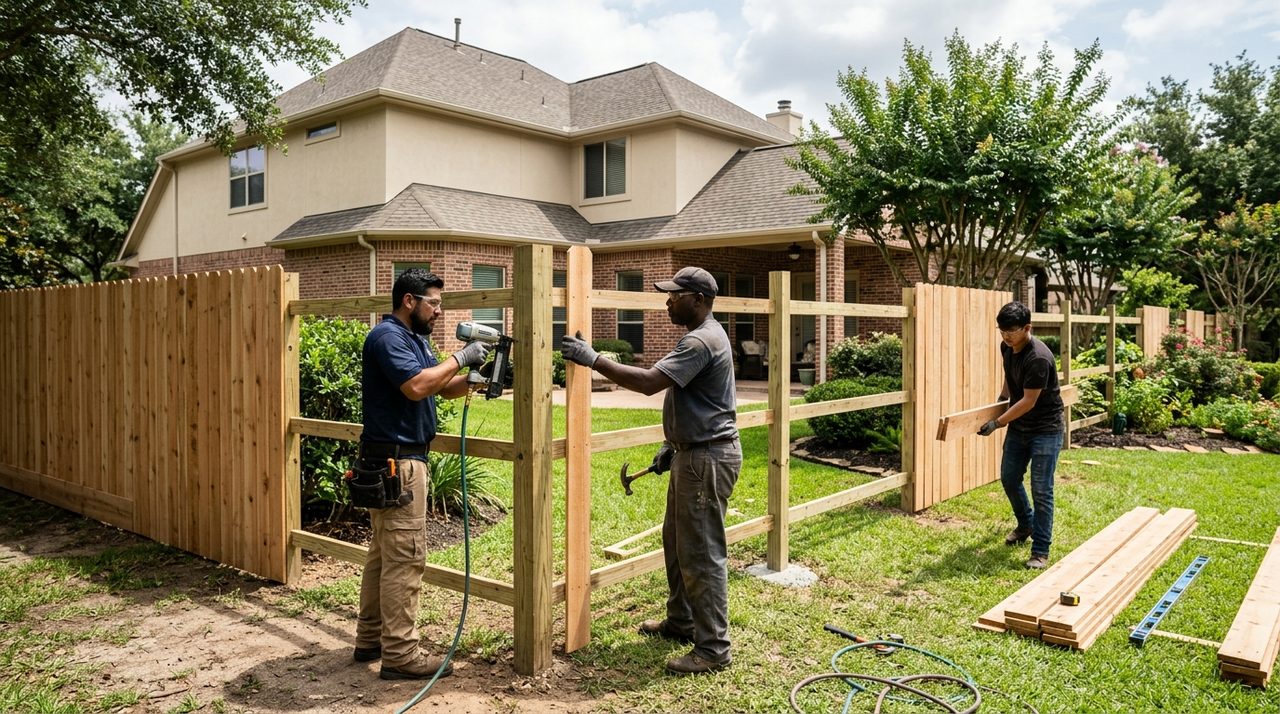
Westbury's roughly 5,000 mid-century ranch homes sit on Houston's expansive Black clay and carry deed restrictions enforced by the Westbury Civic Club's Architectural Review Committee — a combination that turns what looks like a simple backyard fence project into a multi-step approval and engineering exercise. Add the City of Houston's permit requirement for fences over six feet and the clay-driven post movement that has already destabilized fencing installed during Westbury's original 1950s–1960s buildout, and getting this right the first time matters far more than it might in a newer suburb.
Ranked by verified Google rating × review volume × verification tier. How we rank →
Some highly-rated pros serve Westbury from nearby and may not keep a Westbury street address. Those are listed under "Also serving Westbury" with their real city and distance, so you always know where each business is based.
6776 McHard Rd, Houston, TX 77053
5622 Mason Oaks, Houston, TX 77085
Highly-rated pros based nearby who cover Westbury. Distance shown from the Westbury area.
Serving Westbury Based in Meyerland · 0.4 mi away
Serving Westbury Based in Braeswood · 1.6 mi away
Serving Westbury Based in Meyerland · 1.8 mi away
Serving Westbury Based in Meyerland · 2 mi away
Serving Westbury Based in Sharpstown · 2.5 mi away
Serving Westbury Based in Medical Center · 2.6 mi away
Serving Westbury Based in Bellaire · 2.8 mi away
Serving Westbury Based in Bellaire · 3 mi away
Why it matters to you
The Houston Black clay underlying Westbury's 1950s–1960s lots shrinks measurably in dry summers and swells after heavy rain, and that cycle works directly against standard concrete footings poured around fence posts. Many Westbury homeowners replacing original-era fencing discover the old posts are sitting in cracked, tilted concrete — evidence of decades of clay movement — not just ordinary aging. This problem is amplified on the wide, flat lots characteristic of the neighborhood's ranch-home era, where drainage is slow and clay stays saturated longer after each rain event.
What a good pro does
A fence contractor working in Westbury should set posts in deeper footings than the Houston norm — at least 30–36 inches — using a narrower-diameter hole that limits the concrete 'collar' surface area exposed to swelling clay. Some installers in this area use a dry-pack concrete method or add gravel below the post base to improve drainage and reduce footing pressure during wet cycles. Post replacement on a standard Westbury lot typically runs $150–$300 per post including concrete, so an estimate — budget accordingly.
Sources: International Residential Code (as adopted by City of Houston), City of Houston Permitting Center
Why it matters to you
Westbury's deed restrictions, enforced by the Westbury Civic Club Architectural Review Committee (Super Neighborhood 37), require homeowners to obtain written ARC approval before installing or replacing a fence — not after the fact. Restrictions typically govern material (cedar is common; chain-link facing a street is often prohibited), height, and finished-side orientation. Because each section of Westbury may have slightly different recorded deed restriction language on file at the Harris County Clerk, the rules are not perfectly uniform across the neighborhood, and assuming your neighbor's fence sets the standard can get your project forced out.
What a good pro does
Before signing any contract, pull your specific lot's deed restriction document from the Harris County Clerk's recorded plat records and submit a written ARC application to the Westbury Civic Club with material samples, a site plan showing fence location relative to property lines, and the proposed height. Factor in at least two to four weeks for committee review before scheduling installation. A contractor experienced in Westbury will know to build this timeline into the project schedule rather than treating approval as a formality.
Sources: Local HOA / deed restrictions (see area profile), Municipal permit office (see area profile)
Why it matters to you
Westbury lies entirely within City of Houston city limits, so the City of Houston Permitting Center — not a suburban municipal office — governs fence permits here. A permit is required for any fence exceeding six feet in height, and Houston's 811 call-before-you-dig obligation applies to every post hole regardless of fence height. What catches many Westbury homeowners off guard is the recorded drainage and utility easements common on 1950s-era Harris County plats: these often run along rear lot lines exactly where a privacy fence would go, and placing a post inside an easement can trigger a removal demand from the utility or the city.
What a good pro does
Obtain your property survey — or commission a new one if the 1950s original can't be located — and cross-reference it against the recorded plat at the Harris County Clerk before laying out the fence line. Call 811 at least three business days before any digging, and if your survey shows a rear or side easement, ask the contractor to design around it with adjusted post spacing or a slight inset of the fence line. City of Houston permit applications for fences over six feet are submitted through the city's online permitting portal, and inspections are required before backfilling post holes.
Sources: City of Houston Permitting Center, Municipal permit office (see area profile)
Why it matters to you
Westbury is in the southwest Houston corridor that absorbed significant wind damage in both the May 2024 derecho and Hurricane Beryl in July 2024 — events that leveled board-on-board privacy fences throughout Harris County's older neighborhoods. The 6-foot cedar fences common on Westbury's mid-century lots are especially vulnerable when posts are undersized (4x4 where 4x6 belongs), set too shallow, or when fence panels have no wind-relief gaps to let gusts pass through rather than push the entire panel over. Full storm-damage fence replacement in this market has typically run $3,000–$8,000 for an average suburban lot — a range to treat as an estimate only.
What a good pro does
When replacing storm-damaged fencing in Westbury, request that the contractor use 4x6 cedar or pressure-treated posts at maximum 8-foot spacing, set in footings deep enough to resist racking loads, and consider a board-on-board pattern with a slight gap rather than a true solid panel. TWIA wind-zone construction details are a useful benchmark for post embedment and panel bracing, even if homeowner's insurance rather than TWIA covers the repair. Documenting the installation method and materials with photos can also simplify future insurance claims.
Sources: Texas Windstorm Insurance Association (TWIA), International Residential Code (as adopted by City of Houston)
Hiring fence builders in Westbury? Westbury is a large 1950s-era subdivision of roughly 5,000 single-family homes plus thousands of multifamily units in southwest Houston. Homeowners here contend with aging slab foundations, original-era plumbing and electrical systems, and flood risk in sections near Willow Waterhole and Brays Bayou. Deed restrictions enforced by the Westbury Civic Club/HOA require architectural review for exterior modifications, making pre-project compliance checks essential.
Building era
1950s–1960s (original subdivision), with later multifamily and infill development.
Typical style
One-story mid-century ranch homes with brick veneer, low-sloped or hipped roofs, attached garages or carports, and wide lots.
Foundations
Predominantly concrete slab-on-grade; some pier-and-beam may exist in earliest sections but slab is clearly prevalent in listings.
Common systems
Original homes likely have galvanized steel or early copper supply lines, cast iron drain lines, 100-amp electrical panels, and older forced-air HVAC systems or window units later converted to central air. Many systems are 50–70 years old and approaching or past end of life.
What that means for repairs
Kitchen and bathroom remodels are common as owners update mid-century layouts. Whole-house replumbing (replacing galvanized and cast iron), electrical panel upgrades to 200-amp service, and HVAC replacements are frequent due to system age. Some lots see teardown-rebuild activity as land values support new construction.
Permit jurisdiction
City of Houston Permitting Center (Westbury is within Houston city limits).
HOA & deed restrictions
Westbury Civic Club, Inc. operates as the primary neighborhood association (Super Neighborhood 37). Deed restrictions with an Architectural Review/Control Committee are described as mandatory for compliance. The exact legal status of dues (mandatory vs. voluntary for each section) is not fully verifiable from public sources alone — check Harris County Clerk deed restriction records for your specific lot.
Historic districts
No City of Houston historic district designation confirmed.
Contractor note
Contractors must obtain City of Houston permits for structural, mechanical, electrical, and plumbing work, and should verify Westbury's deed restriction and ARC/ACC requirements before beginning any exterior modifications including fencing, roofing material changes, or additions.
FEMA flood zone
FEMA Zone X (low flood risk) per official NFHL data. However, Westbury is adjacent to Brays Bayou and Willow Waterhole, and portions of the neighborhood — especially lower-lying southern and eastern sections near these drainage features — have documented histories of flooding. Parcel-level flood risk can vary significantly; an elevation certificate and HCFCD inundation maps should be consulted for individual addresses.
Hurricane Harvey impact
Significant flooding occurred in portions of Westbury during Hurricane Harvey (2017), particularly in lower-lying sections closest to Willow Waterhole, Brays Bayou, and drainage corridors near US 90A and South Post Oak. Post-Harvey flood mitigation projects were implemented around Willow Waterhole. Block-by-block impact data is not available in text sources; homeowners should request seller's disclosure, prior flood claim history, and Harris County Flood Control District high-water-mark data for specific addresses.
Heat & humidity load
1950s slab homes with original insulation and single-pane windows put heavy loads on HVAC systems during Houston summers. Aging ductwork in unconditioned attics degrades efficiency. Foundation movement on expansive clay soils accelerates during summer drought cycles, making seasonal watering programs and foundation monitoring important for these older slabs.
Working with contractors here
The dominant work in Westbury involves updating 1950s–1960s building systems: whole-house replumbing from galvanized and cast iron to PEX/PVC, electrical panel upgrades from 100-amp to 200-amp service, and HVAC replacement with modern high-efficiency equipment. Slab foundation repair is common due to the age of the homes and Houston's expansive clay soils. Contractors should be aware that the Westbury Architectural Review Committee requires compliance with deed restrictions for exterior work, so scope proposals for roofing, siding, fencing, or additions should account for review and approval timelines. Flood-damaged properties near Willow Waterhole and Brays Bayou may require remediation work including mold abatement, drywall replacement, and elevated mechanical equipment installation.
Local Tip
Always ask for a written estimate before work begins. Texas contractors are required to provide one on jobs over $1,000.
Westbury is a large 1950s-era subdivision of roughly 5,000 single-family homes plus thousands of multifamily units in southwest Houston. Homeowners here contend with aging slab foundations, original-era plumbing and electrical systems, and flood risk in sections near Willow Waterhole and Brays Bayou. Deed restrictions enforced by the Westbury Civic Club/HOA require architectural review for exterior modifications, making pre-project compliance checks essential.
Source: U.S. Census Bureau, ACS 5-Year 2023
Most of Westbury maps to FEMA Zone X (low mapped flood risk), but Houston's flash-flood reality means even low-risk blocks benefit from smart drainage and storm-hardened installs; risk climbs sharply on blocks nearest Brays Bayou, where it varies parcel to parcel.
Source: FEMA National Flood Hazard Layer (NFHL). Flood zones vary by parcel — verify your individual FIRM panel.
Sources: City of Houston Permitting CenterLocal HOA / deed restrictions (see area profile)
Sources: FEMA National Flood Hazard Layer (NFHL)Harris County Flood Control District
Sources: City of Houston Permitting CenterLocal HOA / deed restrictions (see area profile)
Sources: Harris County Flood Control District