Best Foundation Repair in Alvin, TX
Alvin's median home was built in 1984, which puts the bulk of its slab-on-grade ranch stock squarely in the era before modern beam depth and moisture-barrier standards — and directly on Brazoria County's expansive black clay that swells, shrinks, and repeats every wet-dry cycle. Add decades of Gulf Coast weather, the legacy of older under-slab cast-iron drain lines in 1960s–1980s homes, and a permit office that is distinctly the City of Alvin's own (not Houston's), and foundation repair here has local wrinkles that generic advice skips entirely. Read on to understand which failure modes are most common in Alvin, what repair methods actually fit this soil, and what the permitting process looks like before you sign a contract.
- Median home built
- 1984
- Median home value
- $212,500
- FEMA flood zone
- X (low)
- Typical repair cost (est.)
- $4,000–$25,000+ depending on method and pier count
- Most common local issue
- Perimeter void and differential settlement on 1970s–1980s slab ranch homes sitting on Brazoria County clay
Ranked by verified Google rating × review volume × verification tier. How we rank →
Some highly-rated pros serve Alvin from nearby and may not keep a Alvin street address. Those are listed under "Also serving Alvin" with their real city and distance, so you always know where each business is based.
Based in Alvin
10738 County Rd 583A, Alvin, TX 77511
2424 1/2 S Gordon St, Alvin, TX 77511
2531 S Bypass 35, Alvin, TX 77511
Also serving Alvin
Highly-rated pros based nearby who cover Alvin. Distance shown from the Alvin area.
Serving Alvin Based in Pearland · 6.5 mi away
Serving Alvin Based in Friendswood · 7.1 mi away
Serving Alvin Based in Friendswood · 7.1 mi away
Serving Alvin Based in Pearland · 8.4 mi away
Serving Alvin Based in Santa Fe · 8.4 mi away
Serving Alvin Based in Friendswood · 9 mi away
Foundation Repair in Alvin: What You Should Know
Brazoria County Clay Baking Under Alvin's Older Ranch Slabs
Why it matters to you
The flat, minimally shaded lots that characterize Alvin's 1960s–1980s ranch neighborhoods offer almost no canopy buffer against Texas summers, letting the clay dry unevenly — especially along the south and west perimeter edges where sun exposure is greatest. Brazoria County's black clay formations are among the most expansive in the Houston region, and a slab that was poured in 1974 or 1981 typically lacks the beam depth and post-tension reinforcement that newer construction standards require. When that clay dries, it pulls away from the slab edge, leaving an unsupported perimeter that cracks brick veneer and jams door frames in recognizable diagonal patterns.
What a good pro does
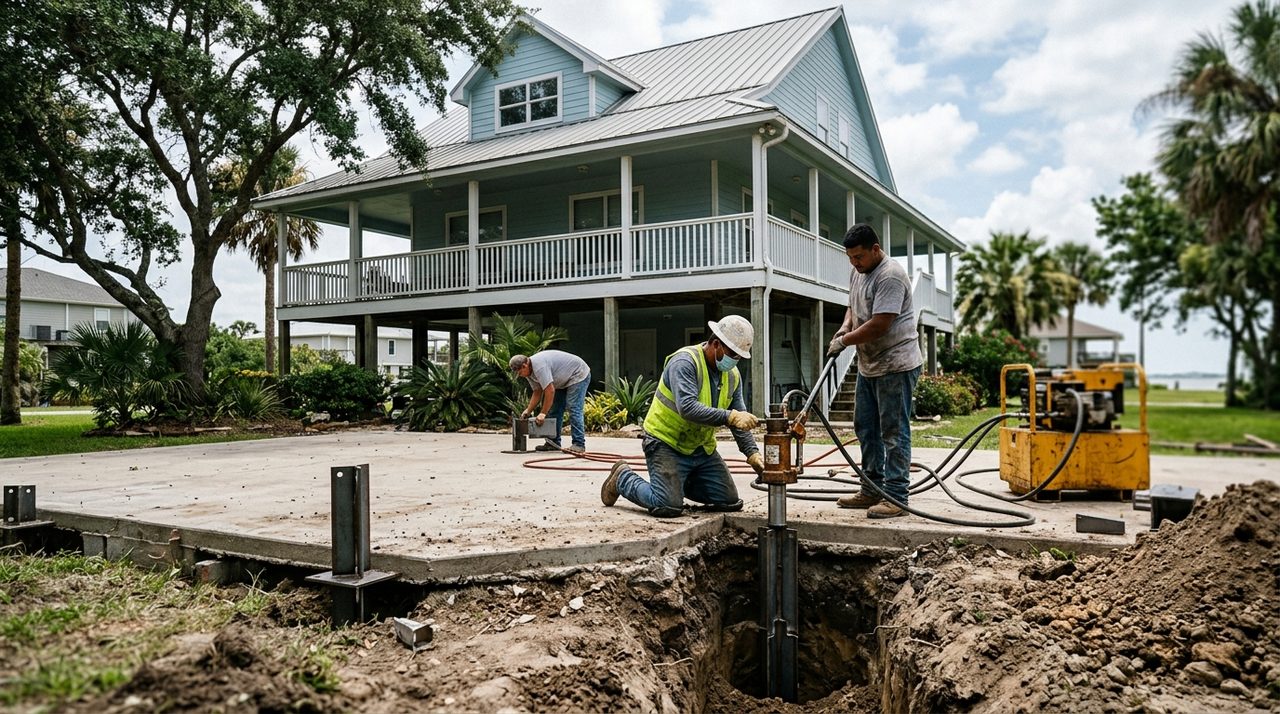
A qualified contractor should probe for perimeter voids before recommending any repair method — a screwdriver or void probe along the beam line costs nothing extra and changes the repair prescription. For settled sections on these older slabs, pressed concrete pilings remain common in Alvin but carry higher long-term failure risk than steel push piers on deep-bearing soil; ask any contractor to specify pier depth and bearing stratum in writing. After repair, installing a soaker hose on a timer 18 inches from the foundation perimeter is the single most effective prevention step for Brazoria County clay.
Sources: Municipal permit office (see area profile), International Residential Code (as adopted by City of Houston)
Post-Uri Under-Slab Drain Failures Compounding Settlement in 1960s–1980s Homes
Why it matters to you
Alvin's pre-1990 ranch homes — a significant share of the city's housing stock per the 2023 ACS median build year of 1984 — were typically plumbed with cast-iron under-slab drain lines that are now 35–60 years old. Winter Storm Uri (February 2021) subjected those aging pipes to freeze-thaw stress even this far south, and many Alvin homeowners patched interior wall damage without testing what happened below the slab. A slow drain leak saturating the clay directly under the center of the slab can cause localized heave followed by collapse settlement, mimicking — and worsening — normal soil movement. The tricky part: a contractor who inspects only for soil-driven settlement may miss an active plumbing leak as the root cause.
What a good pro does
Before signing any foundation repair contract on a pre-1990 Alvin home, budget $250–$400 for a standalone hydrostatic plumbing test performed by a TSBPE-licensed plumber — this fills the drain system with water under pressure and identifies breaches under the slab. If a leak is confirmed, the plumber must be involved in the repair scope; a foundation contractor cannot legally redirect or repair under-slab drain lines without licensed plumbing oversight. Only after a clean plumbing test should you accept a soil-movement diagnosis as complete.
Sources: Texas State Board of Plumbing Examiners, Municipal permit office (see area profile)
Navigating City of Alvin Permits for Underpinning Work
Why it matters to you
Foundation repair in Alvin is permitted through the City of Alvin Permits & Inspections office — not the City of Houston's Development Services Department and not Brazoria County Engineering, which handles unincorporated fringe parcels outside city limits. Many foundation contractors based in the broader Houston metro are accustomed to pulling Houston permits and may be unfamiliar with Alvin's specific inspection schedule and code enforcement process, creating a risk that work is performed without the correct local permit. Unpermitted foundation repair discovered during a resale inspection is a disclosed defect under Texas law and can derail a sale on a home valued around Alvin's median of $212,500.
What a good pro does
Before work begins, ask the contractor to show you a permit number issued by the City of Alvin — not a Harris County or Houston permit. If your property sits on the unincorporated fringe near Alvin, confirm jurisdiction directly with Brazoria County Engineering before any permit is pulled, because the inspection requirements differ. Texas does not issue a standalone state license for foundation repair contractors, so the permit and insurance verification (general liability plus workers' comp) are your primary protections; confirm both independently rather than relying on the contractor's word.
Sources: Municipal permit office (see area profile), Texas Department of Licensing & Regulation
HOA Architectural Review Before Trenching in Newer Alvin Subdivisions
Why it matters to you
Alvin's 2000s–2020s production-builder subdivisions — including Watermark and Forest Heights — carry mandatory HOA or POA agreements, and exterior foundation work that requires perimeter trenching or visible equipment staging may trigger an architectural review requirement before work can legally begin. A homeowner in Forest Heights POA (managed by Goodwin & Co.) who allows a crew to trench the front perimeter beam without prior HOA approval can face fines or a stop-work demand from the POA, even if the City of Alvin permit is already in hand. Older in-town areas and rural lots in Alvin typically have no organized HOA, so this layer applies unevenly across the city.
What a good pro does
Check your deed restrictions and HOA governing documents — or query the Texas HOA registry and Brazoria County Clerk records — before scheduling foundation work in any post-2000 Alvin subdivision. Submit a written scope description and equipment staging plan to the architectural review committee and get written approval before the crew mobilizes. Good contractors working the Alvin market should be familiar with this step; if a contractor is unaware of or dismissive about POA approval requirements in newer subdivisions, treat that as a red flag.
Sources: Local HOA / deed restrictions (see area profile), Municipal permit office (see area profile)
Foundation Repair in Alvin: What You Should Know
Hiring foundation repair in Alvin? Alvin's housing stock spans decades, from 1960s–1980s ranch homes in established neighborhoods to 2020s production-builder subdivisions like Watermark and Forest Heights. Homeowners here navigate a patchwork of mandatory HOAs in newer plats and minimal restrictions in older areas, with all permitting handled through the City of Alvin rather than Houston. The flat Brazoria County clay soils and Gulf proximity make foundation maintenance, drainage management, and hurricane preparedness central to the home services picture.
- Housing era
- Mixed
- Foundation
- Predominantly slab-on-grade for post-1960 subdivisions and all new construction
- Flood zone
- FEMA Zone X (low flood risk) per official NFHL data
- Permits
- City of Alvin Permits & Inspections (Alvin is an incorporated city with its own…
Housing stock & systems
Building era
Mixed: significant 1960s–1980s older stock plus substantial 2000s–2020s new construction.
Typical style
Ranch-style suburban tract homes in older areas; contemporary traditional brick/stone veneer production homes (DR Horton and similar) in newer subdivisions; some rural custom and farmhouse-style homes on larger lots.
Foundations
Predominantly slab-on-grade for post-1960 subdivisions and all new construction; some pier-and-beam may exist in pre-1960 central-town homes, but percentage is not confirmed.
Common systems
Newer homes feature modern forced-air HVAC, PEX or CPVC plumbing, and 200-amp electrical panels. Older 1960s–1980s homes may have original galvanized or copper plumbing, R-22 refrigerant HVAC units approaching or past end-of-life, and 100–150 amp electrical panels. Ductwork in older slab homes typically runs through attic space.
What that means for repairs
Older ranch homes commonly undergo HVAC replacements, kitchen and bathroom remodels, and re-plumbing from galvanized to PEX. Foundation repair on slab homes is a recurring need due to expansive clay soils. Newer subdivisions see relatively little renovation activity but may require warranty-period punch-list work and landscape/drainage improvements.
Permits & restrictions
Permit jurisdiction
City of Alvin Permits & Inspections (Alvin is an incorporated city with its own permitting authority; unincorporated fringe areas fall under Brazoria County Engineering).
HOA & deed restrictions
Many newer subdivisions have mandatory HOAs/POAs (e.g., Forest Heights POA managed by Goodwin & Co., Watermark Residential Community, Inc.). Older in-town areas and rural lots may have only recorded deed restrictions or no organized HOA at all. There is no single citywide HOA. Specific HOA status must be verified at the parcel level via the Texas HOA registry or Brazoria County Clerk records.
Historic districts
No historic district designation confirmed. Alvin is an independent city and is not subject to Houston's HAHC historic preservation overlay.
Contractor note
Contractors must pull permits through the City of Alvin for work within city limits, which has its own inspection schedules and code enforcement separate from Houston. For properties in unincorporated Brazoria County near Alvin, verify jurisdiction before pulling permits.
Flood & weather
FEMA flood zone
FEMA Zone X (low flood risk) per official NFHL data. However, Alvin sits in flat Brazoria County terrain with proximity to Mustang Bayou and Chocolate Bayou watersheds; localized street flooding can occur during extreme rainfall events even in Zone X areas.
Hurricane Harvey impact
Brazoria County experienced significant Harvey-related flooding, particularly along the Brazos and San Bernard Rivers. Research did not confirm specific street-level inundation details for Alvin's residential subdivisions; however, the broader Brazoria County flooding context suggests some areas of Alvin likely experienced impacts. Homeowners should check individual property flood history through Brazoria County records and FEMA claims data for parcel-specific Harvey impact.
Heat & humidity load
Extreme heat and humidity drive heavy HVAC demand from May through October; older units in 1960s–1980s homes are particularly vulnerable to failure during peak summer. Attic-run ductwork in slab-on-grade homes can degrade insulation efficiency. High humidity also contributes to mold risk in poorly ventilated areas and accelerates exterior paint and siding deterioration.
Working with contractors here
Contractors in Alvin most commonly handle HVAC replacement and repair, foundation leveling on slab-on-grade homes affected by expansive clay soils, and re-plumbing of older galvanized systems. Roofing work is frequent due to Gulf Coast storm exposure, and newer subdivisions generate steady demand for fence installation, patio covers, and landscape drainage solutions. Job scoping should account for the wide variation in housing age—a 1970s ranch home will present very different electrical and plumbing conditions than a 2022 DR Horton build. Contractors should also verify whether a property falls within Alvin city limits or unincorporated Brazoria County, as permitting requirements differ significantly.
Local Tip
Always ask for a written estimate before work begins. Texas contractors are required to provide one on jobs over $1,000.
About Alvin
Alvin's housing stock spans decades, from 1960s–1980s ranch homes in established neighborhoods to 2020s production-builder subdivisions like Watermark and Forest Heights. Homeowners here navigate a patchwork of mandatory HOAs in newer plats and minimal restrictions in older areas, with all permitting handled through the City of Alvin rather than Houston. The flat Brazoria County clay soils and Gulf proximity make foundation maintenance, drainage management, and hurricane preparedness central to the home services picture.
- Median year built
- 1984
- Median home value
- $212,500
- Owner-occupied
- 57.8%
- Population
- 27,700
- Housing units
- 12,073
- Median income
- $68,769
Source: U.S. Census Bureau, ACS 5-Year 2023
Flood & storm risk
FEMA Zone XLow flood riskMost of Alvin maps to FEMA Zone X (low mapped flood risk), but Houston's flash-flood reality means even low-risk blocks benefit from smart drainage and storm-hardened installs; as a Brazoria County coastal community, tropical surge and wind add a layer generic guidance misses.
Source: FEMA National Flood Hazard Layer (NFHL). Flood zones vary by parcel — verify your individual FIRM panel.
Houston Storm Readiness in Alvin
Hurricane & flooding
Houston's flash-flood reality means even low-mapped-risk areas like Alvin, TX can see sheet flow accumulate against a foundation during a slow-moving Gulf system, so verify that your perimeter drainage is clear and properly sloped before hurricane season opens. A TDLR-licensed foundation contractor can add or reposition surface drains to intercept runoff before it softens the clay bearing layer beneath your slab. As a Brazoria County community, Alvin may follow county rather than City of Houston storm rebuild rules.
Severe storms & hail
Hail itself does not crack a concrete foundation, but the insurance repair process — contractors dropping equipment, vibrating compactors near the structure — can disturb marginally stable piers in Alvin, TX. Coordinate a brief foundation check with a TDLR-licensed contractor before and after any major roof or exterior repair project that involves heavy equipment operating near your home. As a Brazoria County community, Alvin may follow county rather than City of Houston storm rebuild rules.
Ice storms & freezes
In Alvin, TX, where mapped flood risk is low, the primary post-freeze foundation threat is not surface water but slab-leak-driven soil saturation — Uri 2021 caused widespread pipe failures that fed water silently under slabs for days before homeowners noticed. After any hard freeze, have a plumber pressure-test your lines first, then schedule a foundation elevation check if any under-slab leak is confirmed. With a median build year of 1984, the older building stock here is more exposed to hard-freeze damage than newer construction. As a Brazoria County community, Alvin may follow county rather than City of Houston storm rebuild rules.
Sources: FEMA National Flood Hazard Layer (NFHL), Ready.gov -- Hurricanes, CenterPoint Energy -- Storm Center, City of Houston -- Emergency Preparedness, Ready.gov -- Winter Weather, Harris County Flood Control District
Free Alvin Tools & Calculators
Houston-specific estimators to plan your project before you call a pro. All results are planning estimates — a licensed local pro confirms the details on site.
Houston Soil & Tree Proximity Risk Calculator
Open full tool & FAQ →Grouped by mature root aggression & water demand.
Trunk center to the nearest exterior wall.
The root zone likely reaches your foundation's soil during Houston's dry summers, when clay shrinks most. Watch for sticking doors and diagonal cracks, keep soil moisture even with a soaker hose during drought, and have a foundation pro evaluate if you see any movement.
Find a Houston foundation pro →This is a planning estimate only — actual requirements depend on an on-site assessment by a licensed Houston pro. Guidance is based on general species root behavior in expansive clay, not a soil test.
Houston Freeze Prep & Pipe Insulation Checklist
Open full tool & FAQ →Your freeze checklist — 4 tasks
- 1
Disconnect & drain every outdoor hose bib
Remove hoses, drain the spigots, and cover each with an insulated faucet sock. Un-drained hose bibs are the #1 burst point in a Houston freeze.
- 2
Insulate exposed pipes in the attic & garage
Wrap any pipe in an unconditioned space (attic runs, garage walls) with foam sleeves. Houston homes rarely insulate these because they only matter a few nights a year — which is exactly why they burst.
- 3
Open cabinet doors & keep a pencil-width drip
On hard-freeze nights, open kitchen/bath cabinets so warm air reaches the pipes and let faucets on exterior walls drip to relieve pressure.
- 4
Protect the attic/garage water heater & its lines
An attic or garage tank sits in unconditioned space. Insulate the cold-inlet and hot-outlet lines and confirm the emergency drain pan is clear so a leak doesn't reach the ceiling.
This is a planning estimate only — actual requirements depend on an on-site assessment by a licensed Houston pro. If a pipe has already burst, shut off your main water supply and call a licensed Houston plumber immediately — freeze bursts flood fast.
Frequently Asked Questions
Do I need a permit from the City of Alvin to have steel push piers installed under my slab?
Sources: Municipal permit office (see area profile)
My 1975 Alvin ranch home had a hydrostatic plumbing test that found a leak under the slab. Does the plumber or the foundation contractor handle the repair, and who pulls which permit?
Sources: Texas State Board of Plumbing ExaminersMunicipal permit office (see area profile)
We're in the Watermark subdivision in Alvin. Do we need HOA approval before a foundation contractor can trench around our perimeter?
Sources: Local HOA / deed restrictions (see area profile)