2215 Jasper Dr, Rosharon, TX 77583
Best Foundation Repair in Manvel, TX
Manvel's concrete slab-on-grade homes sit on some of Brazoria County's most reactive black clay soils, and the area's FEMA Zone AO flood designation means those soils cycle between prolonged saturation and baking-dry conditions more dramatically than in most Houston suburbs. Whether you own a 2015 production home in Pomona or a 1980s rural tract near the original town center, understanding how Manvel's soil, drainage, and permit landscape interact is the difference between a lasting repair and a recurring problem.
Verified against Google Business data
Updated 2026
See the 10 Foundation Repair Serving Manvel 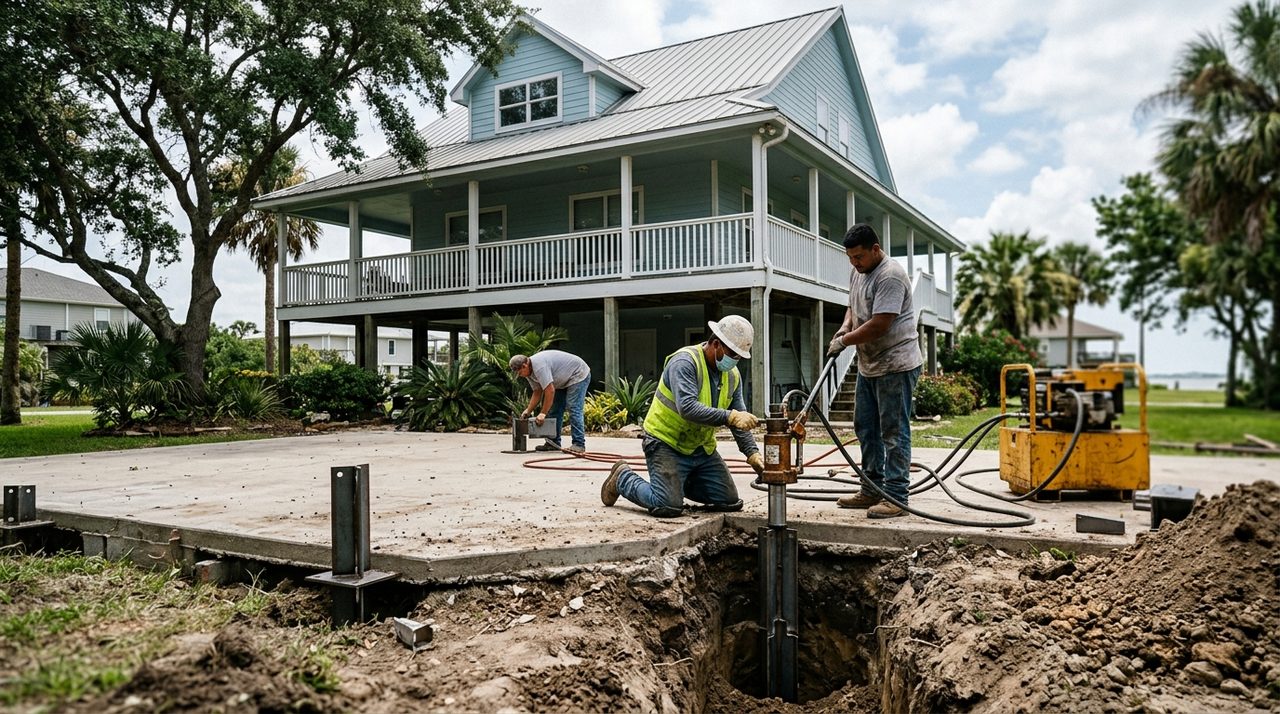
- Median home built
- 2010
- Median home value
- $321,600
- FEMA flood zone
- AO (high)
- Typical foundation repair cost (est.)
- $3,500–$25,000 depending on method and pier count
- Most common local issue
- AO-zone flood-saturation settlement cycling with drought-cycle perimeter voids
Ranked by verified Google rating × review volume × verification tier. How we rank →
Some highly-rated pros serve Manvel from nearby and may not keep a Manvel street address. Those are listed under "Also serving Manvel" with their real city and distance, so you always know where each business is based.
Min rating:
10 resultsBased in Manvel
Also serving Manvel
Highly-rated pros based nearby who cover Manvel. Distance shown from the Manvel area.
Open Now
Serving Manvel Based in Alvin · 3.8 mi away
Serving Manvel Based in Pearland · 7.3 mi away
Closed
Serving Manvel Based in Pearland · 7.9 mi away
Serving Manvel Based in Alvin · 8.1 mi away
Open Now
Serving Manvel Based in Alvin · 8.5 mi away
Closed
Serving Manvel Based in Pearland · 8.7 mi away
Serving Manvel Based in Braeswood · 8.9 mi away
Open Now
Serving Manvel Based in Pearland · 9 mi away
Serving Manvel Based in Pearland · 9.6 mi away
Foundation Repair in Manvel: What You Should Know
FEMA Zone AO Flood Saturation Followed by Drought Is a One-Two Punch for Manvel Slabs
Why it matters to you
Manvel's FEMA Zone AO designation means sheet-flow flooding — not just riverine flooding — repeatedly saturates the black clay beneath newer slabs in Pomona, Valencia, and Sedona Lakes. After events like Hurricane Beryl (2024), standing water can persist for days against the slab perimeter, reconsolidating the clay and reducing its bearing capacity. Then, when Brazoria County's summer drought kicks in — as it did sharply in 2022–2023 — the same clay shrinks back, leaving perimeter voids that the next rain event exploits, accelerating erosion under the slab beam.
What a good pro does
A qualified foundation contractor in Manvel should evaluate both the wet-side and dry-side failure modes before recommending repair. Post-flooding inspections should include a hydrostatic plumbing test ($250–$400 estimated) to confirm that saturated soil movement hasn't cracked under-slab lines, and any void-fill work must account for Brazoria County's soil drainage characteristics. Permits for underpinning work within Manvel city limits are issued through the City of Manvel; properties in the ETJ — including portions of Pomona — fall under Brazoria County Engineering.
Sources: FEMA National Flood Hazard Layer (NFHL), Municipal permit office (see area profile), Harris County Flood Control District
New Production Slabs in Pomona and Valencia Are Already Showing Differential Movement in Their First Decade
Why it matters to you
The census median year built for Manvel is 2010, meaning a large share of homes are still within or just past the builder warranty window — yet Brazoria County's expansive Houston Black clay doesn't wait for a home to age before causing trouble. High-volume production builds in Pomona and Valencia place dozens of similar slab designs on clay that varies in moisture content lot by lot, and a corner of a slab that happens to be near a drainage swale will behave very differently from one near a privacy fence with poor grading. Homeowners often see the first door-stick or brick-veneer crack at the 5–8 year mark and assume it's a warranty issue when it's actually an ongoing soil-moisture management problem.
What a good pro does
A good foundation pro in Manvel will read the crack pattern — diagonal cracks at door corners typically indicate differential settlement, not uniform heave — and assess lot drainage and irrigation coverage before recommending steel push piers ($1,200–$1,800 per pier estimated, 8–16 piers typical) or perimeter void fill. Soaker-hose irrigation along the slab perimeter during Brazoria County's dry months is the primary preventive tool and costs far less than underpinning. Homeowners in Pomona, Valencia, or Sedona Lakes must also check with their respective HOA's architectural review process before any exterior trenching begins, since all three associations enforce mandatory deed restrictions.
Sources: Local HOA / deed restrictions (see area profile), Municipal permit office (see area profile)
Older Rural Tracts Near Manvel's Historic Core May Have Failing Pressed Pilings and Undetected Under-Slab Pipe Damage
Why it matters to you
The 1970s–1990s homes on rural tracts near the original Manvel town center predate modern slab engineering standards and were commonly repaired in the 1990s with pressed concrete pilings — a method now widely regarded as underperforming on Brazoria County's clay because the pilings can't always reach stable load-bearing soil. Winter Storm Uri (February 2021) burst cast-iron under-slab drain lines in homes of this era throughout Brazoria County; many owners patched interior walls but left cracked under-slab pipes in place. Slow leaks from those lines saturate the clay directly beneath the slab, creating localized heave that mimics soil-expansion movement and is easily misdiagnosed.
What a good pro does
Before signing any repair contract on a pre-1995 Manvel home, insist on a hydrostatic plumbing test to rule out active under-slab leaks — foundation movement caused by a leaking drain line will return after pier installation if the pipe isn't fixed first. A licensed plumber (licensed through TSBPE) must perform or oversee any under-slab plumbing repair scope. If existing pressed pilings are present and failing, a structural assessment comparing helical pier replacement ($1,500–$2,200 per pier estimated) against mudjacking or polyurethane foam injection is warranted, and the contractor should pull the appropriate permit through the City of Manvel or Brazoria County Engineering depending on the property's jurisdictional status.
Sources: Texas State Board of Plumbing Examiners, Municipal permit office (see area profile), Texas Department of Licensing & Regulation
Permit Jurisdiction in Manvel Is Split Between the City and Brazoria County — and HOA Approval Runs on a Separate Track
Why it matters to you
Manvel's rapid growth has produced a jurisdictional patchwork that catches homeowners off guard: properties inside Manvel city limits pull foundation repair permits from the City of Manvel, while homes in unincorporated Brazoria County or in ETJ tracts — which includes portions of Pomona — go through Brazoria County Engineering. These two offices have different inspection protocols, fee schedules, and inspection timing requirements. A contractor experienced with City of Houston permitting or Pearland's permit office may be unfamiliar with Brazoria County's process, and unpermitted foundation work surfaces on TREC resale disclosure forms as a material defect that buyers' inspectors specifically flag.
What a good pro does
Before any underpinning or mudjacking contract is signed, confirm the property's jurisdictional status — the county appraisal district parcel record and the city's GIS boundary map are the fastest reference points. The contractor should pull the permit and provide the permit number before work begins, not after. For homes in Pomona, Valencia, or Sedona Lakes, HOA architectural approval must be obtained before the permit is filed, since those associations require pre-approval for any exterior modification including foundation trenching. Texas law requires sellers to disclose known foundation movement and completed repairs on the TREC seller's disclosure form, so documented, permitted work protects resale value directly.
Sources: Municipal permit office (see area profile), Local HOA / deed restrictions (see area profile), Texas Department of Licensing & Regulation
Foundation Repair in Manvel: What You Should Know
Hiring foundation repair in Manvel? Manvel encompasses a wide range of housing from recent master-planned communities like Pomona, Valencia, and Sedona Lakes to older rural tracts near the original town center. Homeowners in newer subdivisions deal primarily with warranty-era maintenance and HOA compliance, while owners of older properties may face deferred maintenance on aging systems. The FEMA AO high-risk flood designation makes drainage, grading, and flood mitigation critical considerations for any home service project.
- Housing era
- Mixed
- Foundation
- Predominantly concrete slab-on-grade in newer subdivisions
- Flood zone
- FEMA Zone AO (high flood risk) — source
- Permits
- City of Manvel for properties within city limits
Housing stock & systems
Building era
Mixed: 2000s–2020s dominant in master-planned communities; 1970s–1990s pockets near historic core and rural tracts.
Typical style
Contemporary suburban Texas production homes — primarily one- and two-story brick or brick-and-stone veneer detached houses with attached garages and composition shingle roofs.
Foundations
Predominantly concrete slab-on-grade in newer subdivisions; older or custom rural homes may include pier-and-beam, but slab is overwhelmingly standard.
Common systems
Newer homes: high-efficiency HVAC systems, PEX or CPVC plumbing, 200-amp electrical panels. Older homes (1970s–1990s): original builder-grade HVAC, possible galvanized or copper plumbing, 100–150 amp panels potentially needing upgrades.
What that means for repairs
Newer MPCs see outdoor living additions, patio covers, and fence upgrades subject to HOA architectural review. Older rural properties see full system replacements (HVAC, plumbing repiping, electrical panel upgrades) and foundation repairs due to expansive clay soils.
Permits & restrictions
Permit jurisdiction
City of Manvel for properties within city limits; Brazoria County Engineering for unincorporated areas and ETJ tracts (some MPCs like Pomona are in Manvel's ETJ).
HOA & deed restrictions
Subdivision-by-subdivision: Pomona HOA, Valencia Residential Owners Association Inc., and Sedona Lakes Homeowners Association are mandatory HOAs with deed restriction enforcement and architectural control. Many other areas in Manvel, particularly older and rural tracts, have no HOA. No single citywide HOA or civic club identified.
Historic districts
No historic district designation confirmed. Manvel has no known HAHC or local historic overlay districts.
Contractor note
Contractors must verify whether a property falls within Manvel city limits or unincorporated Brazoria County, as permit requirements and inspection processes differ significantly. HOA-governed subdivisions require pre-approval for exterior modifications before permits are pulled.
Flood & weather
FEMA flood zone
FEMA Zone AO (high flood risk) — source: fema_nfhl. Zone AO indicates shallow flooding with defined flood depths, typically from sheet flow on sloped terrain. Manvel's flat Brazoria County topography and proximity to Chocolate Bayou and Mustang Bayou tributaries contribute to drainage challenges.
Hurricane Harvey impact
Specific street-level Harvey flooding data for Manvel was not confirmed in available research. Brazoria County broadly experienced significant flooding during Harvey, and Manvel's low-lying terrain and AO flood zone designation suggest vulnerability. Homeowners should check individual property flood claims history through FEMA and the Brazoria County Floodplain Administrator for parcel-specific impact records.
Heat & humidity load
Extreme Houston-area summer heat and humidity drive heavy HVAC demand, especially in newer homes with large square footage and high-volume ductwork. Slab foundations on expansive clay soils are susceptible to movement during drought-to-rain cycles, making foundation monitoring and proper drainage grading essential seasonal maintenance tasks.
Working with contractors here
Contractors in Manvel most commonly handle HVAC installation and maintenance, fence and patio construction, and foundation monitoring — reflecting the area's newer production housing stock and challenging clay soils. In older rural tracts, full system replacements (plumbing repiping from galvanized, electrical panel upgrades, roof replacements) are frequent. The AO flood zone designation means drainage improvements, French drains, and grading work are high-demand services across all property types. Contractors working in HOA communities like Pomona, Valencia, and Sedona Lakes must coordinate exterior modification approvals with the respective management companies before beginning work. Job scoping should always account for MUD-related utility tap and connection requirements in newer developments.
Local Tip
Always ask for a written estimate before work begins. Texas contractors are required to provide one on jobs over $1,000.
About Manvel
Manvel encompasses a wide range of housing from recent master-planned communities like Pomona, Valencia, and Sedona Lakes to older rural tracts near the original town center. Homeowners in newer subdivisions deal primarily with warranty-era maintenance and HOA compliance, while owners of older properties may face deferred maintenance on aging systems. The FEMA AO high-risk flood designation makes drainage, grading, and flood mitigation critical considerations for any home service project.
- Median year built
- 2010
- Median home value
- $321,600
- Owner-occupied
- 77.7%
- Population
- 12,873
- Housing units
- 4,829
- Median income
- $113,938
Source: U.S. Census Bureau, ACS 5-Year 2023
Flood & storm risk
FEMA Zone AOHigh flood riskMuch of Manvel maps to FEMA Zone AO (high flood risk), so flood-resilient detailing -- elevated equipment, water-tolerant materials, and drainage-first thinking -- is essential here, not optional; as a Brazoria County coastal community, tropical surge and wind add a layer generic guidance misses.
Source: FEMA National Flood Hazard Layer (NFHL). Flood zones vary by parcel — verify your individual FIRM panel.
Houston Storm Readiness in Manvel
Hurricane & flooding
Coastal surge exposure in Manvel, TX demands that foundation repair contractors evaluate whether your structure's piers or piling system meets current FEMA coastal construction standards, because storm surge underscores slabs and erodes pier bearing capacity in ways that interior-city flooding does not. Have a TDLR-licensed specialist inspect exposed piling connections and any grade-beam reinforcement before hurricane season and document conditions photographically for insurance purposes. As a Brazoria County community, Manvel may follow county rather than City of Houston storm rebuild rules.
Severe storms & hail
Coastal Manvel, TX properties face combined salt-air corrosion and intense storm-cell winds that together degrade the steel components in both helical piers and push-pier systems faster than inland sites. After the May 2024 derecho-level events, inspect exposed pier hardware and any visible grade-beam connections for rust staining that indicates accelerated corrosion requiring sealing or protective coating. Confirm the current FEMA panel for your Manvel parcel — the area maps to Zone AO, but adjacent lots can differ.
Ice storms & freezes
Coastal Manvel, TX foundations built on pilings or grade beams over sandy fill are less susceptible to clay heave during freezes but face a different Uri-era risk: thermal contraction of exposed concrete elements that can crack grade beams or unseat mudsill connections when temperatures drop suddenly. Inspect exposed foundation concrete and any visible anchor hardware for new cracking or rust-staining each spring as part of your post-winter checklist. As a Brazoria County community, Manvel may follow county rather than City of Houston storm rebuild rules.
Sources: FEMA National Flood Hazard Layer (NFHL), Ready.gov -- Hurricanes, CenterPoint Energy -- Storm Center, City of Houston -- Emergency Preparedness, Ready.gov -- Winter Weather, Harris County Flood Control District
Free Manvel Tools & Calculators
Houston-specific estimators to plan your project before you call a pro. All results are planning estimates — a licensed local pro confirms the details on site.
Houston Soil & Tree Proximity Risk Calculator
Open full tool & FAQ →Grouped by mature root aggression & water demand.
Trunk center to the nearest exterior wall.
Moderate risk
The root zone likely reaches your foundation's soil during Houston's dry summers, when clay shrinks most. Watch for sticking doors and diagonal cracks, keep soil moisture even with a soaker hose during drought, and have a foundation pro evaluate if you see any movement.
Find a Houston foundation pro →This is a planning estimate only — actual requirements depend on an on-site assessment by a licensed Houston pro. Guidance is based on general species root behavior in expansive clay, not a soil test.
Houston Freeze Prep & Pipe Insulation Checklist
Open full tool & FAQ →Your freeze checklist — 4 tasks
- 1
Disconnect & drain every outdoor hose bib
Remove hoses, drain the spigots, and cover each with an insulated faucet sock. Un-drained hose bibs are the #1 burst point in a Houston freeze.
- 2
Insulate exposed pipes in the attic & garage
Wrap any pipe in an unconditioned space (attic runs, garage walls) with foam sleeves. Houston homes rarely insulate these because they only matter a few nights a year — which is exactly why they burst.
- 3
Open cabinet doors & keep a pencil-width drip
On hard-freeze nights, open kitchen/bath cabinets so warm air reaches the pipes and let faucets on exterior walls drip to relieve pressure.
- 4
Protect the attic/garage water heater & its lines
An attic or garage tank sits in unconditioned space. Insulate the cold-inlet and hot-outlet lines and confirm the emergency drain pan is clear so a leak doesn't reach the ceiling.
This is a planning estimate only — actual requirements depend on an on-site assessment by a licensed Houston pro. If a pipe has already burst, shut off your main water supply and call a licensed Houston plumber immediately — freeze bursts flood fast.
Frequently Asked Questions
Do I need a permit from the City of Manvel or Brazoria County to have foundation piers installed under my home?
It depends entirely on where your property sits: homes inside Manvel city limits pull their foundation repair permit through the City of Manvel, while properties on unincorporated rural tracts or in ETJ areas — including parts of Pomona — go through Brazoria County Engineering instead. Ask your contractor to confirm your parcel's jurisdiction before any paperwork is filed, because pulling a permit with the wrong office can delay inspections and create a title problem at resale. Never accept a contractor's verbal assurance that a permit 'isn't required' for pier work in this area.
Sources: Municipal permit office (see area profile)
My Pomona HOA sent a letter saying I need architectural approval before any foundation work — does that really apply to something underground like pier installation?
Yes, and it's more than a formality — Pomona HOA's architectural control process covers any exterior ground disturbance, including perimeter trenching needed to set push piers or helical piers along the slab edge. If your contractor breaks ground before HOA approval is granted, the association can require restoration of the yard at your expense and may impose fines. Submit your contractor's proposal and site plan to the Pomona HOA management company first, then pull the city or county permit, so both tracks are running in the correct order.
Sources: Local HOA / deed restrictions (see area profile)
My 1980s rural-tract home in Manvel had interior pipe repairs after Uri — should I get a plumbing test before signing a foundation repair contract?
Absolutely, and this is especially urgent for pre-1990 Manvel homes that likely have cast-iron under-slab drain lines — a hydrostatic plumbing test (estimated $250–$400) can confirm whether a slow leak is saturating the clay directly beneath your slab and driving the settlement symptoms you're seeing. Any foundation contractor who skips this step and attributes movement solely to soil is leaving a significant variable unexamined. Under Texas law, the actual hydrostatic test and any under-slab pipe repair must be performed or overseen by a plumber licensed through TSBPE — your foundation contractor cannot legally do that scope themselves.
Manvel sits in FEMA Zone AO — will a prior foundation repair affect my flood insurance or elevation certificate when I sell?
It can, particularly if the repair involved slab lifting that altered your finished floor elevation: any change to the structure's elevation in an AO flood zone may require your elevation certificate to be recertified by a licensed surveyor before a buyer's lender will accept it. Texas sellers are also required to disclose known foundation movement and repairs on the TREC disclosure form, so well-documented, permitted repair work actually protects you at closing rather than hurting you. Keep every permit, inspection record, and contractor warranty in a single file you hand over at settlement.
What time of year is the best — or worst — to schedule foundation repair in Manvel?
Late spring (April–May) and late fall (October–November) tend to offer more stable soil moisture conditions than Manvel's extremes of hurricane-season saturation and mid-summer drought, making those windows preferable for pier installation so contractors are working with soil closer to its equilibrium state. Scheduling in the dead of summer when Brazoria County soils are baked dry can mean piers are set into temporarily shrunken soil that then swells when rains return, which affects final slab leveling. That said, if you're seeing active cracking or doors that won't close, don't wait for an ideal season — delaying an actively moving slab typically makes the repair more extensive and more expensive.
My 2017 production home in Valencia is only seven years old — can I really have a foundation problem, and what should I ask the builder's warranty contact?
Yes, Brazoria County's reactive black clay means even recently built Valencia slabs can show differential movement within the first decade, particularly after the post-Harvey saturation cycles and the 2022–2023 drought that hit this part of SE Houston hard. Texas new-home structural warranties typically run 10 years for 'major structural defects,' so ask your builder's warranty contact specifically whether the reported cracks and door misalignment qualify as a covered defect under that structural tier — not just the one- or two-year workmanship coverage. Get any warranty claim and the builder's response in writing, and consider hiring an independent structural engineer (not the builder's inspector) to document current conditions before the 10-year window closes.