Closed
6711 Rampart St #104, Houston, TX 77081
Bellaire sits almost entirely inside FEMA Zone AE, and the post-Harvey teardown-rebuild wave that reshaped the city has left its residential blocks with a sharp split: 1950s–1960s slab-on-grade ranches resting directly on Houston Black clay, and newer elevated two-story rebuilds engineered to clear the 500-year floodplain. That contrast means foundation repair in Bellaire is not a single problem — it is two distinct problems on the same street, each requiring a different diagnostic approach and a permit pulled through the City of Bellaire Building Department, not Harris County or the Houston Permitting Center. Understanding which era your home belongs to — and what the bayou-saturated soils beneath it have been doing since Harvey and Beryl — is the starting point for any honest foundation evaluation here.
Ranked by verified Google rating × review volume × verification tier. How we rank →
Some highly-rated pros serve Bellaire from nearby and may not keep a Bellaire street address. Those are listed under "Also serving Bellaire" with their real city and distance, so you always know where each business is based.
6711 Rampart St #104, Houston, TX 77081
6212 S Rice Ave, Houston, TX 77081
6906 Chetwood Dr, Houston, TX 77081
4900 Fournace Pl STE 556, Bellaire, TX 77401
Highly-rated pros based nearby who cover Bellaire. Distance shown from the Bellaire area.
Serving Bellaire Based in Braeswood · 2.6 mi away
Serving Bellaire Based in Tanglewood · 2.9 mi away
Serving Bellaire Based in Medical Center · 2.9 mi away
Serving Bellaire Based in Upper Kirby · 3 mi away
Serving Bellaire Based in Tanglewood · 3.1 mi away
Serving Bellaire Based in Upper Kirby · 3.2 mi away
Why it matters to you
Bellaire's 1950s–1960s slab-on-grade ranches sit in a city where FEMA maps nearly every parcel as Zone AE. When Hurricane Harvey held standing water over Bellaire neighborhoods for days in 2017, and when Beryl repeated prolonged saturation in 2024, the Beaumont clay beneath those original slabs lost bearing capacity — sometimes weeks after water receded, when settlement finally became visible as sticking doors, cracked brick veneer, or gaps at the roofline. Homes that survived both storms without obvious damage may still be carrying latent soil reconsolidation that has not yet translated into measurable floor elevation change.
What a good pro does
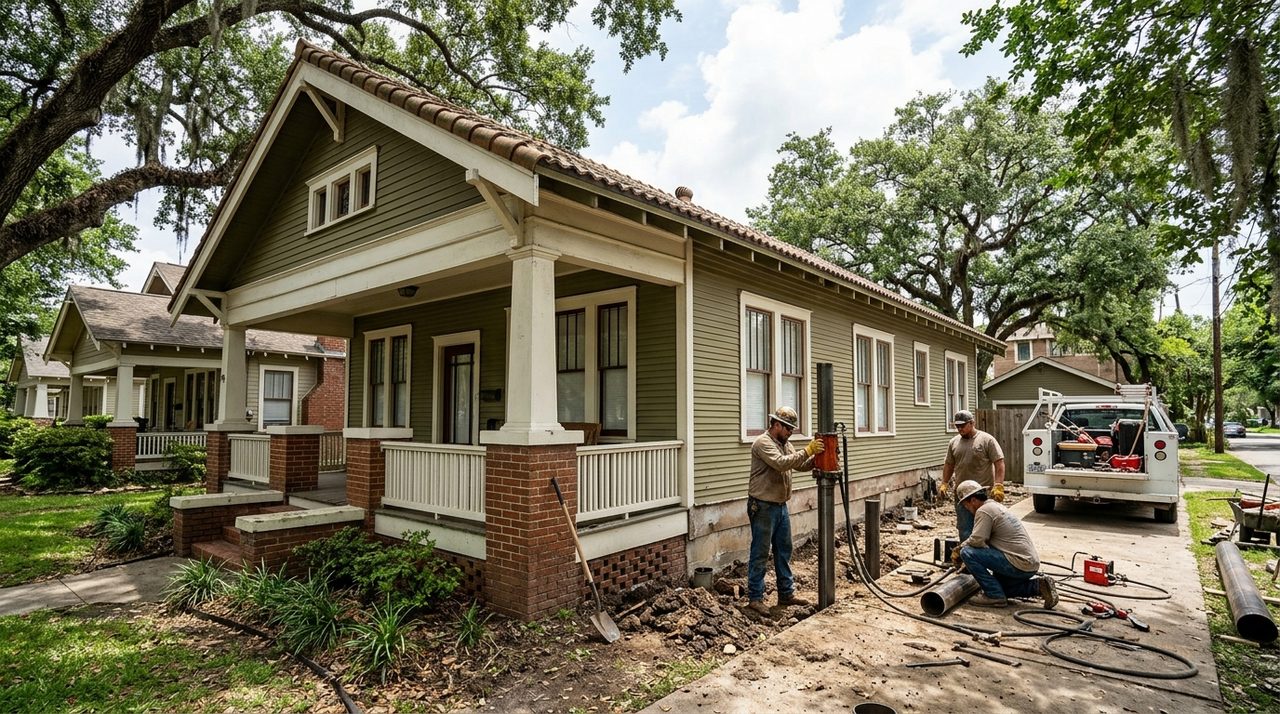
A qualified foundation contractor working in Bellaire should begin with a floor-level survey across multiple points and a direct review of the property's FEMA flood history and elevation certificate before recommending any underpinning method. If steel push piers are proposed for an older ranch, insist on written pier-depth specifications showing that piers will reach stable load-bearing soil below the zone of saturation influence — typically well past the first 10–15 feet of clay. All underpinning work requires a permit through the City of Bellaire Building Department, and the city's floodplain rules mean any associated exterior trenching must be evaluated for compliance with current base flood elevation requirements.
Sources: FEMA National Flood Hazard Layer (NFHL), Municipal permit office (see area profile), Harris County Flood Control District
Why it matters to you
Bellaire's original 1950s–1960s housing stock overwhelmingly used cast-iron under-slab drain lines that froze and cracked during Winter Storm Uri in February 2021. Many owners repaired visible interior damage — walls, flooring, cabinets — but left fractured under-slab pipes in place. Three-plus years of slow drainage leaks directly beneath those slabs have been saturating and destabilizing the clay in localized zones, producing uneven heave in wet periods and localized settlement as soil structure breaks down. In a city already conditioned to attribute every crack to flood damage, these plumbing-driven foundation symptoms are frequently misdiagnosed.
What a good pro does
Before signing any foundation repair contract on a Bellaire home built before 1985, commission a standalone hydrostatic plumbing test — estimated cost $250–$400 — performed by a plumber licensed through the Texas State Board of Plumbing Examiners. If the test reveals a failing drain line, that pipe must be repaired or re-routed before any pier work is done; otherwise the new piers will be fighting an active moisture source. The City of Bellaire requires permits for under-slab plumbing work, and re-routing drain lines through a slab in a Zone AE property may trigger a substantial-improvement review under the city's floodplain ordinance.
Sources: Texas State Board of Plumbing Examiners, Municipal permit office (see area profile), FEMA National Flood Hazard Layer (NFHL)
Why it matters to you
After Harvey, dozens of Bellaire's flood-damaged ranches were demolished and replaced with elevated two-story homes on pier-and-beam or raised structural-pier foundations engineered to meet or exceed the city's 500-year floodplain elevation requirement. These newer structures do not share the clay-contact vulnerabilities of the original slabs, but they introduce a different set of concerns: differential pier settlement if the structural piers were installed in disturbed fill near former flood channels, and horizontal soil movement from the expansive clay acting against grade beams. Owners of post-2000 rebuilds sometimes assume their elevated foundation is immune to Houston's soil dynamics — it is not.
What a good pro does
For elevated post-Harvey rebuilds, the diagnostic priority is a visual and elevation survey of the pier caps and grade beams, not the perimeter void checks appropriate for a slab ranch. If the original geotechnical report from construction is available, a competent contractor should compare it against current observed conditions. Helical piers — estimated at $1,500–$2,200 per pier installed — are the typical remediation method when an elevated foundation pier shows movement, because they can be torqued to verified load capacity in layered clay profiles without the blunt-force refusal risk of push piers. Any structural pier repair on an elevated Bellaire home requires a permit through the City of Bellaire Building Department, and the contractor must confirm that the repair scope does not constitute a 'substantial improvement' that triggers a new elevation-certificate update under FEMA floodplain rules.
Sources: FEMA National Flood Hazard Layer (NFHL), Municipal permit office (see area profile), International Residential Code (as adopted by City of Houston)
Why it matters to you
Bellaire has no single city-wide HOA, but many of its subdivisions carry recorded deed restrictions that impose setback, material, and approval requirements on exterior work — including the perimeter trenching that accompanies pier underpinning or mudjacking. A homeowner who receives approval from the City of Bellaire Building Department may still be in violation of their subdivision's deed restrictions if they trench along a side yard without committee sign-off. Separately, because Bellaire is an incorporated city independent of Houston, a contractor who routinely pulls permits through the Houston Permitting Center is not automatically familiar with Bellaire's floodplain overlay requirements, which add an elevation-certificate review step to most permitted foundation work.
What a good pro does
Before finalizing any repair scope, pull the property's recorded CC&Rs through Harris County property records and confirm with the City of Bellaire Building Department whether the proposed work triggers a floodplain substantial-improvement determination. If your subdivision has an active architectural committee, get written approval in hand before contractors mobilize — a stop-work order mid-repair is costly and can void the warranty terms in your contract. Texas requires disclosure of known foundation movement and prior repairs on the TREC seller's disclosure form, so documented, permitted work through the correct Bellaire jurisdiction protects resale value in a market where post-Harvey buyer scrutiny of foundation history is standard.
Sources: Municipal permit office (see area profile), Local HOA / deed restrictions (see area profile), FEMA National Flood Hazard Layer (NFHL)
Hiring foundation repair in Bellaire? Bellaire is an incorporated city almost entirely within the FEMA AE high-risk flood zone, which means elevation requirements, floodplain permitting, and post-Harvey rebuilds dominate the home service landscape. Housing stock ranges from 1950s slab-on-grade ranches to elevated new-construction traditionals, so contractors must be prepared for both legacy and modern systems on the same block. The city runs its own permitting office, and deed restrictions vary by subdivision, making pre-project due diligence essential.
Building era
1950s–1960s (original ranch stock) with a major wave of teardown/rebuild infill from the 1990s–2020s, accelerated after Hurricane Harvey.
Typical style
Traditional brick two-story (newer builds), single-story brick ranch (original 1950s–60s stock), transitional/Mediterranean customs, and remaining bungalows/cottages from the 1920s–1940s.
Foundations
Mixed — older homes are commonly slab-on-grade; post-Harvey new construction and major remodels are typically elevated on pier-and-beam or raised structural piers to meet floodplain requirements.
Common systems
Older ranches: original copper or galvanized plumbing, single-stage HVAC, 100–150 amp electrical panels. Newer builds: PEX plumbing, high-efficiency multi-stage HVAC, 200+ amp panels with whole-home surge protection. Tankless water heaters increasingly standard in post-2010 construction.
What that means for repairs
The dominant renovation activity is full teardown-and-rebuild or substantial elevation of existing structures to comply with the city's requirement that permitted construction be above the 500-year floodplain. Post-Harvey, many 1950s–60s ranches were demolished and replaced with larger two-story homes on elevated foundations.
Permit jurisdiction
City of Bellaire Building Department (Bellaire is an incorporated city with its own permitting office, independent of Houston Permitting Center and Harris County).
HOA & deed restrictions
No single city-wide mandatory HOA. Bellaire is composed of individual subdivisions, each with its own recorded deed restrictions. Some subdivisions have mandatory HOAs with dues and architectural controls; others rely on voluntary civic clubs or deed-restriction committees for enforcement. HOA status is lot-specific — check recorded CC&Rs via Harris County property records.
Historic districts
No City of Houston historic district designation confirmed. Bellaire is an independent incorporated city and does not fall under the Houston Archaeological and Historical Commission (HAHC).
Contractor note
Bellaire's floodplain regulations require an elevation certificate for most permitted work, and new construction or substantial improvements must meet or exceed the 500-year floodplain elevation. Contractors should confirm current BFE requirements and any deed-restriction architectural controls with the Bellaire Building Department before scoping work.
FEMA flood zone
FEMA Zone AE (high flood risk) — source: fema_nfhl. Virtually the entire city of Bellaire sits within the 100-year floodplain. Brays Bayou runs along Bellaire's northern boundary, and localized drainage issues compound flood risk throughout the city.
Hurricane Harvey impact
Hurricane Harvey (2017) caused significant flooding across Bellaire, inundating a large number of homes — particularly the older slab-on-grade ranch stock. The storm accelerated an already-active teardown cycle, with many flooded homes demolished and replaced by elevated new construction. Post-Harvey, the city enforces strict elevation requirements for permitted work, requiring structures to be built above the 500-year floodplain.
Heat & humidity load
Houston's extreme summer heat and humidity stress older HVAC systems in 1950s–60s ranches, many of which have limited insulation and single-pane windows. Elevated pier-and-beam homes require attention to moisture management and ventilation beneath the structure. Seasonal thunderstorms can overwhelm aging drainage infrastructure, making sump pumps and proper grading critical even for elevated homes.
Working with contractors here
Contractors in Bellaire most commonly handle full teardown-and-rebuild projects, structural elevation of existing homes, and flood damage remediation — all driven by the city's AE flood zone status and post-Harvey rebuilding activity. Older 1950s–60s ranches frequently need complete plumbing re-pipes (galvanized-to-PEX), electrical panel upgrades, and HVAC replacement. Because Bellaire is an incorporated city with its own building department, contractors must pull permits through the City of Bellaire rather than Harris County or Houston, and must navigate subdivision-specific deed restrictions that can impose setback, height, and material requirements. Job scoping should always begin with an elevation certificate review and a check of the property's specific deed restrictions and HOA status, as these vary block by block.
Local Tip
Always ask for a written estimate before work begins. Texas contractors are required to provide one on jobs over $1,000.
Bellaire is an incorporated city almost entirely within the FEMA AE high-risk flood zone, which means elevation requirements, floodplain permitting, and post-Harvey rebuilds dominate the home service landscape. Housing stock ranges from 1950s slab-on-grade ranches to elevated new-construction traditionals, so contractors must be prepared for both legacy and modern systems on the same block. The city runs its own permitting office, and deed restrictions vary by subdivision, making pre-project due diligence essential.
Source: U.S. Census Bureau, ACS 5-Year 2023
Much of Bellaire maps to FEMA Zone AE (high flood risk), so flood-resilient detailing -- elevated equipment, water-tolerant materials, and drainage-first thinking -- is essential here, not optional.
Source: FEMA National Flood Hazard Layer (NFHL). Flood zones vary by parcel — verify your individual FIRM panel.
Drainage grading away from your foundation is your first line of defense when Bellaire sits squarely in FEMA Zone AE inside the 100-year floodplain territory — confirm that soil slopes at least six inches over the first ten feet before storm season. After any hurricane-level saturation event, watch for sticking doors and diagonal cracks at window corners, which are early indicators that clay soil consolidation has shifted your foundation unevenly. Confirm the current FEMA panel for your Bellaire parcel — the area maps to Zone AE, but adjacent lots can differ.
Hail impact does not directly damage a concrete slab, but the intense, short-duration rainfall that accompanies large-cell storms in Bellaire saturates expansive clay rapidly and unevenly, particularly if your landscape grade has shifted since your last inspection. A TDLR-licensed foundation specialist can evaluate whether existing interior piers are still making full contact after a significant storm cluster moves through the area. In-city Bellaire work falls under City of Houston floodplain and permitting rules.
Burst water pipes during a hard freeze release hundreds of gallons beneath or around your slab, and in Bellaire that sudden localized saturation of already-wet clay is one of the most direct causes of post-freeze foundation movement. Coordinate with your plumber on any post-freeze pipe repair to ensure the repair process documents where water escaped, then schedule a foundation inspection at the 60-day mark when soil moisture has partially redistributed. With a median build year of 1981, the older building stock here is more exposed to hard-freeze damage than newer construction. In-city Bellaire work falls under City of Houston floodplain and permitting rules.
Sources: FEMA National Flood Hazard Layer (NFHL), Ready.gov -- Hurricanes, CenterPoint Energy -- Storm Center, City of Houston -- Emergency Preparedness, Ready.gov -- Winter Weather, Harris County Flood Control District
Houston-specific estimators to plan your project before you call a pro. All results are planning estimates — a licensed local pro confirms the details on site.
Grouped by mature root aggression & water demand.
Trunk center to the nearest exterior wall.
The root zone likely reaches your foundation's soil during Houston's dry summers, when clay shrinks most. Watch for sticking doors and diagonal cracks, keep soil moisture even with a soaker hose during drought, and have a foundation pro evaluate if you see any movement.
Find a Houston foundation pro →This is a planning estimate only — actual requirements depend on an on-site assessment by a licensed Houston pro. Guidance is based on general species root behavior in expansive clay, not a soil test.
Disconnect & drain every outdoor hose bib
Remove hoses, drain the spigots, and cover each with an insulated faucet sock. Un-drained hose bibs are the #1 burst point in a Houston freeze.
Insulate exposed pipes in the attic & garage
Wrap any pipe in an unconditioned space (attic runs, garage walls) with foam sleeves. Houston homes rarely insulate these because they only matter a few nights a year — which is exactly why they burst.
Open cabinet doors & keep a pencil-width drip
On hard-freeze nights, open kitchen/bath cabinets so warm air reaches the pipes and let faucets on exterior walls drip to relieve pressure.
Protect the attic/garage water heater & its lines
An attic or garage tank sits in unconditioned space. Insulate the cold-inlet and hot-outlet lines and confirm the emergency drain pan is clear so a leak doesn't reach the ceiling.
This is a planning estimate only — actual requirements depend on an on-site assessment by a licensed Houston pro. If a pipe has already burst, shut off your main water supply and call a licensed Houston plumber immediately — freeze bursts flood fast.
Sources: Municipal permit office (see area profile)
Sources: FEMA National Flood Hazard Layer (NFHL)Municipal permit office (see area profile)
Sources: Municipal permit office (see area profile)
Sources: Local HOA / deed restrictions (see area profile)Municipal permit office (see area profile)