18120 W Bellfort, Richmond, TX 77407
Best Foundation Repair in Cinco Ranch, TX
Cinco Ranch's 1990s–2000s production-built slab-on-grade homes are now 20–35 years into their life on Fort Bend County's expansive black clay soils — the age bracket when differential movement stops being theoretical and starts showing up as sticking doors, diagonal drywall cracks, and brick veneer gaps. Every repair project here runs through two parallel approval tracks: Fort Bend County's development services office for the structural permit, and the Cinco Ranch ACC for exterior work authorization — a dual-track that can add weeks to a timeline if not started simultaneously. Understanding which foundation problems are genuinely soil-driven versus plumbing-driven, and how the HOA process interacts with permitting, will save Cinco Ranch homeowners thousands in misdirected repairs.
Verified against Google Business data
Updated 2026
See the 10 Foundation Repair Serving Cinco Ranch 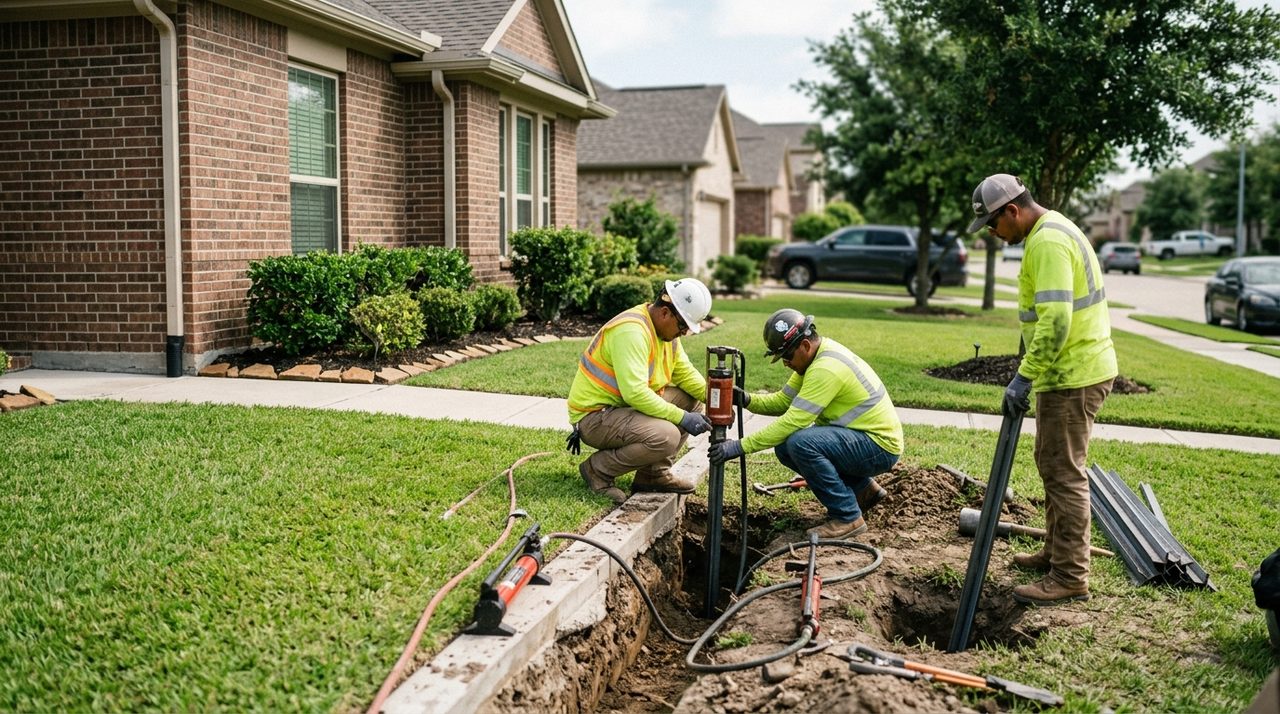
- Median home built
- 1997
- Median home value
- $459,500
- FEMA flood zone
- X (low)
- Typical foundation repair cost (est.)
- $10,000–$25,000 for steel push-pier underpinning; $3,500–$9,000 for pressed-piling work
- Most common local issue
- Drought-cycle perimeter void formation on Fort Bend clay beneath 1990s–2000s slabs
Ranked by verified Google rating × review volume × verification tier. How we rank →
Some highly-rated pros serve Cinco Ranch from nearby and may not keep a Cinco Ranch street address. Those are listed under "Also serving Cinco Ranch" with their real city and distance, so you always know where each business is based.
Min rating:
10 resultsBased in Cinco Ranch
2006 Colbury Ct, Katy, TX 77450
Also serving Cinco Ranch
Highly-rated pros based nearby who cover Cinco Ranch. Distance shown from the Cinco Ranch area.
Closed
Serving Cinco Ranch Based in Katy · 0.9 mi away
Serving Cinco Ranch Based in Katy · 0.9 mi away
Serving Cinco Ranch Based in Katy · 1.7 mi away
Serving Cinco Ranch Based in Katy · 3.7 mi away
Serving Cinco Ranch Based in Katy · 4.2 mi away
Serving Cinco Ranch Based in Katy · 4.4 mi away
Closed
Serving Cinco Ranch Based in Energy Corridor · 4.7 mi away
Closed
Serving Cinco Ranch Based in Katy · 5.5 mi away
Foundation Repair in Cinco Ranch: What You Should Know
Fort Bend Clay Shrink-Swell Is Baking Voids Under Your 1990s Slab Perimeter
Why it matters to you
Cinco Ranch sits on Fort Bend County's Houston Black clay, one of the most expansive soil types in North America. The La Niña drought cycles of 2022–2023 were especially punishing on the open suburban lots common throughout Cinco Ranch's east and west sections — minimal mature tree canopy meant little shade, full sun exposure baked the clay, and perimeter soils pulled away from slab edges. When the 2024 wet season arrived, water rushed into those voids rather than soaking in gradually, undermining the beam seats that production builders poured in the 1990s. Homeowners are seeing sloping floors in back bedrooms and diagonal cracks running from door-frame corners — classic differential perimeter settlement.
What a good pro does
A qualified contractor will probe the perimeter with a soil moisture meter or dial gauge survey across multiple points before proposing any pier plan — not just a visual inspection. If voids are confirmed, the immediate corrective measure is a controlled soaker-hose irrigation protocol to re-stabilize moisture levels before any lifting is attempted. Pier underpinning — typically steel push piers at $1,200–$1,800 per pier installed (est.) — should be paired with a post-repair drainage plan to prevent recurrence. Fort Bend County requires a permit for structural underpinning work; confirm that any contractor you hire is pulling that permit through Fort Bend County development services, not assuming the job is exempt.
Sources: Municipal permit office (see area profile), International Residential Code (as adopted by City of Houston)
PVC Under-Slab Drain Lines From the 1990s Build-Out Are a Silent Foundation Risk
Why it matters to you
Unlike the older cast-iron lines common in 1960s–1970s inner-loop Houston neighborhoods, Cinco Ranch homes built in the 1990s have PVC under-slab drain lines — but 30-year-old PVC is not invulnerable. Winter Storm Uri (February 2021) stressed plumbing systems across Fort Bend County, and slow post-Uri leaks in drain lines under Cinco Ranch slabs can saturate the clay directly beneath the slab without any visible interior sign. That localized saturation causes heave in one area while the perimeter dries and drops, creating the same diagonal-crack pattern as pure soil movement. A foundation company quoting piers without first ruling out active plumbing leaks is skipping a critical diagnostic step.
What a good pro does
Before signing any foundation repair contract, invest $250–$400 (est.) in a hydrostatic plumbing test performed by a plumber licensed by the Texas State Board of Plumbing Examiners (TSBPE). The test pressurizes the drain system and confirms whether any under-slab line is losing water. If a leak is found, a TSBPE-licensed plumber must perform or oversee the repair — foundation contractors cannot legally re-route or repair under-slab plumbing themselves. Get the plumbing clearance in writing before the pier contract is executed, so the repair addresses the actual cause rather than just the symptom.
Sources: Texas State Board of Plumbing Examiners, International Residential Code (as adopted by City of Houston)
Cinco Ranch's Mandatory Dual HOA Approval Is a Hard Stop Before Any Exterior Foundation Work
Why it matters to you
Cinco Ranch operates under a dual HOA structure — Cinco Ranch HOA I east of Katy-Gaston Road and Cinco Ranch Residential Association II west of it — both governed by the Cinco Residential Property Association master association. Foundation repair typically requires perimeter trenching, pier installation staging equipment, and sometimes visible soil spoil piles along the front or sides of the home. All of this constitutes exterior work subject to mandatory ACC pre-approval, and the deed restrictions are legally enforceable. Contractors who skip ACC approval and begin work can be ordered to stop mid-project, and homeowners bear the cost of any required remediation. The ACC review window commonly runs 2–4 weeks.
What a good pro does
Submit your ACC application — including the contractor's scope of work, pier location plan, and equipment staging diagram — before the Fort Bend County permit application, or at the same time, since both run in parallel. Make sure your foundation contractor provides written documentation sufficient for the ACC packet: a site plan showing pier locations, estimated trench dimensions, and a schedule for spoil and equipment removal. Once ACC approval and the Fort Bend County permit are both in hand, work can proceed without the stop-and-restart risk that plagues Cinco Ranch projects where only one approval track was pursued.
Sources: Local HOA / deed restrictions (see area profile), Municipal permit office (see area profile)
Foundation Repair Disclosure and Resale Documentation in a $459K Median Market
Why it matters to you
With Cinco Ranch's median home value at approximately $459,500 (ACS 5-Year 2023), foundation repair history is a material fact that directly affects buyer confidence and negotiating leverage at resale. Texas law requires sellers to disclose known foundation movement and repairs on the TREC seller's disclosure form — and in a neighborhood where many homes were built in the same 5-year production wave and are now hitting the resale market simultaneously, buyers and their inspectors are specifically looking for foundation evidence. Undocumented repairs — work done without a Fort Bend County permit, without a transferable warranty, or without the ACC pre-approval on file — become a liability that can kill a contract or force a price reduction far exceeding the original repair cost.
What a good pro does
Insist that your contractor pull the Fort Bend County structural permit and provide a written, transferable warranty with the repair documentation. Retain the hydrostatic plumbing test results, the ACC approval letter, the permit number, and all inspection sign-off records together in a home-file folder you can hand to a future buyer's agent. Contractors who offer cash-and-no-permit pricing may save a small amount upfront but create a disclosure gap that costs multiples more at the negotiating table. For homes in FEMA Zone X, flood-zone elevation certificates are not typically required at resale, but confirming that no repair altered the finished floor elevation is still prudent before listing.
Sources: Local HOA / deed restrictions (see area profile), FEMA National Flood Hazard Layer (NFHL), Municipal permit office (see area profile)
Foundation Repair in Cinco Ranch: What You Should Know
Hiring foundation repair in Cinco Ranch? Cinco Ranch is one of Houston's largest master-planned communities, featuring production-built suburban homes from the 1990s and 2000s now reaching the age where major system replacements become routine. Homeowners must navigate mandatory HOA architectural review alongside Fort Bend County permitting for exterior modifications, roofing, and additions. The predominantly slab-on-grade construction on Fort Bend County clay soils means foundation monitoring and drainage management are ongoing concerns.
- Housing era
- Primarily 1990s–2000s, with continued build-out into the early 2010s
- Foundation
- Likely predominantly slab-on-grade (consistent with 1990s–2000s Houston-area production building
- Flood zone
- FEMA Zone X (low flood risk) — source
- Permits
- Fort Bend County engineering and development services (unincorporated area — not City of Houston…
Housing stock & systems
Building era
Primarily 1990s–2000s, with continued build-out into the early 2010s.
Typical style
Conventional suburban traditional — brick and brick/stone two-story and single-story homes, with some Mediterranean/stucco accents.
Foundations
Likely predominantly slab-on-grade (consistent with 1990s–2000s Houston-area production building; not explicitly documented in sources reviewed).
Common systems
Central forced-air HVAC (typically 15–25 years old, many nearing or past replacement age), copper or CPVC supply plumbing, PVC drain lines, 200-amp electrical panels. Original HVAC units in 1990s-era sections are likely already replaced or due for replacement.
What that means for repairs
Kitchen and bathroom remodels are common as homes reach 20–30 years. HVAC replacements and roof replacements (composition shingle, 20-year cycle) are the most frequent major projects. All exterior modifications require HOA Architectural Control Committee approval before work begins.
Permits & restrictions
Permit jurisdiction
Fort Bend County engineering and development services (unincorporated area — not City of Houston or any incorporated municipality). MUD districts may also apply for certain infrastructure items.
HOA & deed restrictions
Mandatory dual HOA system: Cinco Ranch HOA I (east of Katy-Gaston Road) and Cinco Ranch Residential Association II, Inc. (west of Katy-Gaston Road), under the Cinco Residential Property Association master association. Deed restrictions and architectural guidelines are legally enforceable. ACC approval required for most exterior changes.
Historic districts
No City of Houston historic district designation confirmed. Cinco Ranch is in unincorporated Fort Bend County and is not subject to HAHC oversight.
Contractor note
Contractors must obtain Fort Bend County permits for structural, electrical, plumbing, and mechanical work, and homeowners must separately secure HOA ACC approval before exterior work begins. Failing to obtain ACC pre-approval can result in required removal of completed work at the homeowner's expense.
Flood & weather
FEMA flood zone
FEMA Zone X (low flood risk) — source: fema_nfhl. Cinco Ranch is largely outside FEMA special flood hazard areas. Some sections near Buffalo Bayou tributaries or detention basins may carry higher risk at the lot level; buyers should verify individual parcels with Fort Bend County floodplain data.
Hurricane Harvey impact
Cinco Ranch is characterized as mostly outside special flood hazard areas and is generally marketed as low flood risk. Broader Harvey-era media coverage referenced Katy-area and Barker Reservoir impacts, but sourced research did not identify specific Cinco Ranch streets or subsections with confirmed significant or recurring Harvey flooding. Lot-level flood history should be verified through Fort Bend County records and individual seller disclosures.
Heat & humidity load
Extreme summer heat drives heavy HVAC demand; aging 1990s-era systems in older sections are particularly vulnerable to compressor failure during sustained 95°F+ stretches. Slab foundations on expansive clay soils can shift during drought cycles, requiring foundation inspections and watering programs. Composition shingle roofs degrade faster under intense UV exposure, and 20-year replacements often come due at 15–18 years.
Working with contractors here
The most common contractor work in Cinco Ranch centers on aging-system replacements: HVAC changeouts, roof replacements, and water heater swaps for homes now 20–30 years old. Foundation repair and drainage improvement are steady demand drivers given the clay soil conditions and slab-on-grade construction. Kitchen and bathroom remodels are the leading interior renovation category as homeowners update original 1990s finishes. Contractors should factor HOA ACC review timelines into project schedules — exterior work proposals can take 2–4 weeks for approval, and non-compliant work may need to be undone. Permitting through Fort Bend County rather than the City of Houston means different inspection scheduling processes and fee structures than inner-loop Houston work.
Local Tip
Always ask for a written estimate before work begins. Texas contractors are required to provide one on jobs over $1,000.
About Cinco Ranch
Cinco Ranch is one of Houston's largest master-planned communities, featuring production-built suburban homes from the 1990s and 2000s now reaching the age where major system replacements become routine. Homeowners must navigate mandatory HOA architectural review alongside Fort Bend County permitting for exterior modifications, roofing, and additions. The predominantly slab-on-grade construction on Fort Bend County clay soils means foundation monitoring and drainage management are ongoing concerns.
- Median year built
- 1997
- Median home value
- $459,500
- Owner-occupied
- 72.5%
- Population
- 19,139
- Housing units
- 6,227
- Median income
- $157,395
Source: U.S. Census Bureau, ACS 5-Year 2023
Flood & storm risk
FEMA Zone XLow flood riskMost of Cinco Ranch maps to FEMA Zone X (low mapped flood risk), but Houston's flash-flood reality means even low-risk blocks benefit from smart drainage and storm-hardened installs.
Source: FEMA National Flood Hazard Layer (NFHL). Flood zones vary by parcel — verify your individual FIRM panel.
Houston Storm Readiness in Cinco Ranch
Hurricane & flooding
Beryl 2024 reminded Houston homeowners that even neighborhoods with low FEMA flood designations experience localized ponding when storm-sewer inlets back up, and that standing water against a foundation for even 12 hours can trigger clay heave in Cinco Ranch, TX. Before the season, confirm your gutters discharge at least five feet from the foundation and that splash blocks direct water toward the street, keeping clay moisture content consistent beneath the slab. As a Fort Bend County community, Cinco Ranch may follow county rather than City of Houston storm rebuild rules.
Severe storms & hail
Even with low mapped flood risk, Cinco Ranch, TX is not immune to the localized sheet flow that accompanies a Houston severe thunderstorm, and repeated minor inundation at the foundation perimeter sustains the clay moisture that drives slow heave cycles. A pre-storm season inspection confirming that soil grade, splash blocks, and downspout extensions all direct water away from the slab is the most cost-effective foundation repair step you can take. As a Fort Bend County community, Cinco Ranch may follow county rather than City of Houston storm rebuild rules.
Ice storms & freezes
Winter Storm Uri's multi-day freeze caused Houston clay soils to go through freeze-thaw cycling not common in the region, and even low-flood-risk neighborhoods in Cinco Ranch, TX saw new door-sticking and brick-step cracking appear in the spring following the storm. A post-winter Zip-Level survey establishes whether that movement is seasonal and self-correcting or progressive and in need of pier work before summer drying amplifies the differential. Confirm the current FEMA panel for your Cinco Ranch parcel — the area maps to Zone X, but adjacent lots can differ.
Sources: FEMA National Flood Hazard Layer (NFHL), Ready.gov -- Hurricanes, CenterPoint Energy -- Storm Center, City of Houston -- Emergency Preparedness, Ready.gov -- Winter Weather, Harris County Flood Control District
Free Cinco Ranch Tools & Calculators
Houston-specific estimators to plan your project before you call a pro. All results are planning estimates — a licensed local pro confirms the details on site.
Houston Soil & Tree Proximity Risk Calculator
Open full tool & FAQ →Grouped by mature root aggression & water demand.
Trunk center to the nearest exterior wall.
Moderate risk
The root zone likely reaches your foundation's soil during Houston's dry summers, when clay shrinks most. Watch for sticking doors and diagonal cracks, keep soil moisture even with a soaker hose during drought, and have a foundation pro evaluate if you see any movement.
Find a Houston foundation pro →This is a planning estimate only — actual requirements depend on an on-site assessment by a licensed Houston pro. Guidance is based on general species root behavior in expansive clay, not a soil test.
Houston Freeze Prep & Pipe Insulation Checklist
Open full tool & FAQ →Your freeze checklist — 4 tasks
- 1
Disconnect & drain every outdoor hose bib
Remove hoses, drain the spigots, and cover each with an insulated faucet sock. Un-drained hose bibs are the #1 burst point in a Houston freeze.
- 2
Insulate exposed pipes in the attic & garage
Wrap any pipe in an unconditioned space (attic runs, garage walls) with foam sleeves. Houston homes rarely insulate these because they only matter a few nights a year — which is exactly why they burst.
- 3
Open cabinet doors & keep a pencil-width drip
On hard-freeze nights, open kitchen/bath cabinets so warm air reaches the pipes and let faucets on exterior walls drip to relieve pressure.
- 4
Protect the attic/garage water heater & its lines
An attic or garage tank sits in unconditioned space. Insulate the cold-inlet and hot-outlet lines and confirm the emergency drain pan is clear so a leak doesn't reach the ceiling.
This is a planning estimate only — actual requirements depend on an on-site assessment by a licensed Houston pro. If a pipe has already burst, shut off your main water supply and call a licensed Houston plumber immediately — freeze bursts flood fast.
Frequently Asked Questions
Do I need a Fort Bend County permit for foundation repair in Cinco Ranch, and how do I pull it?
Yes — because Cinco Ranch sits in unincorporated Fort Bend County, you permit through Fort Bend County's Engineering and Development Services office, not the City of Houston Permitting Center. Most pier underpinning and structural void-fill work requires a county building permit, and the county runs its own inspection scheduling and fee structure that differs from inner-loop Houston jobs. Ask your contractor which specific permit category they'll be filing under and confirm the permit number before any trenching begins — unpermitted structural work can surface as a title issue when you sell in this $459K median-price market.
Sources: Municipal permit office (see area profile)
My Cinco Ranch home was built around 1998 — are the original pressed concrete pilings still an acceptable repair method, or should I insist on steel push piers?
Pressed concrete pilings were the dominant Houston-area method through the 1990s and are still offered by some contractors, but many foundation engineers now consider them less reliable on Fort Bend clay because they lack the depth to reach stable bearing soil and can migrate laterally over time. Steel push piers driven to load-bearing refusal typically perform better on the expansive clays found under late-1990s Cinco Ranch slabs, though they cost significantly more — roughly $1,200–$1,800 per pier installed (estimate). If your home already has original pressed pilings that are failing, a contractor proposing additional pressed pilings without explaining the depth rationale is a red flag worth pressing on with a second or third bid.
Does Cinco Ranch HOA ACC approval add real time to a foundation repair job, and can I start work while the ACC review is pending?
ACC review in the Cinco Ranch dual-HOA system typically takes two to four weeks, and you cannot legally begin any exterior work — including perimeter trenching for pier installation — until written approval is in hand; starting without it can result in the association requiring you to restore the yard at your own expense. Run the ACC application and the Fort Bend County permit application simultaneously from day one to avoid stacking the two wait periods back to back. Make sure your contractor provides the ACC with the exact scope of work, trench dimensions, and any concrete cutting locations, because vague submissions often trigger a resubmission cycle that extends the timeline further.
Sources: Local HOA / deed restrictions (see area profile)
Cinco Ranch is in FEMA Zone X — does that low flood-risk designation mean soil saturation from heavy rain isn't a concern for my foundation?
Zone X means your property is outside the 100-year floodplain and doesn't carry a mandatory flood insurance requirement, but it says nothing about soil behavior during intense rainfall events — and Fort Bend County's black clay is highly reactive regardless of mapped flood risk. Flash flooding from events like Hurricane Beryl (2024) can temporarily saturate the clay under your slab even on Zone X lots, reconsolidating soil that had previously dried and voided under the perimeter beam. Good surface drainage grading away from the foundation and properly functioning gutters are your first line of defense and should be confirmed before and after any repair work.
When is the worst time of year to schedule foundation repair in Cinco Ranch, and does timing actually affect the result?
Late summer through early fall — typically August through October — is when Fort Bend clay is at its driest after months of heat and low rainfall, which means the soil has already shrunk away from the slab perimeter and pier installation can happen when the gap is most visible and measurable. Scheduling a repair in the middle of a wet spring season can mask the true extent of differential movement because saturated clay temporarily re-lifts settled sections, making a problem look smaller than it is. Most experienced local contractors will recommend running a soaker hose along the perimeter for four to six weeks before a final assessment to equilibrate soil moisture, regardless of the season.
If I'm planning to sell my Cinco Ranch home within the next few years, what documentation do I need from a foundation repair to protect myself under Texas disclosure law?
Texas requires sellers to disclose known foundation movement and any repairs on the TREC Seller's Disclosure Notice, so you need a paper trail that is complete and accurate — specifically: the contractor's written scope of work, the Fort Bend County permit with final inspection sign-off, the ACC approval letter, any warranty documents transferable to the buyer, and the results of any hydrostatic plumbing test conducted before the repair. An undocumented repair or a permit that was opened but never closed is often flagged by buyer's home inspectors and can kill a contract in a market where the median home value is around $459,500. Keep all of these in a dedicated home-file folder from the day the job starts.
Sources: Local HOA / deed restrictions (see area profile)Municipal permit office (see area profile)