Closed
2042 Brookmont Dr, Conroe, TX 77301
Conroe's housing stock spans six decades of construction — from 1960s in-town brick ranches on aging lots with mature tree canopy to 2010s master-planned subdivisions built on graded Montgomery County clay — and every era brings its own foundation risk profile. Montgomery County's expansive clay soils shrink aggressively during the dry summers that follow wet springs, making seasonal slab movement a recurring reality across nearly every subdivision in the area. Whether your home sits inside Conroe city limits or in unincorporated Montgomery County, knowing which permit office governs your repair and whether your subdivision's Architectural Control Committee requires pre-approval can be the difference between a clean resale and a last-minute closing headache.
Ranked by verified Google rating × review volume × verification tier. How we rank →
Some highly-rated pros serve Conroe from nearby and may not keep a Conroe street address. Those are listed under "Also serving Conroe" with their real city and distance, so you always know where each business is based.
2042 Brookmont Dr, Conroe, TX 77301
1304 FM 2854 Rd, Conroe, TX 77304
11691 Wren Rd, Conroe, TX 77303
572 Beach Airport Rd, Conroe, TX 77301
10430 Cloud Nine Ct, Conroe, TX 77303
200 S Frazier St, Conroe, TX 77301
Highly-rated pros based nearby who cover Conroe. Distance shown from the Conroe area.
Serving Conroe Based in The Woodlands · 4.3 mi away
Serving Conroe Based in The Woodlands · 7 mi away
Serving Conroe Based in The Woodlands · 9.6 mi away
Why it matters to you
The bulk of Conroe's housing stock — subdivisions built between 1990 and 2015 with a census median year built of 2004 — sits on slab-on-grade foundations poured directly on Montgomery County's expansive clay. These soils swell after spring rains and shrink hard during summer droughts, often moving several inches seasonally. Homes in subdivisions with minimal tree canopy and standard spray-irrigation systems are especially vulnerable because the irrigation heads are typically aimed at turf, leaving the foundation perimeter chronically underwatered during dry stretches and creating voids that accelerate erosion when heavy rain returns.
What a good pro does
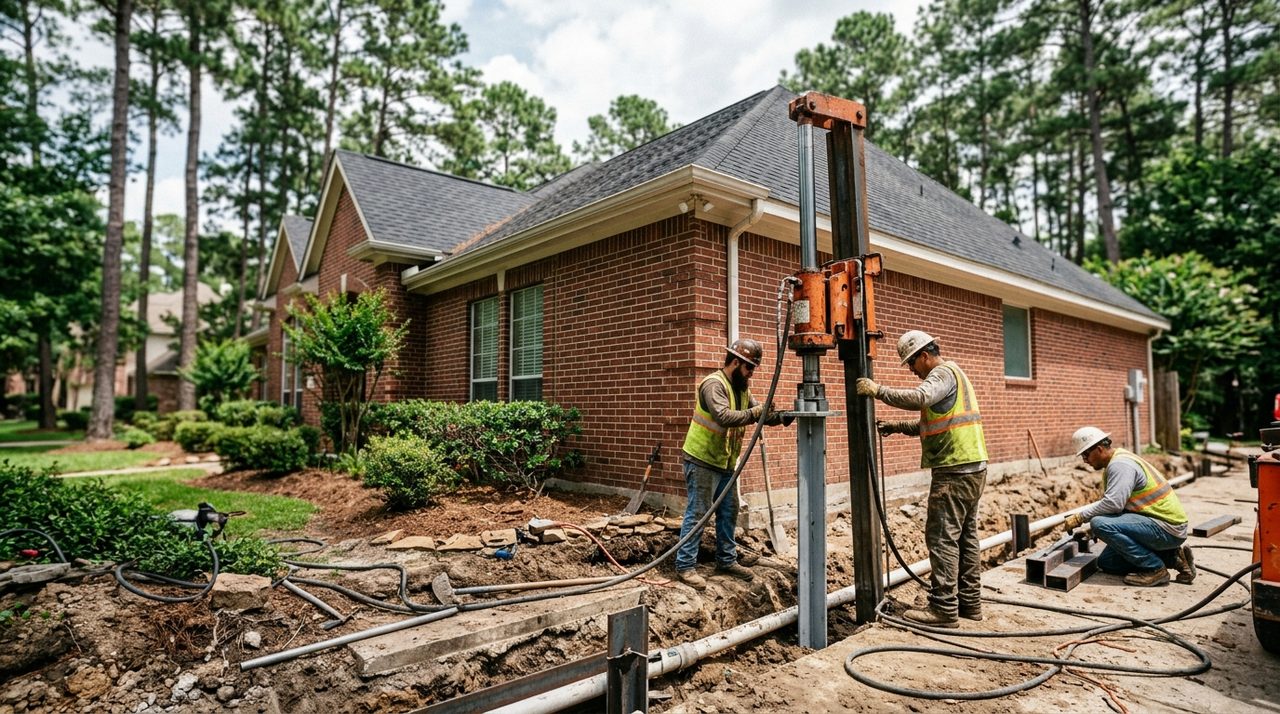
A qualified contractor will probe the perimeter for void gaps before recommending any repair method, and should evaluate whether a soaker-hose irrigation schedule along the foundation edge can stabilize future movement. For active settlement, steel push piers driven to load-bearing soil below the active clay layer are the appropriate fix for most of these post-1990 slabs; estimates for an average 1,800–2,400 sq ft home typically run $10,000–$25,000 for 8–16 piers (estimated). Get three written proposals that specify pier count and depth — contractor preference varies widely in Conroe's competitive market.
Sources: Municipal permit office (see area profile), International Residential Code (as adopted by City of Houston)
Why it matters to you
Conroe's 1960s–1980s in-town neighborhoods have homes with original cast-iron under-slab drain lines that took a hard hit during Winter Storm Uri in February 2021. Many owners patched walls and replaced visible supply lines but left cracked under-slab cast-iron drains in place. Slow ongoing leaks from those lines saturate the clay directly beneath the slab, causing localized heave or settlement that mimics seasonal clay movement — but won't improve with irrigation adjustments alone. A homeowner who has been told they need foundation repair on a pre-1985 Conroe home should not sign a contract until the plumbing is ruled out.
What a good pro does
Before any underpinning contract is signed, ask the contractor to either perform or refer out a hydrostatic plumbing test — a licensed plumber (credentialed through TSBPE) pressurizes the under-slab drain system to identify active leaks. The test typically costs $250–$400 (estimated) and is far cheaper than installing piers over a wet, still-eroding substrate. If a leak is confirmed, re-routing the failed lines under the slab is a prerequisite to any structural repair.
Sources: Texas State Board of Plumbing Examiners, International Residential Code (as adopted by City of Houston)
Why it matters to you
Conroe's older in-town lots — particularly those dating to the 1960s and 1970s — commonly carry mature live oaks, water oaks, and opportunistic Chinese tallow trees whose root systems can extend 30–40 feet from the trunk. On Montgomery County clay, these roots extract soil moisture aggressively on one side of the slab during dry months, causing asymmetric shrinkage and a gradual tilt that shows up as sticking doors, diagonal drywall cracks at corners, and brick mortar separation on the tree-facing elevation. The problem is compounded when deed restrictions or informal neighborhood custom discourages removing mature trees.
What a good pro does
A thorough foundation inspection for an older Conroe in-town home should document which side of the structure shows movement relative to nearby tree canopy, and whether root barriers or selective irrigation can slow the differential before piers are needed. When underpinning is warranted, helical piers (estimated $1,500–$2,200 per pier) are sometimes preferred over push piers in locations where root intrusion complicates access along the perimeter. Always check with the City of Conroe Development Services on any tree removal that may require a permit, separate from the foundation repair permit itself.
Sources: Municipal permit office (see area profile), International Residential Code (as adopted by City of Houston)
Why it matters to you
Conroe is not a single permit jurisdiction. Properties inside city limits are governed by the City of Conroe Permits and Inspections Department; properties in unincorporated areas fall under Montgomery County Engineering. Many contractors active in the Houston metro are unfamiliar with Montgomery County's inspection process and may unknowingly pull — or skip — the wrong permit. Layered on top of that, a significant number of Conroe's master-planned subdivisions (such as those with mandatory HOA covenants like Kellyn Oaks) require Architectural Control Committee approval for exterior work, including the perimeter trenching that accompanies pier installation, before a permit application is even submitted.
What a good pro does
Before signing any repair contract, confirm with the contractor in writing whether the property is inside Conroe city limits or in unincorporated Montgomery County, and request documentation that the correct permit office will be used. Separately, pull your deed or contact your HOA management company to determine whether an ACC submittal — which typically requires a site diagram and scope description — must precede the permit application. Texas requires foundation movement and prior repairs to be disclosed on the TREC seller's disclosure form, so undocumented or unpermitted work creates a direct resale liability for the homeowner.
Sources: Municipal permit office (see area profile), Local HOA / deed restrictions (see area profile), Texas Department of Licensing & Regulation
Hiring foundation repair in Conroe? Conroe's housing stock ranges from 1960s-era in-town neighborhoods to modern master-planned communities, creating diverse home service needs across the area. Contractors must verify HOA and deed restriction status on a per-subdivision basis, as requirements vary widely. The mix of older and newer construction means service providers encounter everything from aging HVAC and galvanized plumbing to contemporary builder-grade systems.
Building era
Mixed: 1960s–1980s in older in-town areas; significant growth in 1990s–2010s suburban subdivisions; ongoing 2020s new construction.
Typical style
Texas Traditional brick ranch, contemporary two-story suburban homes, and some custom/farmhouse-influenced builds near rural and lake-adjacent areas.
Foundations
Predominantly slab-on-grade for post-1970 subdivision homes; pier-and-beam found in some older, custom, or flood-prone/lakefront properties.
Common systems
Older homes (1960s–1980s): original galvanized or copper plumbing, aging R-22 HVAC systems, and 100–150 amp electrical panels. Newer homes (2000s–2020s): PEX or CPVC plumbing, R-410A HVAC, and 200 amp electrical service. Central HVAC is standard across all eras.
What that means for repairs
Older in-town Conroe homes frequently need HVAC replacement, re-plumbing from galvanized to PEX, and electrical panel upgrades. Newer subdivision homes see cosmetic remodeling and builder-grade fixture upgrades within 10–15 years of construction.
Permit jurisdiction
City of Conroe Permits & Inspections Department for properties within city limits; Montgomery County Engineering for unincorporated areas.
HOA & deed restrictions
No single mandatory HOA covers all of Conroe. Individual subdivisions vary widely: many master-planned communities (e.g., Kellyn Oaks HOA) have mandatory HOAs with recorded covenants and assessments; other areas have no HOA or only voluntary associations. HOA status must be verified per subdivision.
Historic districts
No historic district designation confirmed for Conroe. Conroe is not within the City of Houston and would not have HAHC oversight.
Contractor note
Contractors must confirm whether a property is within Conroe city limits or unincorporated Montgomery County, as permit requirements and inspection processes differ. Many subdivisions require Architectural Control Committee approval for exterior work before a permit is even pulled.
FEMA flood zone
FEMA Zone X (low flood risk) per official NFHL data. However, Conroe includes areas near the San Jacinto River, Lake Conroe, and various creeks; properties closer to waterways may carry higher flood risk that should be verified on a parcel-by-parcel basis.
Hurricane Harvey impact
Not confirmed with specific Conroe-area damage data from research. Montgomery County experienced flooding during Harvey (2017), particularly in areas near the San Jacinto River and downstream of Lake Conroe dam releases. Specific impact to individual Conroe neighborhoods should be checked via Montgomery County Flood Control District records.
Heat & humidity load
Extended Houston-area summers with sustained 95°F+ temperatures and high humidity stress HVAC systems heavily. Older units in 1960s–1980s homes are particularly failure-prone during peak summer. Slab foundations in the expansive clay soils of Montgomery County are susceptible to movement during prolonged drought cycles, causing door/window alignment issues and potential plumbing stress.
Working with contractors here
Conroe's diverse housing stock means contractors frequently handle HVAC replacements and duct work in older homes, along with re-plumbing projects to replace deteriorating galvanized lines. In newer master-planned subdivisions, work tends toward warranty-era repairs, cosmetic upgrades, and fence/patio additions that require HOA architectural approval. Foundation repair is a recurring need across all eras due to Montgomery County's clay-heavy soils and seasonal moisture swings. Contractors should always confirm permit jurisdiction (City of Conroe vs. Montgomery County) and whether an ACC submission is required before scheduling exterior work. The geographic spread of the area means job scoping should account for potentially significant drive times between subdivisions.
Local Tip
Always ask for a written estimate before work begins. Texas contractors are required to provide one on jobs over $1,000.
Conroe's housing stock ranges from 1960s-era in-town neighborhoods to modern master-planned communities, creating diverse home service needs across the area. Contractors must verify HOA and deed restriction status on a per-subdivision basis, as requirements vary widely. The mix of older and newer construction means service providers encounter everything from aging HVAC and galvanized plumbing to contemporary builder-grade systems.
Source: U.S. Census Bureau, ACS 5-Year 2023
Most of Conroe maps to FEMA Zone X (low mapped flood risk), but Houston's flash-flood reality means even low-risk blocks benefit from smart drainage and storm-hardened installs; risk climbs sharply on blocks nearest the West Fork San Jacinto River and Lake Conroe, where it varies parcel to parcel.
Source: FEMA National Flood Hazard Layer (NFHL). Flood zones vary by parcel — verify your individual FIRM panel.
Houston's flash-flood reality means even low-mapped-risk areas like Conroe, TX can see sheet flow accumulate against a foundation during a slow-moving Gulf system, so verify that your perimeter drainage is clear and properly sloped before hurricane season opens. A TDLR-licensed foundation contractor can add or reposition surface drains to intercept runoff before it softens the clay bearing layer beneath your slab. Confirm the current FEMA panel for your Conroe parcel — the area maps to Zone X, but adjacent lots can differ.
Hail itself does not crack a concrete foundation, but the insurance repair process — contractors dropping equipment, vibrating compactors near the structure — can disturb marginally stable piers in Conroe, TX. Coordinate a brief foundation check with a TDLR-licensed contractor before and after any major roof or exterior repair project that involves heavy equipment operating near your home. Because Conroe drains toward the West Fork San Jacinto River and Lake Conroe, block-level runoff can differ sharply from the mapped zone.
Winter Storm Uri's multi-day freeze caused Houston clay soils to go through freeze-thaw cycling not common in the region, and even low-flood-risk neighborhoods in Conroe, TX saw new door-sticking and brick-step cracking appear in the spring following the storm. A post-winter Zip-Level survey establishes whether that movement is seasonal and self-correcting or progressive and in need of pier work before summer drying amplifies the differential. As a Montgomery County community, Conroe may follow county rather than City of Houston storm rebuild rules.
Sources: FEMA National Flood Hazard Layer (NFHL), Ready.gov -- Hurricanes, CenterPoint Energy -- Storm Center, City of Houston -- Emergency Preparedness, Ready.gov -- Winter Weather, Harris County Flood Control District
Houston-specific estimators to plan your project before you call a pro. All results are planning estimates — a licensed local pro confirms the details on site.
Grouped by mature root aggression & water demand.
Trunk center to the nearest exterior wall.
The root zone likely reaches your foundation's soil during Houston's dry summers, when clay shrinks most. Watch for sticking doors and diagonal cracks, keep soil moisture even with a soaker hose during drought, and have a foundation pro evaluate if you see any movement.
Find a Houston foundation pro →This is a planning estimate only — actual requirements depend on an on-site assessment by a licensed Houston pro. Guidance is based on general species root behavior in expansive clay, not a soil test.
Disconnect & drain every outdoor hose bib
Remove hoses, drain the spigots, and cover each with an insulated faucet sock. Un-drained hose bibs are the #1 burst point in a Houston freeze.
Insulate exposed pipes in the attic & garage
Wrap any pipe in an unconditioned space (attic runs, garage walls) with foam sleeves. Houston homes rarely insulate these because they only matter a few nights a year — which is exactly why they burst.
Open cabinet doors & keep a pencil-width drip
On hard-freeze nights, open kitchen/bath cabinets so warm air reaches the pipes and let faucets on exterior walls drip to relieve pressure.
Protect the attic/garage water heater & its lines
An attic or garage tank sits in unconditioned space. Insulate the cold-inlet and hot-outlet lines and confirm the emergency drain pan is clear so a leak doesn't reach the ceiling.
This is a planning estimate only — actual requirements depend on an on-site assessment by a licensed Houston pro. If a pipe has already burst, shut off your main water supply and call a licensed Houston plumber immediately — freeze bursts flood fast.
Sources: Municipal permit office (see area profile)
Sources: Local HOA / deed restrictions (see area profile)