Closed
25700 Interstate 45 N Suite 4325 Suite 4325, The Woodlands, TX 77386
The Woodlands sits on Montgomery County's expansive Beaumont clay, and its phased build-out since 1974 means a single street can hold a 1970s slab approaching its sixth decade alongside a 2015 home still under builder warranty — two very different foundation risk profiles under the same soil. Permitting runs through Montgomery County engineering and development services, not the City of Houston, and The Woodlands Township's deed restrictions add a village-level covenant layer that can require approval before any exterior foundation trenching begins. Understanding those site-specific variables — soil moisture dynamics under the community's signature tree canopy, the wide range of slab ages, and the Montgomery County permit process — is what separates a repair that holds from one that fails on resale inspection.
Ranked by verified Google rating × review volume × verification tier. How we rank →
25700 Interstate 45 N Suite 4325 Suite 4325, The Woodlands, TX 77386
1095 Evergreen Cir #430, The Woodlands, TX 77380
1401 Woodlands Pkwy, The Woodlands, TX 77380
1790 Hughes Landing Blvd #550, The Woodlands, TX 77380
13588 Deer Trail, Conroe, TX 77302
2002 Timberloch Pl Suite 200, The Woodlands, TX 77380
25511 Oakhurst Dr, Spring, TX 77386
30526 High Meadow Dr, Magnolia, TX 77354
110 S Wilde Yaupon Ct, Spring, TX 77381
22375 Hidden Hill Ln, Magnolia, TX 77354
Why it matters to you
The Woodlands was designed around its tree canopy, and that canopy is now a foundation liability on lots platted in the 1970s through 1990s. Live oaks and water oaks with root systems extending 30–50 feet pull soil moisture asymmetrically during dry periods, causing the Beaumont clay under one side of a slab to shrink while the shaded side stays comparatively stable. The result is a tilting, cracking slab that produces sticking doors, diagonal drywall cracks at window corners, and brick veneer gaps — symptoms that repeat each summer and partially recover each wet season, masking the cumulative drop.
What a good pro does
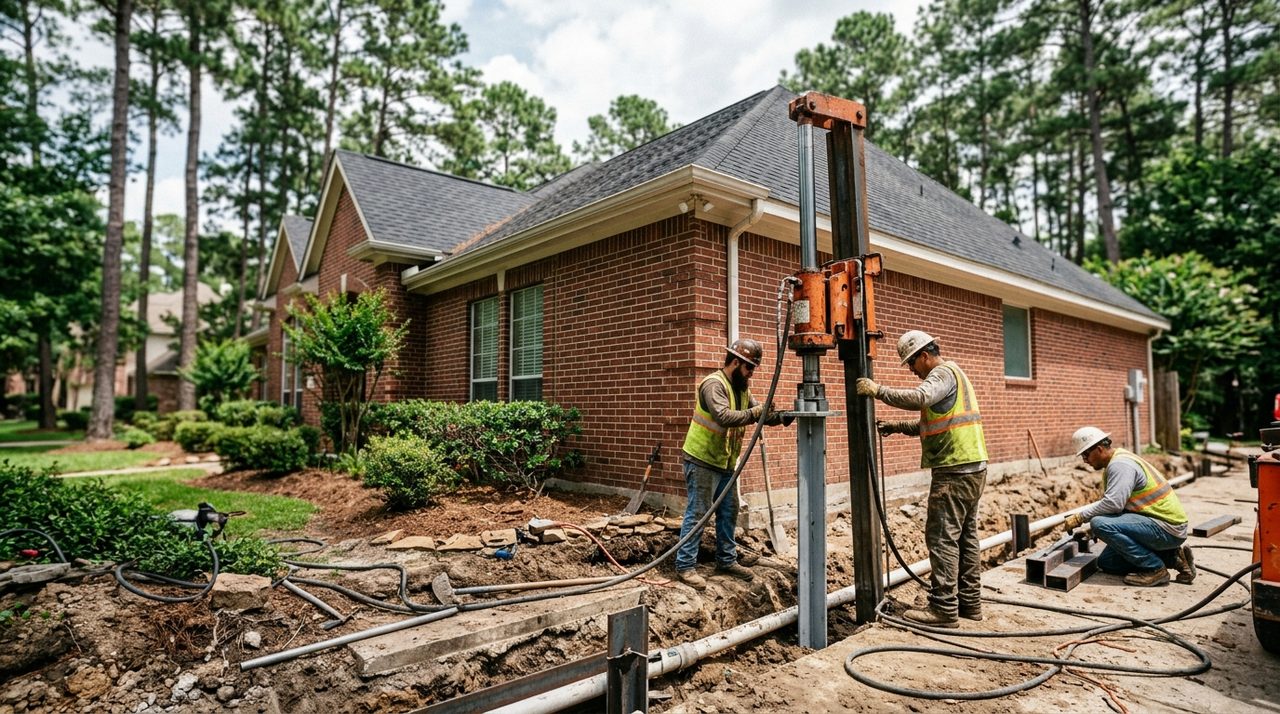
A qualified contractor will probe the perimeter for voids with a moisture meter and visual inspection before recommending any underpinning, and will document the proximity of large trees to the foundation as part of the written scope. For moderate movement on 1970s–1990s homes, steel push piers driven to load-bearing soil (typically 20–40 feet deep in this part of Montgomery County) provide a more durable fix than the pressed concrete pilings that were standard during the community's early build-out years. Expect 8–16 piers on a typical 2,000 sq ft slab, with installed costs running roughly $10,000–$25,000 as an estimate — get three written proposals specifying pier count and depth before signing.
Sources: International Residential Code (as adopted by City of Houston), Local HOA / deed restrictions (see area profile)
Why it matters to you
Homes constructed in The Woodlands' early-to-mid phases — roughly the late 1970s through the 1990s — were frequently repaired or original-built using pressed concrete cylinder pilings, the dominant Houston-area method of that era. Those pilings have a documented tendency to migrate laterally in expansive clay rather than hold vertical load, and after 25–40 years many are no longer providing meaningful bearing support. Homeowners in older villages like Grogan's Mill, Panther Creek, and Cochran's Crossing should treat recurring interior cracks and door alignment problems as a signal to have existing pilings evaluated, not simply re-leveled.
What a good pro does
A reputable contractor will locate existing pilings with a probe rod and assess whether they are still engaged before proposing additional work on top of a compromised system. In most cases where pressed pilings have migrated, the correct repair is steel push pier supplementation or replacement — not adding more pressed pilings. Before any contract is signed, budget $250–$400 (estimated) for a hydrostatic plumbing test to rule out a concurrent under-slab leak from aging cast-iron drain lines, which are common in pre-1990 Woodlands homes and can accelerate clay breakdown beneath the slab.
Sources: International Residential Code (as adopted by City of Houston), Texas State Board of Plumbing Examiners
Why it matters to you
Contractors who routinely work inside Beltway 8 often default to City of Houston permit procedures, but The Woodlands is unincorporated Montgomery County territory, and the permit office, inspection sequence, and fee schedule are entirely different. Foundation underpinning work that disturbs structural elements or requires soil excavation must be permitted through Montgomery County engineering and development services. Homeowners who let a contractor skip the permit — or assume a Houston permit covers the job — face disclosure problems when the work surfaces on a buyer's inspection report, a real concern in a community where the median home value exceeds $479,000 (U.S. Census Bureau, ACS 5-Year 2023).
What a good pro does
Before work begins, confirm with your contractor that they have pulled a Montgomery County permit, not a City of Houston one, and ask for the permit number in writing so you can verify status directly with the county. Additionally, The Woodlands Township's covenant enforcement and some village-level architectural review processes may require notification or approval before exterior trenching begins — check your specific lot's deed restrictions, since requirements vary by village. Keeping permit documentation and the engineer's repair report in your home file protects you at resale, where Texas TREC disclosure forms require sellers to disclose known foundation movement and all prior repairs.
Sources: Municipal permit office (see area profile), Local HOA / deed restrictions (see area profile), Texas Department of Licensing & Regulation
Why it matters to you
Not every Woodlands lot is heavily canopied — newer phases in the northern sections, as well as lots along wider collector streets, can have relatively open exposures that bake under Houston's summer sun. The La Niña drought cycles of 2022–2023 were severe enough across the Houston metro to pull Beaumont clay away from slab edges across Montgomery County, leaving perimeter voids that offer no bearing support when the next heavy rain returns. Even in FEMA Zone X — where most of The Woodlands maps — a single intense storm event can rush water into those voids rather than allowing gradual absorption, undercutting the grade beam.
What a good pro does
The most cost-effective intervention is consistent soaker-hose irrigation along the slab perimeter during dry months, keeping the clay within 18 inches of the foundation edge from shrinking below the beam level — this is maintenance, not repair, but it prevents the $10,000–$25,000 (estimated) repair bill from becoming necessary in the first place. Where voids have already formed, polyurethane foam injection ($2,000–$5,000 estimated for a moderate job) can fill the gap without the mess of mudjacking, and the lighter material causes less additional load on the affected grade beam. Any contractor assessing perimeter settlement should also check that lot drainage slopes away from the foundation at the Montgomery County-code-required grade before recommending structural repair.
Sources: FEMA National Flood Hazard Layer (NFHL), International Residential Code (as adopted by City of Houston), Harris County Flood Control District
Hiring foundation repair in The Woodlands? The Woodlands is a large master-planned community in Montgomery County governed by The Woodlands Township rather than a traditional HOA, with deed restrictions and covenants on individual lots. Housing spans multiple decades since the community's 1974 founding, meaning contractors encounter a wide range of system ages and conditions. Permitting runs through Montgomery County rather than the City of Houston, which affects licensing and inspection requirements for all trades.
Building era
1970s through 2020s — phased development since 1974, with northern sections generally representing later phases.
Typical style
Not confirmed from available sources — likely a mix of traditional, transitional, and contemporary styles typical of Houston-area master-planned communities.
Foundations
Not confirmed — slab-on-grade is typical for the region but not source-verified for this specific area.
Common systems
Given the multi-decade build-out, expect a wide range: older homes may have R-22 HVAC systems and copper/galvanized plumbing, while newer construction features R-410A systems and PEX plumbing.
What that means for repairs
Older 1970s–1990s sections likely drive demand for HVAC upgrades, kitchen and bath remodels, and plumbing replacements. Deed restrictions and township architectural guidelines affect exterior modifications.
Permit jurisdiction
Montgomery County — The Woodlands is an unincorporated community and does not have its own city permit office. Permits are handled through Montgomery County engineering and development services.
HOA & deed restrictions
No traditional mandatory HOA for the overall community. The Woodlands Township, a special-purpose district, provides governance and services. Deed restrictions and covenants apply to individual lots. Some villages or sub-neighborhoods may have their own associations or architectural review processes — check specific lot records.
Historic districts
No City of Houston historic district designation — The Woodlands is in unincorporated Montgomery County, outside HAHC jurisdiction.
Contractor note
Contractors must follow Montgomery County permitting requirements, not City of Houston codes. Exterior modifications may also require approval through The Woodlands Township or village-level covenant enforcement processes, so confirm before starting work.
FEMA flood zone
FEMA Zone X (low flood risk) per official NFHL data. The Woodlands was designed with an integrated drainage system including retention ponds and natural waterways, though proximity to specific creeks or drainage channels may vary by lot.
Hurricane Harvey impact
Not verified from available sources for The Woodlands North specifically. Some areas of The Woodlands experienced flooding during Harvey in 2017, but neighborhood-specific impact and recurring flood streets could not be confirmed — check Montgomery County floodplain maps and FEMA claims data for parcel-level information.
Heat & humidity load
Houston-area summers with sustained high heat and humidity stress HVAC systems heavily, especially in older homes with less efficient insulation. The wooded setting of the community can contribute to moisture-related issues, mold risk, and increased pest pressure around foundations and attic spaces.
Working with contractors here
The Woodlands' multi-decade build-out means contractors encounter everything from 1970s-era homes needing full system overhauls to recently constructed properties still under builder warranty. HVAC replacement and efficiency upgrades are common in older sections, while newer homes may need cosmetic updates or smart home integrations. The township's deed restrictions and village-level architectural controls mean exterior work — roofing, fencing, painting — often requires pre-approval before starting. Contractors should confirm Montgomery County permit requirements rather than assuming City of Houston processes apply. The heavily wooded lots that define the community create recurring demand for tree-related services, gutter maintenance, and drainage work around foundations.
Local Tip
Always ask for a written estimate before work begins. Texas contractors are required to provide one on jobs over $1,000.
The Woodlands is a large master-planned community in Montgomery County governed by The Woodlands Township rather than a traditional HOA, with deed restrictions and covenants on individual lots. Housing spans multiple decades since the community's 1974 founding, meaning contractors encounter a wide range of system ages and conditions. Permitting runs through Montgomery County rather than the City of Houston, which affects licensing and inspection requirements for all trades.
Source: U.S. Census Bureau, ACS 5-Year 2023
Most of The Woodlands maps to FEMA Zone X (low mapped flood risk), but Houston's flash-flood reality means even low-risk blocks benefit from smart drainage and storm-hardened installs.
Source: FEMA National Flood Hazard Layer (NFHL). Flood zones vary by parcel — verify your individual FIRM panel.
Beryl 2024 reminded Houston homeowners that even neighborhoods with low FEMA flood designations experience localized ponding when storm-sewer inlets back up, and that standing water against a foundation for even 12 hours can trigger clay heave in The Woodlands, TX. Before the season, confirm your gutters discharge at least five feet from the foundation and that splash blocks direct water toward the street, keeping clay moisture content consistent beneath the slab. Confirm the current FEMA panel for your The Woodlands parcel — the area maps to Zone X, but adjacent lots can differ.
Hail itself does not crack a concrete foundation, but the insurance repair process — contractors dropping equipment, vibrating compactors near the structure — can disturb marginally stable piers in The Woodlands, TX. Coordinate a brief foundation check with a TDLR-licensed contractor before and after any major roof or exterior repair project that involves heavy equipment operating near your home. As a Montgomery County community, The Woodlands may follow county rather than City of Houston storm rebuild rules.
In The Woodlands, TX, where mapped flood risk is low, the primary post-freeze foundation threat is not surface water but slab-leak-driven soil saturation — Uri 2021 caused widespread pipe failures that fed water silently under slabs for days before homeowners noticed. After any hard freeze, have a plumber pressure-test your lines first, then schedule a foundation elevation check if any under-slab leak is confirmed. Confirm the current FEMA panel for your The Woodlands parcel — the area maps to Zone X, but adjacent lots can differ.
Sources: FEMA National Flood Hazard Layer (NFHL), Ready.gov -- Hurricanes, CenterPoint Energy -- Storm Center, City of Houston -- Emergency Preparedness, Ready.gov -- Winter Weather, Harris County Flood Control District
Houston-specific estimators to plan your project before you call a pro. All results are planning estimates — a licensed local pro confirms the details on site.
Grouped by mature root aggression & water demand.
Trunk center to the nearest exterior wall.
The root zone likely reaches your foundation's soil during Houston's dry summers, when clay shrinks most. Watch for sticking doors and diagonal cracks, keep soil moisture even with a soaker hose during drought, and have a foundation pro evaluate if you see any movement.
Find a Houston foundation pro →This is a planning estimate only — actual requirements depend on an on-site assessment by a licensed Houston pro. Guidance is based on general species root behavior in expansive clay, not a soil test.
Disconnect & drain every outdoor hose bib
Remove hoses, drain the spigots, and cover each with an insulated faucet sock. Un-drained hose bibs are the #1 burst point in a Houston freeze.
Insulate exposed pipes in the attic & garage
Wrap any pipe in an unconditioned space (attic runs, garage walls) with foam sleeves. Houston homes rarely insulate these because they only matter a few nights a year — which is exactly why they burst.
Open cabinet doors & keep a pencil-width drip
On hard-freeze nights, open kitchen/bath cabinets so warm air reaches the pipes and let faucets on exterior walls drip to relieve pressure.
Protect the attic/garage water heater & its lines
An attic or garage tank sits in unconditioned space. Insulate the cold-inlet and hot-outlet lines and confirm the emergency drain pan is clear so a leak doesn't reach the ceiling.
This is a planning estimate only — actual requirements depend on an on-site assessment by a licensed Houston pro. If a pipe has already burst, shut off your main water supply and call a licensed Houston plumber immediately — freeze bursts flood fast.
Sources: Municipal permit office (see area profile)
Sources: Local HOA / deed restrictions (see area profile)
Sources: FEMA National Flood Hazard Layer (NFHL)Texas State Board of Plumbing Examiners
Sources: Municipal permit office (see area profile)Texas Department of Licensing & Regulation