16702 Lee Rd, Humble, TX 77396
Best Foundation Repair in Humble, TX
Humble's post-1970s slab-on-grade subdivisions sit squarely on NE Harris County's expansive Beaumont and Houston Black clay formations, and homes built during the 1980s–1990s building boom — the area's median year of construction is 1983 — are now old enough to show the cumulative effects of decades of wet-dry soil cycles. What makes foundation repair uniquely complicated here is not just the soil: the area straddles three separate permitting jurisdictions (City of Humble, City of Houston, and unincorporated Harris County), and most platted subdivisions layer mandatory HOA architectural approval on top of whatever permit office governs that specific parcel. Getting repair done right means navigating all of that before a single pier is driven.
Verified against Google Business data
Updated 2026
See the 10 Foundation Repair Serving Humble 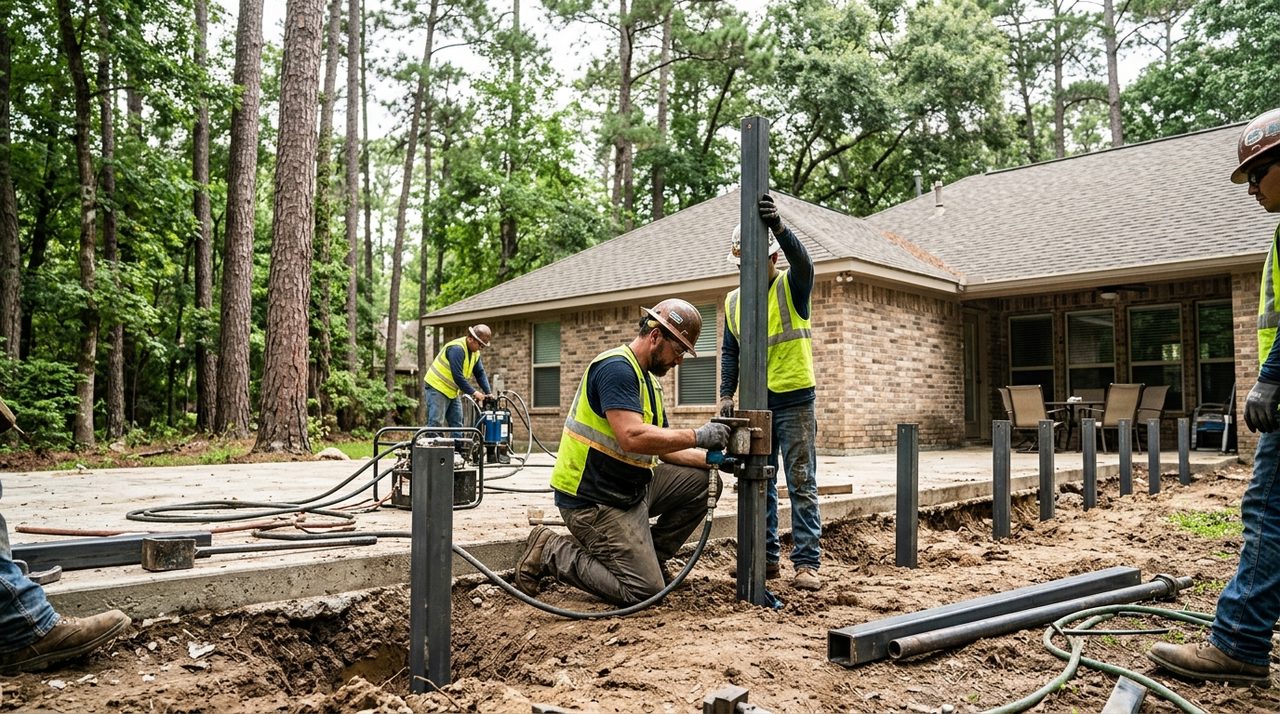
- Median home built
- 1983
- Median home value
- $191,200
- FEMA flood zone
- X (low)
- Typical repair cost (est.)
- $3,500–$25,000 depending on method and pier count
- Most common local issue
- Perimeter void formation from drought-cycle clay shrinkage beneath 1980s–1990s slabs
Ranked by verified Google rating × review volume × verification tier. How we rank →
Some highly-rated pros serve Humble from nearby and may not keep a Humble street address. Those are listed under "Also serving Humble" with their real city and distance, so you always know where each business is based.
Min rating:
10 resultsBased in Humble
Closed
830 Wilson Rd, Humble, TX 77338
Also serving Humble
Highly-rated pros based nearby who cover Humble. Distance shown from the Humble area.
Closed
Serving Humble Based in Porter · 3.7 mi away
Closed
Serving Humble Based in Kingwood · 4.2 mi away
Open Now
Serving Humble Based in Kingwood · 4.5 mi away
Closed
Serving Humble Based in Kingwood · 5.3 mi away
Serving Humble Based in Kingwood · 5.3 mi away
Open Now
Serving Humble Based in Kingwood · 5.4 mi away
Closed
Serving Humble Based in Kingwood · 5.9 mi away
Closed
Serving Humble Based in NE Houston · 8.1 mi away
Foundation Repair in Humble: What You Should Know
Drought-Baked Clay Is Pulling Away from Your 1980s Slab's Perimeter Beam
Why it matters to you
The majority of Humble's housing stock was built in the 1980s and 1990s on NE Harris County clay that contracts dramatically during La Niña drought years like 2022–2023. As the soil pulls back from the slab edge, the perimeter beam loses bearing support and the corner or side of the house begins to drop — often showing up first as sticking doors and diagonal cracks at window corners in brick veneer. Because so many Humble lots in subdivisions like Foxwood and similar communities were developed with turf-heavy landscaping and spray irrigation that underwaters the foundation perimeter, the void can form over a single dry summer and go unnoticed until damage is significant.
What a good pro does
A qualified foundation contractor should probe the perimeter and measure differential elevation across the slab using a zip-level or optical level before recommending any repair. If voids are confirmed and the slab has not yet significantly cracked, a soaker-hose irrigation program around the perimeter is the first line of defense; if underpinning is warranted, steel push piers driven to load-bearing soil (typically 15–25 feet in NE Harris County clay) are the most durable option, with installed costs estimated at $1,200–$1,800 per pier for an average job of 8–16 piers. Any contractor must first verify which of the three jurisdictions governs the property address before pulling the required permit.
Sources: Municipal permit office (see area profile), Harris County Flood Control District
Post-Uri Cast-Iron Under-Slab Drains Are Still Leaking — and Feeding Your Foundation Problems
Why it matters to you
Humble's 1980s-era homes were commonly built with cast-iron under-slab drain lines, and Winter Storm Uri in February 2021 cracked or fractured thousands of these lines across Harris County. Many homeowners had walls and floors patched in 2021 but never addressed the under-slab pipe itself. A slow ongoing leak directly beneath the slab saturates the clay in a localized zone, causing the soil to heave upward in that spot; as the clay structure breaks down over time, that same area can then settle — creating an irregular 'hump and dip' pattern that is often misdiagnosed as pure soil movement. Given that Humble's median home value is approximately $191,200 (ACS 5-Year 2023), the cost of a mis-attributed pier repair that leaves the true plumbing cause in place can exceed the equity available for correction.
What a good pro does
Before signing any foundation repair contract on a pre-1990 Humble home, insist on a hydrostatic plumbing test — a licensed plumber caps the drain system and pressurizes it with water to identify leaks. This test typically costs $250–$400 (estimated) and must be performed by a plumber licensed through the Texas State Board of Plumbing Examiners. If leaks are confirmed, the under-slab drain must be repaired or re-routed first; only after that scope is complete should foundation underpinning be bid and permitted.
Sources: Texas State Board of Plumbing Examiners, Municipal permit office (see area profile)
Three Permit Offices, One Subdivision: Getting Your Repair Legally Documented for Resale
Why it matters to you
A foundation repair job in Humble can fall under the City of Humble Permits office, the Houston Permitting Center, or Harris County Engineering depending on which side of the municipal boundary the parcel sits — and those lines do not follow subdivision plats. Homeowners who assume their contractor knows which office to use are frequently surprised at resale: an unpermitted underpinning job surfaces on the buyer's inspection report as a disclosure liability, and Texas TREC disclosure rules require sellers to report known foundation movement and repairs. Because Humble's owner-occupancy rate is only 36.6% (ACS 5-Year 2023), a significant share of properties are investment or rental homes where documentation gaps are especially common.
What a good pro does
Verify the exact permitting jurisdiction for your property address — not your neighbor's — by cross-referencing the Harris County Appraisal District parcel data with each jurisdiction's boundary maps before work begins. A contractor who pulls the permit in the correct jurisdiction will schedule the required inspection, creating a documented record that travels with the property. Separately, if your subdivision has a mandatory HOA (many Humble subdivisions do), architectural approval for exterior trenching or visible repair work is typically required in addition to the municipal permit — budget an extra 2–4 weeks for that review cycle.
Sources: Municipal permit office (see area profile), City of Houston Permitting Center, Local HOA / deed restrictions (see area profile)
Mature Oak and Tallow Trees in Older Subdivisions Are Drawing Moisture Unevenly Beneath Your Slab
Why it matters to you
Humble's 1980s-era subdivisions now have tree canopies that have had 35–45 years to mature. Live oaks, water oaks, and Chinese tallow trees — all common in NE Harris County neighborhoods — extend root systems 2–3 times the canopy radius, aggressively extracting clay moisture on one side of a slab during dry months while the opposite side remains comparatively moist. The result is a tilting or twisting slab rather than uniform settlement: interior floors may slope noticeably toward the tree side of the house while brick on the opposite elevation remains intact. This pattern is distinct from drought-perimeter voiding and requires a different repair strategy.
What a good pro does
A thorough pre-repair evaluation should include a perimeter elevation survey that maps which corners have dropped and by how much, combined with a visual assessment of root proximity to the foundation beam. If a large tree sits within 15–20 feet of the perimeter and is the clear driver, root barrier installation paired with targeted pier underpinning on the affected side addresses both the symptom and the ongoing cause. Note that some Humble HOAs with architectural control committees — such as those operating under deed restrictions recorded with Harris County — may require approval before exterior trenching for root barriers or piers, so check HOA governing documents before scheduling work.
Sources: Local HOA / deed restrictions (see area profile), Municipal permit office (see area profile), Harris County Flood Control District
Foundation Repair in Humble: What You Should Know
Hiring foundation repair in Humble? Humble spans incorporated city limits, City of Houston boundaries, and unincorporated Harris County, creating a patchwork of permitting jurisdictions that contractors must navigate carefully. Many platted subdivisions have mandatory HOAs with architectural control requirements, while older pockets may rely only on deed restrictions or civic clubs. The predominantly post-1970s housing stock means slab foundations and aging HVAC systems are common service concerns.
- Housing era
- Primarily late 1970s through 2000s across most subdivisions
- Foundation
- Predominantly concrete slab-on-grade, consistent with post-1970s mass-production construction practices in the Houston metro area
- Flood zone
- FEMA Zone X (low flood risk) per official NFHL data
- Permits
- Mixed jurisdiction
Housing stock & systems
Building era
Primarily late 1970s through 2000s across most subdivisions; some newer infill development ongoing.
Typical style
Not confirmed from available sources - typical NE Houston suburban mix expected (traditional brick, ranch, and contemporary styles). Check Harris County Appraisal District for specific subdivisions.
Foundations
Predominantly concrete slab-on-grade, consistent with post-1970s mass-production construction practices in the Houston metro area.
Common systems
Forced-air HVAC (many original systems in 1980s-1990s homes approaching or past useful life), copper and CPVC plumbing, 200-amp electrical panels in newer homes with some older 100-amp panels in 1970s-era construction.
What that means for repairs
HVAC replacement and roof replacement are common due to age of housing stock. Kitchen and bathroom remodels are frequent in 1980s-1990s era homes. Homeowners in HOA-governed subdivisions must obtain architectural approval before exterior modifications.
Permits & restrictions
Permit jurisdiction
Mixed jurisdiction: City of Humble Permits (within Humble city limits), Houston Permitting Center (within Houston city limits), or Harris County Engineering (unincorporated areas). Verify exact jurisdiction by property address before pulling permits.
HOA & deed restrictions
No single area-wide mandatory HOA. Many platted subdivisions have their own mandatory HOAs with architectural control (e.g., Foxwood HOA requires approval for all property improvements and modifications). Some older or smaller areas may have only deed restrictions or civic clubs. Confirm HOA status for any specific address via hoa.texas.gov or Harris County Clerk records.
Historic districts
No City of Houston historic district designation confirmed.
Contractor note
Contractors must verify which jurisdiction governs each property before starting work, as the Humble area straddles three permitting authorities. HOA architectural approval is commonly required in addition to municipal permits.
Flood & weather
FEMA flood zone
FEMA Zone X (low flood risk) per official NFHL data. However, the broader Humble area includes properties along San Jacinto River tributaries and local drainage channels; individual parcels may carry different flood zone designations. Always verify flood zone by specific property address.
Hurricane Harvey impact
No documented, citable Harvey flood-impact information was confirmed for Humble/NE Houston from available research. The broader NE Houston area near the San Jacinto River and Lake Houston experienced significant Harvey-related flooding, but specific street-level impact for Humble subdivisions should be verified through Harris County Flood Control District inundation maps and seller disclosure records.
Heat & humidity load
Extended Houston summers with sustained temperatures above 95°F and high humidity stress aging HVAC systems in 1980s-1990s homes. Slab foundations in clay soils are susceptible to seasonal movement during summer drought cycles, potentially causing door/window alignment issues and minor cracking. Attic temperatures can exceed 150°F, accelerating roof aging and increasing demand for attic insulation and ventilation upgrades.
Working with contractors here
HVAC replacement and repair is the most consistent service need in Humble, driven by aging systems in the large stock of 1980s-1990s homes facing Houston's extreme summer heat. Roof replacement is common, as many original roofs have exceeded their 20-25 year lifespan. Foundation monitoring and minor repair work is frequent due to the expansive clay soils typical of NE Harris County. Contractors should be prepared to navigate HOA architectural review processes in most subdivisions, which can add lead time to exterior projects. The mixed permitting jurisdiction (City of Humble, City of Houston, or Harris County) means contractors must verify the governing authority for each job site before beginning work.
Local Tip
Always ask for a written estimate before work begins. Texas contractors are required to provide one on jobs over $1,000.
About Humble
Humble spans incorporated city limits, City of Houston boundaries, and unincorporated Harris County, creating a patchwork of permitting jurisdictions that contractors must navigate carefully. Many platted subdivisions have mandatory HOAs with architectural control requirements, while older pockets may rely only on deed restrictions or civic clubs. The predominantly post-1970s housing stock means slab foundations and aging HVAC systems are common service concerns.
- Median year built
- 1983
- Median home value
- $191,200
- Owner-occupied
- 36.6%
- Population
- 16,489
- Housing units
- 6,497
- Median income
- $52,927
Source: U.S. Census Bureau, ACS 5-Year 2023
Flood & storm risk
FEMA Zone XLow flood riskMost of Humble maps to FEMA Zone X (low mapped flood risk), but Houston's flash-flood reality means even low-risk blocks benefit from smart drainage and storm-hardened installs; risk climbs sharply on blocks nearest the San Jacinto River, where it varies parcel to parcel.
Source: FEMA National Flood Hazard Layer (NFHL). Flood zones vary by parcel — verify your individual FIRM panel.
Houston Storm Readiness in Humble
Hurricane & flooding
Beryl 2024 reminded Houston homeowners that even neighborhoods with low FEMA flood designations experience localized ponding when storm-sewer inlets back up, and that standing water against a foundation for even 12 hours can trigger clay heave in Humble, TX. Before the season, confirm your gutters discharge at least five feet from the foundation and that splash blocks direct water toward the street, keeping clay moisture content consistent beneath the slab. Because Humble drains toward the San Jacinto River, block-level runoff can differ sharply from the mapped zone.
Severe storms & hail
Even with low mapped flood risk, Humble, TX is not immune to the localized sheet flow that accompanies a Houston severe thunderstorm, and repeated minor inundation at the foundation perimeter sustains the clay moisture that drives slow heave cycles. A pre-storm season inspection confirming that soil grade, splash blocks, and downspout extensions all direct water away from the slab is the most cost-effective foundation repair step you can take. Because Humble drains toward the San Jacinto River, block-level runoff can differ sharply from the mapped zone.
Ice storms & freezes
In Humble, TX, where mapped flood risk is low, the primary post-freeze foundation threat is not surface water but slab-leak-driven soil saturation — Uri 2021 caused widespread pipe failures that fed water silently under slabs for days before homeowners noticed. After any hard freeze, have a plumber pressure-test your lines first, then schedule a foundation elevation check if any under-slab leak is confirmed. With a median build year of 1983, the older building stock here is more exposed to hard-freeze damage than newer construction. Because Humble drains toward the San Jacinto River, block-level runoff can differ sharply from the mapped zone.
Sources: FEMA National Flood Hazard Layer (NFHL), Ready.gov -- Hurricanes, CenterPoint Energy -- Storm Center, City of Houston -- Emergency Preparedness, Ready.gov -- Winter Weather, Harris County Flood Control District
Free Humble Tools & Calculators
Houston-specific estimators to plan your project before you call a pro. All results are planning estimates — a licensed local pro confirms the details on site.
Houston Soil & Tree Proximity Risk Calculator
Open full tool & FAQ →Grouped by mature root aggression & water demand.
Trunk center to the nearest exterior wall.
Moderate risk
The root zone likely reaches your foundation's soil during Houston's dry summers, when clay shrinks most. Watch for sticking doors and diagonal cracks, keep soil moisture even with a soaker hose during drought, and have a foundation pro evaluate if you see any movement.
Find a Houston foundation pro →This is a planning estimate only — actual requirements depend on an on-site assessment by a licensed Houston pro. Guidance is based on general species root behavior in expansive clay, not a soil test.
Houston Freeze Prep & Pipe Insulation Checklist
Open full tool & FAQ →Your freeze checklist — 4 tasks
- 1
Disconnect & drain every outdoor hose bib
Remove hoses, drain the spigots, and cover each with an insulated faucet sock. Un-drained hose bibs are the #1 burst point in a Houston freeze.
- 2
Insulate exposed pipes in the attic & garage
Wrap any pipe in an unconditioned space (attic runs, garage walls) with foam sleeves. Houston homes rarely insulate these because they only matter a few nights a year — which is exactly why they burst.
- 3
Open cabinet doors & keep a pencil-width drip
On hard-freeze nights, open kitchen/bath cabinets so warm air reaches the pipes and let faucets on exterior walls drip to relieve pressure.
- 4
Protect the attic/garage water heater & its lines
An attic or garage tank sits in unconditioned space. Insulate the cold-inlet and hot-outlet lines and confirm the emergency drain pan is clear so a leak doesn't reach the ceiling.
This is a planning estimate only — actual requirements depend on an on-site assessment by a licensed Houston pro. If a pipe has already burst, shut off your main water supply and call a licensed Houston plumber immediately — freeze bursts flood fast.
Frequently Asked Questions
My Humble subdivision HOA is requiring architectural approval before I can trench around my foundation — how long does that typically add to my repair timeline?
HOA architectural review timelines in Humble's platted subdivisions vary widely: some boards meet monthly and take 2–4 weeks to respond, while others with online portals can turn approvals around in 7–10 days. Submit your contractor's written scope, pier location diagram, and a site sketch before you sign anything, since most HOAs want documentation that matches what gets permitted. Getting HOA sign-off and the applicable municipal permit (City of Humble, Houston Permitting Center, or Harris County Engineering — depending on your parcel) running in parallel rather than sequentially can save you several weeks of delay.
Sources: Local HOA / deed restrictions (see area profile)
How do I find out which of the three permit offices actually covers my Humble address for a foundation repair permit?
The cleanest method is to look up your parcel on the Harris County Appraisal District map and cross-reference your address against the City of Humble's corporate limits boundary and the City of Houston's extra-territorial jurisdiction lines — if you fall inside neither city, Harris County Engineering covers you. Your contractor should do this verification before signing a contract, but confirm it yourself because pulling a permit under the wrong jurisdiction can void it on a resale inspection. City of Houston–governed parcels in the Humble area use the Houston Permitting Center; properties within Humble city limits use the City of Humble permit office.
Sources: City of Houston Permitting CenterMunicipal permit office (see area profile)
My home was built in 1986 in a Humble subdivision — should I get a hydrostatic plumbing test before letting a foundation company start pier installation?
Yes, and this is especially important for 1986-era Humble homes, which almost certainly have cast-iron under-slab drain lines that were stress-cracked during Winter Storm Uri in 2021. A hydrostatic test — estimated at $250–$400 — pressurizes the drain system to reveal slow leaks that saturate clay directly beneath the slab and can make a pier repair look successful for a year before the movement resumes. If the test finds active leaks, a licensed plumber must repair those lines before any foundation contract is signed, since under-slab plumbing work in Texas must be performed or overseen by a TSBPE-licensed plumber.
Most of Humble is FEMA Zone X — does that low flood-risk designation mean my slab is less likely to have post-storm settlement problems than homes closer to the bayous?
Zone X means your block has a less than 1% annual chance of mapped riverine flooding, but it says nothing about the standing water that Houston's intense rain events leave on clay soils for days at a time — the same slow-drainage dynamic that made Harvey and Beryl damaging even in low-risk areas. Prolonged surface saturation reconsolidates NE Harris County clay and can trigger post-event settlement weeks after the water clears, regardless of your flood-zone designation. Homes near the San Jacinto River corridor in Humble can jump to higher-risk zones parcel by parcel, so if your lot is near that corridor, verify your actual zone on the FEMA Flood Map Service Center before assuming Zone X applies.
I got three foundation repair quotes for my 1990s Humble home and they recommend completely different methods — one wants pressed pilings, one wants steel push piers. Which is more appropriate for NE Harris County clay?
Pressed concrete pilings were the dominant Houston-area method through the 1990s and remain the lowest upfront cost option (estimated $3,500–$9,000 for a typical Humble-sized slab), but they have a higher reported re-lift rate on expansive clay because they rely on friction rather than bearing on a stable stratum. Steel push piers (estimated $1,200–$1,800 per pier) are driven to refusal on load-bearing soil and transfer the slab load below the active clay zone, making them generally better suited to NE Harris County's deep clay profile — though they cost significantly more. Ask each contractor to provide the proposed pier depth and the soil-bearing rationale in writing, and confirm that whoever you hire will pull the required permit with the correct jurisdiction for your parcel.
Sources: Municipal permit office (see area profile)
If I sell my Humble home within the next few years, what documentation do I need to prove my foundation repair was done legally?
Texas requires sellers to disclose known foundation movement and repairs on the TREC Seller's Disclosure form, so incomplete or undocumented work is a legal liability — buyers' inspectors routinely check for pier caps around the perimeter and will flag repairs that don't have closed permits. You need the original permit (pulled from whichever jurisdiction covers your address), the final inspection sign-off from that office, the contractor's written warranty, and — if any under-slab plumbing was involved — the licensed plumber's documentation. Keep copies of all HOA architectural approvals as well, since a buyer's attorney may request them if your subdivision has mandatory architectural control.
Sources: City of Houston Permitting CenterLocal HOA / deed restrictions (see area profile)Municipal permit office (see area profile)