Closed
1701 Northpark Dr Suite 3, Kingwood, TX 77339
Kingwood's multi-decade build-out — from 1970s villages like Greentree to 2000s-era sections — means foundation conditions vary sharply by subdivision: older slabs have endured more wet-dry clay cycles and more winters, while mid-2000s slabs may still carry residual stress from Hurricane Harvey's prolonged inundation of the Lake Houston and San Jacinto River corridor just miles away. Because Kingwood sits within City of Houston limits, all underpinning work requires a City of Houston permit through the Houston Permitting Center, and exterior trenching around your foundation perimeter also triggers mandatory review by your community or village-level HOA before work begins. Understanding which repairs are actually warranted for your specific village's housing era — and how to document them correctly for resale — is what separates a sound investment from an expensive regret.
Ranked by verified Google rating × review volume × verification tier. How we rank →
Some highly-rated pros serve Kingwood from nearby and may not keep a Kingwood street address. Those are listed under "Also serving Kingwood" with their real city and distance, so you always know where each business is based.
1701 Northpark Dr Suite 3, Kingwood, TX 77339
5510 Atascocita Road Suite 110, Atascocita, TX 77346
1525 Lakeville Dr #134, Kingwood, TX 77339
56 Blue Lake Dr, Huffman, TX 77336
13621 Will Clayton Pkwy #201, Humble, TX 77346
6942 Farm to Market 1960 Rd E #146, Humble, TX 77346
17910 Magenta Springs Dr, Humble, TX 77346
Highly-rated pros based nearby who cover Kingwood. Distance shown from the Kingwood area.
Serving Kingwood Based in Humble · 2.7 mi away
Serving Kingwood Based in Porter · 5.2 mi away
Serving Kingwood Based in Humble · 6.4 mi away
Why it matters to you
Sections of Kingwood platted in the 1970s and 1980s — such as Greentree and Woodland Hills — sit on Houston Black clay that has already endured four-plus decades of seasonal expansion and contraction. That accumulated movement means interior door frames that stick every summer, stair-step cracks in brick veneer that reopen after every dry spell, and diagonal drywall cracks near window corners that no amount of patching permanently fixes. Because these slabs were designed to 1970s-era construction standards, they typically have thinner beam depths and less post-tension reinforcement than slabs built after modern code revisions, making them more vulnerable to differential movement than newer Kingwood subdivisions.
What a good pro does
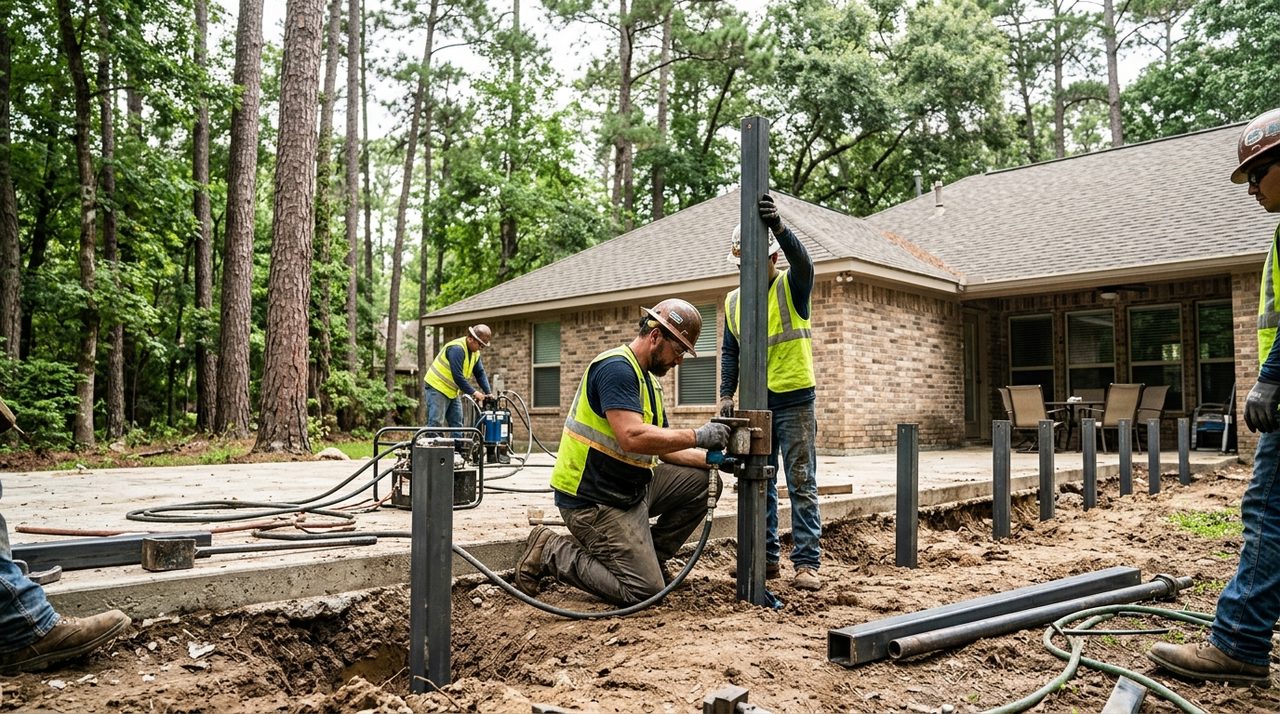
A qualified foundation contractor should map crack patterns room by room, take elevation readings at multiple interior points with a digital level, and correlate the data with your irrigation and rainfall history before recommending any pier work. On pre-2000 Kingwood slabs, pressed concrete pilings installed in the 1990s are sometimes already present and may themselves be failing — ask any contractor to probe for existing pilings before proposing new ones. Steel push piers or helical piers reaching load-bearing strata below the active clay zone are now the preferred approach; a City of Houston permit is required for this scope of underpinning work.
Sources: City of Houston Permitting Center, Municipal permit office (see area profile), International Residential Code (as adopted by City of Houston)
Why it matters to you
Winter Storm Uri in February 2021 froze and cracked under-slab cast-iron and PVC drain lines throughout older Kingwood villages, and many repairs addressed only visible interior wall damage — leaving cracked sub-slab pipes weeping undetected. A slow drain-line leak on Houston clay creates a localized wet zone that first heaves the slab upward, then causes collapse-style settlement as the soil structure degrades. Homeowners in 1970s–1980s Kingwood sections who had significant interior plumbing repairs in 2021 but never tested the under-slab lines may be attributing fresh foundation movement to soil alone when the actual driver is ongoing saturation directly beneath the beam.
What a good pro does
Before signing any foundation repair contract on a pre-1990 Kingwood home, insist on a hydrostatic plumbing test — a licensed plumber (required by TSBPE to oversee under-slab plumbing scope) pressurizes the drain system and measures drop to confirm or rule out sub-slab leaks. This test runs an estimated $250–$400 and can prevent you from spending $15,000 on pier underpinning that will fail within years if the true cause is never addressed. If a leak is confirmed, the under-slab pipe repair must be completed and the soil allowed to restabilize before elevation readings are re-taken and any structural repair is designed.
Sources: Texas State Board of Plumbing Examiners, City of Houston Permitting Center
Why it matters to you
Kingwood's mandatory community association structure — the Lake Houston Community Association at the master level, plus many village-level HOAs — treats perimeter trenching and any visible exterior modification as work requiring prior architectural approval, independent of the City of Houston building permit. Homeowners who allow a contractor to mobilize and trench around the foundation perimeter before obtaining HOA approval risk a stop-work notice and mandatory restoration of landscaping at their own expense, adding thousands to the project cost and weeks of delay. This two-track approval process surprises many Kingwood homeowners who assume the City of Houston permit alone authorizes the work.
What a good pro does
Before scheduling any foundation contractor, request the architectural review application from your village HOA and confirm the submission deadline and typical review window — some Kingwood village associations meet monthly, meaning a missed submission can add four to six weeks to your timeline. Provide the HOA with a site plan showing pier locations, trench dimensions, and a landscaping restoration plan; contractors familiar with Kingwood should have this documentation ready. Simultaneously submit for the City of Houston permit through the Houston Permitting Center, since both approvals must be in hand before work begins.
Sources: Local HOA / deed restrictions (see area profile), City of Houston Permitting Center, Municipal permit office (see area profile)
Why it matters to you
While most of Kingwood maps to FEMA Zone X, blocks closest to the San Jacinto River arm of Lake Houston experienced prolonged inundation during Hurricane Harvey in 2017 and again saw elevated water levels during Hurricane Beryl in 2024 — flood risk in these parcels varies significantly from block to block and cannot be assumed from the neighborhood-wide Zone X designation. Extended saturation on already-stressed clay can trigger settlement that appears weeks to months after water recedes, once the saturated bearing soils reconsolidate under the slab's dead load. Homeowners in these lower-lying Kingwood sections who purchased post-Harvey or who have never had a foundation elevation survey may be unaware that slow movement is already underway.
What a good pro does
If your Kingwood home is within several blocks of the Lake Houston shoreline or the West Fork San Jacinto corridor, a post-storm elevation survey using a digital manometer — not a visual crack inspection alone — is the only way to quantify actual differential movement. If repair is indicated, confirm your FEMA flood zone at the parcel level through FEMA's flood map service before work begins, as any foundation repair that alters finished floor elevation on a flood-zone parcel can affect the validity of an existing elevation certificate, which must be disclosed at resale. A City of Houston permit is required for underpinning in this jurisdiction regardless of flood zone.
Sources: FEMA National Flood Hazard Layer (NFHL), Harris County Flood Control District, City of Houston Permitting Center
Hiring foundation repair in Kingwood? Kingwood is a large master-planned community in northeast Houston with a mandatory community association structure and deed restrictions governing exterior modifications. The neighborhood encompasses multiple villages with varying build periods, meaning housing stock age and systems vary significantly by subdivision. Homeowners should verify both community-wide and village-level deed restrictions before undertaking exterior or structural work.
Building era
Mixed — development spans from the 1970s through the 2010s across various villages. Specific decade varies by subdivision.
Typical style
Not confirmed from available sources — likely a mix of traditional suburban styles typical of Houston master-planned communities across multiple decades.
Foundations
Not confirmed — slab-on-grade is typical for Houston-area suburban construction of this era, but specific confirmation not available for all Kingwood villages.
Common systems
Given the multi-decade build-out, systems range widely: older sections may have original HVAC, galvanized or copper plumbing, and older electrical panels, while newer sections feature modern systems. Homes from the 1970s–1980s may have aging ductwork and R-22 refrigerant HVAC units requiring replacement.
What that means for repairs
Renovation activity likely varies by village age — older Kingwood sections (Greentree, Woodland Hills) may see full HVAC replacements, kitchen/bath remodels, and roof replacements, while newer sections focus on cosmetic updates. All exterior modifications must comply with deed restrictions enforced by the community association.
Permit jurisdiction
Houston Permitting Center — Kingwood is within City of Houston limits. No separate Kingwood municipal permit office exists.
HOA & deed restrictions
Mandatory master association structure — the Lake Houston Community Association manages community-wide facilities and business. Mandatory Kingwood Association fees are approximately $200–$400 annually. Many villages/subdivisions have additional HOAs with fees of $100–$600 annually. Some areas include gated-community surcharges. Deed restrictions are enforced by community associations in lieu of municipal zoning.
Historic districts
No City of Houston historic district designation confirmed.
Contractor note
Contractors must obtain City of Houston permits for regulated work and ensure all exterior modifications comply with both the master community association deed restrictions and any applicable village-level HOA architectural review requirements before beginning work.
FEMA flood zone
FEMA Zone X (low flood risk) — source: fema_nfhl. Note: Kingwood is situated near the San Jacinto River and Lake Houston; flood risk can vary significantly by specific tract and proximity to waterways. Homeowners in areas closer to the river or drainage channels should verify their individual FIRM panel.
Hurricane Harvey impact
Parts of Kingwood were impacted by Hurricane Harvey in 2017, but specific streets and recurring flood areas could not be confirmed from available sources. Homeowners should check Harris County Flood Control District records and FEMA flood insurance claims data for tract-specific Harvey impact information.
Heat & humidity load
Houston's extreme summer heat and humidity stress HVAC systems heavily across Kingwood's varied housing stock. Older homes may have undersized or aging units struggling to maintain efficiency. High humidity also creates conditions for mold growth in attics and crawl spaces, and heavy summer storms can expose roofing and drainage vulnerabilities.
Working with contractors here
Kingwood's multi-decade build-out means contractors encounter a wide range of systems and conditions depending on the specific village. Older sections built in the 1970s–1980s commonly need HVAC replacements, re-roofing, plumbing upgrades, and electrical panel modernization. Newer sections may focus on cosmetic remodeling and energy efficiency improvements. All exterior work must be pre-approved through the relevant community association or village HOA architectural review process, which can add lead time to project scheduling. Contractors should also be aware that flood remediation and moisture mitigation remain relevant trades in sections closer to waterways, even in areas mapped as Zone X.
Local Tip
Always ask for a written estimate before work begins. Texas contractors are required to provide one on jobs over $1,000.
Kingwood is a large master-planned community in northeast Houston with a mandatory community association structure and deed restrictions governing exterior modifications. The neighborhood encompasses multiple villages with varying build periods, meaning housing stock age and systems vary significantly by subdivision. Homeowners should verify both community-wide and village-level deed restrictions before undertaking exterior or structural work.
Source: U.S. Census Bureau, ACS 5-Year 2023
Most of Kingwood maps to FEMA Zone X (low mapped flood risk), but Houston's flash-flood reality means even low-risk blocks benefit from smart drainage and storm-hardened installs; risk climbs sharply on blocks nearest the San Jacinto River and Lake Houston, where it varies parcel to parcel.
Source: FEMA National Flood Hazard Layer (NFHL). Flood zones vary by parcel — verify your individual FIRM panel.
Houston's flash-flood reality means even low-mapped-risk areas like Kingwood, TX can see sheet flow accumulate against a foundation during a slow-moving Gulf system, so verify that your perimeter drainage is clear and properly sloped before hurricane season opens. A TDLR-licensed foundation contractor can add or reposition surface drains to intercept runoff before it softens the clay bearing layer beneath your slab. Confirm the current FEMA panel for your Kingwood parcel — the area maps to Zone X, but adjacent lots can differ.
Hail itself does not crack a concrete foundation, but the insurance repair process — contractors dropping equipment, vibrating compactors near the structure — can disturb marginally stable piers in Kingwood, TX. Coordinate a brief foundation check with a TDLR-licensed contractor before and after any major roof or exterior repair project that involves heavy equipment operating near your home. As a Harris County community, Kingwood may follow county rather than City of Houston storm rebuild rules.
Winter Storm Uri's multi-day freeze caused Houston clay soils to go through freeze-thaw cycling not common in the region, and even low-flood-risk neighborhoods in Kingwood, TX saw new door-sticking and brick-step cracking appear in the spring following the storm. A post-winter Zip-Level survey establishes whether that movement is seasonal and self-correcting or progressive and in need of pier work before summer drying amplifies the differential. Confirm the current FEMA panel for your Kingwood parcel — the area maps to Zone X, but adjacent lots can differ.
Sources: FEMA National Flood Hazard Layer (NFHL), Ready.gov -- Hurricanes, CenterPoint Energy -- Storm Center, City of Houston -- Emergency Preparedness, Ready.gov -- Winter Weather, Harris County Flood Control District
Houston-specific estimators to plan your project before you call a pro. All results are planning estimates — a licensed local pro confirms the details on site.
Grouped by mature root aggression & water demand.
Trunk center to the nearest exterior wall.
The root zone likely reaches your foundation's soil during Houston's dry summers, when clay shrinks most. Watch for sticking doors and diagonal cracks, keep soil moisture even with a soaker hose during drought, and have a foundation pro evaluate if you see any movement.
Find a Houston foundation pro →This is a planning estimate only — actual requirements depend on an on-site assessment by a licensed Houston pro. Guidance is based on general species root behavior in expansive clay, not a soil test.
Disconnect & drain every outdoor hose bib
Remove hoses, drain the spigots, and cover each with an insulated faucet sock. Un-drained hose bibs are the #1 burst point in a Houston freeze.
Insulate exposed pipes in the attic & garage
Wrap any pipe in an unconditioned space (attic runs, garage walls) with foam sleeves. Houston homes rarely insulate these because they only matter a few nights a year — which is exactly why they burst.
Open cabinet doors & keep a pencil-width drip
On hard-freeze nights, open kitchen/bath cabinets so warm air reaches the pipes and let faucets on exterior walls drip to relieve pressure.
Protect the attic/garage water heater & its lines
An attic or garage tank sits in unconditioned space. Insulate the cold-inlet and hot-outlet lines and confirm the emergency drain pan is clear so a leak doesn't reach the ceiling.
This is a planning estimate only — actual requirements depend on an on-site assessment by a licensed Houston pro. If a pipe has already burst, shut off your main water supply and call a licensed Houston plumber immediately — freeze bursts flood fast.
Sources: City of Houston Permitting CenterMunicipal permit office (see area profile)
Sources: Local HOA / deed restrictions (see area profile)
Sources: FEMA National Flood Hazard Layer (NFHL)Harris County Flood Control District
Sources: City of Houston Permitting CenterLocal HOA / deed restrictions (see area profile)