Closed
Serving Rice Military Based in River Oaks · 1.1 mi away
Rice Military's townhome-heavy stock — most slabs poured between the mid-1990s and 2010s — sits on Houston's expansive Beaumont clay just blocks from Buffalo Bayou, a combination that makes seasonal soil movement and post-flood saturation real concerns even for homes in FEMA Zone X. Understanding how your three-story townhome slab behaves differently from a traditional single-family ranch, and which of the neighborhood's project-level HOAs controls your exterior work, will save you from costly surprises before you sign a repair contract.
Ranked by verified Google rating × review volume × verification tier. How we rank →
Some highly-rated pros serve Rice Military from nearby and may not keep a Rice Military street address. Those are listed under "Also serving Rice Military" with their real city and distance, so you always know where each business is based.
Highly-rated pros based nearby who cover Rice Military. Distance shown from the Rice Military area.
Serving Rice Military Based in River Oaks · 1.1 mi away
Serving Rice Military Based in Lazybrook / Timbergrove · 1.4 mi away
Serving Rice Military Based in Lazybrook / Timbergrove · 1.6 mi away
Serving Rice Military Based in Lazybrook / Timbergrove · 1.9 mi away
Serving Rice Military Based in Upper Kirby · 2.4 mi away
Serving Rice Military Based in Upper Kirby · 2.5 mi away
Serving Rice Military Based in Midtown · 2.8 mi away
Serving Rice Military Based in Lazybrook / Timbergrove · 3.7 mi away
Serving Rice Military Based in Lazybrook / Timbergrove · 3.9 mi away
Serving Rice Military Based in The Heights · 3.9 mi away
Why it matters to you
The wave of three-story townhomes constructed in Rice Military from the mid-1990s through the 2000s are now 15–30 years old — old enough for Houston's repeated La Niña drought cycles, most recently 2022–2023, to bake the Beaumont clay beneath their slabs and pull it away from the perimeter beam. These tightly packed lots have minimal shade canopy and small landscaping beds, meaning little natural ground cover to retain moisture during dry stretches. The result is perimeter void formation that leaves the slab edge unsupported; when heavy rains return, water channels into the gap rather than soaking in gradually, accelerating erosion under the beam.
What a good pro does
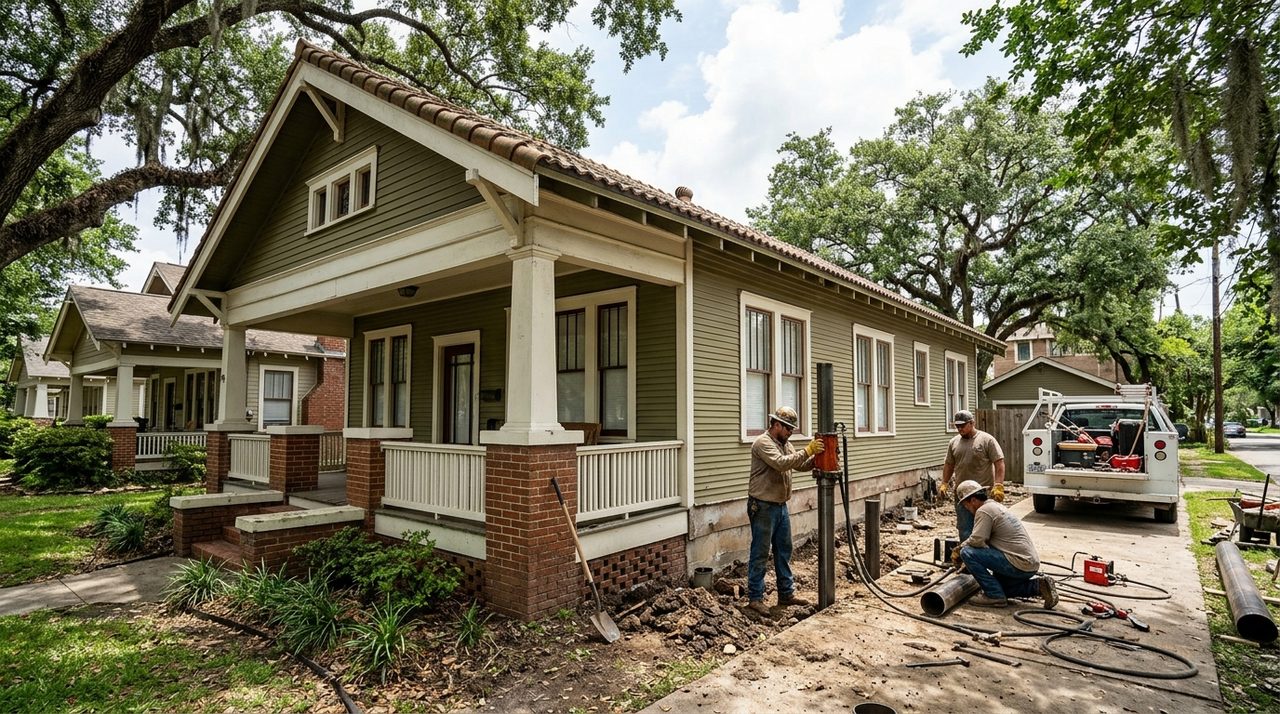
A qualified contractor should probe the perimeter with a moisture meter and camera-inspect any accessible void before recommending repair. Soaker-hose irrigation along the foundation perimeter — run 2–3 times per week during drought conditions — is the most effective low-cost prevention documented for Houston clay slabs. If underpinning is warranted, steel push piers installed to load-bearing soil are the more reliable option on these mid-weight townhome slabs; estimates of $1,200–$1,800 per pier are typical, and City of Houston permits are required for this work.
Sources: City of Houston Permitting Center, Municipal permit office (see area profile)
Why it matters to you
Winter Storm Uri in February 2021 froze and cracked under-slab drain lines throughout Houston's Inner Loop, including Rice Military's first-generation townhomes. Many of those 1990s townhomes were built with cast-iron under-slab drain lines, and repair work at the time often addressed visible wall damage without confirming the integrity of the buried pipe. A slow, ongoing leak beneath the slab saturates the clay locally, triggering heave and then settlement in a cycle that can mimic straightforward soil movement — causing misdiagnosis and wasted repair spending.
What a good pro does
Before signing any foundation repair contract, commission a hydrostatic plumbing test ($250–$400 estimated) conducted by a plumber licensed through the Texas State Board of Plumbing Examiners (TSBPE). If the test reveals a leak, the under-slab line must be repaired or re-routed by a licensed plumber — not the foundation contractor — before any pier work begins. City of Houston permits are required for both the plumbing repair and the foundation underpinning.
Sources: Texas State Board of Plumbing Examiners, City of Houston Permitting Center, Municipal permit office (see area profile)
Why it matters to you
Rice Military has no single neighborhood-wide master HOA, but virtually every individual townhome complex — such as the Courtyards of Detering Place and similar developments — has its own mandatory HOA or POA with architectural standards that govern exterior modifications. Trenching along the foundation perimeter for pier installation, staging equipment on shared driveways, or any visible concrete or masonry disturbance almost certainly falls under these deed restrictions. A contractor who skips HOA review can leave you in violation of your project's governing documents, potentially forcing rework or triggering fines.
What a good pro does
Before obtaining a City of Houston permit, confirm your specific development's HOA requirements through Harris County Clerk deed-restriction records or your HOA's architectural review committee. Get written HOA approval in hand before signing a repair contract. Reputable foundation contractors operating in townhome-dense Inner Loop neighborhoods should be familiar with this step; if a contractor dismisses HOA review as unnecessary, treat that as a red flag.
Sources: Local HOA / deed restrictions (see area profile), City of Houston Permitting Center, Municipal permit office (see area profile)
Why it matters to you
While most of Rice Military maps to FEMA Zone X, flood risk rises sharply on blocks closest to Buffalo Bayou, and events like Hurricane Harvey (2017) and Hurricane Beryl (2024) left some of those parcels under standing water for extended periods. Prolonged saturation reconsolidates the Beaumont clay and can trigger settlement weeks after water recedes — especially on slabs that were already stressed by prior drought cycles. Homeowners on the bayou-adjacent blocks should not assume a Zone X designation means their foundation is insulated from flood-driven soil movement.
What a good pro does
After any major flood event, wait at least 60–90 days before commissioning a foundation inspection, as clay settlement is often still in progress in the weeks immediately following drainage. When you do get an inspection, ask the contractor to document pre-repair crack patterns with photographs and check whether any drainage or grading issues at the site perimeter are channeling water toward the slab — a common problem on the narrow lots typical of Rice Military townhomes. City of Houston permits are required for any underpinning work that follows.
Sources: FEMA National Flood Hazard Layer (NFHL), Harris County Flood Control District, City of Houston Permitting Center
Hiring foundation repair in Rice Military? Rice Military is a townhome-dominated Inner Loop neighborhood where most homes were built between the mid-1990s and 2010s on slab foundations. Homeowners typically deal with project-specific HOA requirements for exterior modifications, and the neighborhood's proximity to Buffalo Bayou makes flood risk and drainage a critical consideration for any ground-level work. Contractors should expect tight lot setbacks, shared walls, and rooftop deck maintenance as recurring service drivers.
Building era
1990s–2010s (dominant); scattered pre-1960s bungalows remain.
Typical style
Three-story attached and freestanding contemporary townhomes with stucco, brick, or mixed-material exteriors; roof decks common.
Foundations
Predominantly slab-on-grade for newer townhomes; remaining older bungalows may be pier-and-beam.
Common systems
Forced-air HVAC systems (typically 15–25 years old on earlier builds), copper or PEX plumbing, 200-amp electrical panels standard on townhome construction of this era.
What that means for repairs
Kitchen and bathroom remodels in first-generation 1990s townhomes are increasingly common as these units age. Roof deck waterproofing, stucco repair, and HVAC replacement on original equipment drive significant service demand. Some older bungalows are demolished for new townhome construction, requiring full demolition and new-build permitting.
Permit jurisdiction
City of Houston – Houston Permitting Center.
HOA & deed restrictions
No single mandatory master HOA for the neighborhood. The Rice Military Civic Club (RMCC) is a voluntary civic organization. Most individual townhome developments have their own mandatory HOAs or POAs (e.g., Courtyards of Detering Place). Deed restrictions are common at the project/subdivision level and must be confirmed per property via Harris County Clerk records.
Historic districts
No City of Houston historic district designation confirmed.
Contractor note
Contractors must verify the specific townhome development's HOA rules before beginning exterior work, as each project-level HOA may impose different architectural standards, color palettes, and material requirements. City of Houston permits are required for structural, electrical, plumbing, and mechanical work.
FEMA flood zone
FEMA Zone X (low flood risk) per official NFHL data. However, Rice Military is bounded on the south by Buffalo Bayou, and flood risk varies significantly at the parcel level. Elevation certificates and Harris County Flood Control District inundation maps should be consulted for properties near the bayou or at lower elevations.
Hurricane Harvey impact
Specific Harvey 2017 inundation data for Rice Military streets was not confirmed in available research. The neighborhood's adjacency to Buffalo Bayou—which experienced significant Harvey flooding—means some properties likely saw impact, but parcel-level documentation was not available. Local real estate professionals consistently flag flood risk and elevation as primary due-diligence items, suggesting meaningful flood history. Property-specific Harvey impact should be verified through Harris County Flood Control District records and individual elevation certificates.
Heat & humidity load
Three-story townhomes with roof decks experience extreme heat loading on upper floors during Houston summers, driving high HVAC demand and potential compressor strain. Flat or low-slope rooftop deck membranes are vulnerable to UV degradation and thermal cycling. Stucco exteriors may develop hairline cracks from thermal expansion, allowing moisture intrusion if not maintained.
Working with contractors here
Rice Military contractors most commonly handle HVAC replacements and maintenance on aging 1990s–2000s townhome systems, rooftop deck waterproofing and re-coating, and stucco facade repair. The dense townhome layout with minimal setbacks creates access challenges for exterior work, often requiring coordination with adjacent property owners or HOAs for scaffolding and equipment staging. Ground-floor flood mitigation—including backflow prevention, sump pump installation, and water-resistant finishing for garage-level spaces—is an important service category given Buffalo Bayou proximity. Contractors should confirm the specific development's HOA approval process before scoping exterior projects, as requirements vary significantly between complexes within the same neighborhood.
Local Tip
Always ask for a written estimate before work begins. Texas contractors are required to provide one on jobs over $1,000.
Rice Military is a townhome-dominated Inner Loop neighborhood where most homes were built between the mid-1990s and 2010s on slab foundations. Homeowners typically deal with project-specific HOA requirements for exterior modifications, and the neighborhood's proximity to Buffalo Bayou makes flood risk and drainage a critical consideration for any ground-level work. Contractors should expect tight lot setbacks, shared walls, and rooftop deck maintenance as recurring service drivers.
Source: U.S. Census Bureau, ACS 5-Year 2023
Most of Rice Military maps to FEMA Zone X (low mapped flood risk), but Houston's flash-flood reality means even low-risk blocks benefit from smart drainage and storm-hardened installs; risk climbs sharply on blocks nearest Buffalo Bayou, where it varies parcel to parcel.
Source: FEMA National Flood Hazard Layer (NFHL). Flood zones vary by parcel — verify your individual FIRM panel.
Beryl 2024 reminded Houston homeowners that even neighborhoods with low FEMA flood designations experience localized ponding when storm-sewer inlets back up, and that standing water against a foundation for even 12 hours can trigger clay heave in Rice Military. Before the season, confirm your gutters discharge at least five feet from the foundation and that splash blocks direct water toward the street, keeping clay moisture content consistent beneath the slab. In-city Rice Military work falls under City of Houston floodplain and permitting rules.
Hail itself does not crack a concrete foundation, but the insurance repair process — contractors dropping equipment, vibrating compactors near the structure — can disturb marginally stable piers in Rice Military. Coordinate a brief foundation check with a TDLR-licensed contractor before and after any major roof or exterior repair project that involves heavy equipment operating near your home. Because Rice Military drains toward Buffalo Bayou, block-level runoff can differ sharply from the mapped zone.
Winter Storm Uri's multi-day freeze caused Houston clay soils to go through freeze-thaw cycling not common in the region, and even low-flood-risk neighborhoods in Rice Military saw new door-sticking and brick-step cracking appear in the spring following the storm. A post-winter Zip-Level survey establishes whether that movement is seasonal and self-correcting or progressive and in need of pier work before summer drying amplifies the differential. In-city Rice Military work falls under City of Houston floodplain and permitting rules.
Sources: FEMA National Flood Hazard Layer (NFHL), Ready.gov -- Hurricanes, CenterPoint Energy -- Storm Center, City of Houston -- Emergency Preparedness, Ready.gov -- Winter Weather, Harris County Flood Control District
Houston-specific estimators to plan your project before you call a pro. All results are planning estimates — a licensed local pro confirms the details on site.
Grouped by mature root aggression & water demand.
Trunk center to the nearest exterior wall.
The root zone likely reaches your foundation's soil during Houston's dry summers, when clay shrinks most. Watch for sticking doors and diagonal cracks, keep soil moisture even with a soaker hose during drought, and have a foundation pro evaluate if you see any movement.
Find a Houston foundation pro →This is a planning estimate only — actual requirements depend on an on-site assessment by a licensed Houston pro. Guidance is based on general species root behavior in expansive clay, not a soil test.
Disconnect & drain every outdoor hose bib
Remove hoses, drain the spigots, and cover each with an insulated faucet sock. Un-drained hose bibs are the #1 burst point in a Houston freeze.
Insulate exposed pipes in the attic & garage
Wrap any pipe in an unconditioned space (attic runs, garage walls) with foam sleeves. Houston homes rarely insulate these because they only matter a few nights a year — which is exactly why they burst.
Open cabinet doors & keep a pencil-width drip
On hard-freeze nights, open kitchen/bath cabinets so warm air reaches the pipes and let faucets on exterior walls drip to relieve pressure.
Protect the attic/garage water heater & its lines
An attic or garage tank sits in unconditioned space. Insulate the cold-inlet and hot-outlet lines and confirm the emergency drain pan is clear so a leak doesn't reach the ceiling.
This is a planning estimate only — actual requirements depend on an on-site assessment by a licensed Houston pro. If a pipe has already burst, shut off your main water supply and call a licensed Houston plumber immediately — freeze bursts flood fast.
Sources: City of Houston Permitting CenterMunicipal permit office (see area profile)
Sources: Local HOA / deed restrictions (see area profile)
Sources: FEMA National Flood Hazard Layer (NFHL)Harris County Flood Control District
Sources: City of Houston Permitting Center