Closed
611 Keith Ave, Pasadena, TX 77504
South Houston's 1950s–1970s slab-on-grade homes sit directly on Harris County's Beaumont clay, and decades of wet-dry cycles — punctuated by Harvey's weeks-long inundation in 2017 and Beryl's renewed saturation in 2024 — have turned foundation movement from an occasional nuisance into a near-universal reality for owners here. Because South Houston is its own incorporated city, every underpinning or mudjacking permit must go through the City of South Houston's building department, not Houston's Development Services office — a distinction that catches contractors and buyers off-guard at resale. This page explains the four specific foundation pressures facing South Houston homeowners and what a properly scoped repair actually looks like on a census-median 1969 ranch slab in FEMA Zone AE.
Ranked by verified Google rating × review volume × verification tier. How we rank →
Some highly-rated pros serve South Houston from nearby and may not keep a South Houston street address. Those are listed under "Also serving South Houston" with their real city and distance, so you always know where each business is based.
611 Keith Ave, Pasadena, TX 77504
11665 Fuqua st, 108 Fuqua business park suite A, Houston, TX 77034
4223 Lurlene St, Houston, TX 77017
414 Avenue G, South Houston, TX 77587
3635 Shaver St, Pasadena, TX 77504
5722 Plainview St, Houston, TX 77087
2030 Ahrens St, Houston, TX 77017
Highly-rated pros based nearby who cover South Houston. Distance shown from the South Houston area.
Serving South Houston Based in Pasadena · 2.6 mi away
Serving South Houston Based in Pasadena · 2.9 mi away
Serving South Houston Based in Pasadena · 3.5 mi away
Why it matters to you
South Houston's FEMA Zone AE designation means much of the city experienced days of standing water during both Harvey (2017) and Beryl (2024). On the expansive Beaumont clay underlying these lots, prolonged saturation breaks down the soil's bearing structure, and the resulting settlement often doesn't fully appear until weeks or months after the water recedes — long after flood-repair contractors have moved on. Ranch-style homes built in the 1960s on thinner slab sections are especially vulnerable because their edge beams were designed to 1950s–60s code minimums, not the post-Uri or post-Harvey reality these foundations now face.
What a good pro does
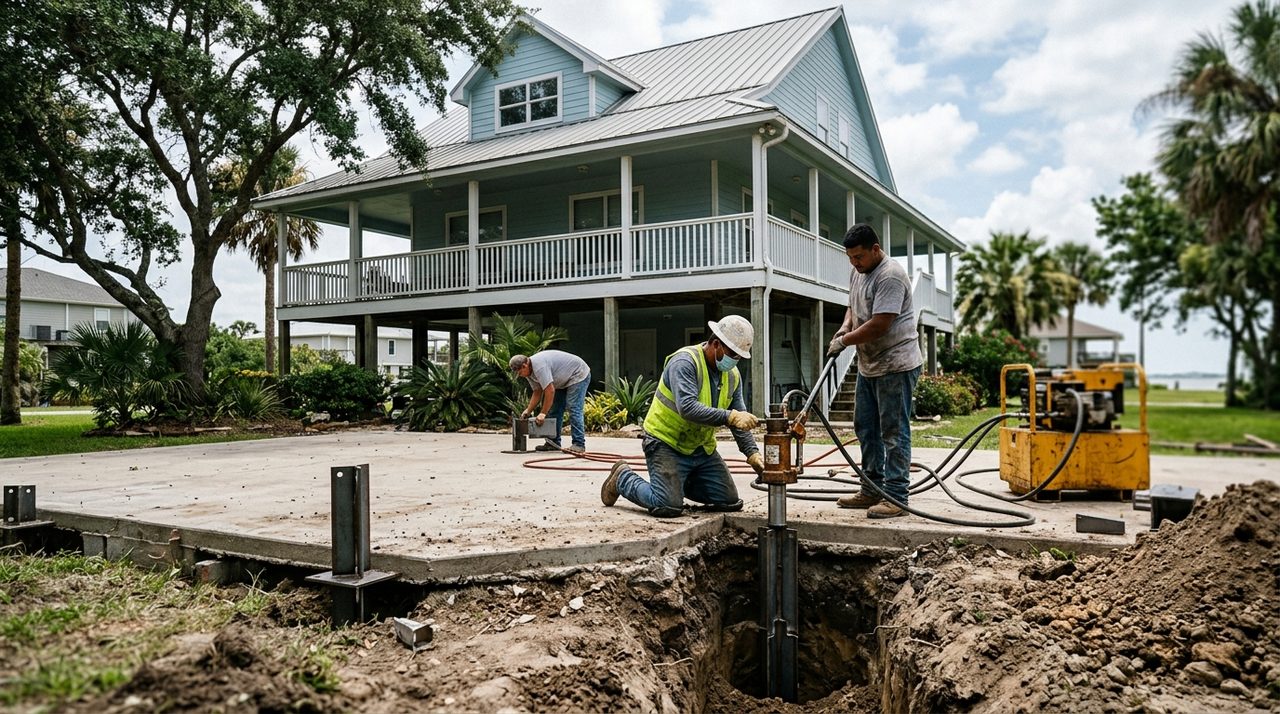
A qualified contractor should pull soil-moisture readings at multiple perimeter points and document any differential elevation across the slab before proposing repair. For South Houston homes in the AE flood zone, steel push piers anchored below the active clay layer — typically 8–16 piers at an estimated $1,200–$1,800 each — are a more durable solution than pressed concrete pilings, which can float or fracture in repeatedly saturated soil. All underpinning work requires a permit through the City of South Houston's building department; confirm the contractor is pulling that permit locally, not assuming Houston or Harris County jurisdiction.
Sources: FEMA National Flood Hazard Layer (NFHL), Harris County Flood Control District, Municipal permit office (see area profile)
Why it matters to you
South Houston's housing stock is centered on a census median build year of 1969, which means a large share of slabs were poured over cast-iron under-slab drain lines that are now 50-plus years old. Winter Storm Uri (February 2021) accelerated failures already in progress — even homes that avoided pipe bursts above grade often have hairline cracks in under-slab lines that have been leaking slowly ever since. That slow leak saturates the clay directly beneath the slab, causing localized heave on one side and settlement on the other, mimicking the irregular crack patterns homeowners mistakenly attribute entirely to soil movement.
What a good pro does
Before signing any foundation repair contract in South Houston, spend the $250–$400 on a hydrostatic plumbing test performed by a Texas State Board of Plumbing Examiners–licensed plumber. If an under-slab leak is confirmed, that pipe must be repaired or rerouted first — otherwise new piers installed into already-saturated soil will not perform as designed. The foundation contractor and plumber should coordinate sequencing, and the plumbing scope requires its own separate permit through the City of South Houston.
Sources: Texas State Board of Plumbing Examiners, Municipal permit office (see area profile), International Residential Code (as adopted by City of Houston)
Why it matters to you
South Houston's lots are modest in size, and many 1950s–1970s ranch homes have mature water oaks or Chinese tallow trees within 20 feet of the foundation — common in the older subdivisions platted along the southeast Harris County grid. On the dry side of a La Niña drought year (2022–2023 being the most recent example), tree roots extract soil moisture asymmetrically: the shaded, root-heavy side of a slab can drop an inch or more relative to the open, sun-exposed side. That creates the classic diagonal stair-step crack in brick veneer and binding interior doors that South Houston homeowners report every summer.
What a good pro does
A competent inspector will measure elevation at 8–12 points around the perimeter and identify whether the low corner correlates with the tree canopy, not just the flood-side of the lot. Running a soaker hose along the foundation perimeter on the tree side during dry months — keeping soil moisture within 6 inches of the beam — is the lowest-cost prevention available. If movement has already occurred, mudjacking or polyurethane foam injection under the dropped corner (estimated $800–$5,000 depending on section size) can restore contact between soil and slab, though this scope also requires a City of South Houston permit for structural work.
Sources: Municipal permit office (see area profile), Harris County Flood Control District
Why it matters to you
South Houston is an independent incorporated municipality entirely surrounded by unincorporated Harris County and the city of Pasadena — it is not part of the City of Houston, and its building department operates independently. Contractors unfamiliar with SE Harris County regularly pull permits through Houston's Development Services center or skip the permit step entirely, assuming a small repair doesn't require one. For a South Houston homeowner, that matters acutely at resale: Texas TREC disclosure forms require disclosure of known foundation movement and repairs, and a buyer's inspector or lender will flag unpermitted structural work. With a census median home value of $176,100, a $15,000 permit deficiency discovered in escrow can derail a sale entirely.
What a good pro does
Before work begins, confirm in writing that the contractor is pulling the permit through the City of South Houston's building department — not Houston, not Harris County Engineering (which governs only unincorporated parcels outside city limits). Request the permit number and verify it through the city directly; the City of South Houston conducts its own inspections at required stages. Keep all signed proposals, pier-count specifications, depth records, and final inspection sign-offs in a permanent home file, as this documentation will be required on a TREC seller's disclosure and protects you from liability if a buyer later challenges the repair.
Sources: Municipal permit office (see area profile), Texas Department of Licensing & Regulation, Local HOA / deed restrictions (see area profile)
Hiring foundation repair in South Houston? South Houston is a small incorporated city surrounded by southeast Harris County, with a housing stock dominated by 1950s–1970s slab-on-grade homes that face persistent flood risk and foundation movement on expansive clay soils. Homeowners here must prioritize drainage improvements, flood damage mitigation, and aging system upgrades. The patchwork of deed-restricted subdivisions and non-HOA blocks means contractor permitting runs through the City of South Houston rather than Houston's permitting center.
Building era
Primarily 1950s–1970s with some pre-war stock and later infill.
Typical style
Ranch-style and traditional suburban detached single-family homes; some smaller post-war cottages and bungalows in older plats.
Foundations
Predominantly slab-on-grade; limited pier-and-beam in pre-1950 structures.
Common systems
Original galvanized or early copper plumbing in older homes; aging central AC systems often undersized by modern standards; 100-amp electrical panels common in 1950s–1960s builds, many needing upgrade to 200-amp service.
What that means for repairs
Foundation repair and re-leveling are frequent due to expansive clay soils. Post-Harvey flood remediation drove significant interior gut-and-rebuild activity. Electrical panel upgrades and re-plumbing with PEX or copper are common as original systems age out.
Permit jurisdiction
City of South Houston Permitting (separate incorporated city — not Houston Permitting Center). Unincorporated parcels in surrounding SE Harris County fall under Harris County Engineering.
HOA & deed restrictions
No city-wide mandatory HOA identified. The area is a patchwork of deed-restricted subdivisions and non-HOA blocks with some voluntary civic clubs. Specific HOA status must be confirmed through Harris County Clerk deed restriction records or the Texas HOA registry at hoa.texas.gov.
Historic districts
No City of Houston historic district designation confirmed. South Houston is a separate incorporated municipality with no known local historic district overlay.
Contractor note
Contractors must obtain permits through the City of South Houston's own building department, not the City of Houston. Confirm municipal jurisdiction at the parcel level, as adjacent properties may fall under Harris County or Pasadena ETJ depending on exact location.
FEMA flood zone
FEMA Zone AE (high flood risk) per official NFHL data. The area sits in low-lying southeast Harris County near major drainage channels and bayous, contributing to elevated flood exposure during heavy rain events.
Hurricane Harvey impact
Southeast Harris County, including the South Houston and Pasadena corridor, experienced significant street and structure flooding during Hurricane Harvey (2017). Harris County Flood Control District sources confirm widespread inundation in the area, though a detailed street-by-street damage summary specific to the City of South Houston was not located in public records. Given the AE flood zone designation and regional flood patterns, substantial residential flood damage is strongly indicated.
Heat & humidity load
High heat and humidity stress aging HVAC systems in 1950s–1970s homes, many of which have inadequate insulation and single-pane windows. Standing water from summer thunderstorms exacerbates foundation movement on clay soils and creates conditions for mold growth in flood-damaged or poorly ventilated structures.
Working with contractors here
The most common contractor work in South Houston involves foundation repair, flood damage restoration, and drainage improvement — all driven by the AE flood zone designation and expansive clay soils beneath aging slab foundations. HVAC replacement is frequent as original systems in 1950s–1970s homes reach end of life, and many homeowners simultaneously upgrade insulation and ductwork. Electrical panel upgrades from 100-amp to 200-amp service are a routine scope item on renovation projects. Contractors should budget for potential mold remediation discovery during interior remodels, especially in homes that took Harvey flooding. Because South Houston is its own municipality, job scoping should confirm permit jurisdiction before bidding — the city's building department has its own inspection requirements separate from Houston or Harris County.
Local Tip
Always ask for a written estimate before work begins. Texas contractors are required to provide one on jobs over $1,000.
South Houston is a small incorporated city surrounded by southeast Harris County, with a housing stock dominated by 1950s–1970s slab-on-grade homes that face persistent flood risk and foundation movement on expansive clay soils. Homeowners here must prioritize drainage improvements, flood damage mitigation, and aging system upgrades. The patchwork of deed-restricted subdivisions and non-HOA blocks means contractor permitting runs through the City of South Houston rather than Houston's permitting center.
Source: U.S. Census Bureau, ACS 5-Year 2023
Much of South Houston maps to FEMA Zone AE (high flood risk), so flood-resilient detailing -- elevated equipment, water-tolerant materials, and drainage-first thinking -- is essential here, not optional.
Source: FEMA National Flood Hazard Layer (NFHL). Flood zones vary by parcel — verify your individual FIRM panel.
Drainage grading away from your foundation is your first line of defense when South Houston, TX sits squarely in FEMA Zone AE inside the 100-year floodplain territory — confirm that soil slopes at least six inches over the first ten feet before storm season. After any hurricane-level saturation event, watch for sticking doors and diagonal cracks at window corners, which are early indicators that clay soil consolidation has shifted your foundation unevenly. Much of the housing stock predates modern wind codes (median build year 1969), so retrofits matter more here. As a Harris County community, South Houston may follow county rather than City of Houston storm rebuild rules.
The May 2024 derecho delivered straight-line winds exceeding 100 mph across Houston, and the lateral load transferred through exterior walls into your foundation can loosen interior piers from their contact points, especially in high-moisture clay soils like those found in South Houston, TX. After any severe thunderstorm with significant wind, check for newly sticking doors or diagonal cracks at door corners — early warning signs that should prompt a professional Zip-Level survey before the next rain event. Confirm the current FEMA panel for your South Houston parcel — the area maps to Zone AE, but adjacent lots can differ.
Burst water pipes during a hard freeze release hundreds of gallons beneath or around your slab, and in South Houston, TX that sudden localized saturation of already-wet clay is one of the most direct causes of post-freeze foundation movement. Coordinate with your plumber on any post-freeze pipe repair to ensure the repair process documents where water escaped, then schedule a foundation inspection at the 60-day mark when soil moisture has partially redistributed. With a median build year of 1969, the older building stock here is more exposed to hard-freeze damage than newer construction. Confirm the current FEMA panel for your South Houston parcel — the area maps to Zone AE, but adjacent lots can differ.
Sources: FEMA National Flood Hazard Layer (NFHL), Ready.gov -- Hurricanes, CenterPoint Energy -- Storm Center, City of Houston -- Emergency Preparedness, Ready.gov -- Winter Weather, Harris County Flood Control District
Houston-specific estimators to plan your project before you call a pro. All results are planning estimates — a licensed local pro confirms the details on site.
Grouped by mature root aggression & water demand.
Trunk center to the nearest exterior wall.
The root zone likely reaches your foundation's soil during Houston's dry summers, when clay shrinks most. Watch for sticking doors and diagonal cracks, keep soil moisture even with a soaker hose during drought, and have a foundation pro evaluate if you see any movement.
Find a Houston foundation pro →This is a planning estimate only — actual requirements depend on an on-site assessment by a licensed Houston pro. Guidance is based on general species root behavior in expansive clay, not a soil test.
Disconnect & drain every outdoor hose bib
Remove hoses, drain the spigots, and cover each with an insulated faucet sock. Un-drained hose bibs are the #1 burst point in a Houston freeze.
Insulate exposed pipes in the attic & garage
Wrap any pipe in an unconditioned space (attic runs, garage walls) with foam sleeves. Houston homes rarely insulate these because they only matter a few nights a year — which is exactly why they burst.
Open cabinet doors & keep a pencil-width drip
On hard-freeze nights, open kitchen/bath cabinets so warm air reaches the pipes and let faucets on exterior walls drip to relieve pressure.
Protect the attic/garage water heater & its lines
An attic or garage tank sits in unconditioned space. Insulate the cold-inlet and hot-outlet lines and confirm the emergency drain pan is clear so a leak doesn't reach the ceiling.
This is a planning estimate only — actual requirements depend on an on-site assessment by a licensed Houston pro. If a pipe has already burst, shut off your main water supply and call a licensed Houston plumber immediately — freeze bursts flood fast.
Sources: Municipal permit office (see area profile)
Sources: FEMA National Flood Hazard Layer (NFHL)Texas State Board of Plumbing Examiners
Sources: Municipal permit office (see area profile)FEMA National Flood Hazard Layer (NFHL)Local HOA / deed restrictions (see area profile)