Closed
510 Pasadena Fwy Frontage Rd, Pasadena, TX 77506
Pasadena's large stock of 1950s–1970s slab-on-grade tract homes sits on southeast Harris County's expansive Beaumont clay — soil that swells, shrinks, and moves seasonally with enough force to crack brick-veneer ranch facades and rack door frames year after year. Add a generation's worth of aging galvanized under-slab plumbing (much of it stressed further by Winter Storm Uri in 2021) and a permitting process run exclusively through the City of Pasadena's own Permitting and Inspections Department, and foundation repair here involves more moving parts than a typical Houston suburb. This page walks Pasadena homeowners through the specific soil, plumbing, and permit realities that should drive every repair decision.
Ranked by verified Google rating × review volume × verification tier. How we rank →
Some highly-rated pros serve Pasadena from nearby and may not keep a Pasadena street address. Those are listed under "Also serving Pasadena" with their real city and distance, so you always know where each business is based.
510 Pasadena Fwy Frontage Rd, Pasadena, TX 77506
510 Pasadena Fwy, Pasadena, TX 77506
712 Walter St, Pasadena, TX 77506
Edmond Ave, Pasadena, TX 77506
2404 Ingersol Ave, Pasadena, TX 77506
817 E Southmore Ave #100E, Pasadena, TX 77502
Highly-rated pros based nearby who cover Pasadena. Distance shown from the Pasadena area.
Serving Pasadena Based in South Houston · 2.4 mi away
Serving Pasadena Based in South Houston · 2.5 mi away
Serving Pasadena Based in South Houston · 2.7 mi away
Why it matters to you
Pasadena's southeast Harris County location places virtually every post-1960 slab-on-grade home directly over Houston Black and Beaumont clay formations — among the most expansive in North America. In the 1950s–1970s tract subdivisions that make up the city's housing backbone, slabs were poured thin and without the post-tensioned reinforcement common in later construction. The result is that every wet season lifts one corner and every La Niña drought year (like 2022–2023) drops it back, cracking the brick-veneer facades and interior drywall in patterns homeowners sometimes mistake for settling that has 'stopped.' It has not stopped — it repeats every cycle.
What a good pro does
A competent foundation contractor serving Pasadena should perform a level survey across all four perimeter corners and at interior grid points before quoting any pier count. Ask specifically for the differential reading in inches — anything over 1.5 inches of differential typically warrants pier underpinning rather than mudjacking alone. Soaker-hose irrigation along the foundation perimeter during dry stretches is the front-line preventive measure that slows future movement regardless of what repair method is chosen. Repair work involving underpinning requires a permit from the City of Pasadena Permitting and Inspections Department, not the Houston Permitting Center.
Sources: Municipal permit office (see area profile), International Residential Code (as adopted by City of Houston)
Why it matters to you
Pasadena's median home was built in 1976, and a large share of the city's 1950s–1960s stock still has original galvanized steel or cast-iron drain lines running beneath the slab. Winter Storm Uri (February 2021) froze and cracked under-slab pipes across Harris County, and many Pasadena homes received surface-level wall repairs while the cracked under-slab lines were left in place. A slow drain leak saturates the clay directly underneath the beam, causing localized heave followed by settlement as the soil structure breaks down — a pattern that mimics normal clay movement but won't respond to pier underpinning alone.
What a good pro does
Before signing any foundation repair contract on a Pasadena home built before 1985, spend the $250–$400 on a hydrostatic plumbing test conducted by a plumber licensed through the Texas State Board of Plumbing Examiners. The test pressurizes the drain system and identifies leaks that a camera alone can miss. If a leak is confirmed, a TSBPE-licensed plumber must perform the under-slab repair — this scope cannot legally be handled by the foundation contractor. Addressing the plumbing first prevents a repaired slab from re-settling for the same underlying reason.
Sources: Texas State Board of Plumbing Examiners, Municipal permit office (see area profile)
Why it matters to you
Pasadena's suburban growth through the 1980s and into the 1990s coincided with the peak era of pressed concrete piling installation — a method once marketed aggressively in southeast Houston as a permanent fix. Many of these 30- to 40-year-old pressed-piling systems are now failing because the pilings were driven into the same unstable clay layer they were meant to bypass, rather than reaching a competent load-bearing stratum. Homeowners in Pasadena subdivisions like Fairmont Estates or Fairway Place who purchased a home with a 'prior foundation repair' disclosure may already be living on a system that needs replacement, not touch-up.
What a good pro does
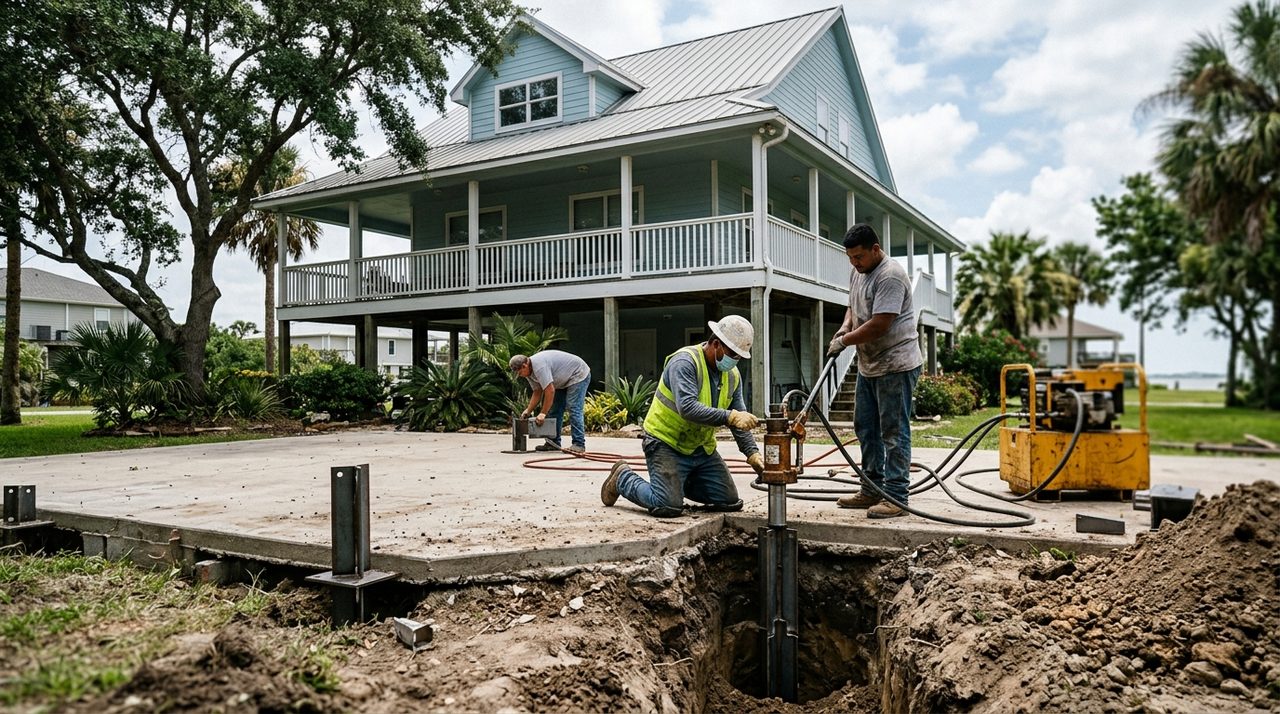
When evaluating a home with existing pressed pilings, ask any bidding contractor to document the depth and condition of visible pier heads before quoting additional piers. Steel push piers — driven until they meet refusal at load-bearing depth — are now the more defensible repair method for Pasadena's clay profile and typically run $1,200–$1,800 per pier installed (estimate). Helical piers at $1,500–$2,200 per pier are used where push piers cannot develop sufficient load. Get at least three written proposals that specify pier type, depth, and load capacity — not just pier count and total price. All underpinning work requires a permit pulled through the City of Pasadena's own permit office, and the homeowner should confirm the permit is active before work begins.
Sources: Municipal permit office (see area profile), Local HOA / deed restrictions (see area profile)
Why it matters to you
Pasadena has no citywide mandatory HOA, but individual subdivisions — including Fairway Place, Fairmont Estates, and others developed during the 1970s–1990s buildout — maintain their own homeowners or property owners associations with architectural review requirements. Foundation repair that involves trenching around the perimeter, installing pier caps visible at grade, or modifying exterior drainage can trigger an HOA approval requirement that the contractor will not flag automatically. Starting exterior foundation work without that sign-off can result in a stop-work demand from the association and complications at resale, where Texas requires sellers to disclose known foundation movement and repairs on the TREC disclosure form.
What a good pro does
Before scheduling any contractor for an on-site estimate, contact your subdivision's HOA or POA directly — the City of Pasadena's Neighborhood Network Information Center can help identify the correct association if you are unsure. If your subdivision has an architectural review committee, request the approval process in writing and factor that timeline into your repair schedule. Document all repair work thoroughly — permitted drawings, inspection sign-offs, and the contractor's written warranty — because a future buyer's inspector will ask, and undocumented repairs create negotiating leverage against you at closing.
Sources: Local HOA / deed restrictions (see area profile), Municipal permit office (see area profile)
Hiring foundation repair in Pasadena? Pasadena is a separate incorporated city in Harris County with a large base of mid-century suburban tract homes built during the petrochemical boom era. Homeowners here face challenges common to aging slab-on-grade construction, including foundation shifting, outdated plumbing, and HVAC systems that struggle with Gulf Coast humidity. The subdivision-by-subdivision patchwork of HOA governance means contractors must verify deed restrictions and architectural review requirements on a per-project basis.
Building era
Primarily 1950s–1970s with additional development through the 1980s–2000s on outer edges.
Typical style
Conventional suburban tract homes, predominantly brick or brick-veneer ranch and traditional styles.
Foundations
Predominantly slab-on-grade for post-1960 construction; some older pier-and-beam in pre-1950s areas — not definitively confirmed from available records.
Common systems
Older homes feature original copper or galvanized steel plumbing, single-stage HVAC units, and 100-amp electrical panels; newer subdivisions typically have PVC/PEX plumbing and 200-amp service.
What that means for repairs
Foundation repair and re-leveling are common due to expansive clay soils. Many homeowners update plumbing from galvanized to PEX and upgrade electrical panels to support modern loads. Post-Harvey flood damage remediation drove significant interior remodeling activity in affected areas.
Permit jurisdiction
City of Pasadena Permitting and Inspections Department (Pasadena is an incorporated city with its own permit office, not under Houston Permitting Center).
HOA & deed restrictions
Subdivision-specific patchwork. Some subdivisions have mandatory HOAs/POAs (e.g., Fairway Place Homeowners Association, Fairmont Estates Sec 04 R/P). Others have voluntary neighborhood associations coordinated through the City of Pasadena's Neighborhood Network Information Center. No single citywide mandatory HOA exists.
Historic districts
No City of Houston historic district designation confirmed. Pasadena is a separate incorporated city and does not fall under HAHC jurisdiction.
Contractor note
Contractors must pull permits through the City of Pasadena, not Houston or Harris County. HOA architectural review requirements vary by subdivision, so pre-approval processes should be confirmed with the specific HOA or POA before starting exterior work.
FEMA flood zone
FEMA Zone X (low flood risk) per official NFHL data. However, Pasadena sits near several bayous and drainage channels, and localized flooding has historically occurred despite Zone X designation in some areas. Homeowners should verify flood risk for specific lots, especially near Armand Bayou and Vince Bayou corridors.
Hurricane Harvey impact
Pasadena experienced significant flooding during Hurricane Harvey in 2017, with numerous neighborhoods sustaining substantial water intrusion. The city's low-lying terrain and proximity to the Houston Ship Channel area contributed to widespread damage. Many homes required full interior gutting and remediation. Specific block-level impact varied widely across the city.
Heat & humidity load
Extended Gulf Coast heat and humidity stress aging HVAC systems in 1950s–1970s homes, often leading to compressor failures and ductwork condensation issues. High humidity also accelerates mold growth in homes with inadequate ventilation, particularly in post-flood-repaired interiors.
Working with contractors here
Contractors in Pasadena most commonly handle foundation repair, HVAC replacement, and plumbing upgrades in the large stock of 1950s–1970s slab-on-grade homes. The expansive clay soils prevalent in southeast Harris County cause ongoing foundation movement, making foundation leveling and pier installation a steady demand driver. Re-piping from galvanized steel to PEX is frequent in older neighborhoods, and many homes still need electrical panel upgrades from 100-amp to 200-amp service. Post-Harvey, interior remodeling and mold remediation remain ongoing needs. Contractors should note that Pasadena operates its own permitting and inspection department independent of Houston, and turnaround times and code interpretations may differ from Harris County or COH standards.
Local Tip
Always ask for a written estimate before work begins. Texas contractors are required to provide one on jobs over $1,000.
Pasadena is a separate incorporated city in Harris County with a large base of mid-century suburban tract homes built during the petrochemical boom era. Homeowners here face challenges common to aging slab-on-grade construction, including foundation shifting, outdated plumbing, and HVAC systems that struggle with Gulf Coast humidity. The subdivision-by-subdivision patchwork of HOA governance means contractors must verify deed restrictions and architectural review requirements on a per-project basis.
Source: U.S. Census Bureau, ACS 5-Year 2023
Most of Pasadena maps to FEMA Zone X (low mapped flood risk), but Houston's flash-flood reality means even low-risk blocks benefit from smart drainage and storm-hardened installs.
Source: FEMA National Flood Hazard Layer (NFHL). Flood zones vary by parcel — verify your individual FIRM panel.
Houston's flash-flood reality means even low-mapped-risk areas like Pasadena, TX can see sheet flow accumulate against a foundation during a slow-moving Gulf system, so verify that your perimeter drainage is clear and properly sloped before hurricane season opens. A TDLR-licensed foundation contractor can add or reposition surface drains to intercept runoff before it softens the clay bearing layer beneath your slab. Confirm the current FEMA panel for your Pasadena parcel — the area maps to Zone X, but adjacent lots can differ.
Even with low mapped flood risk, Pasadena, TX is not immune to the localized sheet flow that accompanies a Houston severe thunderstorm, and repeated minor inundation at the foundation perimeter sustains the clay moisture that drives slow heave cycles. A pre-storm season inspection confirming that soil grade, splash blocks, and downspout extensions all direct water away from the slab is the most cost-effective foundation repair step you can take. As a Harris County community, Pasadena may follow county rather than City of Houston storm rebuild rules.
Ice loading from roof accumulation during a hard freeze transfers compressive stress to your foundation corners, and in Pasadena, TX that added load on clay subgrade that has stiffened from cold can create corner settlement that persists after the thaw. A TDLR-licensed foundation contractor should inspect visible brick-to-foundation transitions and interior door frames after any multi-day freeze event, even if no pipe damage occurred. With a median build year of 1976, the older building stock here is more exposed to hard-freeze damage than newer construction. As a Harris County community, Pasadena may follow county rather than City of Houston storm rebuild rules.
Sources: FEMA National Flood Hazard Layer (NFHL), Ready.gov -- Hurricanes, CenterPoint Energy -- Storm Center, City of Houston -- Emergency Preparedness, Ready.gov -- Winter Weather, Harris County Flood Control District
Houston-specific estimators to plan your project before you call a pro. All results are planning estimates — a licensed local pro confirms the details on site.
Grouped by mature root aggression & water demand.
Trunk center to the nearest exterior wall.
The root zone likely reaches your foundation's soil during Houston's dry summers, when clay shrinks most. Watch for sticking doors and diagonal cracks, keep soil moisture even with a soaker hose during drought, and have a foundation pro evaluate if you see any movement.
Find a Houston foundation pro →This is a planning estimate only — actual requirements depend on an on-site assessment by a licensed Houston pro. Guidance is based on general species root behavior in expansive clay, not a soil test.
Disconnect & drain every outdoor hose bib
Remove hoses, drain the spigots, and cover each with an insulated faucet sock. Un-drained hose bibs are the #1 burst point in a Houston freeze.
Insulate exposed pipes in the attic & garage
Wrap any pipe in an unconditioned space (attic runs, garage walls) with foam sleeves. Houston homes rarely insulate these because they only matter a few nights a year — which is exactly why they burst.
Open cabinet doors & keep a pencil-width drip
On hard-freeze nights, open kitchen/bath cabinets so warm air reaches the pipes and let faucets on exterior walls drip to relieve pressure.
Protect the attic/garage water heater & its lines
An attic or garage tank sits in unconditioned space. Insulate the cold-inlet and hot-outlet lines and confirm the emergency drain pan is clear so a leak doesn't reach the ceiling.
This is a planning estimate only — actual requirements depend on an on-site assessment by a licensed Houston pro. If a pipe has already burst, shut off your main water supply and call a licensed Houston plumber immediately — freeze bursts flood fast.
Sources: Municipal permit office (see area profile)
Sources: Local HOA / deed restrictions (see area profile)