Open Now
5505 Elysian St, Houston, TX 77009
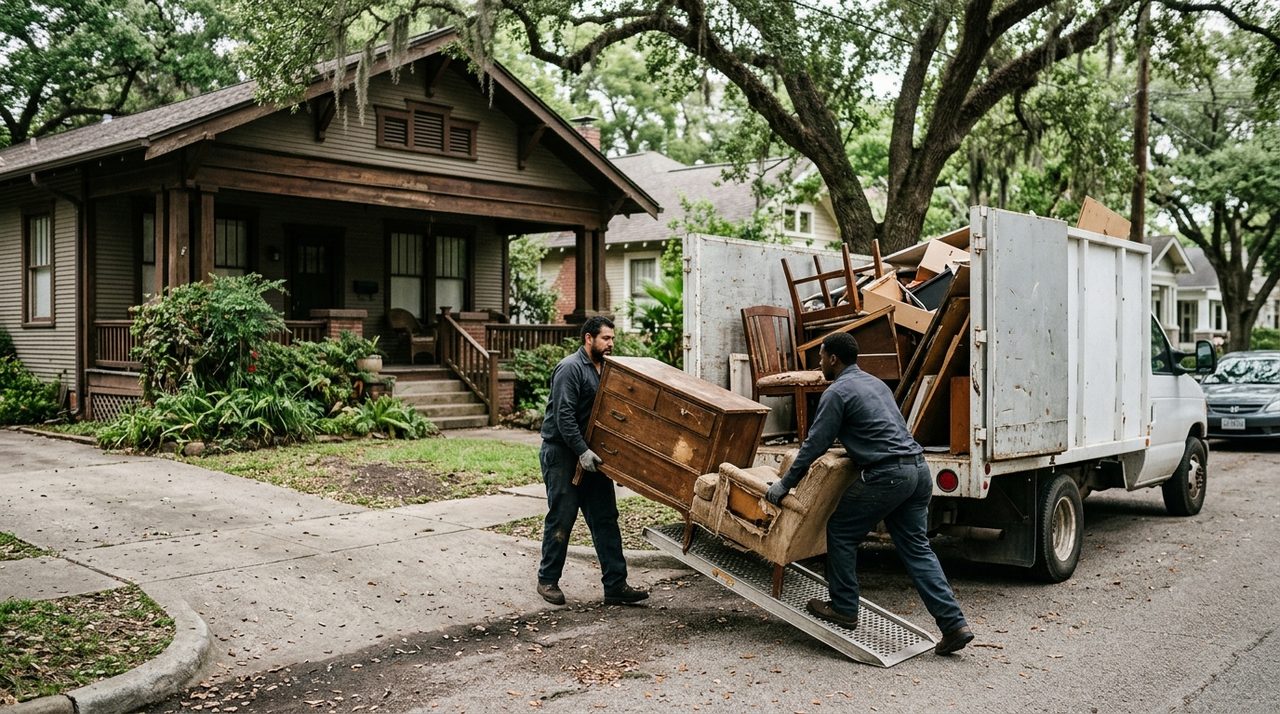
The Heights throws every era of Houston housing at a junk-removal crew on the same block: 1910s Craftsman bungalows on pier-and-beam foundations sit next to 2000s slab-on-grade townhomes, and the neighborhood's constant tear-down-and-rebuild cycle means renovation debris is never far away. Factor in the Houston Permitting Center's active permit pull, deed restrictions recorded with the Harris County Clerk, and small mandatory townhome HOAs that control what can sit at the curb — and a simple cleanout here requires more planning than in most Houston neighborhoods. This page explains what actually drives junk-removal complications in The Heights and what to expect from pricing to staging rules.
Ranked by verified Google rating × review volume × verification tier. How we rank →
Some highly-rated pros serve The Heights from nearby and may not keep a The Heights street address. Those are listed under "Also serving The Heights" with their real city and distance, so you always know where each business is based.
5505 Elysian St, Houston, TX 77009
Highly-rated pros based nearby who cover The Heights. Distance shown from the The Heights area.
Serving The Heights Based in Lazybrook / Timbergrove · 1.1 mi away
Serving The Heights Based in Lazybrook / Timbergrove · 1.8 mi away
Serving The Heights Based in Lazybrook / Timbergrove · 1.9 mi away
Serving The Heights Based in Lazybrook / Timbergrove · 1.9 mi away
Serving The Heights Based in Midtown · 3.1 mi away
Serving The Heights Based in Midtown · 3.2 mi away
Serving The Heights Based in EaDo · 3.4 mi away
Serving The Heights Based in Midtown · 3.4 mi away
Serving The Heights Based in Brookhollow · 4.2 mi away
Why it matters to you
The Heights is one of Houston's most permit-active corridors — older Craftsman cottages are torn down or fully gut-renovated almost weekly, generating loads of tile, cabinetry, galvanized pipe, knob-and-tube wiring, original plaster, and dimensional lumber. Contractors routinely leave this construction and demolition debris behind for homeowners to handle separately, and mixing it into a standard household junk load can violate municipal solid waste rules and trigger sharp per-ton surcharges at facilities like the Westpark or McCarty Road transfer stations.
What a good pro does
A knowledgeable hauler will sort C&D material from household junk on-site before loading, quote the C&D portion separately at the $60–$120-per-ton premium it actually costs (estimate only — final weight determines final price), and confirm disposal at a TCEQ-permitted solid waste facility. Under Texas Health & Safety Code §365.012, illegal dumping is a Class B misdemeanor, so ask your hauler to identify the permitted facility by name before you sign anything.
Sources: Texas Commission on Environmental Quality, City of Houston Permitting Center
Why it matters to you
The Heights' surviving 1890s–1940s bungalows frequently house decades of accumulated possessions — original built-ins being demo'd, CRT televisions, fluorescent shop lights from detached garages, and furniture with pre-1978 lead-based paint finishes. When a long-term owner sells or an estate is cleared ahead of a gut renovation, these materials require careful separation because EPA lead-safe work practice rules govern how lead-painted items are handled during renovation, and CRT monitors and fluorescent bulbs cannot legally go to standard municipal landfill.
What a good pro does
Before the crew loads anything from an older Heights bungalow, a thorough walkthrough should flag painted furniture and cabinetry built before 1978 for EPA-compliant handling, pull CRTs and fluorescent tubes for electronics recyclers (several operate near the Inner Loop), and document any propane tanks or household chemicals for separate disposal. Expect a $75–$150 line item (estimate) for specialty-item surcharges on a typical bungalow estate clearout.
Sources: EPA Lead Renovation, Repair and Painting (RRP) Rule, Texas Commission on Environmental Quality
Why it matters to you
Newer townhome enclaves within The Heights — entities like Heights Abbey HOA and Studemont Heights POA — have recorded deed restrictions that may prohibit roll-off containers in driveways, limit how long debris can sit curbside (often 24–48 hours), and require prior written approval for large removals. Even on original Heights plats without a mandatory HOA, deed restrictions are recorded with the Harris County Clerk and can restrict exterior storage. Violations result in fines that fall on the homeowner, not the hauler.
What a good pro does
Before scheduling any dumpster drop or multi-day curbside staging, pull your specific plat's deed restrictions from the Harris County Clerk's office or your HOA's architectural review committee to confirm what's allowed. A professional hauler working The Heights should offer same-day full-truck removal as an alternative to a roll-off drop precisely because many townhome lots and bungalow driveways cannot legally or physically accommodate a container for more than a few hours.
Sources: Local HOA / deed restrictions (see area profile), Municipal permit office (see area profile)
Why it matters to you
The Heights has some of Houston's densest mature-tree canopy — live oaks and pecans that pre-date many of the homes themselves. The May 2024 derecho's 100-plus-mph gusts and Hurricane Beryl in July 2024 toppled and shredded trees and wood-privacy fences throughout the neighborhood. Tree services typically cut and leave; the resulting slash piles, fence pickets, and damaged detached-garage debris are left for homeowners to clear. The City of Houston's scheduled bulk collection runs on a limited rotation and often cannot keep pace after a major storm event.
What a good pro does
A junk-removal crew handling storm woody debris in The Heights should bring a chipper or coordinate with a chipper service for large-diameter limbs (which dramatically reduce load volume and disposal cost), price fence picket and post removal separately from bulky limb piles, and confirm the disposal site accepts yard waste and wood debris under TCEQ permitted-facility rules. A partial truckload of storm debris typically runs $200–$350 (estimate); full trucks of heavy green wood can push toward $500 due to weight. Book early after any named storm — Heights demand spikes fast.
Sources: Texas Commission on Environmental Quality, Harris County Flood Control District
Hiring junk removal in The Heights? The Heights spans housing from the 1890s through brand-new construction, meaning contractors encounter pier-and-beam Craftsman cottages and modern slab-on-grade townhomes on the same block. Deed restrictions are common across most plats, and dozens of small mandatory HOAs govern newer townhome enclaves, so exterior work often requires checking recorded covenants at the Harris County Clerk's office. The mix of century-old galvanized plumbing and modern PEX systems makes thorough pre-job inspections essential.
Building era
Mixed: original 1890s–1930s bungalows, scattered mid-century infill (1940s–1960s), and a dominant wave of townhome and new single-family construction from the late 1990s through the 2010s.
Typical style
Historic Craftsman bungalows, Victorian/Queen Anne–inspired homes, contemporary 2-to-4-story townhomes with rooftop decks, and transitional new-build single-family homes with traditional exteriors and modern interiors.
Foundations
Mixed — older homes (pre-1950s) are predominantly pier-and-beam; newer townhomes and post-1990s construction are typically slab-on-grade.
Common systems
Older homes: original or retrofitted central HVAC, galvanized or cast-iron drain lines, knob-and-tube or cloth-wrapped wiring that may have been partially updated. Newer construction: modern central HVAC with high-efficiency units, PEX or copper plumbing, 200-amp electrical panels. Many renovated older homes have hybrid systems mixing old and new.
What that means for repairs
Tear-down-and-rebuild of older cottages for new single-family or townhome construction is extremely common. Remaining historic homes frequently undergo full gut renovations including foundation leveling, complete re-plumbing from galvanized to PEX, electrical panel upgrades, and HVAC modernization while preserving Craftsman exterior character.
Permit jurisdiction
Houston Permitting Center (City of Houston).
HOA & deed restrictions
No single neighborhood-wide mandatory HOA. The Houston Heights Association (HHA) is a voluntary civic organization focused on deed restriction enforcement and community events. Numerous small mandatory HOAs/POAs exist for specific townhome and gated developments (e.g., Heights Abbey HOA, Studemont Heights POA). Deed restrictions are common across most original Heights plats and recorded with the Harris County Clerk.
Historic districts
Portions of the Heights fall within City of Houston Historic Districts (Heights East, Heights West, Heights South) subject to Houston Archaeological & Historical Commission (HAHC) review for exterior modifications and demolition. Exact boundaries should be confirmed with the HAHC before any exterior work.
Contractor note
Properties in HAHC-designated historic districts require a Certificate of Appropriateness for exterior changes, including roofing material, siding, windows, and fencing. Contractors should verify historic district status before quoting exterior work, as non-compliant modifications can result in stop-work orders and forced remediation.
FEMA flood zone
FEMA Zone X (low flood risk) per the official NFHL API. However, proximity to White Oak Bayou along the southern and eastern edges of the Heights means localized street flooding and bayou overflow can affect properties near the waterway, particularly south of 11th Street.
Hurricane Harvey impact
Not confirmed with specific damage statistics from research. The Heights generally fared better than many Houston neighborhoods during Hurricane Harvey (2017) due to its slightly elevated terrain — the neighborhood was historically marketed as being higher than downtown Houston. However, areas near White Oak Bayou experienced flooding, and some low-lying streets saw significant water intrusion. Specific property impact should be verified through Harris County Flood Control District records.
Heat & humidity load
Pier-and-beam homes with older insulation and single-pane windows place extreme demands on HVAC systems during Houston summers. Crawl space moisture under pier-and-beam foundations promotes mold, wood rot, and pest issues. Newer townhomes with flat or low-slope roofs and rooftop decks require diligent roof drainage maintenance to prevent ponding and leaks during summer storms.
Working with contractors here
The Heights is one of Houston's most active markets for both renovation and new construction. Contractors most commonly handle foundation leveling and repair on pier-and-beam homes, whole-house re-plumbing to replace aging galvanized lines, and electrical upgrades from outdated panels and wiring to modern 200-amp service. Exterior work on historic district properties requires HAHC approval, adding lead time and material specification constraints that must be factored into bids. Townhome work frequently involves rooftop deck waterproofing, stucco repair, and shared-wall considerations that require coordination with adjacent owners or HOA boards. Given the extreme variation in housing age on a single block, contractors should never assume systems or foundation types based on neighboring properties — each home demands its own inspection.
Local Tip
Always ask for a written estimate before work begins. Texas contractors are required to provide one on jobs over $1,000.
The Heights spans housing from the 1890s through brand-new construction, meaning contractors encounter pier-and-beam Craftsman cottages and modern slab-on-grade townhomes on the same block. Deed restrictions are common across most plats, and dozens of small mandatory HOAs govern newer townhome enclaves, so exterior work often requires checking recorded covenants at the Harris County Clerk's office. The mix of century-old galvanized plumbing and modern PEX systems makes thorough pre-job inspections essential.
Source: U.S. Census Bureau, ACS 5-Year 2023
Most of The Heights maps to FEMA Zone X (low mapped flood risk), but Houston's flash-flood reality means even low-risk blocks benefit from smart drainage and storm-hardened installs; risk climbs sharply on blocks nearest White Oak Bayou, where it varies parcel to parcel.
Source: FEMA National Flood Hazard Layer (NFHL). Flood zones vary by parcel — verify your individual FIRM panel.
Sources: City of Houston Permitting CenterTexas Commission on Environmental Quality
Sources: FEMA National Flood Hazard Layer (NFHL)Harris County Flood Control District
Sources: Local HOA / deed restrictions (see area profile)
Sources: EPA Lead Renovation, Repair and Painting (RRP) RuleTexas Commission on Environmental Quality