1327 Woodmere Ln, Richmond, TX 77406
Best Junk Removal in Richmond, TX
Richmond's housing landscape stretches from the pre-1970s brick storefronts near the historic downtown to brand-new master-planned phases in Harvest Green and Long Meadow Farms — meaning junk removal jobs here can involve anything from a vintage appliance pulled out of a 1960s pier-and-beam home to a full garage cleanout of a 2005 Greatwood two-story. With a patchwork of mandatory HOAs governing most major subdivisions and split permit jurisdiction between the City of Richmond and Fort Bend County Engineering, getting debris off your property without triggering a fine or a rejected dumpster permit requires knowing the specific rules of your subdivision before you call for a pickup.
Verified against Google Business data
Updated 2026
See the 5 Junk Removal Serving Richmond 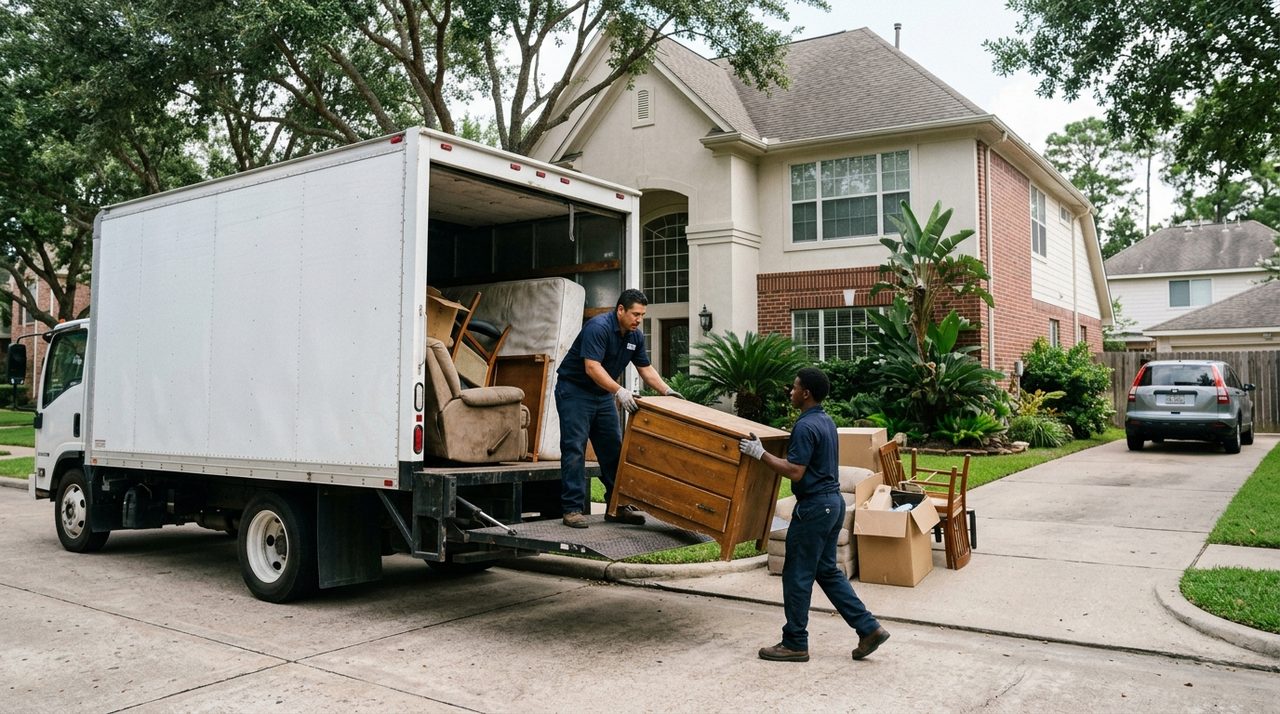
- Median home built
- 1979
- Median home value
- $229,800
- FEMA flood zone
- X (low)
- Typical cost (est.)
- $200–$650
- Most common local issue
- HOA debris-staging restrictions in master-planned subdivisions (Pecan Grove, Greatwood, Harvest Green)
Ranked by verified Google rating × review volume × verification tier. How we rank →
Some highly-rated pros serve Richmond from nearby and may not keep a Richmond street address. Those are listed under "Also serving Richmond" with their real city and distance, so you always know where each business is based.
Min rating:
5 resultsBased in Richmond
Closed
3232 Manford Blvd, Richmond, TX 77469
8415 Douro Valley Dr, Rosenberg, TX 77469
Also serving Richmond
Highly-rated pros based nearby who cover Richmond. Distance shown from the Richmond area.
Closed
Serving Richmond Based in Rosenberg · 2.6 mi away
Serving Richmond Based in Rosenberg · 3.8 mi away
Junk Removal in Richmond: What You Should Know
HOA Staging Restrictions: Not Every Driveway Can Hold a Roll-Off
Why it matters to you
The majority of Richmond's occupied housing sits inside mandatory-HOA subdivisions — Pecan Grove, Greatwood, Long Meadow Farms, Del Webb Sweetgrass, and others each maintain active architectural review committees with their own debris and container rules. Many prohibit open-top roll-off containers in driveways entirely, cap curbside staging windows at 24–48 hours, or require written HOA approval before a haul is scheduled. Fines for violations land on the homeowner, not the hauler.
What a good pro does
A knowledgeable junk removal company operating in Richmond will ask for your subdivision name at booking, not just your address, and will confirm your HOA's specific container and staging rules before dispatch. Where roll-offs are restricted, reputable haulers bring a truck-and-crew same-day load model that eliminates the driveway-container question altogether. Keep a copy of your HOA approval, if required, in hand when the crew arrives.
Sources: Local HOA / deed restrictions (see area profile)
Slab-Heave Concrete Disposal After Clay-Driven Cracking
Why it matters to you
Richmond sits on Fort Bend County's expansive Beaumont and Houston Black clay, the same shrink-swell Vertisol that ripples across the southwest Houston metro. Patios, driveways, and walkways on slab-on-grade homes built in the 1990s and 2000s — the dominant era in Pecan Grove and Greatwood — are now entering the 20-to-30-year range where clay movement produces buckled, cracked concrete that homeowners are replacing. Broken concrete rubble cannot go into a standard household junk truck and must be weighed and billed separately at TCEQ-permitted transfer facilities, which surprises many homeowners who assumed all debris was priced the same.
What a good pro does
When calling for a concrete haul, give the crew an accurate square footage of the removed slab so they can quote a per-ton estimate upfront rather than billing a surcharge at drop-off. Reputable haulers route concrete to TCEQ-registered solid waste facilities — ask for the facility name so you know disposal is legal. Mixing concrete rubble into a standard household junk load is both a pricing problem and a potential violation of municipal solid waste separation rules.
HVAC and Appliance Haul-Away From Aging 2000s-Era Suburban Homes
Why it matters to you
Thousands of Richmond's production homes were built between 2000 and 2015, meaning their original HVAC air handlers, condenser units, and water heaters installed at construction are now at or past their expected service life — and Fort Bend County's brutal summer cooling load accelerates that timeline. Winter Storm Uri (February 2021) also pushed many already-stressed systems into early failure, generating a wave of water heaters and air handlers that needed simultaneous replacement across adjacent subdivisions. On slab-on-grade construction, there is no basement or utility room separate from the living area, so every dead unit has to come out through the house.
What a good pro does
A junk removal crew handling an HVAC or appliance swap in Richmond should bring an appliance dolly rated for compressor units and coordinate with the installing HVAC contractor on staging — the old unit typically needs to be out before the new one can be maneuvered in. Refrigerants in older condensers must be recovered by an EPA-certified technician before the unit is hauled; a junk hauler should not transport a sealed unit with intact refrigerant lines unless recovery is confirmed. Disposal must go to a TCEQ-permitted facility.
Sources: Texas Commission on Environmental Quality, EPA Lead Renovation, Repair and Painting (RRP) Rule
Renovation Debris From Second-Owner Remodels in 1990s–2000s Homes
Why it matters to you
Richmond's 1990s and early-2000s homes — concentrated in Pecan Grove, Greatwood, and Old Orchard — are cycling through second-owner hands and triggering kitchen and bathroom remodels at a steady pace. Contractors frequently leave tile, cabinetry, roofing shingles, and lumber on-site for homeowners to manage separately, and the City of Richmond and Fort Bend County Engineering Department each have their own rules on debris staging, dumpster permits, and C&D waste separation. Mixing construction and demolition debris with standard household junk can drive up disposal costs and, in some cases, violate solid waste rules.
What a good pro does
Before scheduling a post-renovation pickup, sort debris into construction materials (tile, drywall, lumber, roofing) versus standard household junk — haulers price these differently, and combining them in one load often results in the entire truck being billed at the higher C&D rate. Confirm with the hauler that they are registered with TCEQ as a solid waste transporter for loads leaving your municipality, particularly if your property falls in unincorporated Fort Bend County rather than within Richmond city limits, where the permit authority shifts to the county engineering department.
Sources: Texas Commission on Environmental Quality, Municipal permit office (see area profile)
Junk Removal in Richmond: What You Should Know
Hiring junk removal in Richmond? Richmond encompasses a wide range of housing from historic city-center properties to modern master-planned communities, each with its own HOA and deed restrictions. Homeowners must identify their specific subdivision's governing documents before initiating exterior modifications. The mix of newer construction and rapid growth means contractors frequently handle warranty-era repairs, energy efficiency upgrades, and landscape compliance work.
- Housing era
- Mixed
- Foundation
- Predominantly slab-on-grade (post-tension concrete) for suburban tract homes
- Flood zone
- FEMA Zone X (low flood risk) per official NFHL data
- Permits
- City of Richmond permits office for properties within city limits
Housing stock & systems
Building era
Mixed: historic Richmond core dates to pre-1970s; dominant suburban stock built 1980s–2020s, with heaviest construction in the 2000s–2020s across master-planned communities.
Typical style
Traditional suburban brick, brick-and-stone Texas traditional, and contemporary transitional elevations in newer master-planned phases; one- and two-story production homes with front-loaded attached garages.
Foundations
Predominantly slab-on-grade (post-tension concrete) for suburban tract homes; some older historic Richmond homes may have pier-and-beam foundations.
Common systems
Central HVAC (heat pump and gas furnace split systems common), copper and PEX plumbing in newer homes (possible polybutylene in 1980s–early 1990s stock), 200-amp electrical panels standard in post-2000 construction.
What that means for repairs
Kitchen and bathroom remodels are common in 1990s–2000s homes reaching their second-owner cycle. Exterior modifications (fences, patios, driveways, generators) require HOA architectural review in most subdivisions. Older Pecan Grove and Greatwood-era homes often need HVAC replacements and roof upgrades.
Permits & restrictions
Permit jurisdiction
City of Richmond permits office for properties within city limits; Fort Bend County Engineering Department for unincorporated Fort Bend County areas surrounding Richmond.
HOA & deed restrictions
No single mandatory HOA covers all of Richmond. Most master-planned communities (Harvest Green, Old Orchard, Pecan Grove, Greatwood, Long Meadow Farms, Del Webb Sweetgrass, etc.) have mandatory HOAs with recorded deed restrictions and architectural review committees. Some older or rural tracts have no HOA. HOA status is strictly subdivision-by-subdivision.
Historic districts
No City of Houston historic district designation confirmed. Richmond has its own historic downtown area, but formal historic district protections and review processes should be verified with the City of Richmond.
Contractor note
Contractors must determine whether a property is within Richmond city limits or unincorporated Fort Bend County, as permit jurisdiction and inspection requirements differ. Most subdivisions require HOA architectural approval before exterior work begins, and 2026 Texas HOA transparency laws require governing documents to be publicly posted for associations with 60+ lots.
Flood & weather
FEMA flood zone
FEMA Zone X (low flood risk) per official NFHL data. Richmond is situated along the Brazos River, and some areas near the river and Rabbs Bayou carry higher flood risk than the Zone X designation of the sampled point; homeowners should verify their specific lot's flood zone.
Hurricane Harvey impact
Hurricane Harvey (2017) caused significant flooding in parts of Fort Bend County, particularly along the Brazos River corridor. The Barker Reservoir controlled releases and Brazos River flooding impacted numerous Richmond-area subdivisions. Specific impact varied greatly by subdivision and proximity to waterways — homeowners should check individual property flood history through Fort Bend County records.
Heat & humidity load
Extreme summer heat and humidity drive heavy HVAC demand across Richmond's slab-on-grade homes. Expansive clay soils common in Fort Bend County cause seasonal foundation movement, increasing demand for foundation inspection and repair services. Newer homes with large roof spans require periodic inspection for heat-related shingle degradation.
Working with contractors here
Contractors in Richmond work across a wide spectrum of housing ages, from 1980s master-planned homes needing full system replacements to brand-new construction warranty work. HVAC replacement and repair is the most consistent demand driver due to the extreme Fort Bend County summers and the aging of 2000s-era equipment. Foundation monitoring and repair are common given the expansive clay soils, particularly for homes built on slab-on-grade foundations. Exterior work — fencing, patio covers, roofing — almost always requires HOA architectural committee pre-approval, so contractors should build submission lead time into project schedules. The split jurisdiction between City of Richmond and unincorporated Fort Bend County means permit requirements and inspection timelines can differ significantly even between adjacent subdivisions.
Local Tip
Always ask for a written estimate before work begins. Texas contractors are required to provide one on jobs over $1,000.
About Richmond
Richmond encompasses a wide range of housing from historic city-center properties to modern master-planned communities, each with its own HOA and deed restrictions. Homeowners must identify their specific subdivision's governing documents before initiating exterior modifications. The mix of newer construction and rapid growth means contractors frequently handle warranty-era repairs, energy efficiency upgrades, and landscape compliance work.
- Median year built
- 1979
- Median home value
- $229,800
- Owner-occupied
- 60.1%
- Population
- 12,117
- Housing units
- 4,716
- Median income
- $68,564
Source: U.S. Census Bureau, ACS 5-Year 2023
Flood & storm risk
FEMA Zone XLow flood riskMost of Richmond maps to FEMA Zone X (low mapped flood risk), but Houston's flash-flood reality means even low-risk blocks benefit from smart drainage and storm-hardened installs; risk climbs sharply on blocks nearest the Brazos River, where it varies parcel to parcel.
Source: FEMA National Flood Hazard Layer (NFHL). Flood zones vary by parcel — verify your individual FIRM panel.
Frequently Asked Questions
Does the City of Richmond or Fort Bend County require any permit or approval before a junk removal truck hauls debris from my property?
Neither the City of Richmond nor Fort Bend County Engineering requires a homeowner-side permit for a standard junk removal pickup, but the hauler must legally dispose of waste at a TCEQ-permitted solid waste facility — not at an unpermitted site or roadside dump. If your property is within unincorporated Fort Bend County rather than Richmond city limits, the applicable inspection authority for any associated work (say, a demo before clearout) shifts to the Fort Bend County Engineering Department, so confirm your jurisdiction first. Illegal dumping by an unscrupulous hauler can expose you to secondary liability under Texas Health & Safety Code §365.012, so ask your hauler which permitted transfer station they use.
Sources: Texas Commission on Environmental QualityMunicipal permit office (see area profile)
My Pecan Grove subdivision has an HOA — do I need written approval before scheduling a junk removal or placing debris curbside?
Yes, most Pecan Grove and Greatwood-era HOAs have recorded deed restrictions that govern how long bulk debris can sit curbside (commonly 24–48 hours) and whether a roll-off container is permitted on a driveway or street at all. Under Texas's 2026 HOA transparency laws, associations with 60 or more lots must post their governing documents publicly, so you can review the specific rules for your subdivision before booking a hauler. Contact your architectural review committee in writing and get confirmation of staging terms — fines for violations fall on the homeowner, not the hauler.
Sources: Local HOA / deed restrictions (see area profile)
Richmond maps mostly to FEMA Zone X, so do I really need a junk removal company experienced in flood gut-outs, or is that overkill?
For most Richmond subdivisions the low Zone X designation means your flood risk is manageable, but blocks nearest the Brazos River can flip to higher-risk categories on a parcel-by-parcel basis, so check your specific address on FEMA's Flood Map Service Center before assuming you're in the clear. If you do experience a flash-flood gut-out — even in a Zone X home — waterlogged drywall and flooring generate 10–20 cubic yards of debris that requires same-day or next-day staged removal to prevent mold colonization, a timeline that not every hauler can meet. Ask prospective haulers whether they have same-week availability after storm events and whether their pricing accounts for weight surcharges on wet material.
I'm clearing out a 1980s–1990s home in the older Richmond or Pecan Grove area and found CRT televisions and fluorescent bulbs in the garage — can a standard junk removal truck take those?
Most standard junk removal trucks will not legally accept CRT televisions or fluorescent bulbs in a general load, as CRTs contain lead and fluorescent lamps contain mercury, both regulated under EPA and TCEQ solid waste rules. Fort Bend County periodically hosts household hazardous waste (HHW) collection events where residents can drop off electronics and bulbs at no charge — check the Fort Bend County Public Works schedule before your clearout date. Confirm with your junk removal company in writing which items they will and will not accept, and segregate hazardous materials before the crew arrives to avoid a last-minute upcharge or refusal.
Sources: Texas Commission on Environmental QualityEPA Lead Renovation, Repair and Painting (RRP) Rule
What's a realistic timeline and cost estimate for a full garage clearout in a 2000s-era Harvest Green or Long Meadow Farms home in Richmond?
A single-day appointment is typical for a standard two-car garage clearout in a newer Richmond subdivision — most haulers can schedule within three to seven business days under normal (non-storm) conditions, though post-storm demand in the SW Houston corridor can push that to two or three weeks. Cost estimates for a partial truckload (roughly 3–4 cubic yards of typical garage junk) run $200–$350, while a full 10–12 cubic yard truck of mixed household items averages $400–$650; these are estimates and final pricing depends on weight, access, and debris mix. If the clearout includes old HVAC equipment, water heaters, or concrete rubble from a cracked patio slab — common in 2000s-era Greatwood and Pecan Grove homes on expansive clay — budget for a per-ton surcharge of $60–$120 above the base rate.
After the May 2024 derecho hit Fort Bend County, my backyard is full of tree slash and broken fence sections the tree company left behind — will a junk removal company handle that, and is there a seasonal backlog to plan around?
Yes, most full-service junk removal companies will haul tree slash, fence pickets, and damaged shed or pergola debris, but they will quote it separately from standard household junk because loose woody debris is bulky and fills truck volume quickly. In Richmond and across SW Houston, the months immediately following a named storm or major wind event (like the May 2024 derecho or Beryl in July 2024) typically see two-to-four week backlogs for haulers serving Fort Bend County, so call as soon as debris is cut and staged. If your HOA limits curbside staging duration, notify the hauler of that constraint upfront and request a confirmed booking date rather than an open callback window.
Sources: Local HOA / deed restrictions (see area profile)