Open Now
2323 S Voss Rd Suite 315F, Houston, TX 77057
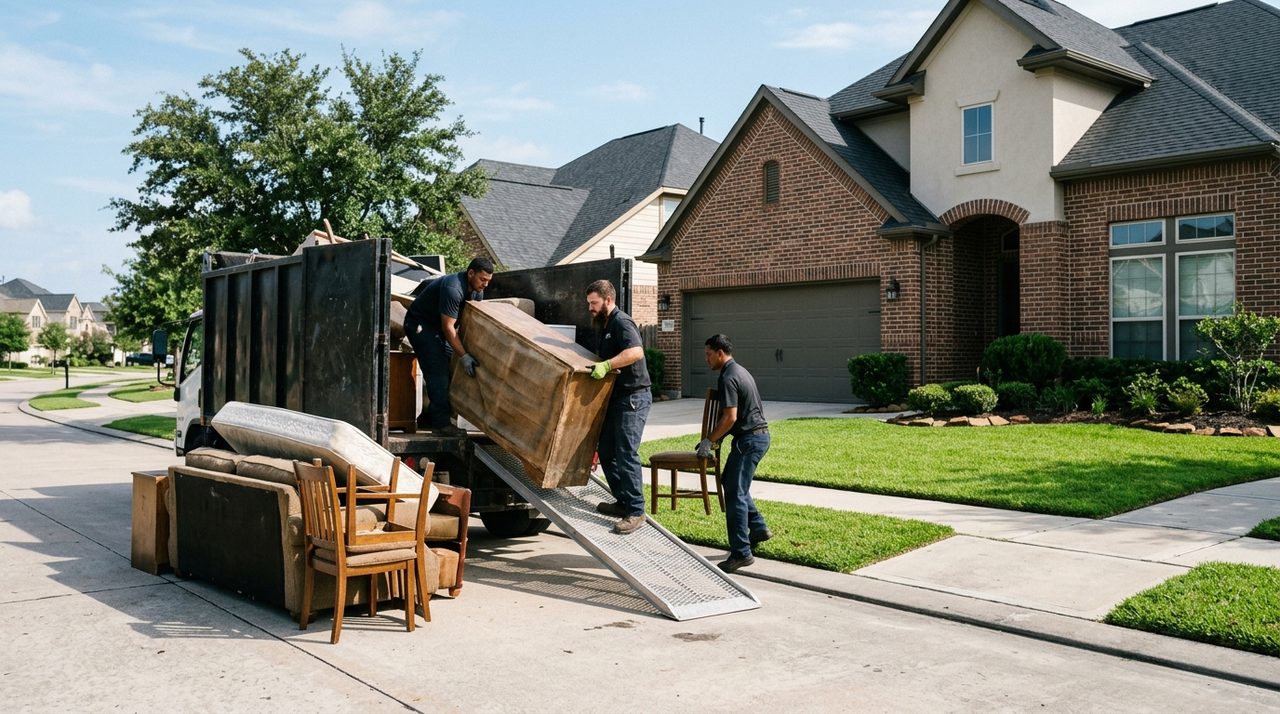
Tanglewood's relentless teardown-and-rebuild cycle — converting 1950s–1960s ranch homes into large custom residences on roughly 1,220 HOA-governed lots — generates some of the most complex junk-removal jobs in West Houston, mixing decades-old appliances and plaster debris with high-end renovation castoffs. The mandatory Tanglewood Homes Association enforces strict deed restrictions on how and where debris can be staged, turning a routine haul-out into a coordination exercise that can result in homeowner fines if mishandled. Understanding what THA allows, what the City of Houston requires for disposal, and how to handle the range of materials coming out of both original mid-century structures and brand-new luxury builds is what separates a smooth clearout from a costly mistake.
Ranked by verified Google rating × review volume × verification tier. How we rank →
Some highly-rated pros serve Tanglewood from nearby and may not keep a Tanglewood street address. Those are listed under "Also serving Tanglewood" with their real city and distance, so you always know where each business is based.
2323 S Voss Rd Suite 315F, Houston, TX 77057
5718 Westheimer Rd, Houston, TX 77057
Highly-rated pros based nearby who cover Tanglewood. Distance shown from the Tanglewood area.
Serving Tanglewood Based in Briargrove · 2.4 mi away
Serving Tanglewood Based in Briargrove · 2.6 mi away
Serving Tanglewood Based in Bellaire · 2.7 mi away
Serving Tanglewood Based in Bellaire · 2.9 mi away
Serving Tanglewood Based in Galleria · 3 mi away
Serving Tanglewood Based in Bellaire · 3.2 mi away
Serving Tanglewood Based in Spring Branch · 3.5 mi away
Serving Tanglewood Based in Lazybrook / Timbergrove · 3.8 mi away
Why it matters to you
The Tanglewood Homes Association — active since 1948 and enforcing restrictions across all 23 sections — treats curbside debris piles and roll-off containers as a property-use and aesthetics matter. A full teardown job can produce 20+ cubic yards of demo material that must be staged somewhere while work continues, but THA's deed restrictions limit where containers can be placed and for how long, and it is the homeowner — not the hauler — who absorbs any resulting fines.
What a good pro does
A junk-removal pro working in Tanglewood should confirm THA's current staging rules in writing before placing any container or beginning curbside staging, ideally routing communications through the homeowner's already-open THA architectural review file for the project. Scheduling same-day or next-morning hauls rather than leaving a roll-off in place for multiple days is the safest approach on these lots. While the City of Houston does not require a separate city permit for junk removal businesses, disposal must still occur at TCEQ-permitted solid waste facilities, so the hauler's compliance chain runs through both THA at the property and TCEQ at the back end.
Sources: Local HOA / deed restrictions (see area profile), Texas Commission on Environmental Quality, Municipal permit office (see area profile)
Why it matters to you
A significant share of Tanglewood's surviving 1950s–1960s ranch homes contain pre-1978 painted surfaces on interior trim, cabinetry, doors, and exterior wood — all of which fall under EPA lead-safe rules when disturbed during demolition or renovation. When junk removers are called in after a contractor has demo'd these materials, they may be handling painted lumber, window frames, and cabinet boxes that require specific loading and disposal practices rather than being tossed loosely into a standard truck.
What a good pro does
Reputable haulers working post-demo loads in Tanglewood should ask the homeowner or GC whether a lead paint inspection or XRF test was conducted on the pre-1978 structure before assuming standard handling is appropriate. Painted C&D debris from pre-1978 homes should be kept separate from general household junk and directed to a TCEQ-permitted facility equipped to accept it. This is especially important on whole-home gut jobs where original plaster, painted drywall, and millwork are all coming out together.
Sources: EPA Lead Renovation, Repair and Painting (RRP) Rule, Texas Commission on Environmental Quality
Why it matters to you
Tanglewood's original ranch homes — many still on slab-on-grade foundations — are being renovated or replaced at a high rate, and that work frequently surfaces aging HVAC air handlers, compressor units, water heaters, and kitchen appliances that are decades past their service life. On slab homes, there is no basement to park equipment in; everything must be moved through the living space or around the exterior, and a large compressor or air handler on a fully landscaped Tanglewood lot with mature trees requires careful maneuvering to avoid damage to hardscape and plantings.
What a good pro does
A good pro will walk the access path before booking — noting gate widths, paver surfaces, and any mature tree root zones that could be damaged by heavy equipment dollies. Appliance and HVAC units should be quoted separately from general junk loads because their weight pushes into per-ton surcharge territory at facilities like the Westpark transfer station. Refrigerants in old AC compressors must be recovered by an EPA Section 608-certified technician before the unit leaves the property; this step is typically handled by the HVAC contractor, but the junk hauler should confirm it is done before loading.
Sources: Texas Commission on Environmental Quality, City of Houston Permitting Center
Why it matters to you
Tanglewood's teardown-and-rebuild activity generates enormous volumes of construction and demolition debris — tile, roofing shingles, lumber, plumbing fixtures, cabinetry — that contractors often leave for homeowners to handle separately. Mixing C&D material with standard household junk in a single load can violate municipal solid waste rules and trigger higher disposal costs, since facilities like McCarty Road charge a per-ton premium for mixed or heavy loads. With median home values above $500,000 and high-end custom finishes being replaced in waves, the material volume per project is substantial.
What a good pro does
Before booking, a homeowner should be clear with the hauler about exactly what is going out and whether it came from active construction work or general household clearing. Reputable haulers will separate C&D streams and quote them at the appropriate per-ton rate — expect $60–$120 per ton above base rates for concrete, tile, and roofing material, all figures estimated based on current Houston-area tipping fees. City of Houston permit records for the active rebuild can help the hauler confirm what category of material is involved, which matters for proper TCEQ-compliant disposal routing.
Sources: Texas Commission on Environmental Quality, City of Houston Permitting Center, Municipal permit office (see area profile)
Hiring junk removal in Tanglewood? Tanglewood is one of Houston's most prestigious single-family neighborhoods, with roughly 1,220 lots governed by the mandatory Tanglewood Homes Association and strict deed restrictions. The housing stock spans original 1950s–1960s ranch homes and extensive new-construction luxury builds, creating a wide range of home service needs from aging-system upgrades to high-end custom installations. Contractors working here must navigate HOA architectural controls in addition to City of Houston permitting requirements.
Building era
1950s–1960s original construction with significant teardown and new-construction activity from the 1990s to present.
Typical style
Mix of original mid-century ranch-style homes and newer traditional and contemporary luxury builds.
Foundations
Likely predominantly slab-on-grade, especially on newer and replacement homes — not explicitly confirmed in sources; verify on a property-by-property basis.
Common systems
Original homes may retain older copper or galvanized plumbing, older electrical panels, and aging central HVAC systems. Newer builds typically feature modern high-efficiency HVAC, PEX or copper plumbing, and 200-amp electrical service. The wide era range means system conditions vary dramatically from lot to lot.
What that means for repairs
Teardown-and-rebuild is extremely common, replacing original 1950s–1960s homes with large custom residences. Whole-home renovations and major additions on surviving original structures are also frequent, often requiring full mechanical system upgrades to meet modern codes and homeowner expectations.
Permit jurisdiction
City of Houston — Houston Permitting Center. Tanglewood is within Houston city limits in Harris County.
HOA & deed restrictions
Mandatory HOA — Tanglewood Homes Association (THA), founded 1948, governing approximately 1,220 residential lots across 23 sections. THA actively enforces strict deed restrictions covering design, construction, and property use. Note: nearby communities such as Tanglewood Park and Tanglewood West have separate HOAs.
Historic districts
No City of Houston historic district designation confirmed. Tanglewood is not listed among HAHC-designated historic districts; no Certificate of Appropriateness is required for exterior work solely due to location in Tanglewood.
Contractor note
Contractors must obtain City of Houston permits for all applicable work and should confirm all exterior modifications and new construction plans with the Tanglewood Homes Association before beginning work, as THA enforces strict architectural and design deed restrictions that may exceed or differ from municipal code requirements.
FEMA flood zone
FEMA Zone X (low flood risk) per official NFHL data. Tanglewood is not immediately adjacent to a major bayou, though its general West Houston location places it in the broader Buffalo Bayou watershed.
Hurricane Harvey impact
No authoritative source documents significant neighborhood-wide structure flooding in Tanglewood during Hurricane Harvey. Available real estate and community descriptions do not flag flood-prone status as a major concern, suggesting Tanglewood did not experience the widespread damage seen in bayou-adjacent neighborhoods. However, this is inference rather than documented fact — flood risk should be evaluated on an address-specific basis using Harris County Flood Control District tools and seller disclosures.
Heat & humidity load
Houston's extreme summer heat and humidity place heavy demand on HVAC systems across all eras of Tanglewood housing stock. Original 1950s–1960s homes may have undersized ductwork and aging insulation, leading to higher cooling costs and more frequent HVAC service calls. Newer luxury builds with large square footage require properly sized multi-zone systems. Prolonged heat also accelerates weathering of exterior materials and drives demand for irrigation system maintenance on Tanglewood's characteristically large, wooded lots.
Working with contractors here
Contractors in Tanglewood most commonly handle full teardown-and-rebuild projects, converting mid-century ranch homes into large custom residences, as well as major whole-home renovations on surviving original structures. Plumbing and electrical upgrades are frequent on pre-1970s homes that still have original galvanized or cast-iron drain lines and older panels. The mandatory Tanglewood Homes Association requires architectural review and approval for exterior work, so contractors should build THA coordination into project timelines. High-end finish expectations are the norm — clients in this neighborhood typically expect premium materials, meticulous workmanship, and detailed project management. Job scoping should account for large lot sizes, mature tree protection, and potential underground utility complications on properties that have been modified over multiple decades.
Local Tip
Always ask for a written estimate before work begins. Texas contractors are required to provide one on jobs over $1,000.
Tanglewood is one of Houston's most prestigious single-family neighborhoods, with roughly 1,220 lots governed by the mandatory Tanglewood Homes Association and strict deed restrictions. The housing stock spans original 1950s–1960s ranch homes and extensive new-construction luxury builds, creating a wide range of home service needs from aging-system upgrades to high-end custom installations. Contractors working here must navigate HOA architectural controls in addition to City of Houston permitting requirements.
Source: U.S. Census Bureau, ACS 5-Year 2023
Most of Tanglewood maps to FEMA Zone X (low mapped flood risk), but Houston's flash-flood reality means even low-risk blocks benefit from smart drainage and storm-hardened installs.
Source: FEMA National Flood Hazard Layer (NFHL). Flood zones vary by parcel — verify your individual FIRM panel.
Sources: Local HOA / deed restrictions (see area profile)
Sources: Texas Commission on Environmental QualityCity of Houston Permitting Center