Serving Third Ward Based in Midtown · 1.4 mi away
Best Junk Removal in Third Ward
Third Ward's junk removal picture is shaped by one of the Inner Loop's sharpest housing contrasts: 1920s–1960s pier-and-beam bungalows undergoing gut renovations on the same block as post-2000 slab-on-grade townhomes, all within reach of Brays Bayou and governed by the Houston Permitting Center rather than any single mandatory HOA. That split stock means haulers see everything from century-old galvanized plumbing pulled during re-pipes to construction debris left by infill townhome contractors — and getting the disposal right under TCEQ solid waste rules matters here as much as the pickup itself.
Verified against Google Business data
Updated 2026
See the 10 Junk Removal Serving Third Ward 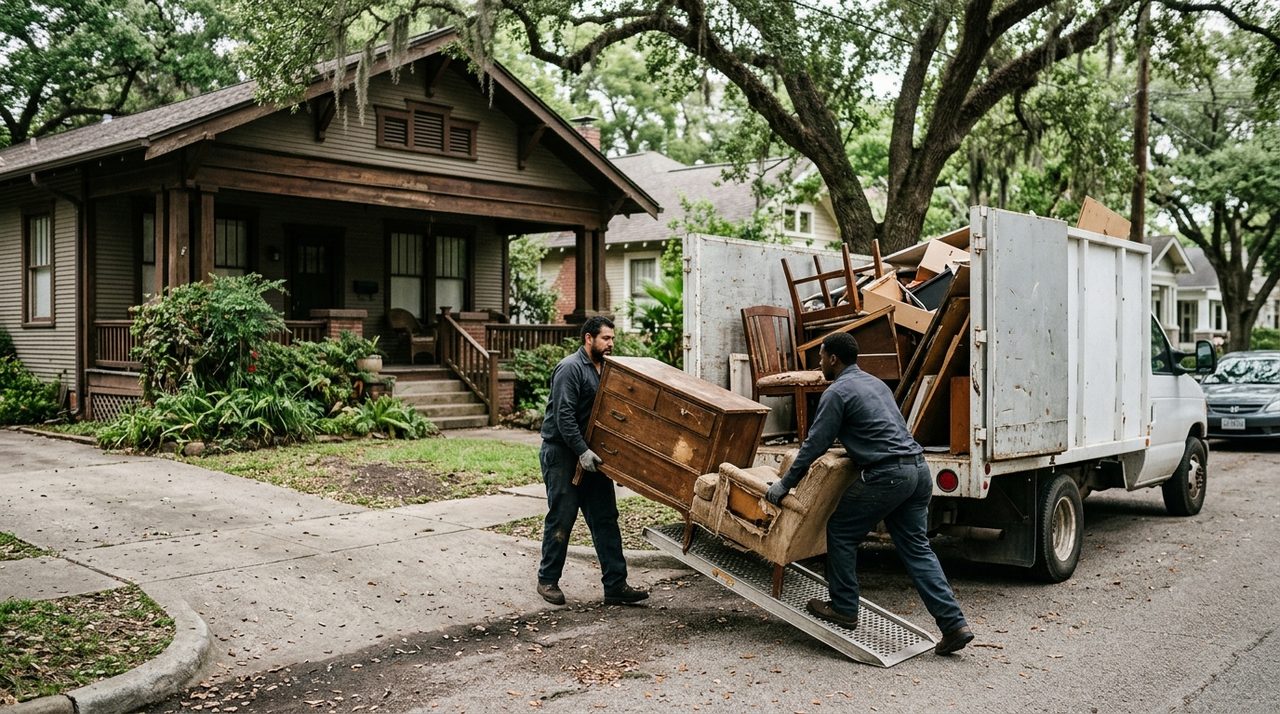
- Median home built
- 1983
- Median home value
- $384,100
- FEMA flood zone
- X (low)
- Typical cost (est.)
- $200–$650
- Most common local issue
- Reno debris from bungalow gut-outs mixed with post-storm woody debris
Ranked by verified Google rating × review volume × verification tier. How we rank →
Some highly-rated pros serve Third Ward from nearby and may not keep a Third Ward street address. Those are listed under "Also serving Third Ward" with their real city and distance, so you always know where each business is based.
Min rating:
10 resultsAlso serving Third Ward
Highly-rated pros based nearby who cover Third Ward. Distance shown from the Third Ward area.
Open Now
Serving Third Ward Based in Midtown · 1.7 mi away
Open Now
Serving Third Ward Based in Midtown · 1.8 mi away
Closed
Serving Third Ward Based in EaDo · 2.1 mi away
Closed
Serving Third Ward Based in EaDo · 2.5 mi away
Closed
Serving Third Ward Based in Upper Kirby · 3 mi away
Serving Third Ward Based in Medical Center · 4.1 mi away
Closed
Serving Third Ward Based in EaDo · 4.2 mi away
Open Now
Serving Third Ward Based in Galleria · 4.8 mi away
Serving Third Ward Based in EaDo · 5 mi away
Junk Removal in Third Ward: What You Should Know
Bungalow Gut-Reno Debris: C&D Overflow That Contractors Leave Behind
Why it matters to you
Third Ward's ongoing gentrification is driving full-system renovations of pre-1960s bungalows — galvanized pipe pull-outs, 60-amp panel replacements, original hardwood subfloor tear-ups, and old plaster-and-lath wall demo all happening at once. Contractors working under Houston Permitting Center permits frequently complete demo and leave the debris staging to the homeowner, who then faces a mixed load of construction and demolition material that cannot legally be tossed in with standard household junk without risking higher tipping fees and potential TCEQ violations.
What a good pro does
A qualified hauler working in Third Ward should sort C&D debris — tile, lumber, plaster, roofing — from standard household junk before loading, since co-mingling can violate TCEQ municipal solid waste transporter rules and spike disposal costs by $60–$120 per ton above base rates at facilities like Westpark or McCarty Road. Ask your hauler upfront whether they hold TCEQ solid waste transporter registration and how they separate construction debris; that answer tells you whether they are operating legitimately or cutting corners.
Sources: Texas Commission on Environmental Quality, City of Houston Permitting Center
Pre-1978 Painted Materials and CRT Electronics in Aging Bungalows
Why it matters to you
Third Ward's legacy bungalows — many built between the 1920s and 1950s — are prime candidates for whole-room clearouts when estates turn over or owners finally renovate. These homes commonly contain furniture, cabinetry, and trim with lead-based paint (any structure built before 1978 falls under EPA lead-safe guidelines), plus CRT televisions, fluorescent shop lights, and old propane tanks that require separate handling. With census data showing a median year built of 1983 for the neighborhood overall, the older bungalow segment skews significantly earlier and concentrates these materials.
What a good pro does
Before scheduling a clearout of a pre-1960s Third Ward bungalow, inventory items with painted surfaces and flag any old electronics or cylinders for the hauler. Reputable junk removal companies operating in Houston will divert CRT televisions and fluorescent bulbs to EPA-compliant electronics recyclers rather than landfilling them, and will not load lead-painted architectural salvage alongside regular debris without proper containment. Ask specifically how they handle legacy electronics — disposal at a TCEQ-permitted facility is required, and illegal dumping under Texas Health & Safety Code §365.012 is a Class B misdemeanor.
Sources: EPA Lead Renovation, Repair and Painting (RRP) Rule, Texas Commission on Environmental Quality
Storm Woody Debris After Derecho and Beryl Hit Third Ward's Mature Canopy
Why it matters to you
Third Ward carries a respectable mature tree canopy — live oaks and pecans common along older residential streets — that took hits from both the May 2024 derecho (100-plus mph gusts) and Hurricane Beryl in July 2024. Tree services cut and chip trunks but routinely leave slash piles, fence pickets snapped off by falling limbs, and damaged wood-frame detached garages that the City of Houston's scheduled bulk collection does not efficiently handle. Homeowners on a biweekly bulk pickup window cannot wait weeks when a debris pile is blocking a driveway.
What a good pro does
Private junk removal is the practical bridge between when the tree crew leaves and when City of Houston bulk collection comes around. A good hauler will stage multiple trailer runs if the volume is high, separate clean wood slash (which some facilities accept at lower tipping rates) from mixed fence debris and roofing material, and confirm that disposal goes to a TCEQ-permitted solid waste facility rather than an unpermitted site. Brush and woody debris alone typically falls in the $200–$400 range for a partial-to-full truckload — get a weight-based estimate, not just a volume quote, since wet wood runs heavy.
Sources: Texas Commission on Environmental Quality, Harris County Flood Control District
Townhome-Cluster HOA Rules on Dumpsters and Staging Areas
Why it matters to you
While Third Ward has no single mandatory HOA covering the neighborhood, the post-2000 infill townhome developments — many clustered near UH and TSU or along gentrifying corridors — commonly carry small, project-specific mandatory HOAs governing shared driveways and common areas. These HOAs can prohibit roll-off containers in shared driveways or limit how long debris can sit curbside, and the fines for violations land on the homeowner, not the hauler. A renter-heavy neighborhood (owner-occupancy is only 37.7 percent per ACS 2023 data) means many residents are unfamiliar with the deed restrictions on their specific townhome cluster.
What a good pro does
Before booking a dumpster drop or scheduling a multi-day clearout at a Third Ward townhome, pull the project's deed restrictions or contact the development's HOA management company to confirm staging rules. If a roll-off is prohibited, a load-and-go junk removal service — where the crew loads directly into their own truck and removes same day — sidesteps the staging problem entirely and typically runs $400–$650 for a full 10–12 cubic yard truck of standard household junk, all estimated costs. Verify the hauler's TCEQ registration before booking regardless of the method.
Sources: Local HOA / deed restrictions (see area profile), Texas Commission on Environmental Quality, City of Houston Permitting Center
Junk Removal in Third Ward: What You Should Know
Hiring junk removal in Third Ward? Third Ward presents contractors with a split housing stock: early 20th-century pier-and-beam bungalows requiring foundation, plumbing, and electrical upgrades alongside modern slab-on-grade townhomes with contemporary systems. Proximity to Brays Bayou means flood-related remediation and drainage work remain ongoing concerns. The absence of a single mandatory HOA simplifies permitting but project-specific HOAs on newer townhome developments may impose architectural and material requirements.
- Housing era
- 1920s–1960s legacy homes with significant 2000s–2020s infill townhome construction
- Foundation
- Mixed — older bungalows predominantly pier-and-beam
- Flood zone
- FEMA Zone X (low flood risk) per official NFHL data
- Permits
- Houston Permitting Center (City of Houston)
Housing stock & systems
Building era
1920s–1960s legacy homes with significant 2000s–2020s infill townhome construction.
Typical style
Early 20th-century frame bungalows and cottages; contemporary 2- to 3-story townhomes with attached garages; some student-oriented multifamily near UH and TSU.
Foundations
Mixed — older bungalows predominantly pier-and-beam; newer townhomes and infill predominantly slab-on-grade.
Common systems
Older homes: galvanized or cast-iron plumbing, 60–100 amp electrical panels, window units or aging central HVAC. Newer townhomes: PEX or copper plumbing, 200 amp panels, modern central HVAC with multi-zone capability.
What that means for repairs
Gut renovations and full-system upgrades of pre-1960s bungalows are common as the neighborhood gentrifies. Electrical panel upgrades, re-plumbing from galvanized to PEX, and pier-and-beam foundation leveling are frequent scopes. Newer townhomes see comparatively less renovation but occasional warranty-period repairs and cosmetic upgrades.
Permits & restrictions
Permit jurisdiction
Houston Permitting Center (City of Houston).
HOA & deed restrictions
No single mandatory HOA covers the neighborhood. Multiple voluntary civic clubs operate including Canfield Oaks Civic Association, Third Ward is Home Civic Club, and University Village Civic Club. Newer townhome and condo developments commonly have small, project-specific mandatory HOAs governing shared driveways and common areas.
Historic districts
No City of Houston historic district designation confirmed for Third Ward as a whole. Individual structures may have landmark status — check HAHC records for specific addresses.
Contractor note
Houston has no citywide zoning, so building controls depend on subdivision-level deed restrictions that vary block by block. Contractors working on older homes should verify whether the lot is in a deed-restricted subdivision before proposing accessory structures or lot modifications.
Flood & weather
FEMA flood zone
FEMA Zone X (low flood risk) per official NFHL data. However, Third Ward sits directly north of Brays Bayou and includes low-lying areas near bayou tributaries and older storm sewer infrastructure, which can create localized flooding risk not fully captured by Zone X designation.
Hurricane Harvey impact
Third Ward lies within the broader Brays Bayou watershed, which experienced significant flooding during Hurricane Harvey in 2017. However, no neighborhood-specific documentation was found quantifying the extent of Harvey damage or identifying specific flooded streets within Third Ward. Property-level Harvey impact should be verified through FEMA Harvey inundation layers, Harris County Flood Control District mapping tools, and seller's disclosure for any individual address.
Heat & humidity load
Older pier-and-beam bungalows with aging insulation and single-pane windows face extreme summer cooling loads; HVAC systems in these homes are frequently undersized or failing. High humidity under pier-and-beam homes can accelerate subfloor rot and encourage pest infestations. Newer townhomes perform better thermally but three-story designs can struggle with uneven cooling between floors, making multi-zone HVAC balancing a common summer service call.
Working with contractors here
Contractors in Third Ward most commonly handle two categories of work: full-system renovations of pre-1960s bungalows and routine maintenance on post-2000 townhomes. On older homes, pier-and-beam foundation leveling, galvanized plumbing replacement, electrical panel upgrades from 60 to 200 amps, and HVAC installation are the most frequent scopes. Newer townhomes generate calls for HVAC zone balancing, minor foundation settling on slab construction, and cosmetic remodels. Proximity to Brays Bayou means flood damage remediation—including drywall removal, mold treatment, and flooring replacement—remains a recurring need after heavy rain events. Job scoping should account for the wide variance in building age and condition even within a single block, and contractors should verify project-specific HOA requirements on newer developments before beginning exterior work.
Local Tip
Always ask for a written estimate before work begins. Texas contractors are required to provide one on jobs over $1,000.
About Third Ward
Third Ward presents contractors with a split housing stock: early 20th-century pier-and-beam bungalows requiring foundation, plumbing, and electrical upgrades alongside modern slab-on-grade townhomes with contemporary systems. Proximity to Brays Bayou means flood-related remediation and drainage work remain ongoing concerns. The absence of a single mandatory HOA simplifies permitting but project-specific HOAs on newer townhome developments may impose architectural and material requirements.
- Median year built
- 1983
- Median home value
- $384,100
- Owner-occupied
- 37.7%
- Population
- 35,866
- Housing units
- 18,321
- Median income
- $65,901
Source: U.S. Census Bureau, ACS 5-Year 2023
Flood & storm risk
FEMA Zone XLow flood riskMost of Third Ward maps to FEMA Zone X (low mapped flood risk), but Houston's flash-flood reality means even low-risk blocks benefit from smart drainage and storm-hardened installs; risk climbs sharply on blocks nearest Brays Bayou, where it varies parcel to parcel.
Source: FEMA National Flood Hazard Layer (NFHL). Flood zones vary by parcel — verify your individual FIRM panel.
Frequently Asked Questions
Does the Houston Permitting Center require any permit or notification just to have junk removed from my Third Ward bungalow renovation?
The Houston Permitting Center does not issue permits for junk removal itself — that is a private hauling transaction, not a regulated construction activity. However, if your hauler is disposing of demolition debris from a permitted renovation scope (such as the galvanized pipe replacements or panel upgrades common in Third Ward bungalows), the disposal must go to a TCEQ-permitted solid waste facility, not a general landfill that accepts only household trash. Mixing regulated C&D waste with standard junk can expose you to liability under Texas Health and Safety Code rules, so confirm your hauler's disposal destination before they load up.
Sources: City of Houston Permitting CenterTexas Commission on Environmental Quality
My Third Ward home is a 1940s bungalow — about 62% of owner-occupied units in the area were built before 1980. How does that affect what a junk hauler can and can't take in one trip?
Pre-1978 construction is the key threshold: painted materials (trim, cabinet doors, plaster lath) from those bungalows are presumed to contain lead under EPA rules, and reputable haulers will separate them rather than commingle them with standard loads. CRT televisions and monitors, common in homes occupied for decades, require separate e-waste handling and cannot go to a standard transfer station. Budget for at least one separate disposal run or a hauler who explicitly includes lead-era painted materials and e-waste in their pricing, because a single mixed load may be rejected at facilities like Westpark or McCarty Road.
Sources: EPA Lead Renovation, Repair and Painting (RRP) RuleTexas Commission on Environmental Quality
Most of Third Ward maps to FEMA Zone X, so am I likely to have a flood gut-out debris situation, or is that mostly a concern on blocks near Brays Bayou?
Zone X is indeed the dominant designation across most of Third Ward, indicating lower mapped flood risk, but parcels closest to Brays Bayou shift to higher-risk zones on a block-by-block basis — so your specific address matters more than the neighborhood average. Even in Zone X, Houston's intense flash-flood events (Beryl 2024 dropped several inches in hours across the Inner Loop) can overwhelm storm drains and push water into pier-and-beam crawl spaces and low-slab garages. If your home sits within two to three blocks of Brays, verify your parcel's FEMA designation directly, because that proximity is where post-flood gut-out debris loads become a realistic scenario rather than a remote one.
Sources: FEMA National Flood Hazard Layer (NFHL)Harris County Flood Control District
My townhome is part of a small HOA on the east side of Third Ward. Can the HOA actually stop a junk hauler from staging a roll-off in the shared driveway?
Yes — project-specific HOAs on Third Ward's newer townhome developments frequently govern shared driveways and common areas through deed restrictions that can prohibit or time-limit roll-off containers without prior written approval from the HOA board. Because the City of Houston has no zoning that would override those private restrictions, the HOA's deed language is enforceable, and any fines for violations fall on you as the homeowner, not the hauler. Before scheduling a container drop, pull your HOA's CC&Rs and ask in writing whether a roll-off is allowed and for how many days — most haulers will work with a load-and-go truck approach instead if a container is prohibited.
Sources: Local HOA / deed restrictions (see area profile)
What is a realistic timeline and estimated cost to clear a full bungalow attic in Third Ward — the kind packed with decades of furniture, galvanized pipe scraps, and old window units?
A whole-attic clearout on a 1940s–1960s Third Ward bungalow typically takes one crew four to six hours and fills a full 10–12 cubic yard truck; estimate $450–$700 for standard mixed household junk, though old galvanized pipe (heavy per linear foot) and window AC units can trigger weight surcharges that push the total to $750 or more — all estimates, final pricing depends on weight and access. Scheduling in late fall or winter (November through February) generally means faster crew availability than the post-hurricane-season rush that follows major weather events. Ask any hauler upfront how they weigh heavy metal items like pipe and whether appliances with intact refrigerant (window units) are included in the base rate or billed separately as a special-handling line item.
After the May 2024 derecho tore through Third Ward's mature tree canopy, the city collected some debris but left slash and fence boards. Who is responsible for taking what city trucks won't touch?
The City of Houston's bulk collection program has routes and pickup windows that typically run every two weeks per address, and cut tree limbs must meet size limits (usually 4 inches in diameter or less and bundled) to qualify — large slash piles and fence pickets left by tree crews after the derecho often exceeded those limits or aged past the post-storm pickup window. A private junk hauler can take the remaining woody debris and fence material with no city permit required, but confirm the hauler disposes at a TCEQ-permitted site; some outfits divert clean wood to mulching facilities, which is both legal and cheaper for them, potentially lowering your cost estimate versus landfill tipping fees. Get a written receipt showing the disposal destination if you ever need to document responsible disposal for insurance or HOA purposes.
Sources: Texas Commission on Environmental QualityCity of Houston Permitting Center