Open Now
11000 Wilcrest Dr UNIT 150, Houston, TX 77099
Alief's subdivision-by-subdivision patchwork of 1970s–1990s slab-on-grade homes, expansive Houston Black clay soil, and FEMA Zone X500 flood designation creates a layered pest-control environment that generic metro-wide advice consistently misses. Aging cast-iron drain lines in older tracts, seasonal slab movement from clay shrink-swell cycles, and post-rain standing water that lingers on flat lots combine to push cockroaches, rodents, and termites into living spaces in ways that differ meaningfully from newer, better-sealed Houston subdivisions. Understanding which of Alief's dozens of individual subdivisions has a mandatory HOA — and which relies only on a civic club — also determines what exterior treatments and visible bait stations you can legally install without triggering an architectural review.
Ranked by verified Google rating × review volume × verification tier. How we rank →
Some highly-rated pros serve Alief from nearby and may not keep a Alief street address. Those are listed under "Also serving Alief" with their real city and distance, so you always know where each business is based.
11000 Wilcrest Dr UNIT 150, Houston, TX 77099
10560 Bissonnet St, Houston, TX 77099
10560 Bissonnet St, Houston, TX 77099
10560 Bissonnet St #190, Houston, TX 77099
7430 Pouter Dr, Houston, TX 77083
Highly-rated pros based nearby who cover Alief. Distance shown from the Alief area.
Serving Alief Based in Sharpstown · 2.3 mi away
Serving Alief Based in Sharpstown · 3.7 mi away
Serving Alief Based in Sugar Land · 4.1 mi away
Serving Alief Based in Stafford · 4.9 mi away
Serving Alief Based in Stafford · 4.9 mi away
Why it matters to you
Alief's median year-built of 1986 means a substantial share of homes — particularly in the area's earliest tracts — were plumbed with cast-iron drain lines that corrode, crack, and create warm, humid harborage directly below the slab. After any significant rain, American cockroaches displaced from Alief's flat, slow-draining storm infrastructure migrate through slab plumbing penetrations and weep holes into kitchens and bathrooms in numbers that interior spray alone cannot resolve. The flat topography that gives Alief its Zone X500 designation keeps storm sewers near capacity during heavy-rain events, compounding the displacement cycle season after season.
What a good pro does
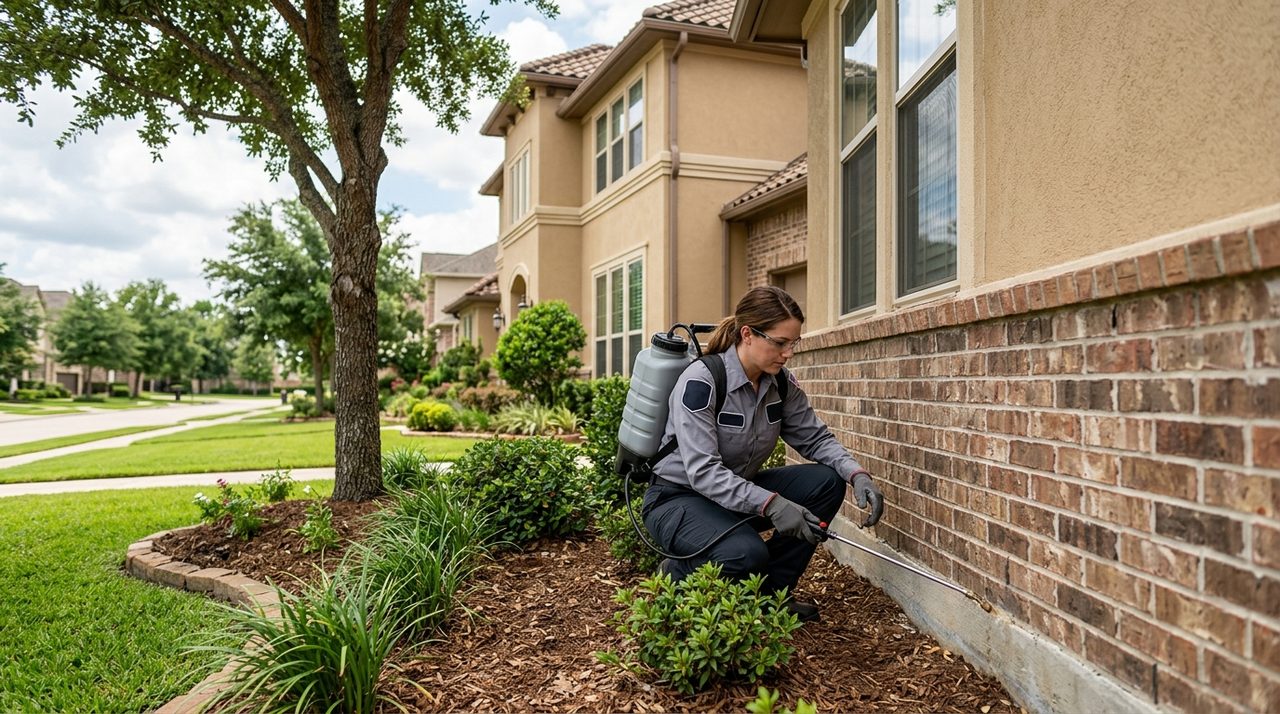
A licensed TDLR Structural Pest Control operator should combine exterior perimeter exclusion — sealing weep holes with copper mesh, caulking plumbing penetrations — with a residual drain treatment targeting the sub-slab harborage, not just interior baseboards. Ask the technician to confirm they hold a General Household Pest endorsement and have scoped the drain access points specific to your home's construction era before scheduling recurring service.
Sources: Texas Department of Licensing & Regulation, Harris County Flood Control District
Why it matters to you
Homes built in Alief before roughly 1990 predate the widespread adoption of termiticide pre-treatment during slab pour, leaving expansion joints, post-tension cable sleeves, and utility penetrations as direct soil-to-wood highways for Formosan and Reticulitermes termites — the two species that define Houston's USDA Zone 5 termite pressure. The clay soil common throughout southwest Harris County retains moisture from Zone X500 rain events longer than sandy soils, extending the soil saturation window that encourages swarm activity and new colony establishment near foundations. A home built in 1978 in Alief may carry four decades of uninterrupted termite pressure with no original chemical barrier.
What a good pro does
A TDLR-licensed operator with a Termite (Subterranean) category endorsement should conduct a full slab perimeter inspection before recommending liquid barrier (Termidor-type, estimated $800–$1,800 for a typical Alief ranch footprint) or bait station installation (Sentricon-type, estimated $1,200–$2,000 plus annual monitoring at $300–$500/year). Liquid barriers require drilling through concrete at penetration points on slab-on-grade homes — confirm the technician has done this on comparable 1970s–1980s Houston slab construction.
Sources: Texas Department of Licensing & Regulation, FEMA National Flood Hazard Layer (NFHL)
Why it matters to you
Houston's expansive Beaumont/Houston Black clay shrinks during dry summers and expands after heavy rains, causing seasonal vertical movement that repeatedly opens and reseals gaps around plumbing penetrations and garage door sweeps on Alief's older slab homes. Post-Harvey (2017) and post-Beryl (2024) pipe repairs throughout Alief's southwest Houston tracts frequently left utility chases improperly resealed, creating new rodent entry points in homes that may have had no prior rat or mouse history. Active construction activity along Westheimer and Beechnut corridors near Alief continues to displace rodent populations into established residential lots.
What a good pro does
Rodent exclusion in Alief requires a physical inspection of all slab penetrations, brick weep holes, and garage weatherstripping — not just bait placement — because gaps will re-emerge with the next clay-shrink cycle if not permanently sealed with steel wool, hardware cloth, or caulk rated for slab movement. A TDLR-licensed technician should also check for post-repair gaps in any plumbing work done after Harvey or Beryl. Professional exclusion plus interior treatment is estimated at $400–$900 for an average Alief home.
Sources: Texas Department of Licensing & Regulation, Harris County Flood Control District
Why it matters to you
Alief has no single governing HOA, but mandatory HOAs do exist in specific subdivisions — Park West Community Association being one confirmed example — while other tracts operate under informal civic clubs with no enforcement authority. If your home falls under a mandatory HOA with an active architectural control committee, placing visible Sentricon-type termite bait stations along the foundation perimeter or broadcasting fire ant bait on shared turf may trigger a violation notice, regardless of the treatment's effectiveness. Homeowners who don't first check their Harris County deed records before signing an annual pest service contract risk having legally installed equipment flagged during a property inspection.
What a good pro does
Before authorizing any exterior bait station installation or perimeter broadcast treatment, pull your subdivision's deed restrictions from Harris County records and confirm whether a mandatory HOA governs your lot — the Alief Super Neighborhood Council is a community forum only and cannot grant or deny approval for exterior work. If an HOA does apply, ask your pest control operator for station placement options that comply with typical setback and visibility restrictions; bait stations can often be relocated against the foundation edge or screened by existing landscaping to satisfy architectural guidelines without sacrificing monitoring effectiveness.
Sources: Local HOA / deed restrictions (see area profile), Texas Department of Licensing & Regulation
Hiring pest control in Alief? Alief is a large, diverse area in southwest Houston encompassing dozens of individual subdivisions, each with its own governance structure, housing stock, and deed restrictions. Homeowners should verify their specific subdivision's HOA status, deed restrictions, and flood history at the parcel level rather than relying on area-wide generalizations. The moderate flood risk zone and aging housing stock across many tracts drive significant demand for plumbing, foundation, and weatherproofing services.
Building era
Not confirmed at the neighborhood-wide level — varies by subdivision. Many tracts developed from the 1970s through 1990s, but this should be verified tract-by-tract.
Typical style
Not confirmed — Alief includes a mix of single-family ranch-style homes, townhomes, and multi-family units depending on the subdivision.
Foundations
Primarily slab-on-grade, consistent with Houston-area construction norms, but not universally confirmed across all Alief subdivisions.
Common systems
Homes from the 1970s–1990s era typically feature central HVAC systems that may need replacement, copper or galvanized plumbing (older tracts), and electrical panels that may require upgrading to modern standards.
What that means for repairs
Not confirmed at the area-wide level. Given the likely age range of housing stock, common renovation activity likely includes HVAC replacement, re-piping from galvanized to PEX or copper, roof replacement, and kitchen/bath modernization.
Permit jurisdiction
City of Houston Permitting Center (Alief is generally within Houston city limits, though boundary verification is recommended for any specific address).
HOA & deed restrictions
No single area-wide HOA governs Alief. Some subdivisions have mandatory HOAs (e.g., Park West Community Association, Inc.). Others are organized only through civic clubs or the Alief Super Neighborhood Council, which is a community forum, not an HOA. Check Harris County deed records for the specific subdivision.
Historic districts
No City of Houston historic district designation confirmed. No evidence found that any part of Alief requires HAHC Certificates of Appropriateness.
Contractor note
Contractors must verify the specific subdivision's HOA requirements before beginning exterior work, as rules vary dramatically across Alief. Confirm the property is within Houston city limits for correct permitting jurisdiction.
FEMA flood zone
FEMA Zone X500 (moderate flood risk) — source: fema_nfhl. Alief is situated in southwest Houston; proximity to specific bayous or drainage channels should be verified at the parcel level.
Hurricane Harvey impact
Specific Harvey 2017 impact data for Alief was not confirmed through available research. Flood impact varied by subdivision and street; homeowners and contractors should check parcel-level flood history using Harris County Flood Control District tools and FEMA flood claim records rather than relying on area-wide assumptions.
Heat & humidity load
Houston's extreme summer heat and humidity place heavy demand on HVAC systems, particularly in older homes with less efficient equipment. Slab foundations in clay soils are susceptible to movement during prolonged dry spells, and moisture intrusion risks increase during summer storm events.
Working with contractors here
Alief's large geographic footprint and subdivision-by-subdivision variability mean contractors must scope each job individually rather than assuming uniform conditions. Older homes from the 1970s–1980s commonly need re-piping, electrical panel upgrades, and HVAC replacement. Foundation repair is a recurring need given Houston's expansive clay soils and the moderate flood risk designation. Exterior work such as siding, roofing, and fencing may be subject to HOA architectural review in some subdivisions but not others, so pre-job verification is essential. Language diversity in the area may also be a practical consideration for customer-facing contractors.
Local Tip
Always ask for a written estimate before work begins. Texas contractors are required to provide one on jobs over $1,000.
Alief is a large, diverse area in southwest Houston encompassing dozens of individual subdivisions, each with its own governance structure, housing stock, and deed restrictions. Homeowners should verify their specific subdivision's HOA status, deed restrictions, and flood history at the parcel level rather than relying on area-wide generalizations. The moderate flood risk zone and aging housing stock across many tracts drive significant demand for plumbing, foundation, and weatherproofing services.
Source: U.S. Census Bureau, ACS 5-Year 2023
Alief carries FEMA Zone X500 (moderate flood risk): outside the 100-year floodplain but inside the 500-year, so heavy-rain events still reach homes and flood-aware work pays off.
Source: FEMA National Flood Hazard Layer (NFHL). Flood zones vary by parcel — verify your individual FIRM panel.
Houston-specific estimators to plan your project before you call a pro. All results are planning estimates — a licensed local pro confirms the details on site.
| Pest | Cadence | Active window |
|---|---|---|
Mosquito control A standard 4-week barrier treatment holds a typical suburban lot through Houston's core mosquito season. | Every 28 days | April – October |
Termite (subterranean) A once-a-year spring inspection is the baseline for a drier, sunnier Houston lot — catch mud tubes and swarmer wings before damage compounds. | Annual inspection | Spring |
General pest guard (roaches, ants, spiders) Houston's year-round warmth means general pests never fully die off — a quarterly perimeter treatment is the standard maintenance rhythm. | Quarterly | Mar · Jun · Sep · Dec |
This is a planning estimate only — actual requirements depend on an on-site assessment by a licensed Houston pro. Texas requires an SPCB-licensed applicator for chemical treatment — ask for the technician's license number.
Sources: Harris County Flood Control DistrictFEMA National Flood Hazard Layer (NFHL)
Sources: Local HOA / deed restrictions (see area profile)