Open Now
1700 N Main St, Baytown, TX 77520
Baytown's split personality — 1950s–1970s ranch homes with aging cast-iron drains alongside 1990s–2000s brick-veneer tract subdivisions sitting on Houston Black clay — creates a layered pest pressure that shifts block by block. Proximity to Galveston Bay and the Houston Ship Channel keeps humidity consistently elevated even on FEMA Zone X parcels, accelerating the conditions that drive termite activity, cockroach sewer migration, and rodent intrusion year-round. Understanding which pressures apply to your specific housing era and subdivision status is the first step toward an effective, lasting treatment plan.
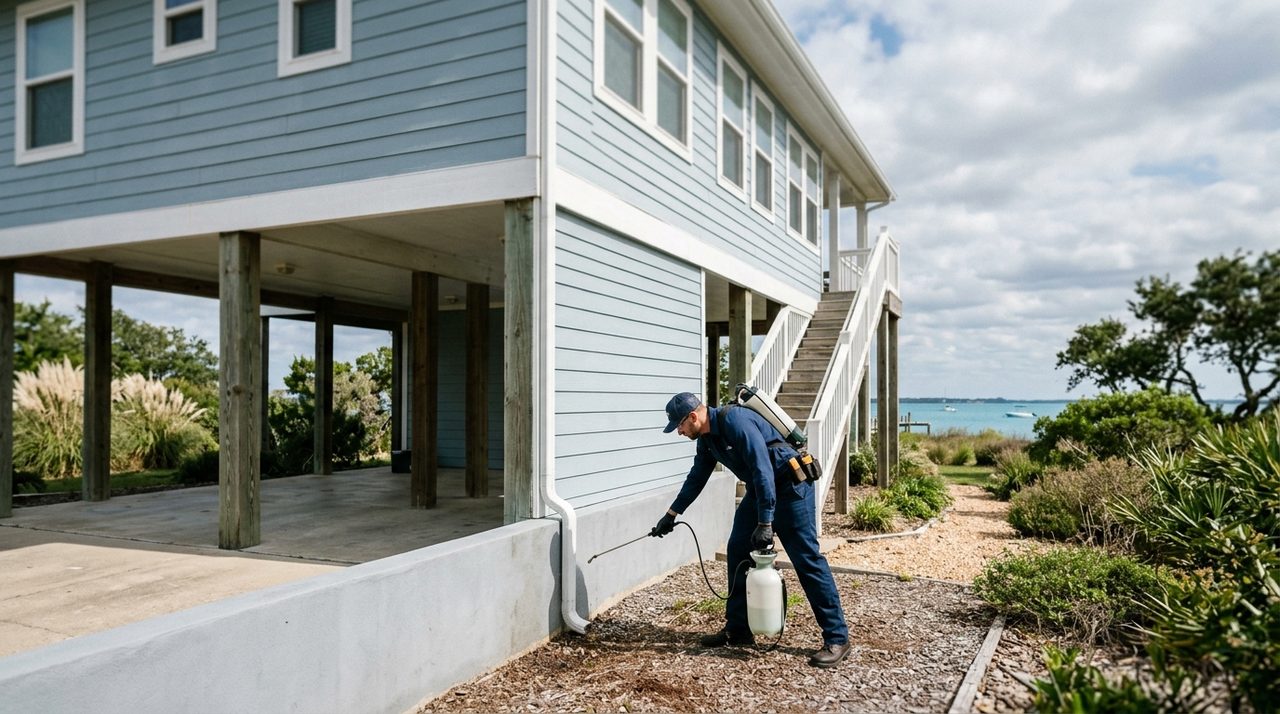
Ranked by verified Google rating × review volume × verification tier. How we rank →
Some highly-rated pros serve Baytown from nearby and may not keep a Baytown street address. Those are listed under "Also serving Baytown" with their real city and distance, so you always know where each business is based.
1700 N Main St, Baytown, TX 77520
217 N Alexander Dr, Baytown, TX 77520
7639 Decker Dr, Baytown, TX 77520
1012 E Cedar Bayou Lynchburg Rd, Baytown, TX 77521
Highly-rated pros based nearby who cover Baytown. Distance shown from the Baytown area.
Serving Baytown Based in La Porte · 6.3 mi away
Serving Baytown Based in La Porte · 6.8 mi away
Why it matters to you
Baytown's in-town neighborhoods — many built in the 1950s through 1970s — commonly retain original cast-iron drain lines beneath slab-on-grade foundations. As these pipes corrode and develop cracks, they connect Baytown's flat, slow-draining sewer infrastructure directly to your home's interior. The area's coastal humidity and proximity to Ship Channel industrial waterways mean storm-displaced roaches migrate through floor drains, weep holes, and plumbing penetrations even during moderate rain events, not just named storms.
What a good pro does
A licensed Structural Pest Control operator (TDLR-certified under the Texas Structural Pest Control Act) should inspect drain access points, apply residual gel treatments inside slab penetrations, and install door sweeps and weep-hole covers as exclusion measures — not just spray baseboards. If cast-iron lines are confirmed corroded, coordinate with a Baytown-permitted plumber, as the City of Baytown's independent permitting office (not Houston's) governs any plumbing work that accompanies the exclusion repair.
Sources: Texas Department of Licensing & Regulation, Texas Commission on Environmental Quality
Why it matters to you
Baytown's newer HOA subdivisions — Sterling Point, Independence Bend, and Eastpoint, mostly built between the 1990s and 2010s — feature brick-veneer construction over slab-on-grade foundations on Houston Black clay soil. That clay causes seasonal slab movement that repeatedly opens and reseals expansion joints and plumbing sleeve gaps: exactly the entry points Formosan and Reticulitermes subterranean termites exploit. Houston sits in USDA's highest termite pressure zone, and the Ship Channel corridor's persistent moisture elevates that baseline further.
What a good pro does
Effective protection requires either a liquid termiticide barrier (Termidor-type, estimated $800–$1,800 depending on perimeter linear footage) or a bait station monitoring system (Sentricon-type, estimated $1,200–$2,000 installed plus $300–$500/year monitoring) — not a one-time spray. The treating company must hold a TDLR termite category endorsement, and homeowners in Sterling Point or Independence Bend should confirm with their HOA's Architectural Review Committee whether exterior bait station placement requires prior approval under recorded CC&Rs before installation begins.
Sources: Texas Department of Licensing & Regulation, Local HOA / deed restrictions (see area profile)
Why it matters to you
Baytown's census median year built of 1981 puts a large share of its housing stock squarely in the window where post-Harvey (2017) and post-Uri (2021) pipe repairs were made — and those repairs frequently left utility chases around PEX re-pipes and new electrical runs improperly resealed. Houston Black clay's seasonal expansion and contraction continuously re-opens gaps around garage door thresholds, brick weep holes, and plumbing penetrations, giving Norway rats and house mice recurring entry points even in well-maintained homes.
What a good pro does
A TDLR-licensed pest control operator should conduct a full exterior exclusion audit, using copper mesh and foam sealant at every slab penetration and weep hole, combined with interior snap-trap programs rather than open rodenticide bait that can harm neighborhood wildlife. In HOA subdivisions, confirm that exterior bait station hardware meets the community's aesthetic standards before installation — Baytown's subdivision HOAs like Eastpoint (219 homes) and Baytown Country Club Manor HOA have enforced CC&Rs that can require removal of non-approved exterior fixtures.
Sources: Texas Department of Licensing & Regulation, Local HOA / deed restrictions (see area profile)
Why it matters to you
Baytown's newer HOA subdivisions with irrigated St. Augustine lawns on clay-heavy soil create near-ideal conditions for Red Imported Fire Ant colony establishment along foundation edges, irrigation controller boxes, and HVAC condenser pads — where RIFA colonies can short out electrical contacts. TAMU Extension classifies the entire Houston metro, including Harris County east to Baytown, as high-density RIFA territory, and re-infestation from adjacent lots or HOA common-area turf is nearly guaranteed without a coordinated perimeter treatment schedule.
What a good pro does
Individual mound treatments alone will not hold in a subdivision setting; broadcast bait applications across the full lot perimeter on a two-to-three-times-per-year schedule, timed around Baytown's wet season, are the industry-recommended approach. Homeowners in Sterling Point or Independence Bend should ask their HOA board whether a community-wide fire ant program is already contracted — if so, individual service contracts must be coordinated to avoid conflicting applications that reduce efficacy, and any common-area treatments require HOA approval before a private operator can apply product on shared turf.
Sources: Local HOA / deed restrictions (see area profile), Texas Commission on Environmental Quality
Hiring pest control in Baytown? Baytown is an incorporated city east of Houston with a diverse housing stock ranging from 1950s-era non-HOA neighborhoods to modern master-planned HOA subdivisions. Homeowners should verify their specific subdivision's deed restrictions and HOA status, as governance varies block by block. Proximity to the Houston Ship Channel and coastal waterways means moisture management, corrosion resistance, and flood preparedness are critical home maintenance considerations.
Building era
Mixed: older in-town areas from 1950s–1970s; many HOA-managed subdivisions built 1990s–2010s.
Typical style
One- and two-story traditional brick or brick-veneer tract homes in newer subdivisions; ranch-style and bungalow homes in older non-HOA areas.
Foundations
Predominantly slab-on-grade in post-1970s subdivisions; some older homes may have pier-and-beam — not confirmed in research for specific neighborhoods.
Common systems
Older homes (1950s–1970s): original copper or galvanized plumbing, older electrical panels. Newer subdivisions (1990s–2010s): PEX or CPVC plumbing, 200-amp electrical panels, central HVAC with standard efficiency units.
What that means for repairs
Older non-HOA neighborhoods see plumbing re-pipes, panel upgrades, and foundation leveling. Newer HOA subdivisions focus on cosmetic updates and HVAC replacements as original systems age out of warranty.
Permit jurisdiction
City of Baytown Permitting — Baytown is an incorporated city with its own building codes and permit office, separate from Houston Permitting Center and Harris County Engineering.
HOA & deed restrictions
No single city-wide HOA. Multiple subdivision-level mandatory HOAs exist, including Sterling Point Community Association (managed by Crest Management), The Park at Independence Bend HOA, Eastpoint Subdivision HOA (219 homes), and Baytown Country Club Manor HOA. Older in-town areas may have no HOA or only informal civic clubs. Verify HOA status via Texas Property Code §209 management certificates for any specific address.
Historic districts
No City of Houston historic district designation confirmed. Baytown is an independent incorporated city and does not fall under HAHC jurisdiction.
Contractor note
Contractors must pull permits through the City of Baytown, not Houston or Harris County. HOA Architectural Review Committee approval may be required in subdivisions like Sterling Point or Independence Bend before exterior modifications begin.
FEMA flood zone
FEMA Zone X (low flood risk) per official NFHL API data at the queried point. However, Baytown is a large city and many areas near the San Jacinto River, Goose Creek, and Cedar Bayou carry higher flood designations. Property-specific FEMA lookups are strongly recommended.
Hurricane Harvey impact
Not confirmed from provided research with specific damage figures. Baytown's location near the San Jacinto River and coastal waterways made it vulnerable during Hurricane Harvey in 2017, and the broader region experienced significant flooding. Homeowners should check Harris County Flood Control District records for address-specific Harvey inundation data.
Heat & humidity load
Baytown's coastal proximity produces high humidity and salt-air exposure, accelerating corrosion on HVAC condensers, metal roofing components, and exterior hardware. Summer heat loads on older homes with original insulation and single-pane windows can strain HVAC systems significantly. Moisture intrusion and mold risk are elevated in older pier-and-beam structures.
Working with contractors here
Contractors in Baytown most commonly handle HVAC replacements, plumbing re-pipes, and foundation work — driven by the area's split between aging 1950s–1970s housing and maturing 1990s–2000s tract homes. Corrosion from the industrial and coastal environment creates above-average demand for exterior painting, metal component replacement, and roof maintenance. In HOA-managed subdivisions, contractors should confirm architectural committee requirements before beginning any visible exterior work, as communities like Sterling Point and Independence Bend enforce recorded CC&Rs. The City of Baytown's independent permitting process means contractors familiar only with Houston or unincorporated Harris County codes need to verify local requirements.
Local Tip
Always ask for a written estimate before work begins. Texas contractors are required to provide one on jobs over $1,000.
Baytown is an incorporated city east of Houston with a diverse housing stock ranging from 1950s-era non-HOA neighborhoods to modern master-planned HOA subdivisions. Homeowners should verify their specific subdivision's deed restrictions and HOA status, as governance varies block by block. Proximity to the Houston Ship Channel and coastal waterways means moisture management, corrosion resistance, and flood preparedness are critical home maintenance considerations.
Source: U.S. Census Bureau, ACS 5-Year 2023
Most of Baytown maps to FEMA Zone X (low mapped flood risk), but Houston's flash-flood reality means even low-risk blocks benefit from smart drainage and storm-hardened installs; risk climbs sharply on blocks nearest Galveston Bay and the Houston Ship Channel, where it varies parcel to parcel.
Source: FEMA National Flood Hazard Layer (NFHL). Flood zones vary by parcel — verify your individual FIRM panel.
Houston-specific estimators to plan your project before you call a pro. All results are planning estimates — a licensed local pro confirms the details on site.
| Pest | Cadence | Active window |
|---|---|---|
Mosquito control A standard 4-week barrier treatment holds a typical suburban lot through Houston's core mosquito season. | Every 28 days | April – October |
Termite (subterranean) A once-a-year spring inspection is the baseline for a drier, sunnier Houston lot — catch mud tubes and swarmer wings before damage compounds. | Annual inspection | Spring |
General pest guard (roaches, ants, spiders) Houston's year-round warmth means general pests never fully die off — a quarterly perimeter treatment is the standard maintenance rhythm. | Quarterly | Mar · Jun · Sep · Dec |
This is a planning estimate only — actual requirements depend on an on-site assessment by a licensed Houston pro. Texas requires an SPCB-licensed applicator for chemical treatment — ask for the technician's license number.
Sources: Harris County Flood Control DistrictFEMA National Flood Hazard Layer (NFHL)
Sources: Local HOA / deed restrictions (see area profile)
Sources: Texas Windstorm Insurance Association (TWIA)Texas Department of Licensing & Regulation