Closed
2501 Central Pkwy c1, Houston, TX 77092
Brookhollow's 1960s–1980s slab-on-grade ranch homes along the US-290 corridor combine aging cast-iron drain lines, Houston Black clay soil, and brick veneer weep holes into a set of pest entry points that newer subdivisions rarely face all at once. FEMA Zone X status limits flood-driven mosquito pressure here compared to bayou-adjacent neighborhoods, but the trade-off is a concentrated focus on termites, American cockroaches pushing up through aging plumbing, and rodents exploiting slab gaps that Houston's expansive clay soils keep reopening. Understanding which pressures are real in Brookhollow — and which are overblown — helps homeowners spend pest-control dollars where they actually matter.
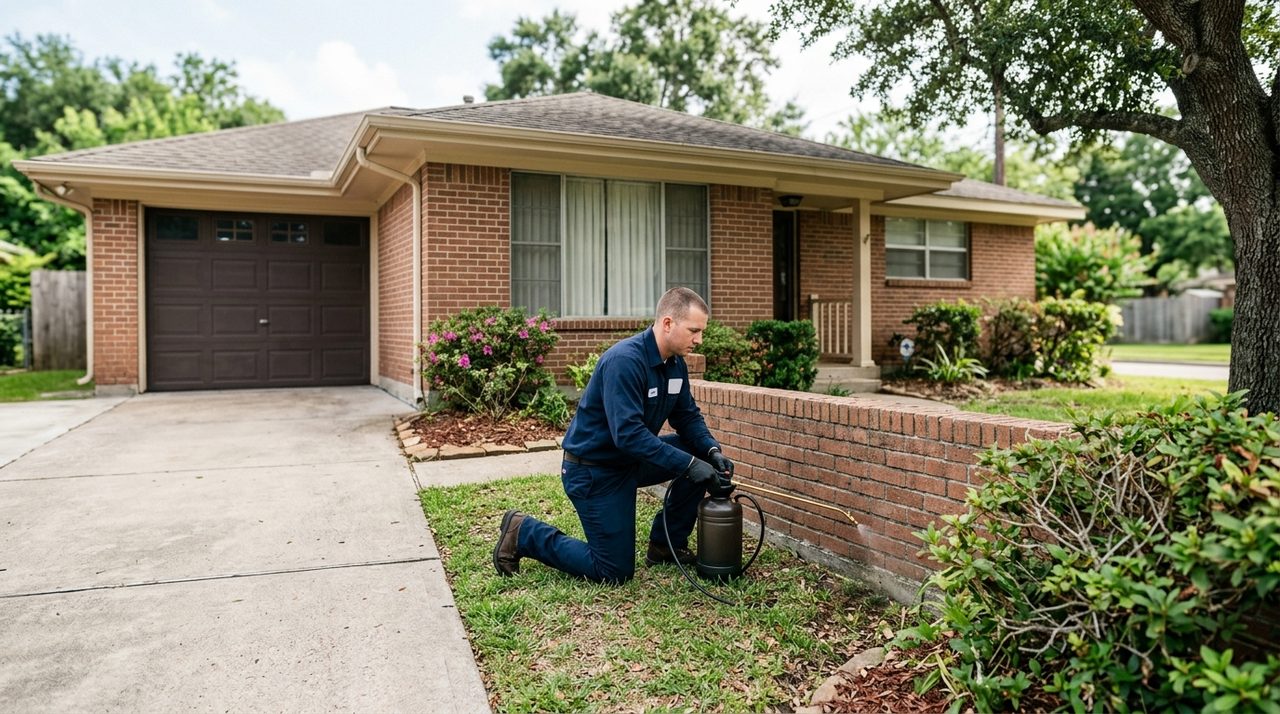
Ranked by verified Google rating × review volume × verification tier. How we rank →
Some highly-rated pros serve Brookhollow from nearby and may not keep a Brookhollow street address. Those are listed under "Also serving Brookhollow" with their real city and distance, so you always know where each business is based.
2501 Central Pkwy c1, Houston, TX 77092
4930 Dacoma St ste g, Houston, TX 77092
12460 Northwest Fwy Suite B, Houston, TX 77092
5151 Mitchelldale St building 12 suite b11, Houston, TX 77092
5635 2043, NW Central Dr ste e101, Houston, TX 77092
Highly-rated pros based nearby who cover Brookhollow. Distance shown from the Brookhollow area.
Serving Brookhollow Based in Lazybrook / Timbergrove · 0.7 mi away
Serving Brookhollow Based in Lazybrook / Timbergrove · 1.6 mi away
Serving Brookhollow Based in Lazybrook / Timbergrove · 2 mi away
Serving Brookhollow Based in Lazybrook / Timbergrove · 2.4 mi away
Serving Brookhollow Based in Lazybrook / Timbergrove · 2.8 mi away
Why it matters to you
Brookhollow's median home was built around 1975, well before modern termiticide pre-treatment standards became routine in Harris County construction. Slab-on-grade homes of that era have expansion joints, post-tension cable sleeves, and plumbing penetrations that give Coptotermes formosanus — the aggressive Formosan subterranean termite that thrives in Houston's USDA Zone 5 heartland — a direct soil-to-wood pathway with no crawlspace to slow them down. Brick veneer construction, common in this neighborhood's ranch-style homes, also provides protected foraging corridors behind the veneer where colonies can grow undetected for months.
What a good pro does
A TDLR-licensed termite operator should perform a full perimeter inspection of all slab penetrations and expansion joints, not just a cursory walk-around. Liquid barrier treatments (Termidor-type, estimated $800–$1,800 for a typical Brookhollow footprint) require trenching along the foundation perimeter; bait station programs (Sentricon-type, estimated $1,200–$2,000 installed plus $300–$500 per year monitoring) suit homeowners who prefer a non-liquid approach. Because no City of Houston permit is required for routine pest control service, verify the operator's TDLR license number and specific termite category endorsement before signing any contract.
Why it matters to you
Homes built in Brookhollow during the 1960s and 1970s frequently retain original cast-iron sanitary drain lines that have corroded, cracked, or settled unevenly due to Houston's expansive clay soil movement. Periplaneta americana — the large 'waterbug' species Houston homeowners know well — colonizes warm sewer infrastructure and enters living spaces through floor drains, slab plumbing penetrations, and weep holes in brick veneer after heavy rain displaces them from storm sewers. Interior spray treatments alone cannot break this cycle when harborage exists in deteriorating pipe segments under or adjacent to the slab.
What a good pro does
An effective treatment plan for a Brookhollow home with suspected cast-iron lines starts with exterior drain treatment and weep-hole exclusion work at the brick veneer, combined with gel bait placement at interior slab penetrations rather than relying solely on baseboard spray. If cast-iron lines have been partially re-piped (a common renovation in homes of this era), the operator should ask the homeowner specifically which sections remain original, since those are the highest-risk harborage zones. TDLR-licensed operators holding a general household pest endorsement can perform this work; no separate City of Houston permit is required for the pest control service itself, though any associated plumbing repairs to drain lines would require a City of Houston plumbing permit.
Why it matters to you
Houston's expansive Beaumont/Houston Black clay soil causes measurable seasonal vertical movement in slabs, and Brookhollow's 40-to-60-year-old homes have experienced decades of this cycle. Gaps that open around plumbing penetrations, garage door thresholds, and utility chases do not stay sealed — the clay shrinks in drought and swells after rain, working sealant loose over time. Roof rats and house mice exploit these recurrent openings, and the problem intensified for homes in the area that underwent pipe repairs after Winter Storm Uri (2021), where utility chases were often resealed hastily or incompletely.
What a good pro does
Rodent exclusion in Brookhollow requires a two-phase approach: identifying and mechanically sealing active gap points with steel wool and appropriate caulk or metal flashing, followed by interior snap-trap placement and exterior bait station deployment away from areas accessible to children or pets. Estimated cost for exclusion plus treatment ranges $400–$900. Because clay soil movement will reopen gaps over time, the operator should schedule a 90-day follow-up inspection — not just a one-time visit — to check whether sealed penetrations have shifted. Verify the operator's TDLR rodent category endorsement before hiring.
Why it matters to you
Brookhollow's lots with irrigated turf and clay-dominant soil create ideal conditions for Solenopsis invicta mound-building along foundation edges, around HVAC condenser pads, and near irrigation control boxes — all common features of the ranch-style homes here. TAMU Extension classifies the entire Houston metro as high-density RIFA territory, and clay soil with poor drainage (a consistent characteristic of NW Houston lots on the US-290 corridor) concentrates mound activity precisely where HVAC contractors and homeowners are most likely to encounter stings. Fire ant colonies that establish inside HVAC junction boxes or irrigation controllers can cause costly short-circuit damage on top of the sting risk.
What a good pro does
Seasonal perimeter broadcast treatment — typically applied in spring and again in fall — is more effective in Brookhollow's clay-soil conditions than individual mound drenches, which are quickly re-established from neighboring colonies. A TDLR-licensed operator should treat a buffer zone of at least four feet out from the foundation perimeter and pay specific attention to the HVAC condenser pad and any buried irrigation wiring. Quarterly pest control service plans, which typically run $40–$70 per visit in the Houston metro, can include fire ant perimeter treatment as part of a bundled exterior program. No City of Houston permit is required for this work.
Hiring pest control in Brookhollow? Brookhollow is a northwest Houston neighborhood along the US-290 corridor with housing stock generally dating to the 1960s–1980s. Homeowners here should expect maintenance patterns typical of aging slab-on-grade ranch homes, including HVAC system replacements, cast-iron drain line issues, and periodic foundation monitoring. The neighborhood falls within City of Houston permitting jurisdiction with no historic district restrictions limiting exterior modifications.
Building era
1960s–1980s (area-wide pattern; not confirmed for this specific subdivision).
Typical style
One- and two-story ranch, traditional brick, and contemporary traditional homes — based on area-wide NW Houston/US-290 corridor patterns.
Foundations
Concrete slab-on-grade (predominant for post-1960 NW Houston subdivisions; not independently confirmed for this specific neighborhood).
Common systems
Original homes likely have central A/C units nearing or past useful life, galvanized or cast-iron plumbing transitioning to PVC/PEX in renovated units, and older electrical panels (100–150 amp) that may need upgrading for modern loads.
What that means for repairs
Kitchen and bathroom remodels are common in homes of this era, along with re-piping from original galvanized or cast-iron lines, HVAC replacements, and foundation repair due to Houston's expansive clay soils.
Permit jurisdiction
City of Houston Permitting Center (neighborhood is within Houston city limits).
HOA & deed restrictions
Not confirmed — multiple 'Brookhollow' associations exist in Harris County (including Brookhollow Crossing Association, Inc. and Brookhollow Court HOA), but none could be reliably matched to the NW Houston Brookhollow area near US-290. Check Harris County Clerk records for recorded deed restrictions or management certificates tied to specific plat names.
Historic districts
No City of Houston historic district designation confirmed. Brookhollow does not appear on the HAHC list of designated historic districts, and no Certificate of Appropriateness is required for exterior work.
Contractor note
Contractors should verify lot-specific deed restrictions through Harris County Clerk records before planning exterior modifications, as HOA/POA governance for this specific Brookhollow area could not be confirmed. Standard City of Houston building permits apply.
FEMA flood zone
FEMA Zone X (low flood risk) — source: fema_nfhl. Specific bayou or creek proximity for this neighborhood could not be confirmed from available research; homeowners should verify drainage patterns at the parcel level using Harris County Flood Control District tools.
Hurricane Harvey impact
Harvey impact for the specific Brookhollow neighborhood near US-290 could not be confirmed from available sources. Harvey flood mapping in Harris County is organized by watershed rather than neighborhood name, and no news articles or HCFCD documents explicitly identified Brookhollow (NW Houston) for neighborhood-level Harvey inundation. The FEMA Zone X designation suggests lower overall flood risk, but parcel-level verification is recommended.
Heat & humidity load
Houston's extreme summer heat and humidity place heavy demand on aging HVAC systems common in 1960s–1980s homes. Slab-on-grade foundations in expansive clay soils may experience seasonal movement during drought-to-rain cycles, making foundation monitoring important. Attic insulation upgrades and proper roof ventilation are common service needs to manage cooling costs.
Working with contractors here
Contractors working in Brookhollow most commonly handle HVAC replacements, re-piping from original galvanized or cast-iron drain lines, and foundation repair — all driven by the aging mid-century housing stock typical of the US-290 corridor. Roof replacements on homes 30–50+ years old are frequent, and electrical panel upgrades are common as homeowners add modern loads. Because the HOA landscape is unclear, contractors should verify any exterior modification restrictions with the homeowner and Harris County deed records before scoping jobs. The City of Houston permitting process applies to all structural, electrical, plumbing, and mechanical work requiring permits.
Local Tip
Always ask for a written estimate before work begins. Texas contractors are required to provide one on jobs over $1,000.
Brookhollow is a northwest Houston neighborhood along the US-290 corridor with housing stock generally dating to the 1960s–1980s. Homeowners here should expect maintenance patterns typical of aging slab-on-grade ranch homes, including HVAC system replacements, cast-iron drain line issues, and periodic foundation monitoring. The neighborhood falls within City of Houston permitting jurisdiction with no historic district restrictions limiting exterior modifications.
Source: U.S. Census Bureau, ACS 5-Year 2023
Most of Brookhollow maps to FEMA Zone X (low mapped flood risk), but Houston's flash-flood reality means even low-risk blocks benefit from smart drainage and storm-hardened installs.
Source: FEMA National Flood Hazard Layer (NFHL). Flood zones vary by parcel — verify your individual FIRM panel.
Houston-specific estimators to plan your project before you call a pro. All results are planning estimates — a licensed local pro confirms the details on site.
| Pest | Cadence | Active window |
|---|---|---|
Mosquito control A standard 4-week barrier treatment holds a typical suburban lot through Houston's core mosquito season. | Every 28 days | April – October |
Termite (subterranean) A once-a-year spring inspection is the baseline for a drier, sunnier Houston lot — catch mud tubes and swarmer wings before damage compounds. | Annual inspection | Spring |
General pest guard (roaches, ants, spiders) Houston's year-round warmth means general pests never fully die off — a quarterly perimeter treatment is the standard maintenance rhythm. | Quarterly | Mar · Jun · Sep · Dec |
This is a planning estimate only — actual requirements depend on an on-site assessment by a licensed Houston pro. Texas requires an SPCB-licensed applicator for chemical treatment — ask for the technician's license number.
Sources: FEMA National Flood Hazard Layer (NFHL)Harris County Flood Control District
Sources: Local HOA / deed restrictions (see area profile)