Closed
10050 Northwest Fwy Suite 130, Houston, TX 77092
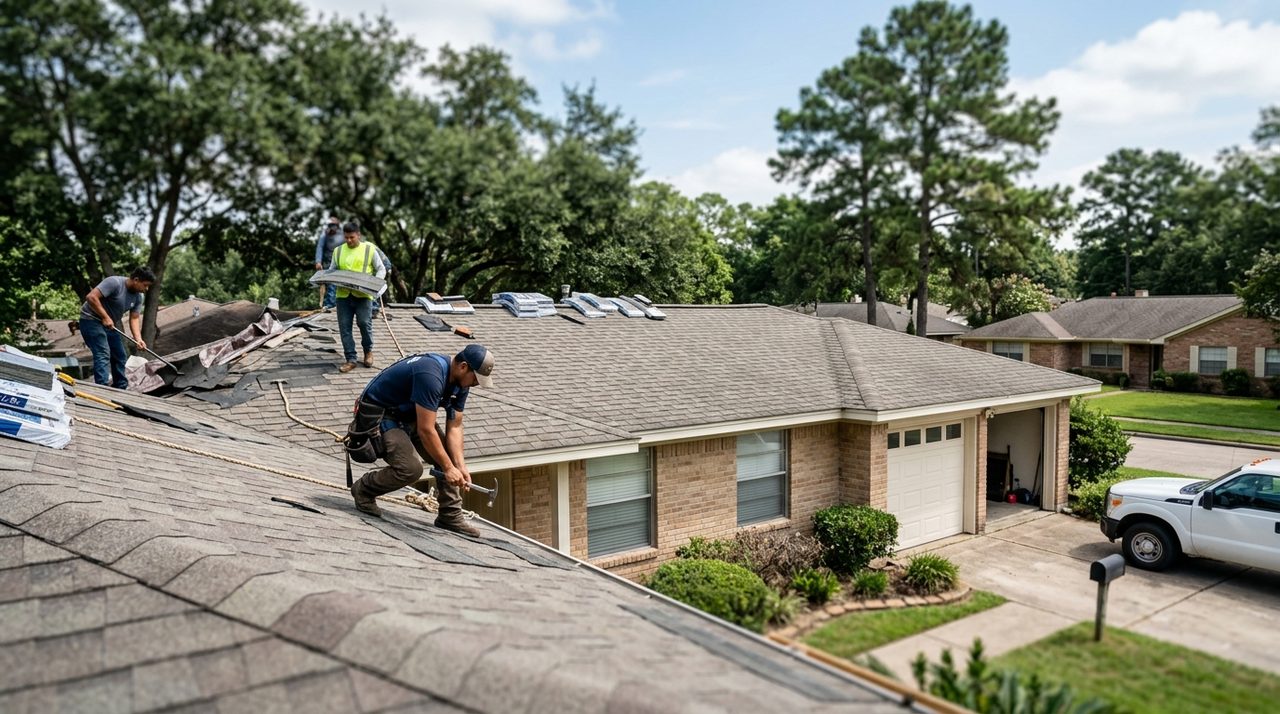
Brookhollow's 1960s–1980s ranch homes along the US-290 corridor carry roofs that are now 30–50+ years old — well past the practical lifespan of original 3-tab shingles in Houston's punishing heat-and-hail environment. The May 2024 derecho tracked directly across Harris County's northwest quadrant, and homes in this NW Houston corridor absorbed straight-line wind damage that is easy to miss from the ground. Understanding what City of Houston permitting actually requires — and what it doesn't — saves Brookhollow homeowners money and protects them from post-storm contractor fraud.
Ranked by verified Google rating × review volume × verification tier. How we rank →
Some highly-rated pros serve Brookhollow from nearby and may not keep a Brookhollow street address. Those are listed under "Also serving Brookhollow" with their real city and distance, so you always know where each business is based.
10050 Northwest Fwy Suite 130, Houston, TX 77092
2409 McAllister Rd, Houston, TX 77092
2855 Mangum Rd Unit B201B, Houston, TX 77092
2400 Central Pkwy Suite J, Houston, TX 77092
6535 Thornwall St, Houston, TX 77092
9800 Northwest Fwy Ste. 502A, Houston, TX 77092
Highly-rated pros based nearby who cover Brookhollow. Distance shown from the Brookhollow area.
Serving Brookhollow Based in NW Houston · 0.6 mi away
Serving Brookhollow Based in Lazybrook / Timbergrove · 1.3 mi away
Serving Brookhollow Based in Lazybrook / Timbergrove · 1.4 mi away
Serving Brookhollow Based in Lazybrook / Timbergrove · 1.6 mi away
Why it matters to you
The census median year built for Brookhollow is 1975, which means a significant share of homes still carry original or early-replacement 3-tab shingles that are now 30–40 years old. Harris County averages 3–5 significant hail events per year, and those older fiberglass-mat shingles accumulate granule loss and invisible bruising with each event — damage that voids manufacturer warranties and accelerates UV breakdown under Houston's intense summer sun without ever showing a visible hole from the street.
What a good pro does
A qualified roofer should perform a close-up physical inspection — not just a drive-by assessment — checking for mat bruising, granule accumulation in gutters, and soft spots at ridge lines. On Brookhollow's typical low-pitch ranch geometry, upgrading to Class 4 impact-resistant architectural shingles is a concrete step that adds an estimated $1,500–$3,500 to project cost but meaningfully extends service life and may qualify for insurer discounts. Because Texas has no state roofing license through TDLR, homeowners must independently verify that any contractor carries general liability and workers' compensation coverage before signing a contract.
Sources: Texas Windstorm Insurance Association (TWIA), International Residential Code (as adopted by City of Houston)
Why it matters to you
The May 2024 derecho produced 100-plus mph straight-line winds across Harris County's northwest corridor — the exact path that includes Brookhollow. Homes built before 2006 were constructed under older IRC wind-resistance standards that permitted nail patterns and underlayment attachments insufficient for that level of uplift. On Brookhollow's one- and two-story ranch roofs, the most common derecho damage is lifted ridge caps, detached shingle tabs at corners and rakes, and underlayment tears that admit moisture even when the shingles look intact from below.
What a good pro does
After any major wind event, have a roofer inspect from on the roof — ridge caps, perimeter rows, and flashing at any skylights or penetrations are the first failure points on pre-2006 construction. If a full re-roof is warranted, current IRC R905 nail-pattern requirements (6-nail patterns in high-wind zones) should be confirmed in writing on the contractor's scope of work. The City of Houston requires a building permit for full re-roofs and structural deck repairs; confirm your contractor will pull that permit through the City of Houston Permitting Center so an independent inspection is on record.
Sources: International Residential Code (as adopted by City of Houston), City of Houston Permitting Center, Texas Windstorm Insurance Association (TWIA)
Why it matters to you
Brookhollow's mid-century ranch homes were commonly built with box or gable vents only — no continuous ridge-and-soffit ventilation system. Houston's annual average relative humidity exceeds 75%, and on slab-on-grade construction there is no crawl space to buffer moisture movement. Without proper balanced ventilation meeting IRC R806 ratios, warm humid air condenses on the underside of OSB or plywood decking year-round, silently delaminating the deck so that a new shingle layer installed over it begins failing within 5–8 years.
What a good pro does
Any roofer scoping a re-roof on a Brookhollow home should walk the attic and document the existing ventilation net-free area against the IRC R806 1:150 (or 1:300 with vapor barrier) requirement before pricing the job. If existing gable vents fall short, adding continuous ridge vent and clearing soffit baffles is typically a few hundred dollars added to the project and prevents premature deck failure. Request that the contractor specify whether decking replacement is included or excluded in the bid — on 40-plus-year-old roofs, partial deck replacement is common and should be line-itemed, not left as a surprise charge.
Sources: International Residential Code (as adopted by City of Houston), City of Houston Permitting Center
Why it matters to you
Brookhollow falls entirely within City of Houston jurisdiction, not a suburban municipality with its own permit office, which is actually simpler — but homeowners here are frequently told by post-storm contractors that 'no permit is needed' for a full tear-off and re-roof. That claim is incorrect: the City of Houston requires a building permit for full re-roofs and any structural deck repairs, though like-for-like shingle-only repairs on non-structural work may not. Skipping the permit means no city inspection, no independent verification of nail patterns or underlayment, and potential complications on future insurance claims or resale.
What a good pro does
Before signing a storm-repair contract, ask the contractor directly whether a City of Houston permit will be pulled and who is responsible for scheduling the inspection. The City of Houston Permitting Center also requires contractor registration for anyone pulling a building permit — you can verify a contractor's registration status directly with the permitting center. Because Texas issues no state roofing license, that registration check and an insurance certificate review are the two most concrete protections a Brookhollow homeowner has against unqualified storm chasers.
Sources: City of Houston Permitting Center, Municipal permit office (see area profile)
Hiring roofers in Brookhollow? Brookhollow is a northwest Houston neighborhood along the US-290 corridor with housing stock generally dating to the 1960s–1980s. Homeowners here should expect maintenance patterns typical of aging slab-on-grade ranch homes, including HVAC system replacements, cast-iron drain line issues, and periodic foundation monitoring. The neighborhood falls within City of Houston permitting jurisdiction with no historic district restrictions limiting exterior modifications.
Building era
1960s–1980s (area-wide pattern; not confirmed for this specific subdivision).
Typical style
One- and two-story ranch, traditional brick, and contemporary traditional homes — based on area-wide NW Houston/US-290 corridor patterns.
Foundations
Concrete slab-on-grade (predominant for post-1960 NW Houston subdivisions; not independently confirmed for this specific neighborhood).
Common systems
Original homes likely have central A/C units nearing or past useful life, galvanized or cast-iron plumbing transitioning to PVC/PEX in renovated units, and older electrical panels (100–150 amp) that may need upgrading for modern loads.
What that means for repairs
Kitchen and bathroom remodels are common in homes of this era, along with re-piping from original galvanized or cast-iron lines, HVAC replacements, and foundation repair due to Houston's expansive clay soils.
Permit jurisdiction
City of Houston Permitting Center (neighborhood is within Houston city limits).
HOA & deed restrictions
Not confirmed — multiple 'Brookhollow' associations exist in Harris County (including Brookhollow Crossing Association, Inc. and Brookhollow Court HOA), but none could be reliably matched to the NW Houston Brookhollow area near US-290. Check Harris County Clerk records for recorded deed restrictions or management certificates tied to specific plat names.
Historic districts
No City of Houston historic district designation confirmed. Brookhollow does not appear on the HAHC list of designated historic districts, and no Certificate of Appropriateness is required for exterior work.
Contractor note
Contractors should verify lot-specific deed restrictions through Harris County Clerk records before planning exterior modifications, as HOA/POA governance for this specific Brookhollow area could not be confirmed. Standard City of Houston building permits apply.
FEMA flood zone
FEMA Zone X (low flood risk) — source: fema_nfhl. Specific bayou or creek proximity for this neighborhood could not be confirmed from available research; homeowners should verify drainage patterns at the parcel level using Harris County Flood Control District tools.
Hurricane Harvey impact
Harvey impact for the specific Brookhollow neighborhood near US-290 could not be confirmed from available sources. Harvey flood mapping in Harris County is organized by watershed rather than neighborhood name, and no news articles or HCFCD documents explicitly identified Brookhollow (NW Houston) for neighborhood-level Harvey inundation. The FEMA Zone X designation suggests lower overall flood risk, but parcel-level verification is recommended.
Heat & humidity load
Houston's extreme summer heat and humidity place heavy demand on aging HVAC systems common in 1960s–1980s homes. Slab-on-grade foundations in expansive clay soils may experience seasonal movement during drought-to-rain cycles, making foundation monitoring important. Attic insulation upgrades and proper roof ventilation are common service needs to manage cooling costs.
Working with contractors here
Contractors working in Brookhollow most commonly handle HVAC replacements, re-piping from original galvanized or cast-iron drain lines, and foundation repair — all driven by the aging mid-century housing stock typical of the US-290 corridor. Roof replacements on homes 30–50+ years old are frequent, and electrical panel upgrades are common as homeowners add modern loads. Because the HOA landscape is unclear, contractors should verify any exterior modification restrictions with the homeowner and Harris County deed records before scoping jobs. The City of Houston permitting process applies to all structural, electrical, plumbing, and mechanical work requiring permits.
Local Tip
Always ask for a written estimate before work begins. Texas contractors are required to provide one on jobs over $1,000.
Brookhollow is a northwest Houston neighborhood along the US-290 corridor with housing stock generally dating to the 1960s–1980s. Homeowners here should expect maintenance patterns typical of aging slab-on-grade ranch homes, including HVAC system replacements, cast-iron drain line issues, and periodic foundation monitoring. The neighborhood falls within City of Houston permitting jurisdiction with no historic district restrictions limiting exterior modifications.
Source: U.S. Census Bureau, ACS 5-Year 2023
Most of Brookhollow maps to FEMA Zone X (low mapped flood risk), but Houston's flash-flood reality means even low-risk blocks benefit from smart drainage and storm-hardened installs.
Source: FEMA National Flood Hazard Layer (NFHL). Flood zones vary by parcel — verify your individual FIRM panel.
Wind uplift at the roof-to-wall connection is the structural failure mode that matters most in Brookhollow since flooding is not the primary risk here. Ask your roofer to inspect the starter-course fastening pattern and, if your home was built before the 2009 IRC updates, discuss installing supplemental ring-shank nails along all perimeter rows before the next major storm. Much of the housing stock predates modern wind codes (median build year 1975), so retrofits matter more here. Confirm the current FEMA panel for your Brookhollow parcel — the area maps to Zone X, but adjacent lots can differ.
After a severe thunderstorm, the first thing a roofer should check in Brookhollow is whether wind-driven rain has pushed up under any low-slope transition sections—areas where a steep roof meets a flatter porch or addition—because these joints separate under gust pressure and rarely reseal on their own. Sealing those transitions with a peel-and-stick modified bitumen patch costs far less than replacing the framing they protect. In-city Brookhollow work falls under City of Houston floodplain and permitting rules.
Ice loading in Brookhollow is infrequent but disproportionately damaging because Houston roofs and their fastening systems are designed for wind, not sustained dead weight. Ask a licensed roofer to inspect your ridge board connections and confirm that collar ties or rafter ties are present in the attic, since Uri 2021 produced several ridge-sag failures in well-maintained Houston homes where the framing had no freeze-load margin. With a median build year of 1975, the older building stock here is more exposed to hard-freeze damage than newer construction. Confirm the current FEMA panel for your Brookhollow parcel — the area maps to Zone X, but adjacent lots can differ.
Sources: FEMA National Flood Hazard Layer (NFHL), Ready.gov -- Hurricanes, CenterPoint Energy -- Storm Center, City of Houston -- Emergency Preparedness, Ready.gov -- Winter Weather, Harris County Flood Control District
Houston-specific estimators to plan your project before you call a pro. All results are planning estimates — a licensed local pro confirms the details on site.
Estimated design wind speed for your zone
Outside the TDI catastrophe area, so a WPI-8 is generally not mandated — but Houston still sees hurricane-force gusts (Beryl, 2024). Insist on properly rated shingles installed to the manufacturer's high-wind nailing pattern (6 nails) and starter strips, or a wind claim can be denied for improper installation.
Find a Houston roofer →This is a planning estimate only — actual requirements depend on an on-site assessment by a licensed Houston pro. Wind-speed zones are approximate; your exact TDI/WPI-8 obligation depends on your address's designation. Verify with the Texas Department of Insurance before contracting.
Disconnect & drain every outdoor hose bib
Remove hoses, drain the spigots, and cover each with an insulated faucet sock. Un-drained hose bibs are the #1 burst point in a Houston freeze.
Insulate exposed pipes in the attic & garage
Wrap any pipe in an unconditioned space (attic runs, garage walls) with foam sleeves. Houston homes rarely insulate these because they only matter a few nights a year — which is exactly why they burst.
Open cabinet doors & keep a pencil-width drip
On hard-freeze nights, open kitchen/bath cabinets so warm air reaches the pipes and let faucets on exterior walls drip to relieve pressure.
Protect the attic/garage water heater & its lines
An attic or garage tank sits in unconditioned space. Insulate the cold-inlet and hot-outlet lines and confirm the emergency drain pan is clear so a leak doesn't reach the ceiling.
This is a planning estimate only — actual requirements depend on an on-site assessment by a licensed Houston pro. If a pipe has already burst, shut off your main water supply and call a licensed Houston plumber immediately — freeze bursts flood fast.
Sources: City of Houston Permitting CenterMunicipal permit office (see area profile)
Sources: International Residential Code (as adopted by City of Houston)
Sources: Local HOA / deed restrictions (see area profile)
Sources: City of Houston Permitting Center