Closed
5047 W Bayshore Dr, Bacliff, TX 77518
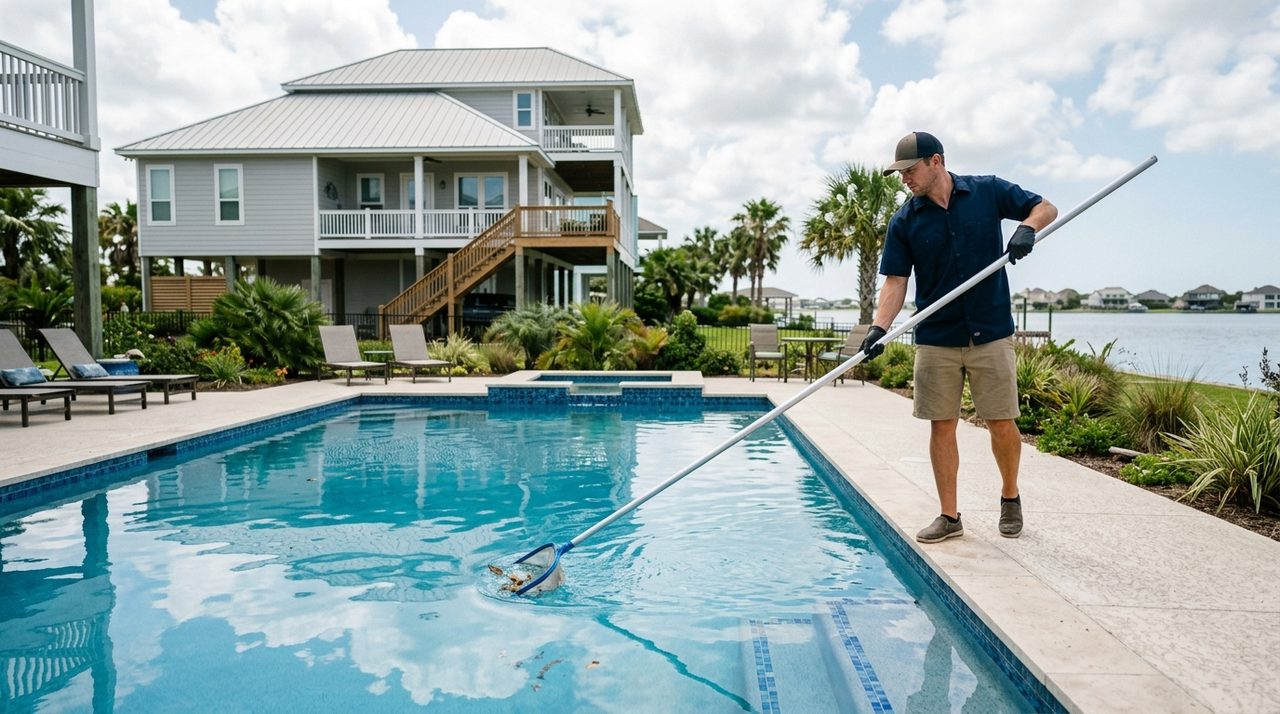
Pools in Kemah sit inside FEMA Zone AE on Galveston Bay, meaning salt-laden air off the water corrodes equipment at an accelerated rate, storm surge from events like Hurricane Beryl (July 2024) can flood pool decks and contaminate water with bay sediment and metals, and every service visit happens in one of the most corrosive outdoor environments in the Houston metro. Understanding those coastal realities — not generic pool chemistry — is what separates a competent Kemah pool technician from one who learned the trade inland.
Ranked by verified Google rating × review volume × verification tier. How we rank →
Some highly-rated pros serve Kemah from nearby and may not keep a Kemah street address. Those are listed under "Also serving Kemah" with their real city and distance, so you always know where each business is based.
5047 W Bayshore Dr, Bacliff, TX 77518
1005 Aspen Rd Suite B, Clear Lake Shores, TX 77565
512 Seminole Dr, Kemah, TX 77565
1130 Winfield Ln, Kemah, TX 77565
153 FM 518 Ste A, Kemah, TX 77565
440 Grand Ave, Bacliff, TX 77518
Highly-rated pros based nearby who cover Kemah. Distance shown from the Kemah area.
Serving Kemah Based in League City · 2.2 mi away
Serving Kemah Based in Clear Lake · 4.7 mi away
Serving Kemah Based in Dickinson · 4.7 mi away
Serving Kemah Based in Clear Lake · 4.9 mi away
Why it matters to you
Kemah's bayfront and canal-side properties — concentrated in the 1990s–2000s waterfront redevelopment corridors and the elevated townhome marina communities — sit in a salt-spray microclimate that rapidly corrodes pump motor housings, salt chlorinator cells, heat exchanger fins, and exposed electrical conduit. Homeowners often discover a failing pump motor or a corroded salt cell not because it reached the end of its normal service life but because salt-air oxidation cut that lifespan in half compared to a pool in Katy or Sugar Land.
What a good pro does
A technician servicing pools in Kemah should inspect all exposed metal components — motor end caps, conduit fittings, bonding wire connections, and salt cell terminals — at every visit and document deterioration early. Recommending marine-grade or polymer-housed equipment at replacement time, and applying dielectric grease to electrical connections, can meaningfully extend service intervals. Equipment replacements such as pump motors or salt cells may require a permit through the City of Kemah's own building department, not Harris County or the City of Houston, so confirm that scope before any electrical work begins.
Sources: Municipal permit office (see area profile), Texas Department of Licensing & Regulation
Why it matters to you
Hurricane Beryl's July 2024 landfall and the historical pattern of storm surge reaching Kemah's lowest-lying blocks mean that bay water — carrying silt, organic matter, metals, and biologicals — can overtop pool decks or flood surrounding areas during major events, crashing sanitizer levels and spiking phosphates, turbidity, and metal content simultaneously. Homes in the original Kemah Townsite and older 1970s–1980s infill sections closest to the bay are most exposed, but even elevated pier-supported properties see debris accumulation from wind-driven storm loads. This is not a situation where a normal weekly service visit restores water safety.
What a good pro does
Proper post-storm remediation for a Kemah pool starts with a full water chemistry panel — including metals and phosphate testing, not just chlorine and pH — before any chemicals are added, because dosing without knowing metal levels risks permanent staining of plaster surfaces. Shock treatment, phosphate remover, clarifier, and multiple filter backwashes are typically required before water is swimmable again, and the pool should be re-tested 24 hours after treatment. Costs for a full green-pool or storm-contaminated pool remediation in this range typically run $250–$600 depending on pool size and how much bay sediment entered the water.
Sources: FEMA National Flood Hazard Layer (NFHL), Harris County Flood Control District
Why it matters to you
Kemah's Gulf Coast latitude puts summer UV index at 10–11 from May through September, and Galveston Bay's thermal influence keeps pool water temperatures elevated well into October — sometimes into November. For pools on south- and west-facing waterfront lots with no mature shade canopy (common in the newer elevated townhome and marina developments built post-2000), unstabilized or under-stabilized pool water can lose its entire free chlorine residual within hours of a service visit, leaving the water unsanitary before the tech's truck leaves the neighborhood.
What a good pro does
Maintaining cyanuric acid (stabilizer) in the 30–50 ppm range is non-negotiable in Kemah's sun exposure environment — without it, chlorine photodegrades too quickly between weekly visits to provide reliable sanitation. A competent technician will test stabilizer levels monthly and adjust accordingly, and may recommend switching to stabilized chlorine tablets or a salt chlorination system for continuous dosing between visits. Because salt cells in Kemah's salt-air environment need more frequent inspection (see above), any salt system recommendation should come with a clear maintenance protocol for the cell itself.
Why it matters to you
Much of Kemah maps to FEMA Zone AE, which carries specific requirements for flood-resistant materials and, critically, the substantial improvement rule — any renovation or repair exceeding 50% of the structure's market value triggers full floodplain compliance. While routine pool cleaning doesn't involve structural work, homeowners who want to replace a pool equipment pad, add a gas heater, or rebuild a deck adjacent to the pool in a flood-zone parcel may find the project scope expands significantly once the City of Kemah's building department applies AE zone rules. This is especially relevant for the pre-1960s and 1970s–1980s cottage-era properties that may not have elevation certificates on file.
What a good pro does
Before authorizing any capital equipment project beyond a simple pump or cell swap — such as a new equipment pad, electrical subpanel for the pool, or structural deck work — Kemah homeowners should confirm the current FEMA flood zone designation for their specific parcel, since risk and applicable rules vary block by block near the bay. All permits for pool equipment work go through the City of Kemah's building department, not any county or regional office. A pool contractor working in Kemah should be familiar with flood-resistant materials requirements below the Base Flood Elevation and should not be surprised when an equipment replacement triggers an elevation certificate review.
Sources: FEMA National Flood Hazard Layer (NFHL), Municipal permit office (see area profile)
Hiring pool cleaning in Kemah? Kemah is a small incorporated city on Galveston Bay with a mix of original bay cottages, 1990s–2000s waterfront redevelopment, and newer elevated townhome/marina communities. Homeowners here face persistent challenges from storm surge exposure, salt-air corrosion, and FEMA floodplain compliance requirements. Contractors working in Kemah must be familiar with elevated foundation systems, coastal building codes, and the City of Kemah's own permitting process.
Building era
Mixed: pre-1960s original cottages, 1970s–1980s infill, significant 1990s–2000s waterfront redevelopment, and post-2008 elevated infill.
Typical style
Coastal raised beach-house style (pier-supported with elevated living areas), traditional suburban SFRs (brick veneer or siding), and townhome/condo marina-oriented developments with stucco or fiber-cement siding.
Foundations
Mixed — pier-and-beam/elevated pile foundations dominate along the bayfront and canal-adjacent properties; slab-on-grade more common in interior and newer suburban pockets.
Common systems
Older cottages may have original copper or galvanized plumbing and outdated electrical panels; 1990s–2000s homes typically feature central HVAC, PVC/CPVC plumbing, and 200-amp electrical service. Salt-air exposure accelerates corrosion on HVAC condensers, metal roofing components, and exterior electrical fixtures across all eras.
What that means for repairs
Most common renovation activity includes elevating older homes to meet current FEMA BFE requirements, replacing storm-damaged structures with new elevated construction, upgrading HVAC and exterior materials to salt-air-resistant alternatives, and converting or remodeling ground-level areas beneath raised homes for parking or storage.
Permit jurisdiction
City of Kemah (independent incorporated city with its own municipal government and building department).
HOA & deed restrictions
No city-wide mandatory HOA or master association. HOAs are present in specific newer townhome, condo, and marina developments on a project-by-project basis. Older platted areas (e.g., original Kemah Townsite) generally have no organized HOA. Voluntary civic clubs may exist in some pockets but are not confirmed. Deed restrictions vary by subdivision — check Galveston County Clerk records for specific parcels.
Historic districts
No City of Houston historic district designation confirmed. Kemah is an independent incorporated city; no HAHC jurisdiction applies. No locally designated historic districts confirmed in current city records.
Contractor note
Contractors must pull permits through the City of Kemah, not Houston or Galveston County. Coastal AE zone requirements often mandate elevation certificates, flood-resistant materials below BFE, and compliance with FEMA substantial improvement/damage rules for renovations exceeding 50% of the structure's market value.
FEMA flood zone
FEMA Zone AE (high flood risk) — source: fema_nfhl. Kemah sits directly on Galveston Bay and is exposed to both storm surge and tidal flooding. Much of the city falls within AE and potentially VE (velocity) zones along the immediate shoreline. Proximity to Clear Creek and Galveston Bay amplifies flood risk during tropical weather events.
Hurricane Harvey impact
Kemah experienced flooding during Hurricane Harvey (2017) from a combination of extreme rainfall and storm surge/tidal influence from Galveston Bay. Specific damage data for Kemah was not itemized separately from broader Galveston County FEMA reports, but the bayfront location and low elevation made the area vulnerable to both surge-driven and rain-driven flooding. Many older, non-elevated homes in the area sustained water damage. Post-Harvey, elevated construction and stricter floodplain compliance have become more prevalent.
Heat & humidity load
Extreme humidity and sustained heat along Galveston Bay push HVAC systems hard from May through October. Salt-laden coastal air accelerates corrosion on condenser coils, ductwork fasteners, and exterior metal components. Pier-and-beam homes benefit from under-house ventilation but require regular inspection for moisture damage, mold, and pest intrusion during the humid season.
Working with contractors here
Contractors in Kemah most frequently handle foundation elevation projects, HVAC replacement with salt-air-resistant units, and exterior envelope repairs caused by coastal weather exposure. Roof replacements are common after storm events, with wind-rated materials and proper tie-downs critical given the bayfront exposure. Plumbing work in older cottages often involves full re-pipes from galvanized to modern materials. Job scoping must account for FEMA elevation requirements — any substantial improvement to a structure in the AE zone requires bringing the entire building into current floodplain compliance, which can dramatically expand project scope and cost. Access can be tight on narrow waterfront lots, and contractors should verify whether the specific property falls under a project-level HOA with architectural review requirements before beginning exterior work.
Local Tip
Always ask for a written estimate before work begins. Texas contractors are required to provide one on jobs over $1,000.
Kemah is a small incorporated city on Galveston Bay with a mix of original bay cottages, 1990s–2000s waterfront redevelopment, and newer elevated townhome/marina communities. Homeowners here face persistent challenges from storm surge exposure, salt-air corrosion, and FEMA floodplain compliance requirements. Contractors working in Kemah must be familiar with elevated foundation systems, coastal building codes, and the City of Kemah's own permitting process.
Source: U.S. Census Bureau, ACS 5-Year 2023
Much of Kemah maps to FEMA Zone AE (high flood risk), so flood-resilient detailing -- elevated equipment, water-tolerant materials, and drainage-first thinking -- is essential here, not optional; risk climbs sharply on blocks nearest Galveston Bay, where it varies parcel to parcel.
Source: FEMA National Flood Hazard Layer (NFHL). Flood zones vary by parcel — verify your individual FIRM panel.
Sources: Municipal permit office (see area profile)
Sources: FEMA National Flood Hazard Layer (NFHL)Municipal permit office (see area profile)
Sources: Local HOA / deed restrictions (see area profile)