Open Now
16527 W Blue Hyacinth Dr, Cypress, TX 77433
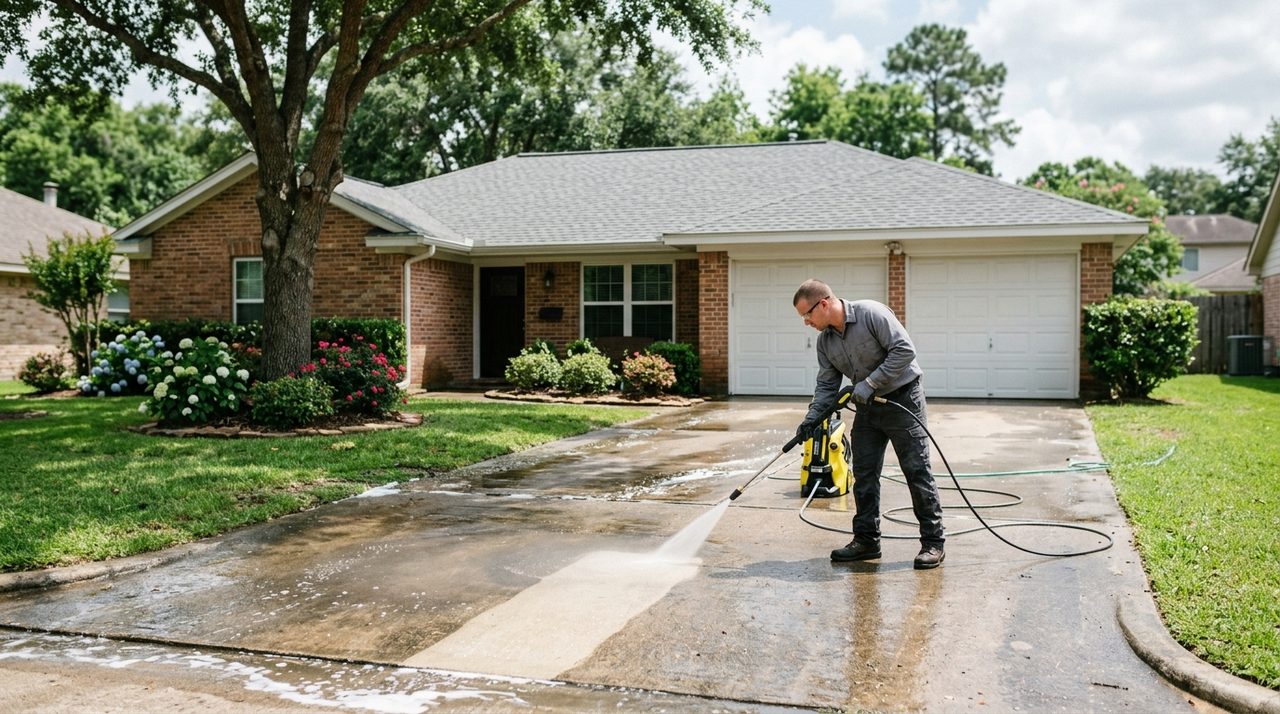
Cypress is a patchwork of HOA-governed subdivisions stretching from FM 1960 to the Grand Parkway, with slab-on-grade homes built across five decades sitting on Harris County's expansive Beaumont clay — a combination that loads driveways, brick facades, and wood fences with mineral staining, algae, and UV damage year after year. Because Cypress is unincorporated Harris County rather than a city, there is no municipal code enforcement driving cleaning timelines, but the subdivision HOAs absolutely are: architectural committees in communities like Lakewood Forest and Cypress Oaks North routinely flag algae-darkened driveways and gray wood fences with 30-day cure notices. This page explains what Cypress homeowners actually face on their exteriors and how to address it correctly.
Ranked by verified Google rating × review volume × verification tier. How we rank →
Some highly-rated pros serve Cypress from nearby and may not keep a Cypress street address. Those are listed under "Also serving Cypress" with their real city and distance, so you always know where each business is based.
16527 W Blue Hyacinth Dr, Cypress, TX 77433
14150 Huffmeister Rd Suite 200, Cypress, TX 77429
11934 Barker Cypress Rd, Cypress, TX 77433
21403 E Gold Buttercup Ct, Cypress, TX 77433
13340 Telge Rd Suite 401, Cypress, TX 77429
9907 Double Bayou Ct, Cypress, TX 77433
Cypress, TX 77429
25825 US-290 #303, Cypress, TX 77429
16635 Spring Cypress Rd #1933, Cypress, TX 77429
Highly-rated pros based nearby who cover Cypress. Distance shown from the Cypress area.
Serving Cypress Based in Jersey Village · 5.2 mi away
Why it matters to you
Cypress's dozens of independently operated subdivision HOAs — Lakewood Forest Fund, Cypress Creek Crossing, Villages of Cypress Lakes West, and many others — each maintain their own architectural review committees that issue written notices when driveways show green or black algae streaking or when wood fences turn gray. Cure windows can be as short as 30 days, and in a climate where Houston's annual humidity sits above 75%, staining returns quickly without a post-wash biocide treatment. Because Cypress is unincorporated Harris County rather than an incorporated city, there is no competing municipal code to navigate, but HOA deed restrictions carry contractual force with real fines.
What a good pro does
A knowledgeable operator will apply a sodium hypochlorite or quaternary ammonia biocide rinse after pressure washing driveways and concrete, extending the clean appearance by six months or more instead of the two to three months you get from water alone. For fences, the pro should match PSI to wood condition — weathered 1980s-era pine in older Cypress subdivisions near FM 1960 requires no more than 1,200 PSI to avoid splintering the grain — and document the completed work with photos you can submit to your HOA architectural committee to close the violation.
Sources: Local HOA / deed restrictions (see area profile)
Why it matters to you
Nearly every home in Cypress sits on a slab poured directly over Houston Black expansive clay, and that clay works against you through repeated wet-dry cycles: mineral salts wick upward through concrete and mortar joints, depositing chalky white efflorescence on driveway edges and foundation-level brick, while red-clay mud splash-back bakes onto brick during heavy rain events like the May 2024 derecho. Homes built in the 1980s and 1990s — a large share of Cypress's housing stock — have older, more porous concrete that absorbs these deposits deeper than newer pours.
What a good pro does
Standard cold-water rinsing at high pressure blasts the surface but does not dissolve mineral salt crystals locked in concrete pores; an experienced operator pre-treats efflorescence with a dilute muriatic or phosphoric acid solution, allows dwell time, then rinses at controlled pressure to lift deposits without etching the slab. On brick facades, a low-pressure soft-wash at under 500 PSI with an appropriate surfactant protects mortar joints that may already be stressed by decades of clay movement. No Harris County permit is required for residential pressure washing, and Texas has no state license for the trade itself, but operators applying algaecide or biocide products classified as pesticides should hold a Texas Department of Agriculture applicator credential.
Sources: International Residential Code (as adopted by City of Houston)
Why it matters to you
Cypress's median home was built in 2007 per Census data, meaning a large portion of the housing stock now carries roofs that are 15-plus years old — squarely in the zone where Gloeocapsa magma black algae streaks are highly visible and where asphalt shingle granules are already thinning from UV and storm wear. The May 2024 derecho and the broader Houston storm cycle have accelerated granule loss on many roofs, and HOA architectural committees in master-planned Cypress communities do cite discolored roofs in violation notices. Hitting an aging 3-tab or architectural shingle with high-pressure water above 500 PSI strips additional granules and can void manufacturer warranties.
What a good pro does
Proper roof cleaning in Cypress means a dedicated soft-wash rig operating at under 500 PSI — typically 100 to 300 PSI at the nozzle — delivering a sodium hypochlorite-based solution that kills algae at the root rather than blasting it off mechanically. A qualified operator will also post-treat with a zinc or copper sulfate residual to slow regrowth, which in Houston's humidity matters because untreated roofs can reshow streaking within two to three years. Confirm that any operator working on your roof carries general liability insurance sized for elevated work, since Texas has no trade license requirement for pressure washing but insurance is your primary protection against granule-loss or fall damage claims.
Sources: Local HOA / deed restrictions (see area profile), International Residential Code (as adopted by City of Houston)
Why it matters to you
Cypress's older subdivisions along FM 1960 and Huffmeister Road contain a meaningful number of 1980s and early-1990s homes with original concrete driveways that have never been sealed — 30-plus years of vehicle oil, transmission fluid, and tire oxidation have penetrated well below the surface layer. Winter Storm Uri in February 2021 made this worse by causing surface micro-spalling on driveways across unincorporated Harris County, opening the concrete's pore structure further and allowing subsequent oil deposits to migrate deeper. Cold-water pressure washing at any PSI setting will not emulsify petroleum-based staining trapped below the surface.
What a good pro does
Hot-water pressure washing units operating at 180°F to 200°F combined with an alkaline degreaser pre-soak are the industry standard for petroleum staining on aged concrete; the heat breaks the oil's bond with the slab matrix in a way cold water cannot. Operators using chemical degreasers must comply with TCEQ stormwater rules — wash water containing petroleum or chemical cleaners cannot be allowed to sheet into storm drains, which in Cypress route to Cypress Creek and its tributaries. Budget a 20 to 40 percent premium over standard driveway pricing for hot-water chemical jobs, putting a typical Cypress driveway in the $210 to $490 range (estimate) for this level of service.
Hiring pressure washing in Cypress? Cypress is an unincorporated area composed of dozens of separately platted subdivisions, each with its own HOA and deed restrictions. The housing stock spans from late-1970s ranch-style homes near FM 1960 to brand-new construction along the Grand Parkway, meaning contractors encounter a wide range of system ages and maintenance needs. Slab foundations, production-style builds, and HOA-regulated exteriors define the home services landscape here.
Building era
Late 1970s through 2020s, with concentrations in the 1980s–2000s era.
Typical style
Production suburban traditional and ranch-influenced one- and two-story homes; newer master-planned communities feature transitional and modern traditional facades with brick or brick-and-siding exteriors.
Foundations
Slab-on-grade (overwhelmingly dominant given post-1960s suburban construction; pier-and-beam is rare and limited to custom builds).
Common systems
Older 1980s–1990s homes: original builder-grade HVAC (10–15 SEER), copper or CPVC plumbing, and 100–200 amp electrical panels. 2000s–2010s homes: higher-efficiency HVAC, PEX plumbing, 200 amp panels. Homes from the 1970s–1980s may still have galvanized drain lines or polybutylene supply lines.
What that means for repairs
Kitchen and bath remodels are common in 1980s–1990s homes as original finishes age out. HVAC replacements are frequent in homes over 15 years old. Exterior updates often require HOA architectural review and approval before work begins.
Permit jurisdiction
Harris County Engineering Department (unincorporated area - not within City of Houston or any incorporated city limits).
HOA & deed restrictions
Mandatory HOAs are the norm in most platted subdivisions. Each subdivision operates independently (e.g., Lakewood Forest Fund, Cypress Creek Crossing HOA, Cypress Oaks North HOA, Villages of Cypress Lakes West). Older rural pockets and acreage tracts may have voluntary civic clubs or no organized association. Approximately 77% of Houston metro listings carry a mandatory HOA fee, and Cypress is explicitly cited as a high-HOA area.
Historic districts
No City of Houston historic district designation confirmed. Cypress is unincorporated Harris County with no known historic preservation overlays.
Contractor note
Contractors must pull permits through Harris County for structural, electrical, plumbing, and mechanical work. Nearly all subdivisions require HOA architectural committee approval for exterior modifications, fencing, roofing material changes, and paint colors before work begins.
FEMA flood zone
FEMA Zone X (low flood risk) per official NFHL data. Cypress Creek and its tributaries run through portions of the area, and specific parcels near waterways may carry higher flood designations — property-level FEMA lookups are recommended for homes near Cypress Creek, Faulkey Gully, or retention basins.
Hurricane Harvey impact
Not confirmed from provided research with subdivision-level specificity. Cypress Creek corridor flooding during Harvey (2017) impacted portions of the area, particularly homes in low-lying sections near creeks and bayous. Homeowners should check individual property flood claim history through FEMA and Harris County Flood Control District records.
Heat & humidity load
Prolonged 95°F+ heat and high humidity stress HVAC systems heavily; older 1980s–1990s units frequently fail during peak summer. Slab-on-grade foundations on expansive clay soils experience seasonal movement during summer drought cycles, leading to crack repair and foundation leveling demand. Exterior caulking and weatherproofing degrade quickly in UV and humidity.
Working with contractors here
Contractors in Cypress most commonly handle HVAC replacements and repairs, as the wide range of home ages means systems from the 1980s through the 2010s are cycling through end-of-life. Roof replacements are a major category, driven by storm damage and aging composition shingles, with HOA requirements often dictating material and color specifications. Plumbing repipes — especially replacing polybutylene or aging CPVC in 1980s–1990s homes — are a steady source of work. Foundation repair is common given the expansive clay soils and slab construction. Contractors should budget time for HOA architectural review submissions and Harris County permitting, as both processes can add lead time before work can commence.
Local Tip
Always ask for a written estimate before work begins. Texas contractors are required to provide one on jobs over $1,000.
Cypress is an unincorporated area composed of dozens of separately platted subdivisions, each with its own HOA and deed restrictions. The housing stock spans from late-1970s ranch-style homes near FM 1960 to brand-new construction along the Grand Parkway, meaning contractors encounter a wide range of system ages and maintenance needs. Slab foundations, production-style builds, and HOA-regulated exteriors define the home services landscape here.
Source: U.S. Census Bureau, ACS 5-Year 2023
Most of Cypress maps to FEMA Zone X (low mapped flood risk), but Houston's flash-flood reality means even low-risk blocks benefit from smart drainage and storm-hardened installs.
Source: FEMA National Flood Hazard Layer (NFHL). Flood zones vary by parcel — verify your individual FIRM panel.
Sources: Local HOA / deed restrictions (see area profile)
Sources: Local HOA / deed restrictions (see area profile)
Sources: Local HOA / deed restrictions (see area profile)