Serving Kemah Based in League City · 2.7 mi away
Best Pressure Washing in Kemah, TX
Kemah's bayfront location on Galveston Bay puts every exterior surface — pier-supported cottage decks, stucco townhome facades, fiber-cement siding, and ground-level parking slabs beneath elevated homes — in near-constant contact with salt air, tidal humidity, and storm surge residue. Homes here range from pre-1960s wood cottages to post-2008 elevated infill, and the combination of FEMA Zone AE flood exposure and Gulf-coast humidity means exterior grime, flood-line staining, and biological growth accumulate faster than anywhere inland. Understanding which surfaces can handle pressure and which require soft-wash chemistry — and how to keep wash water out of Galveston Bay — is what separates a competent Kemah wash job from one that damages a coastal home or draws a TCEQ notice.
Verified against Google Business data
Updated 2026
See the 10 Pressure Washing Serving Kemah 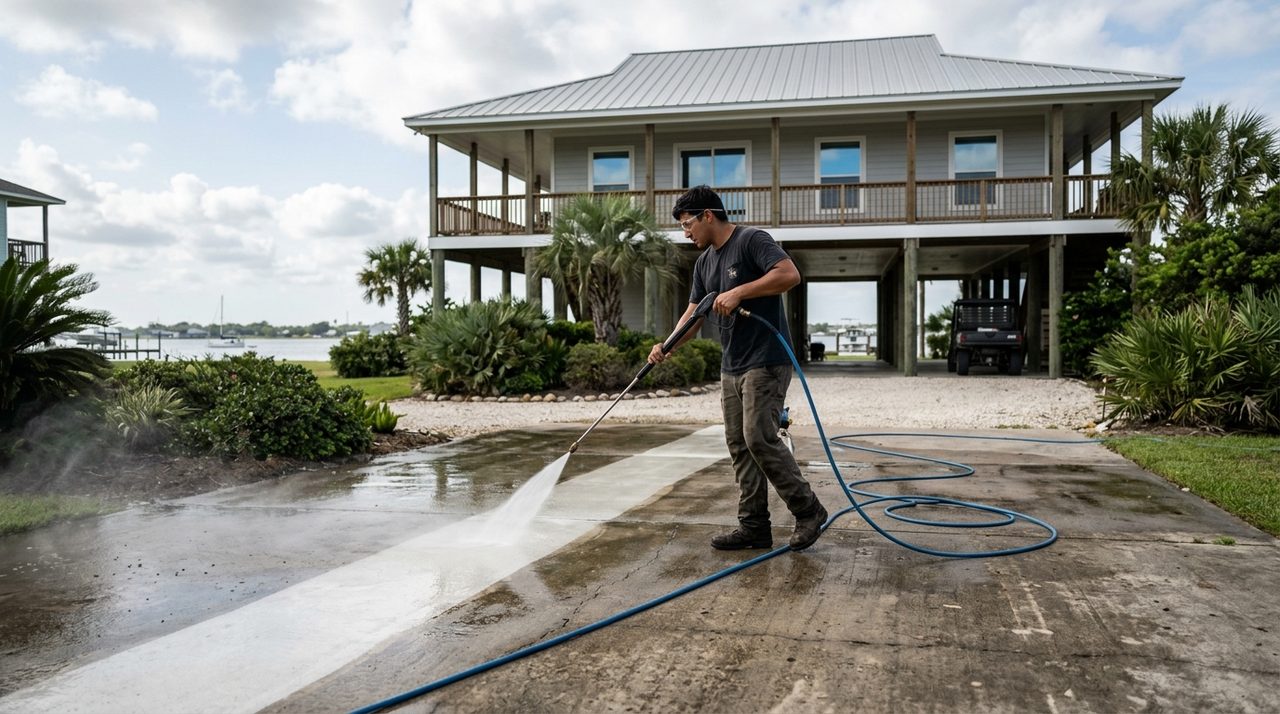
- Median home built
- 1995
- Median home value
- $268,900
- FEMA flood zone
- AE (high)
- Typical cost (est.)
- $250–$900
- Most common local issue
- Flood-line staining and salt-air biological crust on elevated pier homes
Ranked by verified Google rating × review volume × verification tier. How we rank →
Some highly-rated pros serve Kemah from nearby and may not keep a Kemah street address. Those are listed under "Also serving Kemah" with their real city and distance, so you always know where each business is based.
Min rating:
10 resultsAlso serving Kemah
Highly-rated pros based nearby who cover Kemah. Distance shown from the Kemah area.
Open Now
Serving Kemah Based in League City · 2.9 mi away
Open Now
Serving Kemah Based in Seabrook · 3.2 mi away
Open Now
Serving Kemah Based in Dickinson · 4 mi away
Closed
Serving Kemah Based in Seabrook · 4 mi away
Open Now
Serving Kemah Based in Clear Lake · 4.2 mi away
Closed
Serving Kemah Based in Dickinson · 4.7 mi away
Closed
Serving Kemah Based in Clear Lake · 5.3 mi away
Open Now
Serving Kemah Based in La Porte · 5.4 mi away
Closed
Serving Kemah Based in Webster · 5.8 mi away
Pressure Washing in Kemah: What You Should Know
Flood-Line Staining on Pier-Foundation Homes After Storm Surge
Why it matters to you
Kemah sits in FEMA Zone AE, and surge events — including Beryl in 2024 — deposit a distinct 'bathtub ring' of mud, organic matter, and mineral residue on the piling shafts, lower siding panels, and stair risers of elevated homes at exactly the high-water mark. On the pre-1960s and 1970s–1980s wood cottages still common near the original Kemah Townsite, that flood line can penetrate untreated wood grain and become nearly invisible until mold blooms behind it weeks later.
What a good pro does
A qualified operator will identify the flood-water height line before touching the surface, use a low-to-medium pressure rinse (under 1,500 PSI) on pilings and concrete stair treads, and apply a diluted sodium hypochlorite biocide to kill embedded organics on wood and fiber-cement panels rather than trying to blast them off. Post-storm jobs on Kemah's elevated homes almost always qualify for the 20–40% chemical pre-treatment premium given the depth of staining. Because the City of Kemah runs its own building department independently of Galveston County, no municipal wash permit is required — but TCEQ stormwater rules still govern where detergent-laden water is allowed to flow.
Sources: FEMA National Flood Hazard Layer (NFHL), Texas Commission on Environmental Quality
Salt-Air Biological Crust on Stucco and Fiber-Cement Townhome Facades
Why it matters to you
The 1990s–2000s waterfront redevelopment wave that reshaped Kemah's marina corridor produced hundreds of stucco and fiber-cement sided townhomes and condo units. Salt-laden Gulf breezes off Galveston Bay deposit a thin mineral film on these surfaces year-round, and Houston's 75%-plus average humidity gives Gloeocapsa magma (black algae) and green mold a persistent foothold — often re-colonizing within six to nine months of a basic rinse. On stucco in particular, high-pressure washing can open hairline cracks that accelerate moisture intrusion in a coastal environment where that moisture carries salt.
What a good pro does
The correct approach for Kemah's marina-district townhomes is a soft-wash system delivering under 500 PSI paired with a surfactant-enhanced sodium hypochlorite solution that dwells on the surface long enough to kill the biological growth at the root rather than just dislodging the visible layer. Project-level HOAs in some of Kemah's newer marina developments may impose architectural review requirements on exterior work — owners should pull their deed restriction documents from Galveston County Clerk records before scheduling, as cure windows for appearance violations can run as short as 30 days.
Sources: Local HOA / deed restrictions (see area profile), Texas Commission on Environmental Quality
Weathered Wood Deck and Dock-Access Stair Surfaces Beneath Elevated Homes
Why it matters to you
Kemah's elevated pier-and-beam homes — particularly the pre-1980s cottages and the 1990s redevelopments along the canals — typically feature wood decks, exterior stairways, and dock-access walkways that bear the full brunt of coastal weather: 100°F summers alternating with heavy tropical rain, and termite and carpenter-ant pressure that is sharply elevated in this bayfront environment. Untreated pine decking grays and checks within 12–18 months, and the spaces beneath raised homes trap humidity that accelerates mold growth on underside framing visible from the parking area.
What a good pro does
Pressure washing these surfaces before staining or sealing is a critical biennial step, but weathered coastal pine requires restraint — anything above 1,200 PSI will splinter soft grain that has been repeatedly wetted and dried by salt air. A competent operator will use a wide-fan tip (25–40 degree), maintain 12–18 inch stand-off distance, and follow the wash with a wood brightener to restore pH before the homeowner applies a penetrating sealer rated for coastal exposure. Texas does not require a state license for pressure washing as a standalone trade, so homeowners should ask specifically for proof of general liability insurance and experience with elevated coastal construction before booking.
Sources: Texas Commission on Environmental Quality, International Residential Code (as adopted by City of Houston)
Stormwater Runoff Compliance When Washing Near Galveston Bay
Why it matters to you
In Kemah, the storm drainage system does not terminate at a treatment plant — it flows directly toward Galveston Bay and the surrounding estuary. TCEQ regulations prohibit pressure-wash wastewater containing detergents, degreasers, or chemical algaecides from entering those storm drains, and the City of Kemah's own code enforcement operates independently from Harris County, meaning violations can be initiated at the municipal level. For homes with ground-level parking slabs or boat-trailer pads beneath elevated structures — a common Kemah configuration — oil and fuel residue from stored watercraft makes degreaser use nearly unavoidable.
What a good pro does
On any Kemah job involving chemical cleaners on a driveway, boat pad, or ground-level slab, a responsible operator will use inlet protection (drain blockers and berms) to contain wash water, vacuum-recover the contaminated runoff, and dispose of it properly rather than letting it sheet-flow toward the bay. This containment step adds time and cost — budget for the 20–40% premium typical of chemical pre-treatment jobs — but it is the only compliant approach on properties this close to a sensitive coastal waterway. Business registration and liability insurance are the practical minimum credentials to verify; no TDLR license exists for pressure washing in Texas, but TDA pesticide applicator credentials matter if the operator is applying concentrated algaecides.
Sources: Texas Commission on Environmental Quality, FEMA National Flood Hazard Layer (NFHL)
Pressure Washing in Kemah: What You Should Know
Hiring pressure washing in Kemah? Kemah is a small incorporated city on Galveston Bay with a mix of original bay cottages, 1990s–2000s waterfront redevelopment, and newer elevated townhome/marina communities. Homeowners here face persistent challenges from storm surge exposure, salt-air corrosion, and FEMA floodplain compliance requirements. Contractors working in Kemah must be familiar with elevated foundation systems, coastal building codes, and the City of Kemah's own permitting process.
- Housing era
- Mixed
- Foundation
- Mixed — pier-and-beam/elevated pile foundations dominate along the bayfront and canal-adjacent properties
- Flood zone
- FEMA Zone AE (high flood risk) — source
- Permits
- City of Kemah (independent incorporated city with its own municipal government and building department)
Housing stock & systems
Building era
Mixed: pre-1960s original cottages, 1970s–1980s infill, significant 1990s–2000s waterfront redevelopment, and post-2008 elevated infill.
Typical style
Coastal raised beach-house style (pier-supported with elevated living areas), traditional suburban SFRs (brick veneer or siding), and townhome/condo marina-oriented developments with stucco or fiber-cement siding.
Foundations
Mixed — pier-and-beam/elevated pile foundations dominate along the bayfront and canal-adjacent properties; slab-on-grade more common in interior and newer suburban pockets.
Common systems
Older cottages may have original copper or galvanized plumbing and outdated electrical panels; 1990s–2000s homes typically feature central HVAC, PVC/CPVC plumbing, and 200-amp electrical service. Salt-air exposure accelerates corrosion on HVAC condensers, metal roofing components, and exterior electrical fixtures across all eras.
What that means for repairs
Most common renovation activity includes elevating older homes to meet current FEMA BFE requirements, replacing storm-damaged structures with new elevated construction, upgrading HVAC and exterior materials to salt-air-resistant alternatives, and converting or remodeling ground-level areas beneath raised homes for parking or storage.
Permits & restrictions
Permit jurisdiction
City of Kemah (independent incorporated city with its own municipal government and building department).
HOA & deed restrictions
No city-wide mandatory HOA or master association. HOAs are present in specific newer townhome, condo, and marina developments on a project-by-project basis. Older platted areas (e.g., original Kemah Townsite) generally have no organized HOA. Voluntary civic clubs may exist in some pockets but are not confirmed. Deed restrictions vary by subdivision — check Galveston County Clerk records for specific parcels.
Historic districts
No City of Houston historic district designation confirmed. Kemah is an independent incorporated city; no HAHC jurisdiction applies. No locally designated historic districts confirmed in current city records.
Contractor note
Contractors must pull permits through the City of Kemah, not Houston or Galveston County. Coastal AE zone requirements often mandate elevation certificates, flood-resistant materials below BFE, and compliance with FEMA substantial improvement/damage rules for renovations exceeding 50% of the structure's market value.
Flood & weather
FEMA flood zone
FEMA Zone AE (high flood risk) — source: fema_nfhl. Kemah sits directly on Galveston Bay and is exposed to both storm surge and tidal flooding. Much of the city falls within AE and potentially VE (velocity) zones along the immediate shoreline. Proximity to Clear Creek and Galveston Bay amplifies flood risk during tropical weather events.
Hurricane Harvey impact
Kemah experienced flooding during Hurricane Harvey (2017) from a combination of extreme rainfall and storm surge/tidal influence from Galveston Bay. Specific damage data for Kemah was not itemized separately from broader Galveston County FEMA reports, but the bayfront location and low elevation made the area vulnerable to both surge-driven and rain-driven flooding. Many older, non-elevated homes in the area sustained water damage. Post-Harvey, elevated construction and stricter floodplain compliance have become more prevalent.
Heat & humidity load
Extreme humidity and sustained heat along Galveston Bay push HVAC systems hard from May through October. Salt-laden coastal air accelerates corrosion on condenser coils, ductwork fasteners, and exterior metal components. Pier-and-beam homes benefit from under-house ventilation but require regular inspection for moisture damage, mold, and pest intrusion during the humid season.
Working with contractors here
Contractors in Kemah most frequently handle foundation elevation projects, HVAC replacement with salt-air-resistant units, and exterior envelope repairs caused by coastal weather exposure. Roof replacements are common after storm events, with wind-rated materials and proper tie-downs critical given the bayfront exposure. Plumbing work in older cottages often involves full re-pipes from galvanized to modern materials. Job scoping must account for FEMA elevation requirements — any substantial improvement to a structure in the AE zone requires bringing the entire building into current floodplain compliance, which can dramatically expand project scope and cost. Access can be tight on narrow waterfront lots, and contractors should verify whether the specific property falls under a project-level HOA with architectural review requirements before beginning exterior work.
Local Tip
Always ask for a written estimate before work begins. Texas contractors are required to provide one on jobs over $1,000.
About Kemah
Kemah is a small incorporated city on Galveston Bay with a mix of original bay cottages, 1990s–2000s waterfront redevelopment, and newer elevated townhome/marina communities. Homeowners here face persistent challenges from storm surge exposure, salt-air corrosion, and FEMA floodplain compliance requirements. Contractors working in Kemah must be familiar with elevated foundation systems, coastal building codes, and the City of Kemah's own permitting process.
- Median year built
- 1995
- Median home value
- $268,900
- Owner-occupied
- 65%
- Population
- 1,952
- Housing units
- 872
- Median income
- $95,152
Source: U.S. Census Bureau, ACS 5-Year 2023
Flood & storm risk
FEMA Zone AEHigh flood riskMuch of Kemah maps to FEMA Zone AE (high flood risk), so flood-resilient detailing -- elevated equipment, water-tolerant materials, and drainage-first thinking -- is essential here, not optional; risk climbs sharply on blocks nearest Galveston Bay, where it varies parcel to parcel.
Source: FEMA National Flood Hazard Layer (NFHL). Flood zones vary by parcel — verify your individual FIRM panel.
Frequently Asked Questions
Do I need a permit from the City of Kemah to have my house exterior or driveway pressure washed?
Routine residential pressure washing does not require a building permit through the City of Kemah's own municipal building department — the same is true across most of the Houston metro. However, because Kemah is an independent incorporated city, any questions should go directly to City of Kemah Building and Inspections, not to Houston's Permitting Center or Galveston County. If a wash job is paired with structural repairs to an elevated foundation or deck that cross the FEMA substantial-improvement threshold (50% of the structure's market value), that repair work — not the washing itself — will trigger permit and floodplain compliance review.
My pier-foundation home in Kemah is in FEMA Zone AE — does that affect what products a pressure washing company can legally use near the water?
Yes, indirectly. TCEQ regulations prohibit wash water containing detergents, degreasers, or chemical algaecides from entering storm drains, which in Kemah drain rapidly toward Galveston Bay — a sensitive coastal water body. A legitimate operator working near the bay or a canal-adjacent lot should use a containment setup or low-volume soft-wash methods that minimize runoff, and should be able to explain their wastewater handling. Ask any company specifically how they manage chemical runoff on waterfront or near-water properties before they start.
Sources: Texas Commission on Environmental QualityFEMA National Flood Hazard Layer (NFHL)
How soon after a storm like Hurricane Beryl should Kemah homeowners schedule pressure washing to remove flood-line staining from brick or stucco?
Waiting at least two to four weeks after floodwaters fully recede is advisable, primarily so any structural or moisture-intrusion inspection can happen first — washing a facade too early can force water into cracks or compromised mortar joints on older cottages and 1990s-era stucco townhomes. Once surfaces are confirmed structurally sound, the sooner organic flood residue, silt, and tannin staining are addressed the better, because baked-in summer heat sets those stains into porous brick and fiber-cement siding faster in Kemah's Gulf-coast climate. Post-storm jobs typically carry a 20–40% cost premium over routine cleaning due to chemical pre-treatment requirements — budget that as an estimate when getting quotes.
I have a townhome in one of Kemah's marina developments with a project-level HOA — can my HOA restrict which pressure washing methods I use?
Yes. Project-specific HOAs in Kemah's newer waterfront townhome and marina communities can include architectural review provisions in their CC&Rs that restrict high-pressure washing on certain exterior cladding materials — stucco and fiber-cement siding are the most commonly protected surfaces because high-pressure wands can open micro-cracks that accelerate salt-air intrusion. Before hiring anyone, pull your CC&Rs from Galveston County Clerk records to check whether your HOA specifies soft-wash-only methods or requires prior approval for exterior cleaning. If your development has no HOA — as is common in older platted areas like the original Kemah Townsite — you have no HOA review requirement, but the TCEQ runoff rules still apply regardless.
Sources: Local HOA / deed restrictions (see area profile)Texas Commission on Environmental Quality
Does the salt air in Kemah mean pressure washing needs to happen more frequently than it would for an inland Houston home?
In practice, most Kemah homeowners with bayfront or canal-facing elevations find that biological crust, algae, and salt-mineral deposits become visually noticeable every 12 to 18 months rather than the 24-to-36-month cycle typical of inland Houston suburbs. The combination of persistent Gulf humidity, salt-laden air off Galveston Bay, and frequent moisture from tidal events accelerates surface colonization on stucco, fiber-cement, and wood deck boards. Applying a post-wash biocide or UV-stabilized sealant after each cleaning — particularly on wood surfaces beneath elevated decks and stair stringers — is the most cost-effective way to extend time between service visits.
Are there pressure washing companies that specifically know how to work on Kemah's elevated pier homes without damaging the ground-level structural piling areas?
You should specifically ask any company whether they have experience with pier-and-beam or pile-supported coastal construction, because the underside of an elevated home presents real access and pressure-control challenges — water forced into gaps between treated piling and beam connections can accelerate wood rot or corrode metal connector hardware if the operator is not careful with angle and PSI. Ask for references from other Kemah or Clear Lake-area elevated-home jobs, and confirm they carry general liability insurance sized for waterfront properties where equipment or water damage could affect both the structure and a neighbor's dock or boat. Checking the Texas Secretary of State or Galveston County records for business registration is a straightforward baseline verification step.