2401 25th Ave N, Texas City, TX 77590
Best Roofers in Texas City, TX
Texas City sits on Galveston Bay's northwestern shore, placing its rooftops in TWIA's coastal catastrophe zone where salt-laden Gulf winds, tropical systems, and the May 2024 derecho's 100-mph-plus straight-line gusts converge on a housing stock ranging from mid-century Gulf Coast cottages near the historic core to brand-new production-builder homes in Lago Mar and Park Place South. Permitting runs through the City of Texas City's own Permits and Inspections Department — not Houston's permitting center — and HOA architectural approval requirements in the newer master-planned subdivisions add a layer of compliance that can delay storm repairs by weeks. This page covers the roofing challenges that actually apply here: coastal wind uplift, salt-air fastener corrosion, heat and UV breakdown on low-slope sections, and the HOA approval process specific to Lago Mar and Park Place South.
Verified against Google Business data
Updated 2026
See the 8 Roofers Serving Texas City 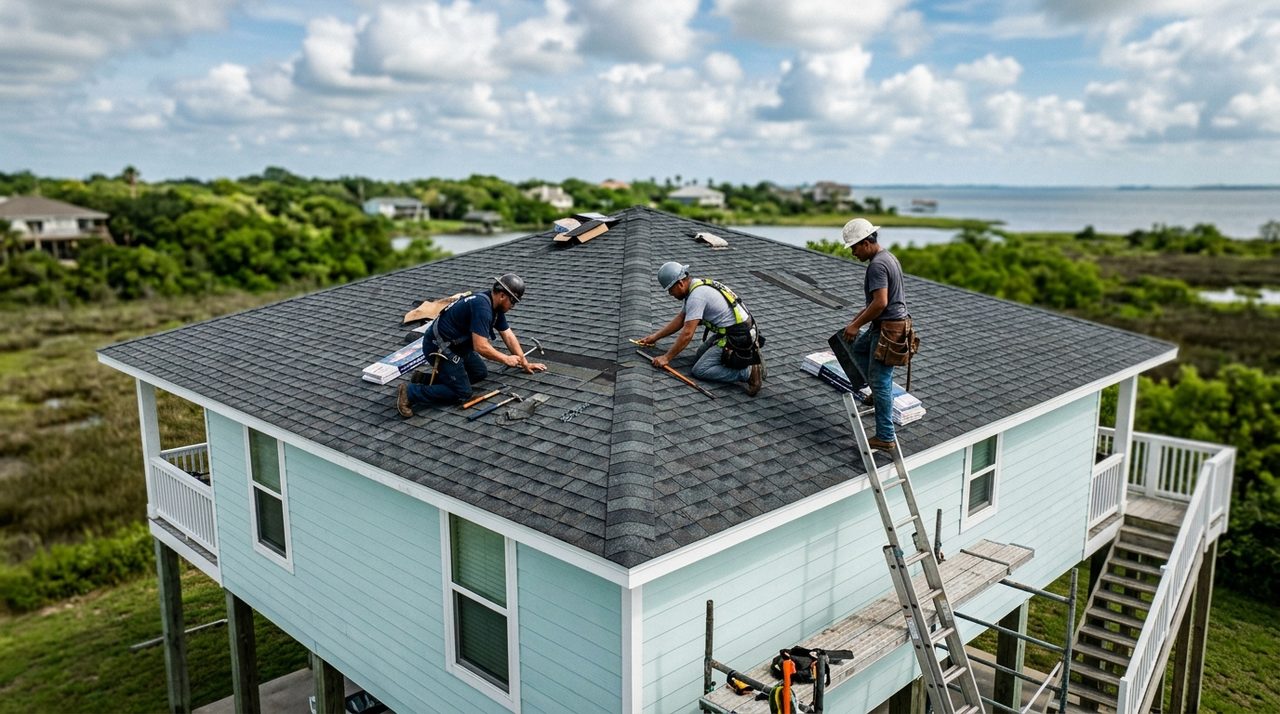
- Median home built
- 1981
- Median home value
- $190,600
- FEMA flood zone
- X (low)
- Typical re-roof cost (est.)
- $9,000–$16,000 (arch. shingle, 1,800–2,400 sq ft); Class 4 upgrade adds $1,500–$3,500
- Most common local issue
- Coastal wind uplift + salt-air fastener corrosion on aging Gulf Coast housing stock
Ranked by verified Google rating × review volume × verification tier. How we rank →
Some highly-rated pros serve Texas City from nearby and may not keep a Texas City street address. Those are listed under "Also serving Texas City" with their real city and distance, so you always know where each business is based.
Min rating:
8 resultsBased in Texas City
5013 Allen Cay Dr, Texas City, TX 77590
Closed
1450 Texas Ave, Texas City, TX 77590
Also serving Texas City
Highly-rated pros based nearby who cover Texas City. Distance shown from the Texas City area.
Closed
Serving Texas City Based in La Marque · 4.3 mi away
Open Now
Serving Texas City Based in La Marque · 4.5 mi away
Closed
Serving Texas City Based in La Marque · 5 mi away
Closed
Serving Texas City Based in La Marque · 6.4 mi away
Closed
Serving Texas City Based in Galveston · 8.7 mi away
Roofers in Texas City: What You Should Know
TWIA Wind Zone Uplift on Texas City's Older Gulf Coast Homes
Why it matters to you
Homes built near Texas City's historic core and refinery-adjacent neighborhoods in the mid-20th century predate the 2006 IRC wind-resistance upgrades that standardized improved nail patterns and enhanced starter-strip adhesion. Texas City's Galveston County location places it squarely inside TWIA's designated catastrophe area, meaning your roof must meet specific wind-rated installation standards to remain insurable — and an aging 3-tab or early architectural shingle roof almost certainly falls short. The May 2024 derecho and every tropical system that crosses Galveston Bay test these roofs directly, with ridge caps and shingle tabs being the first casualties on homes with inadequate fastening.
What a good pro does
A qualified roofer working in Texas City should specify corrosion-resistant ring-shank or screw-shank nails and a minimum six-nail pattern on field shingles to satisfy TWIA's wind-rated installation requirements. They should also pull a permit through the City of Texas City Permits and Inspections Department before work begins — not the Houston Permitting Center, which has no jurisdiction here — so the installation is inspected and documented for TWIA claims purposes. Upgrading to a Class 4 impact-resistant architectural shingle at replacement adds wind and hail resilience that can reduce TWIA premium exposure.
Sources: Texas Windstorm Insurance Association (TWIA), International Residential Code (as adopted by City of Houston), Municipal permit office (see area profile)
Salt-Air Corrosion Attacking Fasteners, Flashing, and Metal Roof Components
Why it matters to you
Texas City's position on Galveston Bay means airborne salt aerosols continuously attack metal roofing components — standard galvanized flashing, roofing nails, ridge vent hardware, and pipe boot collars begin corroding within years rather than decades in this environment. This is especially pronounced on the older homes near the historic core and along bay-adjacent streets, where original flashing may already show pinhole rust and failed sealant joints that let moisture track into the OSB decking. A census median year built of 1981 means a large share of Texas City's housing stock has original or first-replacement roofing details that were not specified for a marine-adjacent salt environment.
What a good pro does
Roofers working in Texas City should spec stainless-steel or hot-dipped galvanized ring-shank nails (not electro-galvanized) and use copper or aluminum step flashing rather than standard galvanized sheet at wall-to-roof junctions. Pipe boots should be neoprene or silicone-collared aluminum, not standard EPDM, which salt air degrades faster. All penetration flashing should be sealed with a polyurethane-based caulk rated for coastal exposure, and any re-roof contract should include a decking inspection to identify salt-moisture-compromised OSB panels before new shingles are laid.
Sources: International Residential Code (as adopted by City of Houston), Municipal permit office (see area profile)
Extreme UV and Heat Breakdown on Low-Slope Sections in Newer Subdivisions
Why it matters to you
The production-builder homes dominant in Lago Mar and Park Place South — constructed primarily in the 2010s and 2020s — frequently include low-slope or flat roof sections over garages, rear covered patios enclosed under a shed roof, or single-story great-room bumps where the pitch drops below 2:12. Houston's 2,700-plus cooling degree days and sustained 95–105°F ambient temperatures from May through September push attic deck temps well above 160°F, accelerating binder oxidation in modified bitumen membranes and causing TPO seams to soften and open. Because these sections are often invisible from the street, homeowners in Lago Mar commonly discover ponding-related interior damage only after drywall staining appears.
What a good pro does
At re-roof or repair, a roofer should verify that any low-slope section (under 2:12) receives a membrane system — modified bitumen or TPO — rather than standard shingles, which the IRC does not approve below 2:12 without special detailing. Drains and scuppers should be cleared and upsized if possible to handle Houston's extreme rainfall intensity. For newer homes still within builder warranty periods, document all deficiencies in writing before the warranty expires, since Lago Mar and Park Place South homes built in the late 2010s are approaching the typical 10-year structural warranty cutoff.
Sources: International Residential Code (as adopted by City of Houston), ENERGY STAR / U.S. Dept. of Energy, FEMA National Flood Hazard Layer (NFHL)
HOA Architectural Approval Delays in Lago Mar and Park Place South
Why it matters to you
Homeowners in Lago Mar (managed by Principle Management Group) and Park Place South face mandatory Architectural Review Committee approval before any roofing material change — including switching shingle color, upgrading to metal, or installing a different product line than the original. ARC review cycles in active master-planned communities commonly run 10–30 days, which creates a real problem when storm damage demands fast action: starting work without written ARC approval risks fines and a forced redo at your expense, but waiting the full review cycle extends interior water exposure. Texas City's patchwork HOA landscape means older neighborhoods near the historic core may have only recorded deed restrictions and no active HOA, so confirm your specific lot's status before assuming either direction.
What a good pro does
Before signing a roofing contract in an HOA-governed Texas City subdivision, request the ARC submittal form from the management company and have your roofer prepare a product spec sheet, color sample, and manufacturer data sheet as part of the submission package — a complete submission moves faster than a partial one. If storm damage is active, contact the HOA in writing immediately to establish a documented emergency timeline; some associations allow temporary weatherproofing (tarping) to proceed without full ARC approval while the formal review runs. Confirm HOA status lot-by-lot via the Galveston County Clerk or hoa.texas.gov rather than relying on a neighbor's experience, since deed restriction status is not uniform block-to-block in Texas City.
Sources: Local HOA / deed restrictions (see area profile), Municipal permit office (see area profile)
Roofers in Texas City: What You Should Know
Hiring roofers in Texas City? Texas City is an incorporated Galveston County city with a wide range of housing stock, from newer master-planned communities like Lago Mar to older neighborhoods near the historic core and refineries. Homeowners here face coastal weather exposure, salt-air corrosion, and varying flood risk depending on elevation and proximity to the bay. Permitting runs through the City of Texas City, not Houston, and HOA requirements vary significantly by subdivision.
- Housing era
- Mixed — older core neighborhoods date to the mid-20th century
- Foundation
- Predominantly slab-on-grade in modern subdivisions
- Flood zone
- FEMA Zone X (low flood risk) per official NFHL data
- Permits
- City of Texas City Permits and Inspections Department (independent municipality, not Houston Permitting Center)
Housing stock & systems
Building era
Mixed — older core neighborhoods date to the mid-20th century; master-planned communities like Lago Mar and Park Place South are primarily 2010s–2020s construction.
Typical style
Modern production-builder suburban homes (brick and stone, one- and two-story) in newer subdivisions; older areas feature more varied Gulf Coast residential styles.
Foundations
Predominantly slab-on-grade in modern subdivisions; some older coastal and bay-adjacent homes may be pier-and-beam or raised construction — confirm via Galveston County Appraisal District records.
Common systems
Newer homes feature modern central HVAC, PEX or CPVC plumbing, and 200-amp electrical panels; older homes may have original ductwork, galvanized or copper plumbing, and smaller electrical services requiring upgrades.
What that means for repairs
Older homes near the historic core often need HVAC modernization, electrical panel upgrades, and corrosion-related exterior repairs due to salt air and industrial proximity. Newer HOA communities focus on cosmetic upgrades and energy efficiency improvements.
Permits & restrictions
Permit jurisdiction
City of Texas City Permits and Inspections Department (independent municipality, not Houston Permitting Center).
HOA & deed restrictions
Mixed — mandatory HOAs govern newer subdivisions including Lago Mar Owners Association (managed by Principle Management Group) and Park Place South Homeowners Association. Older neighborhoods may have only recorded deed restrictions with no active HOA. HOA status must be confirmed lot-by-lot via deed records, Galveston County Clerk, or hoa.texas.gov.
Historic districts
No City of Houston historic district designation confirmed. Texas City is a separate incorporated municipality; any local historic designations would be administered by the City of Texas City.
Contractor note
Contractors must pull permits through the City of Texas City, not Harris County or the City of Houston. HOA-governed subdivisions like Lago Mar and Park Place South require architectural approval before exterior work begins; confirm requirements with the specific HOA management company.
Flood & weather
FEMA flood zone
FEMA Zone X (low flood risk) per official NFHL data. However, Texas City is a low-lying coastal community along Galveston Bay, and localized flooding can occur in areas near Dickinson Bayou, Moses Lake, and the bay shoreline. Flood risk varies significantly by subdivision and elevation.
Hurricane Harvey impact
Specific Harvey 2017 flood depths and damage data for Texas City subdivisions were not confirmed in available research. As a low-lying coastal community in Galveston County, Texas City likely experienced storm surge and rainfall impacts, but street-level or subdivision-specific flood data should be verified through FEMA claims records, the Galveston County Appraisal District, or the Texas General Land Office.
Heat & humidity load
Extreme humidity and salt air from Galveston Bay accelerate exterior corrosion on HVAC condensers, metal roofing components, and fasteners. Older homes without adequate insulation or modern HVAC systems face heavy cooling loads. Mold risk is elevated in poorly ventilated homes, especially those with pier-and-beam foundations near the coast.
Working with contractors here
Texas City's dual housing stock creates two distinct contractor markets. In newer master-planned communities like Lago Mar and Park Place South, work centers on warranty-period punch lists, fence and patio additions within HOA guidelines, and energy-efficiency upgrades. In older neighborhoods, contractors commonly handle HVAC system replacements, electrical panel upgrades from 100-amp to 200-amp service, re-piping from galvanized to PEX, and exterior repairs driven by salt-air corrosion. Coastal proximity means roofing contractors must account for wind uplift ratings and corrosion-resistant fasteners. All work requires City of Texas City permits, and contractors unfamiliar with the local permitting process should budget additional time compared to Houston-area jurisdictions.
Local Tip
Always ask for a written estimate before work begins. Texas contractors are required to provide one on jobs over $1,000.
About Texas City
Texas City is an incorporated Galveston County city with a wide range of housing stock, from newer master-planned communities like Lago Mar to older neighborhoods near the historic core and refineries. Homeowners here face coastal weather exposure, salt-air corrosion, and varying flood risk depending on elevation and proximity to the bay. Permitting runs through the City of Texas City, not Houston, and HOA requirements vary significantly by subdivision.
- Median year built
- 1981
- Median home value
- $190,600
- Owner-occupied
- 53.9%
- Population
- 54,159
- Housing units
- 23,248
- Median income
- $65,447
Source: U.S. Census Bureau, ACS 5-Year 2023
Flood & storm risk
FEMA Zone XLow flood riskMost of Texas City maps to FEMA Zone X (low mapped flood risk), but Houston's flash-flood reality means even low-risk blocks benefit from smart drainage and storm-hardened installs; as a Galveston County coastal community, tropical surge and wind add a layer generic guidance misses.
Source: FEMA National Flood Hazard Layer (NFHL). Flood zones vary by parcel — verify your individual FIRM panel.
Houston Storm Readiness in Texas City
Hurricane & flooding
For homeowners in Texas City, TX: beryl 2024 stripped unsealed ridge vents and attic ventilators off roofs across low-flood-risk Houston neighborhoods, creating interior soaking before homeowners even knew there was an opening. Have a roofer install hurricane-rated ridge vent covers or temporarily cap off-ridge ventilators if a storm is within 72 hours of landfall. As a Galveston County community, Texas City may follow county rather than City of Houston storm rebuild rules.
Severe storms & hail
After a severe thunderstorm, the first thing a roofer should check in Texas City, TX is whether wind-driven rain has pushed up under any low-slope transition sections—areas where a steep roof meets a flatter porch or addition—because these joints separate under gust pressure and rarely reseal on their own. Sealing those transitions with a peel-and-stick modified bitumen patch costs far less than replacing the framing they protect. Confirm the current FEMA panel for your Texas City parcel — the area maps to Zone X, but adjacent lots can differ.
Ice storms & freezes
Even in lower-flood-risk Texas City, TX, a hard freeze following a rainstorm can trap water under lifted perimeter shingles and expand it into cracks in the decking, a failure mode that became widespread during Uri 2021. Ask a roofer to hand-seal any perimeter shingles showing daylight beneath them before December so freeze-water expansion does not open your deck to spring rains. With a median build year of 1981, the older building stock here is more exposed to hard-freeze damage than newer construction. As a Galveston County community, Texas City may follow county rather than City of Houston storm rebuild rules.
Sources: FEMA National Flood Hazard Layer (NFHL), Ready.gov -- Hurricanes, CenterPoint Energy -- Storm Center, City of Houston -- Emergency Preparedness, Ready.gov -- Winter Weather, Harris County Flood Control District
Free Texas City Tools & Calculators
Houston-specific estimators to plan your project before you call a pro. All results are planning estimates — a licensed local pro confirms the details on site.
Hurricane Roof Wind-Load & TDI/WPI-8 Estimator
Open full tool & FAQ →115–120 mph
Estimated design wind speed for your zone
Outside the TDI catastrophe area, so a WPI-8 is generally not mandated — but Houston still sees hurricane-force gusts (Beryl, 2024). Insist on properly rated shingles installed to the manufacturer's high-wind nailing pattern (6 nails) and starter strips, or a wind claim can be denied for improper installation.
Find a Houston roofer →This is a planning estimate only — actual requirements depend on an on-site assessment by a licensed Houston pro. Wind-speed zones are approximate; your exact TDI/WPI-8 obligation depends on your address's designation. Verify with the Texas Department of Insurance before contracting.
Houston Freeze Prep & Pipe Insulation Checklist
Open full tool & FAQ →Your freeze checklist — 4 tasks
- 1
Disconnect & drain every outdoor hose bib
Remove hoses, drain the spigots, and cover each with an insulated faucet sock. Un-drained hose bibs are the #1 burst point in a Houston freeze.
- 2
Insulate exposed pipes in the attic & garage
Wrap any pipe in an unconditioned space (attic runs, garage walls) with foam sleeves. Houston homes rarely insulate these because they only matter a few nights a year — which is exactly why they burst.
- 3
Open cabinet doors & keep a pencil-width drip
On hard-freeze nights, open kitchen/bath cabinets so warm air reaches the pipes and let faucets on exterior walls drip to relieve pressure.
- 4
Protect the attic/garage water heater & its lines
An attic or garage tank sits in unconditioned space. Insulate the cold-inlet and hot-outlet lines and confirm the emergency drain pan is clear so a leak doesn't reach the ceiling.
This is a planning estimate only — actual requirements depend on an on-site assessment by a licensed Houston pro. If a pipe has already burst, shut off your main water supply and call a licensed Houston plumber immediately — freeze bursts flood fast.
Frequently Asked Questions
Do I need a permit from the City of Texas City to replace my roof after storm damage?
Yes — roofing permits in Texas City are pulled through the City of Texas City Permits and Inspections Department, which is a completely separate jurisdiction from the City of Houston Permitting Center or Harris County. A full re-roof or structural deck repair requires a permit; confirm with the department whether a like-for-like shingle repair on a non-structural section triggers the same requirement, as the rules differ from Houston's. Any contractor who tells you they'll 'handle it through Houston' is filing in the wrong jurisdiction and your work may be unpermitted.
Sources: Municipal permit office (see area profile)
My Texas City home was built in the early 1980s — should I expect the roofer to find rotted decking underneath the old shingles?
Homes built around Texas City's Census median year of 1981 commonly have original plywood decking that has been exposed to Gulf Coast humidity for over 40 years, and some were re-roofed with a second layer of shingles stacked on top rather than torn off — trapping moisture against the deck. Ask any roofer you interview whether they do a full tear-off and how they price per-sheet decking replacement, which is typically charged as an add-on (estimate $2–$4 per square foot for new OSB or plywood) after the old material is removed. Coastal salt air accelerates fastener and deck degradation, so budget for at least partial decking replacement on a home of this era.
Sources: International Residential Code (as adopted by City of Houston)
Does Texas City's FEMA Zone X designation mean I don't need to worry about wind ratings on my new roof?
FEMA Zone X addresses mapped flood risk, not wind exposure — and Texas City's position as a Galveston County coastal community places it squarely within TWIA's catastrophe zone regardless of flood designation. That means your roofing materials and installation method should meet TWIA's product approval and nail pattern requirements if you carry wind coverage through the Texas Windstorm Insurance Association, which is the primary wind insurer for Galveston County properties. Confirm with your TWIA policy that the shingles installed are on TWIA's approved products list before installation begins, not after.
Sources: Texas Windstorm Insurance Association (TWIA)FEMA National Flood Hazard Layer (NFHL)
I live in Lago Mar — do I need HOA approval before I let a roofer start work, or can I get the permit first and approve the materials later?
In Lago Mar, the Lago Mar Owners Association (managed by Principle Management Group) requires Architectural Review Committee approval before exterior work begins, and this runs on a separate track from the City of Texas City permit process — you need both, and the HOA step can take 10–30 days. Starting work without ARC approval, even with a valid city permit in hand, can result in fines and a forced redo at your expense if the HOA rejects the material color or product choice after installation. Submit your shingle sample, color, and manufacturer spec sheet to the HOA before you schedule the crew.
Sources: Local HOA / deed restrictions (see area profile)
When is the worst time of year to schedule a roof replacement in Texas City, and how far out should I book?
Atlantic hurricane season runs June through November, and a major Gulf event — like a direct or near-direct hit — can trigger a contractor backlog that pushes prices 15–25% above baseline for 6–18 months as post-storm demand floods the market (as seen after Harvey in 2017). The practical window for planned replacement is January through March, when demand is lower, crews are more available, and daytime temperatures allow adhesive strips on shingles to seat properly before summer heat sets in. If you're doing a post-storm claim repair in peak season, confirm your chosen contractor is registered with the City of Texas City and not a storm-chaser operating without local ties.
Sources: Municipal permit office (see area profile)
Texas has no state roofing license — so what exactly should I ask a Texas City roofer to verify before I sign anything?
Because Texas does not issue a state roofing contractor license through TDLR or any other agency, the burden of vetting falls entirely on you as the homeowner. Ask the contractor for a current Certificate of Insurance showing general liability and workers' compensation coverage, proof of City of Texas City contractor registration (required to pull a permit here), and documentation that the shingles they plan to install are on TWIA's approved products list if you carry windstorm coverage. For older homes near the Texas City historic core, also confirm whether the roof deck age triggers any lead-paint or asbestos-containing material protocol on pre-1978 structures before demolition begins.
Sources: Texas Windstorm Insurance Association (TWIA)EPA Lead Renovation, Repair and Painting (RRP) Rule