Serving The Heights Based in Lazybrook / Timbergrove · 1.7 mi away
Best Solar Installers in The Heights
The Heights throws solar installers an unusually complex hand: a single block can hold a 1910 Craftsman bungalow with cloth-wrapped wiring and a 2015 four-story townhome with a 200-amp panel and a rooftop deck, and portions of the neighborhood fall inside City of Houston Historic Districts where exterior modifications—including panel placement—require a Certificate of Appropriateness from the Houston Archaeological & Historical Commission before a permit can even be submitted. Add the City of Houston Permitting Center's 2–4 week electrical review queue and the need to reconcile aging electrical infrastructure in renovated bungalows with battery-storage code requirements, and this inner-loop neighborhood demands more pre-job homework than most Houston ZIP codes. Reading this page will help you sort out what questions to ask before signing any contract.
Verified against Google Business data
Updated 2026
See the 10 Solar Installers Serving The Heights 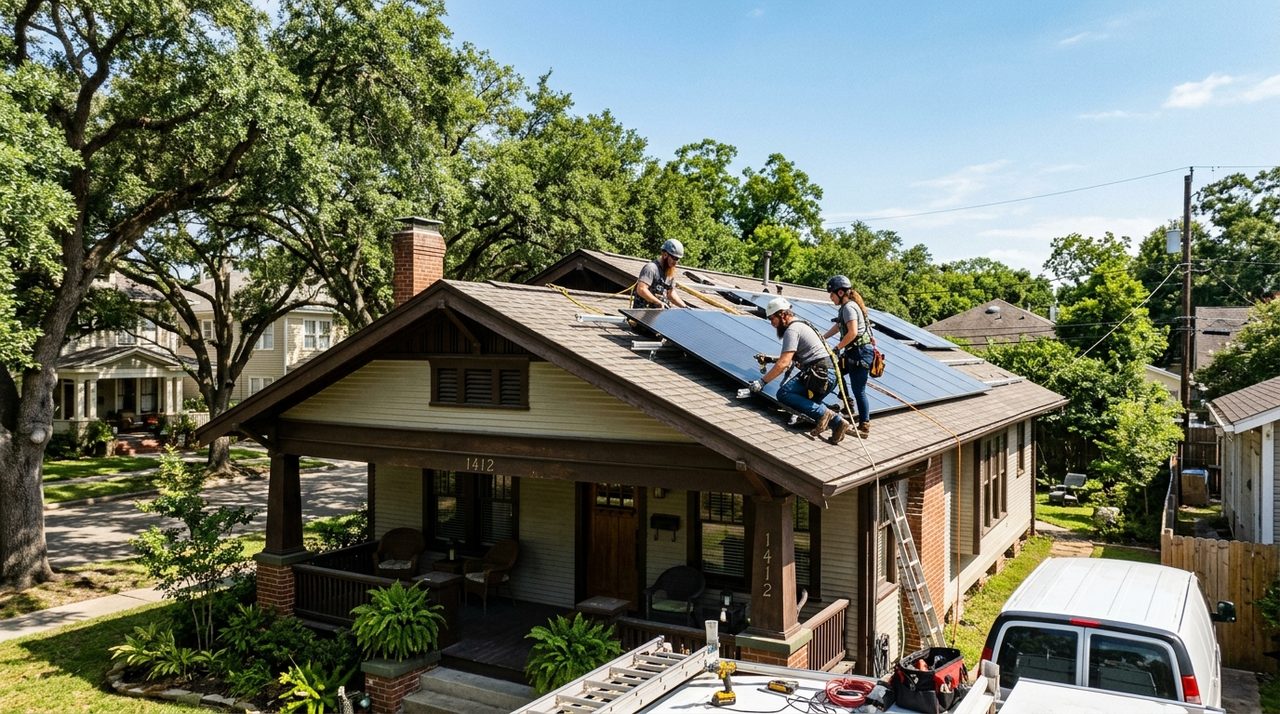
- Median home built
- 1978
- Median home value
- $513,961
- FEMA flood zone
- X (low)
- Typical system cost (est., before 30% ITC)
- $22,000–$35,000 for 8–10 kW
- Most common local issue
- Outdated electrical panels in renovated bungalows requiring full upgrade before solar or battery installation
Ranked by verified Google rating × review volume × verification tier. How we rank →
Some highly-rated pros serve The Heights from nearby and may not keep a The Heights street address. Those are listed under "Also serving The Heights" with their real city and distance, so you always know where each business is based.
Min rating:
10 resultsAlso serving The Heights
Highly-rated pros based nearby who cover The Heights. Distance shown from the The Heights area.
Closed
Serving The Heights Based in Lazybrook / Timbergrove · 2.8 mi away
Closed
Serving The Heights Based in Spring Branch · 2.9 mi away
Closed
Serving The Heights Based in Midtown · 3 mi away
Open Now
Serving The Heights Based in Midtown · 3.2 mi away
Closed
Serving The Heights Based in Lazybrook / Timbergrove · 3.4 mi away
Closed
Serving The Heights Based in Midtown · 3.4 mi away
Closed
Serving The Heights Based in Midtown · 3.4 mi away
Closed
Serving The Heights Based in Midtown · 3.6 mi away
Solar Installers in The Heights: What You Should Know
Historic District Review Can Stop a Solar Project Before It Starts
Why it matters to you
Portions of The Heights—Heights East, Heights West, and Heights South—are City of Houston Historic Districts governed by the Houston Archaeological & Historical Commission. Any exterior modification, including mounting solar panels on a street-facing or visible roof slope, requires a Certificate of Appropriateness before the Houston Permitting Center will accept a permit application. An installer who skips this step and pulls a standard electrical permit can trigger a stop-work order and forced panel removal, costs that fall squarely on the homeowner. Texas Property Code §202.010 protects your right to install solar, but it explicitly allows restrictions on placement visible from the street—exactly the language HAHC uses to enforce Historic District standards.
What a good pro does
A qualified Heights installer will pull your parcel's historic district status from the HAHC boundary maps before drafting a proposal, not after. If your home is within a designated district, they will prepare a placement plan showing rear-slope or non-street-visible mounting and submit it to HAHC—a process that typically adds 4–8 weeks to the timeline. The City of Houston Permitting Center electrical permit cannot be issued until HAHC clearance is confirmed, so sequencing this correctly is non-negotiable.
Sources: City of Houston Permitting Center, Local HOA / deed restrictions (see area profile), Municipal permit office (see area profile)
Pre-1980 Electrical Panels Turn a Solar Quote Into a Remodel Budget
Why it matters to you
The Heights's original bungalow stock—homes built between the 1890s and 1940s—frequently still carries partially updated electrical systems: knob-and-tube or cloth-wrapped wiring that was patched rather than replaced, and 100-amp or smaller service panels that cannot safely support a grid-tied inverter, let alone a paired battery. Even renovated bungalows that preserved their Craftsman exterior often have hybrid electrical systems where the panel was upsized but branch circuits were left at original gauge. The census median year built for The Heights is 1978, masking the reality that the oldest homes on original plats are substantially more aged than that figure suggests. Installing a modern solar system on an undersized panel is a TDLR code violation and will fail City of Houston inspection.
What a good pro does
A licensed installer should conduct a full load-calculation review of the existing service before finalizing system size, and any panel upgrade to 200-amp service must be pulled as a separate electrical permit at the Houston Permitting Center by a TDLR-licensed master electrician. Budget $3,000–$6,000 for a panel upgrade as a realistic line item in Heights bungalow projects. The solar installer and the electrician should coordinate permit sequencing so inspections do not hold up interconnection queue placement with CenterPoint Energy.
Sources: Texas Department of Licensing & Regulation, City of Houston Permitting Center, Municipal permit office (see area profile)
Post-Uri Battery Storage Adds Weeks to Your CenterPoint Interconnection Timeline
Why it matters to you
Winter Storm Uri's 2021 grid failure and the June 2024 Beryl outage—which left large swaths of inner-loop Houston without power for 5–10 days in summer heat—have made battery backup a top homeowner priority in The Heights. The demand is real, but the administrative friction is equally real: CenterPoint Energy requires a separate metering application for storage-paired systems, which routinely adds 6–10 weeks to the interconnection approval process on top of the Houston Permitting Center's standard 2–4 week electrical review. For older Heights bungalows with pre-2000 panels, the battery enclosure fire-separation requirements under the current Houston-adopted electrical code add another layer of inspection complexity.
What a good pro does
Request an honest timeline from your installer at the outset: a Heights battery-plus-solar project realistically takes 3–5 months from signed contract to energized system when you account for HAHC review (if applicable), panel upgrade permits, City of Houston electrical inspection, and the CenterPoint storage interconnection queue. A NABCEP-certified installer familiar with inner-loop Houston projects will submit the CenterPoint storage application concurrently with the permit application—not after—to compress that 6–10 week window as much as possible.
Sources: North American Board of Certified Energy Practitioners (NABCEP), Texas Department of Licensing & Regulation, City of Houston Permitting Center
Houston's Cooling Load Means System Sizing on National Averages Will Disappoint
Why it matters to you
The Heights's mix of renovated bungalows and new townhomes creates a wide spread in actual energy consumption. A gut-renovated 1920s bungalow with new spray-foam insulation and a high-SEER unit may use 900–1,100 kWh per month in July, while a minimally updated version of the same footprint on the next block can easily consume 1,600–1,800 kWh. Houston's roughly 3,000 cooling degree days annually—among the highest in the continental U.S.—mean that any installer who plugs in national consumption averages will produce a system that offsets 40–50% of your actual load rather than the 80–100% they quoted. Heights townhomes with rooftop decks and western-facing glass walls compound the issue.
What a good pro does
Require your installer to base system sizing on 12–24 months of your actual CenterPoint Energy billing history, not ZIP-code averages or square-footage rules of thumb. A properly sized Heights system for a renovated bungalow typically lands in the 8–12 kW range before accounting for any planned EV charger or pool pump additions. An Energy Star-aligned load analysis completed before array sizing will protect you from the most common source of post-installation disappointment in this neighborhood.
Sources: ENERGY STAR / U.S. Dept. of Energy, North American Board of Certified Energy Practitioners (NABCEP)
Solar Installers in The Heights: What You Should Know
Hiring solar installers in The Heights? The Heights spans housing from the 1890s through brand-new construction, meaning contractors encounter pier-and-beam Craftsman cottages and modern slab-on-grade townhomes on the same block. Deed restrictions are common across most plats, and dozens of small mandatory HOAs govern newer townhome enclaves, so exterior work often requires checking recorded covenants at the Harris County Clerk's office. The mix of century-old galvanized plumbing and modern PEX systems makes thorough pre-job inspections essential.
- Housing era
- Mixed
- Foundation
- Mixed — older homes (pre-1950s) are predominantly pier-and-beam
- Flood zone
- FEMA Zone X (low flood risk) per the official NFHL API
- Permits
- Houston Permitting Center (City of Houston)
Housing stock & systems
Building era
Mixed: original 1890s–1930s bungalows, scattered mid-century infill (1940s–1960s), and a dominant wave of townhome and new single-family construction from the late 1990s through the 2010s.
Typical style
Historic Craftsman bungalows, Victorian/Queen Anne–inspired homes, contemporary 2-to-4-story townhomes with rooftop decks, and transitional new-build single-family homes with traditional exteriors and modern interiors.
Foundations
Mixed — older homes (pre-1950s) are predominantly pier-and-beam; newer townhomes and post-1990s construction are typically slab-on-grade.
Common systems
Older homes: original or retrofitted central HVAC, galvanized or cast-iron drain lines, knob-and-tube or cloth-wrapped wiring that may have been partially updated. Newer construction: modern central HVAC with high-efficiency units, PEX or copper plumbing, 200-amp electrical panels. Many renovated older homes have hybrid systems mixing old and new.
What that means for repairs
Tear-down-and-rebuild of older cottages for new single-family or townhome construction is extremely common. Remaining historic homes frequently undergo full gut renovations including foundation leveling, complete re-plumbing from galvanized to PEX, electrical panel upgrades, and HVAC modernization while preserving Craftsman exterior character.
Permits & restrictions
Permit jurisdiction
Houston Permitting Center (City of Houston).
HOA & deed restrictions
No single neighborhood-wide mandatory HOA. The Houston Heights Association (HHA) is a voluntary civic organization focused on deed restriction enforcement and community events. Numerous small mandatory HOAs/POAs exist for specific townhome and gated developments (e.g., Heights Abbey HOA, Studemont Heights POA). Deed restrictions are common across most original Heights plats and recorded with the Harris County Clerk.
Historic districts
Portions of the Heights fall within City of Houston Historic Districts (Heights East, Heights West, Heights South) subject to Houston Archaeological & Historical Commission (HAHC) review for exterior modifications and demolition. Exact boundaries should be confirmed with the HAHC before any exterior work.
Contractor note
Properties in HAHC-designated historic districts require a Certificate of Appropriateness for exterior changes, including roofing material, siding, windows, and fencing. Contractors should verify historic district status before quoting exterior work, as non-compliant modifications can result in stop-work orders and forced remediation.
Flood & weather
FEMA flood zone
FEMA Zone X (low flood risk) per the official NFHL API. However, proximity to White Oak Bayou along the southern and eastern edges of the Heights means localized street flooding and bayou overflow can affect properties near the waterway, particularly south of 11th Street.
Hurricane Harvey impact
Not confirmed with specific damage statistics from research. The Heights generally fared better than many Houston neighborhoods during Hurricane Harvey (2017) due to its slightly elevated terrain — the neighborhood was historically marketed as being higher than downtown Houston. However, areas near White Oak Bayou experienced flooding, and some low-lying streets saw significant water intrusion. Specific property impact should be verified through Harris County Flood Control District records.
Heat & humidity load
Pier-and-beam homes with older insulation and single-pane windows place extreme demands on HVAC systems during Houston summers. Crawl space moisture under pier-and-beam foundations promotes mold, wood rot, and pest issues. Newer townhomes with flat or low-slope roofs and rooftop decks require diligent roof drainage maintenance to prevent ponding and leaks during summer storms.
Working with contractors here
The Heights is one of Houston's most active markets for both renovation and new construction. Contractors most commonly handle foundation leveling and repair on pier-and-beam homes, whole-house re-plumbing to replace aging galvanized lines, and electrical upgrades from outdated panels and wiring to modern 200-amp service. Exterior work on historic district properties requires HAHC approval, adding lead time and material specification constraints that must be factored into bids. Townhome work frequently involves rooftop deck waterproofing, stucco repair, and shared-wall considerations that require coordination with adjacent owners or HOA boards. Given the extreme variation in housing age on a single block, contractors should never assume systems or foundation types based on neighboring properties — each home demands its own inspection.
Local Tip
Always ask for a written estimate before work begins. Texas contractors are required to provide one on jobs over $1,000.
About The Heights
The Heights spans housing from the 1890s through brand-new construction, meaning contractors encounter pier-and-beam Craftsman cottages and modern slab-on-grade townhomes on the same block. Deed restrictions are common across most plats, and dozens of small mandatory HOAs govern newer townhome enclaves, so exterior work often requires checking recorded covenants at the Harris County Clerk's office. The mix of century-old galvanized plumbing and modern PEX systems makes thorough pre-job inspections essential.
- Median year built
- 1978
- Median home value
- $513,961
- Owner-occupied
- 58.9%
- Population
- 76,262
- Housing units
- 38,599
- Median income
- $114,376
Source: U.S. Census Bureau, ACS 5-Year 2023
Flood & storm risk
FEMA Zone XLow flood riskMost of The Heights maps to FEMA Zone X (low mapped flood risk), but Houston's flash-flood reality means even low-risk blocks benefit from smart drainage and storm-hardened installs; risk climbs sharply on blocks nearest White Oak Bayou, where it varies parcel to parcel.
Source: FEMA National Flood Hazard Layer (NFHL). Flood zones vary by parcel — verify your individual FIRM panel.
Houston Storm Readiness in The Heights
Hurricane & flooding
After extended outages during past Gulf storms, homeowners in The Heights discovered that grid-tied solar without battery storage goes dark the moment CenterPoint cuts power for line-worker safety. Ask your licensed solar installer about adding a code-compliant rapid-shutdown device and a battery backup that can island critical loads during a multi-day outage. Confirm the current FEMA panel for your The Heights parcel — the area maps to Zone X, but adjacent lots can differ.
Severe storms & hail
Wind uplift from severe thunderstorm straight-line winds — not just hurricanes — is the most common cause of panel dislodgement in The Heights; confirm with your TDLR-licensed installer that your racking was installed with hurricane-rated lag screws into verified rafter locations, not just into decking. The May 2024 derecho demonstrated that 80-plus-mph gusts arrive with little warning and no opportunity for last-minute hardware checks. Confirm the current FEMA panel for your The Heights parcel — the area maps to Zone X, but adjacent lots can differ.
Ice storms & freezes
For The Heights homeowners whose primary storm concern is wind and power disruption rather than flood, a freeze event like Uri 2021 highlights the value of solar battery backup: when CenterPoint lost generation capacity statewide, a charged battery bank sustained critical loads regardless of what was happening on the grid. Confirm with your TDLR-licensed installer that your battery's thermal management system is rated to operate in temperatures below 20°F, which Uri brought to the Houston area. With a median build year of 1978, the older building stock here is more exposed to hard-freeze damage than newer construction. Because The Heights drains toward White Oak Bayou, block-level runoff can differ sharply from the mapped zone.
Sources: FEMA National Flood Hazard Layer (NFHL), Ready.gov -- Hurricanes, CenterPoint Energy -- Storm Center, City of Houston -- Emergency Preparedness, Ready.gov -- Winter Weather, Harris County Flood Control District
Free The Heights Tools & Calculators
Houston-specific estimators to plan your project before you call a pro. All results are planning estimates — a licensed local pro confirms the details on site.
Houston Freeze Prep & Pipe Insulation Checklist
Open full tool & FAQ →Your freeze checklist — 4 tasks
- 1
Disconnect & drain every outdoor hose bib
Remove hoses, drain the spigots, and cover each with an insulated faucet sock. Un-drained hose bibs are the #1 burst point in a Houston freeze.
- 2
Insulate exposed pipes in the attic & garage
Wrap any pipe in an unconditioned space (attic runs, garage walls) with foam sleeves. Houston homes rarely insulate these because they only matter a few nights a year — which is exactly why they burst.
- 3
Open cabinet doors & keep a pencil-width drip
On hard-freeze nights, open kitchen/bath cabinets so warm air reaches the pipes and let faucets on exterior walls drip to relieve pressure.
- 4
Protect the attic/garage water heater & its lines
An attic or garage tank sits in unconditioned space. Insulate the cold-inlet and hot-outlet lines and confirm the emergency drain pan is clear so a leak doesn't reach the ceiling.
This is a planning estimate only — actual requirements depend on an on-site assessment by a licensed Houston pro. If a pipe has already burst, shut off your main water supply and call a licensed Houston plumber immediately — freeze bursts flood fast.
Frequently Asked Questions
Do I need a separate permit for solar in The Heights, and who actually issues it?
All residential solar installations in The Heights go through the City of Houston Permitting Center — there is no separate county permit office involved, since the neighborhood is fully within Houston city limits. Your installer's licensed master electrician must pull both a building/electrical permit and obtain CenterPoint Energy's interconnection approval before the system can be energized; plan on the City's review queue adding roughly 2–4 weeks to your project timeline as an estimate. You can track permit status through the COH online portal once your installer submits.
Sources: City of Houston Permitting CenterMunicipal permit office (see area profile)
My Heights bungalow was built in 1923 and has a pier-and-beam foundation — does that affect whether I can do a ground-mount solar array in the backyard?
Pier-and-beam foundations on 1920s bungalows are largely unrelated to a ground-mount decision, but the underlying Houston Black clay soil in The Heights is the real concern: expansive Vertisol clay can heave ground-mount footings seasonally, so any ground-mount system requires engineered pier specs adjusted for local soil conditions rather than standard Great Plains specifications. Because Heights lots are also typically narrow (25–33 feet wide on original platted lots), most homeowners find a roof-mount is the only practical option. If you do pursue ground-mount, budget an estimated 20–35% cost premium per watt over a comparable roof system to cover geotechnical work.
My Heights townhome has a rooftop deck — can solar panels go on it, and is there a wind-rating issue given Houston's hurricane exposure?
Rooftop decks on Heights townhomes can support solar racking, but the deck's structural framing must be independently verified to carry the added dead load before any installer quotes the job — this is rarely included in a standard site visit. Houston's ASCE 7 Wind Zone D design speeds of 130–140 mph mean racking hardware must be rated accordingly, and your installer should provide documentation of the rail attachment torque specifications and flashing details, which CenterPoint and the City of Houston Permitting Center may both request during interconnection and permit review.
Sources: City of Houston Permitting CenterInternational Residential Code (as adopted by City of Houston)
I've heard HOAs in some Heights townhome enclaves can restrict where panels go — how do I find out if mine applies, and what does Texas law actually allow them to require?
The Heights has no neighborhood-wide mandatory HOA, but specific townhome developments (such as Heights Abbey HOA and Studemont Heights POA) have recorded covenants that you can look up at the Harris County Clerk's office before signing any solar contract. Texas Property Code §202.010 protects your right to install solar but does allow an HOA to require placement that keeps panels 'not visible from the street,' which on a typical Heights townhome with a rear-facing or side roof slope could reduce production by an estimated 15–25% compared to an optimal south-facing layout. Confirm your lot's recorded restrictions before your installer designs the array orientation.
Sources: Local HOA / deed restrictions (see area profile)
What time of year is best to start a solar project in The Heights to avoid the worst scheduling delays?
Submitting permits and starting the CenterPoint interconnection application in January through early March historically avoids the summer backlog, when Heights homeowners rushing to offset peak cooling bills — June through September can run 1,400–1,800 kWh per month in a typical home — flood installer schedules and the City's review queue simultaneously. Fall (October–November) is the second-best window; the permit queue is shorter and re-roofing work that sometimes must precede a solar install is easier to schedule before Houston's brief cool season. Avoid committing to a summer energization date as a firm target given the 2–4 week city permit estimate plus the additional 6–10 week CenterPoint interconnection timeline if you're adding battery storage.
Sources: City of Houston Permitting Center
How do I verify that a solar installer bidding my Heights home is actually licensed to do electrical work in Texas, not just a sales-and-subcontract operation?
In Texas, the electrical work on any solar installation must be performed under a valid Electrical Contractor license issued by TDLR (Texas Department of Licensing and Regulation), and a licensed master electrician must be the permit applicant of record at the City of Houston Permitting Center — you can verify both the contractor license and the master electrician's individual license on the TDLR public lookup tool before signing a contract. Beyond the state license, look for NABCEP PV Installation Professional certification on the lead installer, which is the nationally recognized solar-specific credential and signals hands-on design competency beyond the baseline electrical license. In The Heights specifically, ask whether the bidder has pulled permits through the City of Houston Permitting Center before, since COH submittal requirements differ from the suburban county permit offices some regional installers are more familiar with.
Sources: Texas Department of Licensing & RegulationNorth American Board of Certified Energy Practitioners (NABCEP)City of Houston Permitting Center