336 McFarland Rd, Houston, TX 77060
Best Tree Removal in Greenspoint
Greenspoint's 1970s–1990s tract subdivisions sit on Houston's heavy clay soils within close proximity to Greens Bayou, a combination that has given decades of mature water oaks, Chinese tallow volunteers, and loblolly pines plenty of time to push roots into aging slab foundations and cast-iron sewer lines. Because Greenspoint falls entirely within City of Houston jurisdiction, homeowners face no municipal tree-removal permit requirement — but the neighborhood's patchwork of subdivision-level Property Owners Associations means the real approval gatekeeper may be your specific POA's architectural review committee, not City Hall. Understanding that distinction before the chainsaw starts is what separates a smooth removal from a fine and a forced replanting.
Verified against Google Business data
Updated 2026
See the 10 Tree Removal Serving Greenspoint 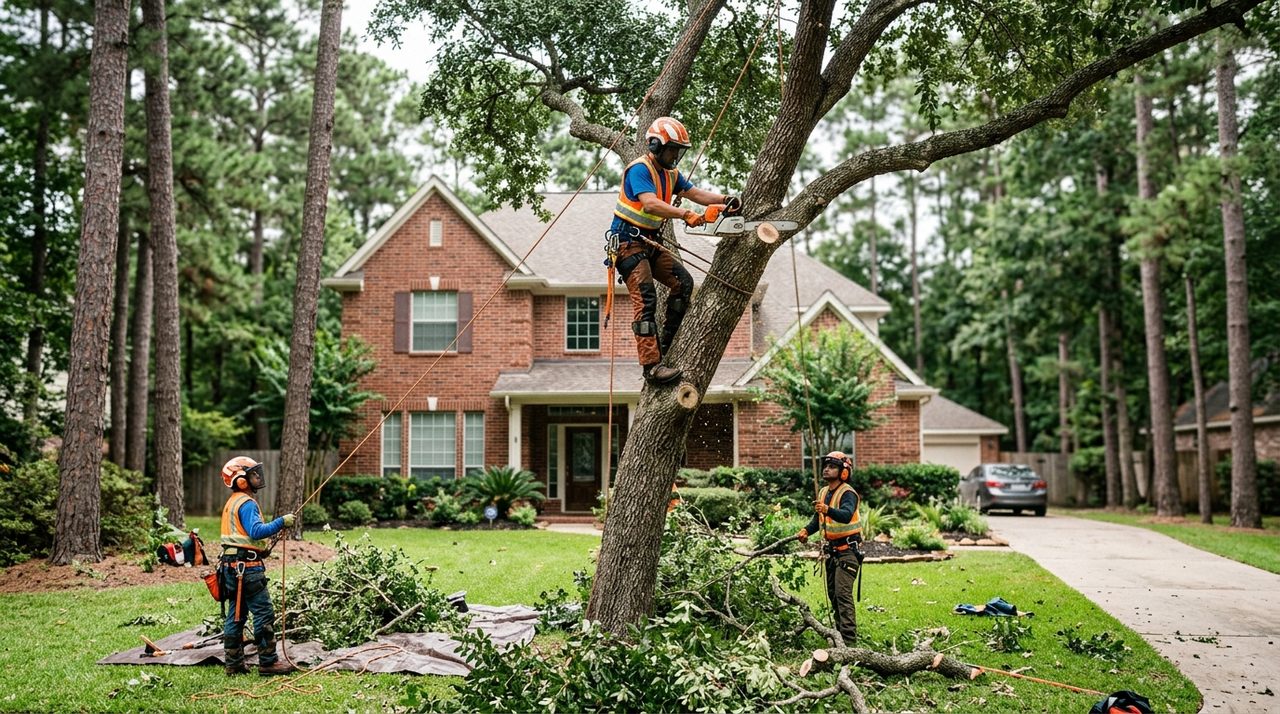
- Median home built
- 1985
- Median home value
- $167,179
- FEMA flood zone
- X (low)
- Typical removal cost (est.)
- $750–$3,500+
- Most common local issue
- Tallow root intrusion into 1970s–1980s cast-iron sewer laterals
Ranked by verified Google rating × review volume × verification tier. How we rank →
Min rating:
10 results Closed
2711 Grand Canyon Dr, Houston, TX 77067
Open Now
550 Greens Pkwy Suite# 244, Houston, TX 77067
2610 Woodsdale Blvd, Houston, TX 77038
Open Now
2500 west mount, Houston, TX 77038
1166 Woolwich Dr, Houston, TX 77032
Closed
1222 Fallbrook Dr, Houston, TX 77038
Open Now
214 La Fonda Dr, Houston, TX 77060
Open Now
1423 Greenshadow Dr, Houston, TX 77032
Closed
13126 Daywood Dr, Houston, TX 77038
Tree Removal in Greenspoint: What You Should Know
Chinese Tallow Invaders Along Greens Bayou-Adjacent Lots
Why it matters to you
Chinese tallow trees reseed aggressively from the disturbed, frequently saturated soils near Greens Bayou and any undeveloped commercial parcels that rim Greenspoint's older subdivisions. On homes built in the 1970s and 1980s — which still commonly have cast-iron or clay sewer laterals — tallow's fast-growing roots exploit every joint gap, causing blockages and lateral failures that cost far more than the tree removal itself. Texas lists Chinese tallow as an invasive species, and stumps left without proper grinding will resprout within a single growing season.
What a good pro does
A qualified arborist should confirm the species before quoting, then plan for deep stump grinding (not just flush cutting) and a follow-up herbicide application on the cut surface to prevent resprout. Because many Greenspoint sewer laterals are original cast iron nearing or past 40 years old, it is worth scheduling a camera inspection of the lateral after removal to document any existing root infiltration before it worsens. Disposal note: some Houston-area facilities refuse Chinese tallow green waste, so confirm chip or haul-off arrangements upfront.
Sources: Texas Commission on Environmental Quality, Harris County Flood Control District
Tree Roots vs. Aging Slabs and 40-Year-Old Utilities
Why it matters to you
Greenspoint's census median build year of 1985 places the overwhelming majority of homes at 35–50 years old, sitting on expansive Beaumont Black clay that shrinks every dry summer and swells every wet spring. Mature water oaks and live oaks planted close to foundations during original landscaping in the 1970s and 1980s now commonly have surface-feeding roots within 10–15 feet of slab edges, exploiting that seasonal clay movement to heave driveway slabs and stress foundation perimeters already prone to differential settlement. With 43 percent owner occupancy, many of these homes have seen multiple renters and deferred maintenance, meaning root damage may be further along than it appears.
What a good pro does
Before removal, a good contractor will probe or visually trace the root flare and flag any root that runs under hardscape toward the slab. Post-removal, stump grinding to at least 12 inches below grade is especially important on clay soils because large decaying root masses alter local soil moisture and can create voids as they decompose. If a foundation repair contractor has already placed piers, the tree company should know pier locations to avoid disturbing them during stump work.
Sources: City of Houston Permitting Center
Post-Storm Pricing Surge After the May 2024 Derecho and Beryl
Why it matters to you
The May 2024 derecho tracked straight-line winds through North Houston, and Hurricane Beryl followed in July 2024, leaving many Greenspoint subdivisions — where mature pines and oaks from the 1970s original landscaping are now at full size — with significant storm-damaged canopy. In the weeks following both events, regional demand pushed removal pricing 40–80 percent above normal, and out-of-state crews with no local ties moved through the area. Greenspoint's relatively modest median home value of approximately $167,000 makes overpaying on storm-surge pricing especially painful.
What a good pro does
Get at least two written quotes that itemize base removal, stump grinding, and debris haul-off separately so you can compare apples to apples. Ask any incoming crew for a certificate of liability insurance naming you as additionally insured — uninsured damage to your slab, fencing, or neighbor's property is entirely your financial exposure if the contractor walks. ISA Certified Arborist credentials are a useful signal that a crew has formal training rather than just a truck and a saw. The City of Houston does not require a contractor's tree-removal license, so insurance and certification are the primary homeowner protections.
Sources: City of Houston Permitting Center, Local HOA / deed restrictions (see area profile)
Navigating Greenspoint's Subdivision-by-Subdivision POA Rules
Why it matters to you
There is no single Greenspoint HOA — instead, at least eight separate mandatory Property Owners Associations govern specific subdivisions, including Northborough POA, Rankin Park POA, Greens Crossing POA, and others, while some lots carry no HOA restrictions at all. This fragmentation means a homeowner two streets over may need written architectural committee approval to remove a tree above a specified trunk diameter while you do not, or vice versa. Removing a tree without required POA approval can result in fines and mandatory replanting at your expense.
What a good pro does
Before any work begins, locate your property's recorded deed restrictions — Harris County Clerk online records or your title policy will identify which POA, if any, controls your lot. If a POA governs your subdivision, request the architectural review standards in writing to confirm whether tree removal above a minimum caliper (commonly 6–8 inches DBH in Houston-area deed restrictions) requires a formal application and waiting period. A reputable local tree company familiar with Greenspoint will ask this question upfront rather than leaving the compliance burden entirely on you.
Sources: Local HOA / deed restrictions (see area profile), City of Houston Permitting Center
Tree Removal in Greenspoint: What You Should Know
Hiring tree removal in Greenspoint? Greenspoint is a sprawling North Houston area with a mix of single-family subdivisions, multifamily complexes, and commercial properties developed primarily from the 1970s through the 1990s. Homeowners face aging infrastructure concerns typical of that era—original HVAC systems, galvanized or polybutylene plumbing, and slab foundation movement—compounded by proximity to Greens Bayou and associated flood risk. The fragmented POA landscape means deed restrictions and exterior modification rules vary subdivision by subdivision, so contractors should verify requirements before starting work.
- Housing era
- 1970s–1990s, with some later infill
- Foundation
- Predominantly slab-on-grade (inferred from Houston-area building practices for this era
- Flood zone
- FEMA Zone X (low flood risk) per official NFHL data
- Permits
- Houston Permitting Center (City of Houston jurisdiction)
Housing stock & systems
Building era
1970s–1990s, with some later infill.
Typical style
One- and two-story ranch and contemporary suburban tract homes with brick veneer and attached garages (inferred from broader Houston north-side patterns; no Greenspoint-specific architectural survey located).
Foundations
Predominantly slab-on-grade (inferred from Houston-area building practices for this era; not confirmed by a Greenspoint-specific source).
Common systems
Original homes likely have central AC with R-22 refrigerant systems nearing or past end of life, galvanized steel or polybutylene supply lines, copper or cast-iron waste lines, and 100–150 amp electrical panels. Many systems are 30–50 years old and due for replacement.
What that means for repairs
HVAC replacement, re-plumbing to PEX or CPVC, and electrical panel upgrades are common due to system age. Foundation repair is frequent given expansive clay soils and slab-on-grade construction. Kitchen and bath remodels are typical value-add projects in this price-accessible market.
Permits & restrictions
Permit jurisdiction
Houston Permitting Center (City of Houston jurisdiction).
HOA & deed restrictions
No single area-wide HOA. Multiple mandatory Property Owners Associations govern specific subdivisions, including Greenspoint Property Owners' Association Inc., Greenspoint Landing POA, Greenbriar North POA, Northborough POA, Northpoint POA, Town Center POA, Greens Crossing POA, and Rankin Park POA. Some properties in the broader area have no HOA at all. Deed restrictions are subdivision-specific; no unified set exists for 'Greenspoint' as a whole.
Historic districts
No City of Houston historic district designation confirmed.
Contractor note
Because POA governance is fragmented, contractors should confirm which POA (if any) governs a specific property and whether exterior work requires POA architectural review before commencing. Some lots have no HOA restrictions at all, while adjacent ones may have strict covenants.
Flood & weather
FEMA flood zone
FEMA Zone X (low flood risk) per official NFHL data. However, the Greenspoint area sits along Greens Bayou and its tributaries, and properties closer to the bayou channel may carry higher-risk designations. Homeowners should verify individual lot flood zone status, as Zone X designation may not apply uniformly across all parcels in the area.
Hurricane Harvey impact
Research sources did not include Harvey-specific damage reports or high-water-mark data for Greenspoint. The area's proximity to Greens Bayou makes it plausible that sections near the bayou and its tributaries experienced flooding during Harvey, but street-level impact cannot be confirmed from available sources. Homeowners should check Harris County Flood Control District records and FEMA repetitive loss data for their specific address.
Heat & humidity load
Aging 1970s–1990s HVAC systems in this area are heavily stressed during Houston's extreme summer heat and humidity. Original insulation levels are often inadequate by modern standards, driving up cooling costs and accelerating compressor failure. Slab-on-grade foundations on expansive clay soils are vulnerable to differential settlement during summer drought cycles, making foundation monitoring essential.
Working with contractors here
Contractors in Greenspoint most commonly handle HVAC replacement, foundation repair, and whole-house re-plumbing—all driven by the 30–50 year age of the housing stock. Slab foundation leveling with pressed piers is a frequent job given the clay-heavy soils and decades of seasonal moisture cycling. Electrical panel upgrades from original 100-amp service to 200-amp are common as homeowners modernize. Because the area includes a wide range of property conditions and price points, thorough scoping and upfront material cost discussions are important. Contractors should also verify whether the property falls under a POA with architectural review requirements before beginning any exterior work.
Local Tip
Always ask for a written estimate before work begins. Texas contractors are required to provide one on jobs over $1,000.
About Greenspoint
Greenspoint is a sprawling North Houston area with a mix of single-family subdivisions, multifamily complexes, and commercial properties developed primarily from the 1970s through the 1990s. Homeowners face aging infrastructure concerns typical of that era—original HVAC systems, galvanized or polybutylene plumbing, and slab foundation movement—compounded by proximity to Greens Bayou and associated flood risk. The fragmented POA landscape means deed restrictions and exterior modification rules vary subdivision by subdivision, so contractors should verify requirements before starting work.
- Median year built
- 1985
- Median home value
- $167,179
- Owner-occupied
- 43.3%
- Population
- 186,176
- Housing units
- 63,567
- Median income
- $46,300
Source: U.S. Census Bureau, ACS 5-Year 2023
Flood & storm risk
FEMA Zone XLow flood riskMost of Greenspoint maps to FEMA Zone X (low mapped flood risk), but Houston's flash-flood reality means even low-risk blocks benefit from smart drainage and storm-hardened installs; risk climbs sharply on blocks nearest Greens Bayou, where it varies parcel to parcel.
Source: FEMA National Flood Hazard Layer (NFHL). Flood zones vary by parcel — verify your individual FIRM panel.
Houston Storm Readiness in Greenspoint
Hurricane & flooding
After a hurricane makes landfall, tree removal demand across the Houston metro surges overnight, so contracting a licensed crew in Greenspoint for pre-storm hazard removal is far faster and less expensive than emergency post-storm work. Focus removal priority on trees with crowns that extend over the roofline or within one tree-length of the structure, which is where wind-throw damage concentrates. Confirm the current FEMA panel for your Greenspoint parcel — the area maps to Zone X, but adjacent lots can differ.
Severe storms & hail
Proactive removal of trees with significant deadwood or structural defects in Greenspoint costs a fraction of the emergency extraction and roof repair that follows a thunderstorm failure. Severe storms in the Houston area can produce 70-plus mph gusts with almost no advance warning, which means the pre-storm window is the only realistic time to act before a low-flood-risk yard becomes a debris field. Confirm the current FEMA panel for your Greenspoint parcel — the area maps to Zone X, but adjacent lots can differ.
Ice storms & freezes
Wind loading on ice-coated canopies in Greenspoint during a hard freeze creates the same failure risk as a severe windstorm, and lower flood-risk areas are just as exposed to ice-storm tree damage as any other part of the Houston metro. Uri 2021 left neighborhoods across the city dealing with fallen trees on homes and vehicles for weeks, primarily because no pre-storm removal of structurally weak specimens had been completed. With a median build year of 1985, the older building stock here is more exposed to hard-freeze damage than newer construction. Confirm the current FEMA panel for your Greenspoint parcel — the area maps to Zone X, but adjacent lots can differ.
Sources: FEMA National Flood Hazard Layer (NFHL), Ready.gov -- Hurricanes, CenterPoint Energy -- Storm Center, City of Houston -- Emergency Preparedness, Ready.gov -- Winter Weather, Harris County Flood Control District
Free Greenspoint Tools & Calculators
Houston-specific estimators to plan your project before you call a pro. All results are planning estimates — a licensed local pro confirms the details on site.
Houston Soil & Tree Proximity Risk Calculator
Open full tool & FAQ →Grouped by mature root aggression & water demand.
Trunk center to the nearest exterior wall.
Moderate risk
The root zone likely reaches your foundation's soil during Houston's dry summers, when clay shrinks most. Watch for sticking doors and diagonal cracks, keep soil moisture even with a soaker hose during drought, and have a foundation pro evaluate if you see any movement.
Find a Houston foundation pro →This is a planning estimate only — actual requirements depend on an on-site assessment by a licensed Houston pro. Guidance is based on general species root behavior in expansive clay, not a soil test.
Houston Freeze Prep & Pipe Insulation Checklist
Open full tool & FAQ →Your freeze checklist — 4 tasks
- 1
Disconnect & drain every outdoor hose bib
Remove hoses, drain the spigots, and cover each with an insulated faucet sock. Un-drained hose bibs are the #1 burst point in a Houston freeze.
- 2
Insulate exposed pipes in the attic & garage
Wrap any pipe in an unconditioned space (attic runs, garage walls) with foam sleeves. Houston homes rarely insulate these because they only matter a few nights a year — which is exactly why they burst.
- 3
Open cabinet doors & keep a pencil-width drip
On hard-freeze nights, open kitchen/bath cabinets so warm air reaches the pipes and let faucets on exterior walls drip to relieve pressure.
- 4
Protect the attic/garage water heater & its lines
An attic or garage tank sits in unconditioned space. Insulate the cold-inlet and hot-outlet lines and confirm the emergency drain pan is clear so a leak doesn't reach the ceiling.
This is a planning estimate only — actual requirements depend on an on-site assessment by a licensed Houston pro. If a pipe has already burst, shut off your main water supply and call a licensed Houston plumber immediately — freeze bursts flood fast.
Frequently Asked Questions
Do I need a permit from the City of Houston to remove a tree in my Greenspoint yard?
No — the City of Houston does not require a homeowner permit for removing a tree on private residential property, so Greenspoint homeowners are not subject to a municipal tree-removal permit. Your real checkpoint is whether your specific subdivision POA has an architectural review requirement before any exterior work begins, since Greenspoint has eight or more separate POAs with different rules. Confirm with your POA in writing before the crew arrives.
Sources: City of Houston Permitting CenterLocal HOA / deed restrictions (see area profile)
My Greenspoint home was built in the early 1980s — could tree roots have already gotten into my cast-iron sewer line before I even call a tree company?
Very likely, yes. Homes built in Greenspoint during the 1970s and 1980s typically have original cast-iron or clay sewer laterals, and Houston's heavy clay soils create moisture gradients that draw surface-feeding roots — especially from water oaks and Chinese tallow — directly toward pipe joints. Before scheduling removal, it is worth running a sewer scope camera to confirm whether roots have already infiltrated, because the tree company's bid should factor in stump grinding deep enough to stop regrowth near those lines. A sewer scope typically runs $150–$300 as an estimate and can save you a much larger repair bill later.
My property is in FEMA Zone X, so am I in the clear when it comes to storm-debris rules after a hurricane or derecho?
Zone X designation means your parcel carries low mapped flood risk, but it does not exempt you from post-storm debris-management rules that Harris County and the City of Houston activate during FEMA-declared disaster events. After events like the May 2024 derecho, curbside storm-debris pickup windows are strictly time-limited and require debris to be staged correctly at the right-of-way — not piled on drainage easements or over storm inlets near Greens Bayou. If your block is close to the bayou, check current HCFCD guidance before staging large wood debris, as proximity to drainage infrastructure can affect what is accepted curbside.
Sources: FEMA National Flood Hazard Layer (NFHL)Harris County Flood Control District
How long should I expect to wait for a Greenspoint tree company to schedule routine removal versus emergency storm work?
In normal conditions, a routine removal of a single mid-size water oak or tallow tree in Greenspoint can typically be scheduled within one to two weeks. In the weeks immediately following a major storm event — as happened after both the May 2024 derecho and Hurricane Beryl 2024 — regional demand surge pushes wait times to four to eight weeks for non-emergency jobs, and pricing estimates commonly run 40–80% above normal. If your situation is not an imminent hazard, scheduling during the late fall or winter off-peak window (November through February) tends to yield shorter waits and more competitive estimates.
What should I ask a Greenspoint tree company about their insurance before I sign anything, given the age of the homes and narrow lots here?
Ask for a certificate of liability insurance naming you as the certificate holder and verify that coverage is at least $1 million per occurrence — standard for tree work near structures. Given that Greenspoint's 1970s–1990s brick-veneer tract homes sit on slabs with minimal setback from property lines, falling limb or equipment damage to your slab edge, neighbor's fence, or utility lateral is a real risk. Also confirm the crew carries workers' compensation; if an uninsured worker is injured on your property, you can be held liable under Texas law. Texas does not license tree removal contractors through TDLR, so insurance verification and ISA Certified Arborist credentials are your primary quality filters.
I want to remove a large water oak on the west side of my Greenspoint house — will that noticeably change my summer electric bill?
Yes, and the impact is often underestimated in Houston's climate, which routinely logs 3,500 or more cooling degree days per year. A mature water oak shading west-facing walls or your AC condenser unit can meaningfully reduce your cooling load, with estimates ranging from 15–25% savings on that exposure. Removing it before replacing it with a smaller species or adding exterior shade will likely show up in your first post-removal July or August bill. If the tree must come out for foundation or utility reasons, ask your tree company to time the removal for late fall and discuss strategic replanting to restore that west-side shading over time.