Closed
10015 Hardison Ln, Houston, TX 77041
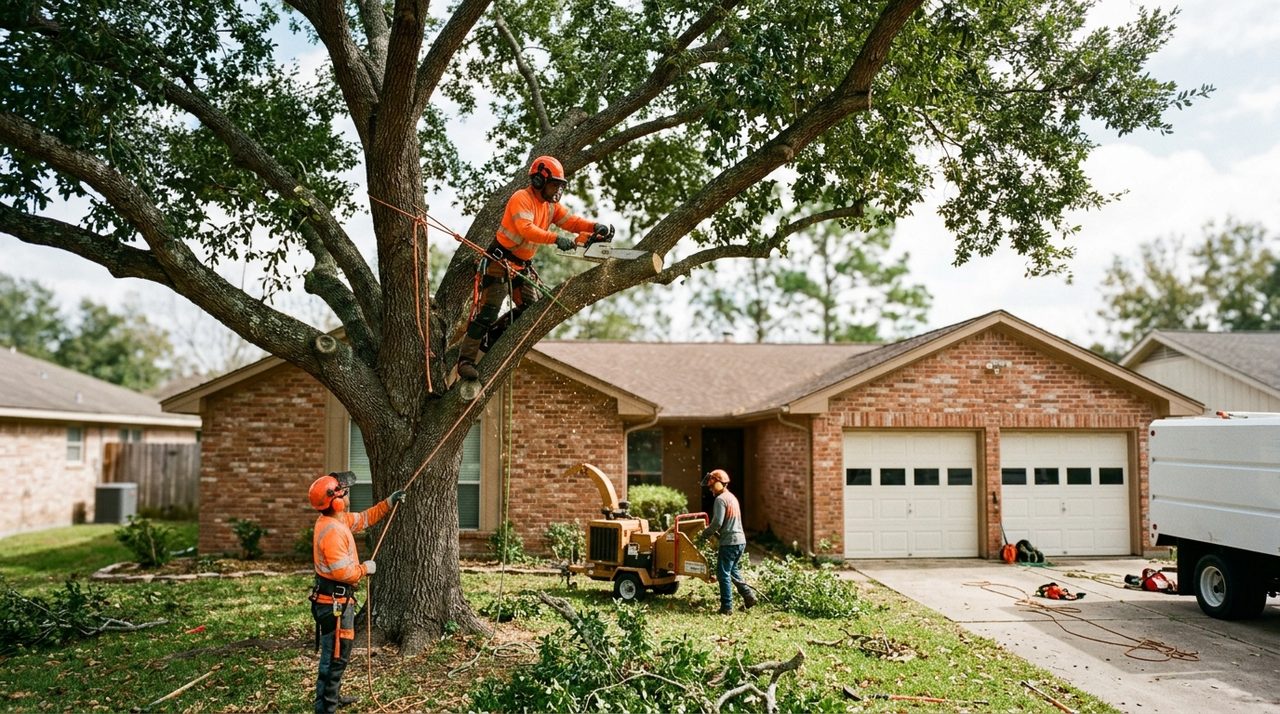
Jersey Village's 1960s–1980s ranch and brick homes sit inside FEMA Zone AE along White Oak Bayou tributaries, meaning storm-felled trees don't just damage roofs — they land in flood-prone yards where saturated clay soil and standing water complicate every phase of removal and debris disposal. Because Jersey Village is an independent municipality, all tree-related work with any structural or utility interface must go through the City of Jersey Village's own permitting office, not Houston's Permitting Center. Understanding those local rules — and the flood-zone debris pickup timelines that kick in after a declared disaster — is the difference between a clean job and a regulatory headache.
Ranked by verified Google rating × review volume × verification tier. How we rank →
Some highly-rated pros serve Jersey Village from nearby and may not keep a Jersey Village street address. Those are listed under "Also serving Jersey Village" with their real city and distance, so you always know where each business is based.
10015 Hardison Ln, Houston, TX 77041
13322 Chimney Sweep Dr, Houston, TX 77041
9802 Porto Rico Rd, Houston, TX 77041
13603 Blazey Dr, Houston, TX 77041
11385 Jones Rd E, Houston, TX 77065
10418 Crescent Moon Dr, Houston, TX 77064
Highly-rated pros based nearby who cover Jersey Village. Distance shown from the Jersey Village area.
Serving Jersey Village Based in NW Houston · 1.6 mi away
Serving Jersey Village Based in NW Houston · 3.8 mi away
Serving Jersey Village Based in Champions Forest · 4 mi away
Serving Jersey Village Based in Spring Branch · 4.6 mi away
Why it matters to you
Hurricane Beryl (2024) and the May 2024 derecho both drove regional demand spikes across Harris County, and Jersey Village — already stressed by White Oak Bayou flooding — saw out-of-state operators canvassing streets within days of each event. When your yard is still wet and a leaning water oak is threatening a 1970s brick wall, the pressure to hire the first crew that shows up is real, but post-storm pricing regularly runs 40–80% above normal rates and unlicensed operators frequently skip stump grinding and debris sorting.
What a good pro does
Get at least two written quotes from ISA Certified Arborists even when time feels short — most reputable local crews can give a same-day quote without starting work. Verify the contractor carries liability insurance adequate for a Zone AE property where soggy ground increases the risk of equipment sinking or trees dropping unexpectedly. Texas does not issue a state arborist license through TDLR, so ISA certification is the primary credential to confirm.
Sources: FEMA National Flood Hazard Layer (NFHL), Harris County Flood Control District
Why it matters to you
Jersey Village's predominant slab-on-grade foundations — most poured in the 1960s through 1980s — sit on expansive Beaumont Black clay that swells and contracts with Houston's wet-dry cycles. Large water oaks and Chinese tallow trees common in these yards push surface-feeding roots under slab edges, and homes from this era still carrying original clay sewer laterals face a double risk: root intrusion into deteriorating pipes as well as slab edge heaving. A tree that looks healthy above ground may already be undermining the foundation or a lateral line.
What a good pro does
Before removal, a qualified crew should probe root spread relative to the foundation perimeter and document any existing slab cracks. Stump grinding to at least 12 inches below grade — quoted separately at roughly $150–$400 per stump — is essential in clay soil because tallow and water oak stumps left shallow will resprout and continue root growth. If sewer line damage is suspected, schedule a camera inspection of the clay lateral after the stump is ground, while access is still easy.
Sources: Harris County Flood Control District, Municipal permit office (see area profile)
Why it matters to you
Jersey Village operates its own code enforcement and permitting authority entirely separate from the Houston Permitting Center or Harris County. Contractors unfamiliar with the area sometimes pull no permit at all — or worse, call the wrong office — which can trigger stop-work orders on older homes where the permit history is already thin. Tree removal near overhead lines also requires coordination with CenterPoint Energy, and in a neighborhood where 40-to-60-year-old utility infrastructure runs close to mature tree canopy, that step is frequently skipped by discount crews.
What a good pro does
Confirm with the City of Jersey Village's permit office before any work begins whether the specific removal triggers a local code review — particularly for trees adjacent to structures, easements, or the public right-of-way along bayou corridors. Ask your contractor to show proof of coordination with CenterPoint if any limbs are within striking distance of service lines. Reputable local firms operating in Jersey Village already know the city's inspection cadence and can factor permit lead time into their schedule.
Sources: Municipal permit office (see area profile), City of Houston Permitting Center
Why it matters to you
Because much of Jersey Village maps to FEMA Zone AE, major storm events frequently trigger federal disaster declarations that activate Harris County's time-limited curbside debris pickup programs. Homeowners in AE zones who are unfamiliar with these windows sometimes pay contractors to haul tree debris privately — at full commercial rates — when curbside pickup would have been available at no cost if the debris had been staged correctly at the right-of-way within the announced period. Missing that window is a costly mistake on a tight budget after storm damage.
What a good pro does
In the immediate aftermath of any FEMA-declared event affecting Harris County, check Harris County Flood Control District and the City of Jersey Village's official channels for debris staging guidelines before authorizing a contractor to haul material offsite. Debris must typically be placed at the curb in separate piles (woody debris separate from construction material) and within a specific number of days post-declaration. A good local tree crew will know this protocol and can stage the debris appropriately rather than loading everything onto a truck the same day.
Sources: FEMA National Flood Hazard Layer (NFHL), Harris County Flood Control District
Hiring tree removal in Jersey Village? Jersey Village is an independent municipality with a housing stock predominantly built between the 1960s and 1980s, featuring ranch-style and traditional brick homes on concrete slab foundations. Homeowners face significant flood risk due to proximity to White Oak Bayou and tributaries, making drainage, foundation maintenance, and flood mitigation among the most critical home service needs. The city handles its own code enforcement and permitting, so contractors must work through the City of Jersey Village rather than Houston or Harris County offices.
Building era
1960s–1980s, with some later infill construction.
Typical style
Ranch-style and traditional two-story brick homes with attached garages; suburban production architecture typical of northwest Houston.
Foundations
Slab-on-grade (dominant); pier-and-beam may exist on rare older or custom structures but is not documented.
Common systems
Original homes likely have copper or galvanized steel plumbing (transitioning to CPVC/PEX in later builds), R-22 refrigerant HVAC systems nearing or past end of life, and 100–200 amp electrical panels. Many systems in this era are candidates for full replacement.
What that means for repairs
Kitchen and bathroom remodels are common as homeowners update 40–60-year-old finishes. Re-piping from galvanized to PEX, HVAC upgrades to modern refrigerant systems, and flood-related restoration work (raised electrical panels, moisture-resistant materials) are frequent renovation drivers.
Permit jurisdiction
City of Jersey Village Permitting (independent municipality – permits are not issued through Houston Permitting Center or Harris County).
HOA & deed restrictions
No mandatory city-wide HOA for core Jersey Village neighborhoods; property standards are enforced through city code enforcement and deed restrictions. The Park at Jersey Village HOA exists but appears to be a separate, newer subdivision not located in the traditional Jersey Village city limits. Specific section-level deed restrictions may exist but were not confirmed in public records.
Historic districts
No City of Houston historic district designation confirmed. Jersey Village is an independent city and not subject to HAHC review.
Contractor note
Contractors must obtain permits through the City of Jersey Village, which has its own building codes, inspections, and zoning requirements separate from both Houston and Harris County. Familiarity with the city's specific permit process and code enforcement standards is essential.
FEMA flood zone
FEMA Zone AE (high flood risk) — source: fema_nfhl. Jersey Village is situated near White Oak Bayou and associated tributaries, placing much of the community in a designated high-risk floodplain with base flood elevations established.
Hurricane Harvey impact
Jersey Village is in a bayou-adjacent northwest Harris County area that experienced flooding during Hurricane Harvey, though a precise street-by-street damage assessment specific to the City of Jersey Village was not confirmed in available public records. The White Oak Bayou corridor and tributaries in this area flooded significantly. Homeowners should check HCFCD flood layers, FEMA FIRM maps, and property-level flood loss history (CLUE reports) for individual address risk.
Heat & humidity load
Houston's extreme summer heat and humidity place heavy demand on aging HVAC systems common in 1960s–80s homes, often triggering emergency repairs or full system replacements. Slab foundations in clay-heavy soils can shift with summer drought cycles, and prolonged moisture from summer storms combined with Zone AE flood risk can lead to mold, moisture intrusion, and recurring drainage issues.
Working with contractors here
Contractors in Jersey Village most commonly work on HVAC replacement, re-piping, foundation repair, and flood damage restoration driven by the aging 1960s–80s housing stock and high flood risk. Slab foundation repair is a frequent need as expansive clay soils shift seasonally, and many homes still have original galvanized plumbing requiring full re-pipes. Flood mitigation work—including raising electrical panels, installing sump systems, and replacing flood-damaged drywall and flooring with moisture-resistant materials—is a significant segment of the local market. Because Jersey Village is an incorporated city with its own permitting authority, contractors unfamiliar with the area should budget time for the city's specific inspection and permit processes rather than defaulting to Houston or Harris County procedures. Roofing and exterior work on 40–60-year-old brick veneer homes is also common, particularly after severe weather events.
Local Tip
Always ask for a written estimate before work begins. Texas contractors are required to provide one on jobs over $1,000.
Jersey Village is an independent municipality with a housing stock predominantly built between the 1960s and 1980s, featuring ranch-style and traditional brick homes on concrete slab foundations. Homeowners face significant flood risk due to proximity to White Oak Bayou and tributaries, making drainage, foundation maintenance, and flood mitigation among the most critical home service needs. The city handles its own code enforcement and permitting, so contractors must work through the City of Jersey Village rather than Houston or Harris County offices.
Source: U.S. Census Bureau, ACS 5-Year 2023
Much of Jersey Village maps to FEMA Zone AE (high flood risk), so flood-resilient detailing -- elevated equipment, water-tolerant materials, and drainage-first thinking -- is essential here, not optional.
Source: FEMA National Flood Hazard Layer (NFHL). Flood zones vary by parcel — verify your individual FIRM panel.
After a hurricane passes through Jersey Village, TX, do not approach downed trees in FEMA Zone AE inside the 100-year floodplain conditions until CenterPoint confirms power to nearby lines is cut, since energized conductors are frequently pinned beneath root balls. A licensed tree removal crew trained in post-storm work can safely section and remove trees while coordinating with utility clearance requirements. Confirm the current FEMA panel for your Jersey Village parcel — the area maps to Zone AE, but adjacent lots can differ.
Straight-line wind events like the May 2024 derecho give no warning and target trees weakened by repeated flood-stress cycles common in Jersey Village, TX, so have a TDLR-licensed arborist assess any tree showing crown dieback, fungal conks, or soil heave near the base. Removing those specimens before severe storm season reduces the single largest source of sudden structural damage in FEMA Zone AE inside the 100-year floodplain neighborhoods. Confirm the current FEMA panel for your Jersey Village parcel — the area maps to Zone AE, but adjacent lots can differ.
Ice loading during a hard freeze adds hundreds of pounds to canopy branches, and trees in Jersey Village, TX that are already stressed by seasonal FEMA Zone AE inside the 100-year floodplain inundation are far more likely to shed large limbs under that weight. Scheduling removal of any tree with wide-angled branch attachments or visible decay before winter freeze events is the most effective way to prevent ice-storm damage to your roof or fence. Confirm the current FEMA panel for your Jersey Village parcel — the area maps to Zone AE, but adjacent lots can differ.
Sources: FEMA National Flood Hazard Layer (NFHL), Ready.gov -- Hurricanes, CenterPoint Energy -- Storm Center, City of Houston -- Emergency Preparedness, Ready.gov -- Winter Weather, Harris County Flood Control District
Houston-specific estimators to plan your project before you call a pro. All results are planning estimates — a licensed local pro confirms the details on site.
Grouped by mature root aggression & water demand.
Trunk center to the nearest exterior wall.
The root zone likely reaches your foundation's soil during Houston's dry summers, when clay shrinks most. Watch for sticking doors and diagonal cracks, keep soil moisture even with a soaker hose during drought, and have a foundation pro evaluate if you see any movement.
Find a Houston foundation pro →This is a planning estimate only — actual requirements depend on an on-site assessment by a licensed Houston pro. Guidance is based on general species root behavior in expansive clay, not a soil test.
Disconnect & drain every outdoor hose bib
Remove hoses, drain the spigots, and cover each with an insulated faucet sock. Un-drained hose bibs are the #1 burst point in a Houston freeze.
Insulate exposed pipes in the attic & garage
Wrap any pipe in an unconditioned space (attic runs, garage walls) with foam sleeves. Houston homes rarely insulate these because they only matter a few nights a year — which is exactly why they burst.
Open cabinet doors & keep a pencil-width drip
On hard-freeze nights, open kitchen/bath cabinets so warm air reaches the pipes and let faucets on exterior walls drip to relieve pressure.
Protect the attic/garage water heater & its lines
An attic or garage tank sits in unconditioned space. Insulate the cold-inlet and hot-outlet lines and confirm the emergency drain pan is clear so a leak doesn't reach the ceiling.
This is a planning estimate only — actual requirements depend on an on-site assessment by a licensed Houston pro. If a pipe has already burst, shut off your main water supply and call a licensed Houston plumber immediately — freeze bursts flood fast.
Sources: Municipal permit office (see area profile)
Sources: FEMA National Flood Hazard Layer (NFHL)Harris County Flood Control District