Open Now
10510 Deval Dr, Cypress, TX 77429
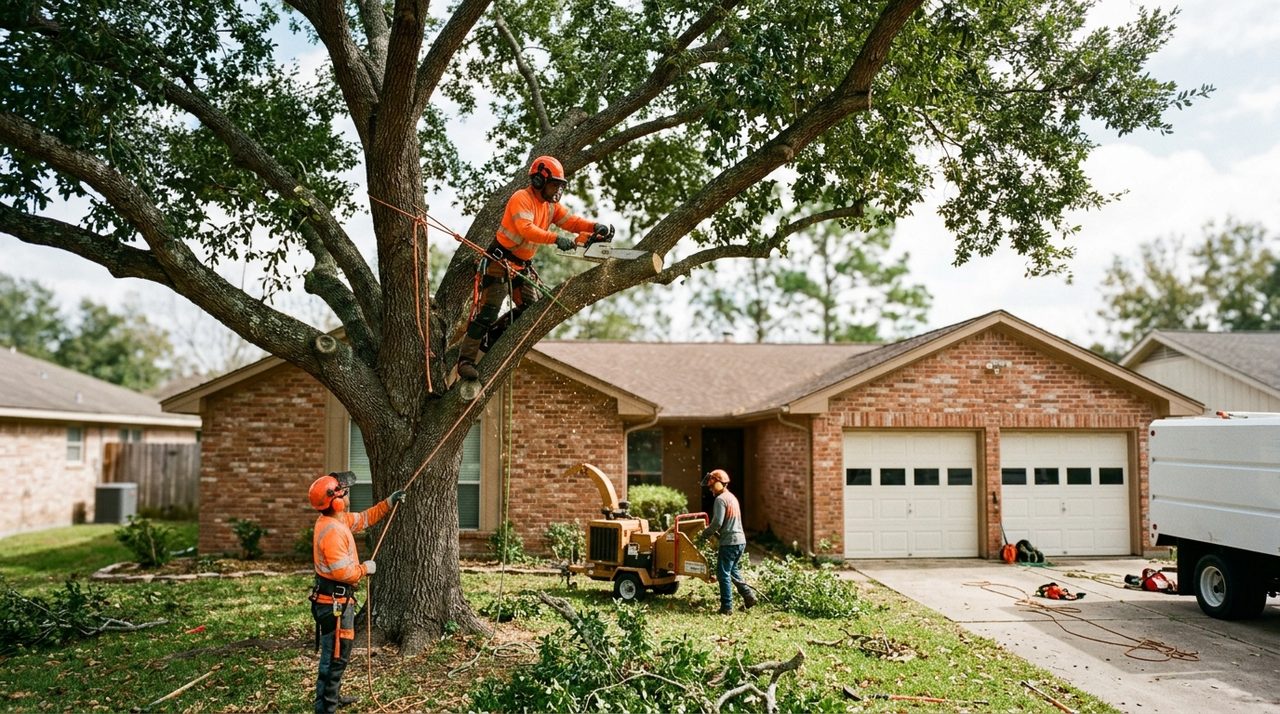
Cypress is an unincorporated Harris County community where mature water oaks, live oaks, and fast-growing Chinese tallow trees planted during the 1980s–2000s building boom are now pressing up against slab foundations, driveways, and HOA-regulated exteriors across dozens of independently governed subdivisions. Because Cypress sits outside any incorporated city limits, tree work on private property requires no municipal permit — but nearly every platted subdivision here enforces its own deed restrictions that require architectural committee sign-off before a chainsaw touches a tree. Understanding the difference between the county's role and your HOA's role can save Cypress homeowners a costly fine and a forced replanting order.
Ranked by verified Google rating × review volume × verification tier. How we rank →
Some highly-rated pros serve Cypress from nearby and may not keep a Cypress street address. Those are listed under "Also serving Cypress" with their real city and distance, so you always know where each business is based.
10510 Deval Dr, Cypress, TX 77429
14120 Cypress North Houston Rd, Cypress, TX 77429
16135 Barklea Rd, Cypress, TX 77429
14610 Annarbor Heights Ct, Cypress, TX 77433
Highly-rated pros based nearby who cover Cypress. Distance shown from the Cypress area.
Serving Cypress Based in Tomball · 6.2 mi away
Why it matters to you
Cypress is composed of dozens of separately platted subdivisions — Lakewood Forest, Cypress Creek Crossing, Villages of Cypress Lakes West, and many others — each enforcing its own deed restrictions independently. Most require written architectural committee approval before removing any tree above a specified caliper (commonly 6–8 inches DBH). A homeowner who skips this step and removes a tree first can face subdivision fines and a mandatory replanting requirement that costs more than the removal itself.
What a good pro does
Before scheduling any crew, pull your subdivision's deed restrictions and submit a removal request with a site sketch to your HOA architectural review committee. A reputable Cypress tree-removal contractor will ask upfront which subdivision you are in and will wait for written approval before mobilizing — if a bidder never mentions HOA paperwork, that is a red flag. Turnaround times vary by subdivision board, so build two to four weeks of lead time into your project schedule, especially for non-emergency removals.
Sources: Local HOA / deed restrictions (see area profile)
Why it matters to you
The housing stock concentrated in Cypress's older sections near FM 1960 dates to the 1980s and 1990s, meaning trees planted at those homes are now 30–40 years old with root systems that have had decades to expand across Houston's expansive Beaumont Black clay soil. Water oaks and live oaks in particular develop wide, shallow root systems that can heave slab edges and crack driveways, and homes built in that era may still have galvanized or early-plastic drain lines susceptible to root intrusion — a problem that compounds fast on clay-heavy lots.
What a good pro does
When getting bids, ask each arborist to assess not just the tree canopy but the root flare relative to your foundation, driveway, and sewer cleanout location. An ISA Certified Arborist can identify which roots pose the most immediate risk and whether directional stump grinding (rather than standard grinding) is needed to protect adjacent hardscape. Always include stump grinding in the scope — estimated separately at $150–$400 per stump — because an untreated stump from a water oak will resprout vigorously in Cypress's climate.
Sources: Harris County Flood Control District
Why it matters to you
The May 2024 derecho that tracked through the NW Houston corridor and Hurricane Beryl just weeks later in July 2024 generated an enormous backlog of tree work across Cypress, where the suburban canopy of mature oaks planted in the 1990s and 2000s took widespread damage. In the weeks following both events, regional pricing ran 40–80% above normal estimates, and out-of-state crews with no established local presence — and sometimes no verifiable liability insurance — moved through subdivisions soliciting door-to-door work.
What a good pro does
Texas does not license tree removal contractors at the state level through TDLR, so the credential to verify is ISA Certified Arborist status, combined with a current certificate of liability insurance naming you as an additional insured for the job. Ask for both documents before signing anything. Because Cypress is unincorporated Harris County, there is no municipal permit required for private-property tree removal, but that also means there is no municipal oversight to backstop you if an uninsured crew drops a limb on your roof — your homeowner's insurance becomes your only recourse.
Sources: City of Houston Permitting Center, Local HOA / deed restrictions (see area profile)
Why it matters to you
Chinese tallow trees are a state-listed invasive in Texas that colonize Cypress lots along drainage swales, back fence lines, and undeveloped strips between subdivisions with remarkable speed — often growing five or more feet per year. Many Cypress homeowners discover what they thought was a manageable backyard tree is actually several tallow volunteers that have fused into a multi-trunk clump. Standard stump grinding is often insufficient because tallow stumps send up dense resprouting growth within weeks in Harris County's warm, humid climate, and some regional green-waste facilities restrict or refuse tallow wood due to its invasive classification.
What a good pro does
Confirm with your removal contractor that they will apply a cut-stump herbicide treatment immediately after grinding — the application window is measured in minutes after cutting for maximum effectiveness. Ask specifically how they plan to dispose of the wood and whether the disposal yard they use accepts Chinese tallow; if not, confirm an alternate disposal plan is included in your written estimate. Because tallow seeds proliferate from bird-dispersed berries, removing a tallow on your property while a neighbor's tree drops seeds nearby means follow-up monitoring for volunteers in subsequent seasons is worthwhile.
Sources: Texas Commission on Environmental Quality, Local HOA / deed restrictions (see area profile)
Hiring tree removal in Cypress? Cypress is an unincorporated area composed of dozens of separately platted subdivisions, each with its own HOA and deed restrictions. The housing stock spans from late-1970s ranch-style homes near FM 1960 to brand-new construction along the Grand Parkway, meaning contractors encounter a wide range of system ages and maintenance needs. Slab foundations, production-style builds, and HOA-regulated exteriors define the home services landscape here.
Building era
Late 1970s through 2020s, with concentrations in the 1980s–2000s era.
Typical style
Production suburban traditional and ranch-influenced one- and two-story homes; newer master-planned communities feature transitional and modern traditional facades with brick or brick-and-siding exteriors.
Foundations
Slab-on-grade (overwhelmingly dominant given post-1960s suburban construction; pier-and-beam is rare and limited to custom builds).
Common systems
Older 1980s–1990s homes: original builder-grade HVAC (10–15 SEER), copper or CPVC plumbing, and 100–200 amp electrical panels. 2000s–2010s homes: higher-efficiency HVAC, PEX plumbing, 200 amp panels. Homes from the 1970s–1980s may still have galvanized drain lines or polybutylene supply lines.
What that means for repairs
Kitchen and bath remodels are common in 1980s–1990s homes as original finishes age out. HVAC replacements are frequent in homes over 15 years old. Exterior updates often require HOA architectural review and approval before work begins.
Permit jurisdiction
Harris County Engineering Department (unincorporated area - not within City of Houston or any incorporated city limits).
HOA & deed restrictions
Mandatory HOAs are the norm in most platted subdivisions. Each subdivision operates independently (e.g., Lakewood Forest Fund, Cypress Creek Crossing HOA, Cypress Oaks North HOA, Villages of Cypress Lakes West). Older rural pockets and acreage tracts may have voluntary civic clubs or no organized association. Approximately 77% of Houston metro listings carry a mandatory HOA fee, and Cypress is explicitly cited as a high-HOA area.
Historic districts
No City of Houston historic district designation confirmed. Cypress is unincorporated Harris County with no known historic preservation overlays.
Contractor note
Contractors must pull permits through Harris County for structural, electrical, plumbing, and mechanical work. Nearly all subdivisions require HOA architectural committee approval for exterior modifications, fencing, roofing material changes, and paint colors before work begins.
FEMA flood zone
FEMA Zone X (low flood risk) per official NFHL data. Cypress Creek and its tributaries run through portions of the area, and specific parcels near waterways may carry higher flood designations — property-level FEMA lookups are recommended for homes near Cypress Creek, Faulkey Gully, or retention basins.
Hurricane Harvey impact
Not confirmed from provided research with subdivision-level specificity. Cypress Creek corridor flooding during Harvey (2017) impacted portions of the area, particularly homes in low-lying sections near creeks and bayous. Homeowners should check individual property flood claim history through FEMA and Harris County Flood Control District records.
Heat & humidity load
Prolonged 95°F+ heat and high humidity stress HVAC systems heavily; older 1980s–1990s units frequently fail during peak summer. Slab-on-grade foundations on expansive clay soils experience seasonal movement during summer drought cycles, leading to crack repair and foundation leveling demand. Exterior caulking and weatherproofing degrade quickly in UV and humidity.
Working with contractors here
Contractors in Cypress most commonly handle HVAC replacements and repairs, as the wide range of home ages means systems from the 1980s through the 2010s are cycling through end-of-life. Roof replacements are a major category, driven by storm damage and aging composition shingles, with HOA requirements often dictating material and color specifications. Plumbing repipes — especially replacing polybutylene or aging CPVC in 1980s–1990s homes — are a steady source of work. Foundation repair is common given the expansive clay soils and slab construction. Contractors should budget time for HOA architectural review submissions and Harris County permitting, as both processes can add lead time before work can commence.
Local Tip
Always ask for a written estimate before work begins. Texas contractors are required to provide one on jobs over $1,000.
Cypress is an unincorporated area composed of dozens of separately platted subdivisions, each with its own HOA and deed restrictions. The housing stock spans from late-1970s ranch-style homes near FM 1960 to brand-new construction along the Grand Parkway, meaning contractors encounter a wide range of system ages and maintenance needs. Slab foundations, production-style builds, and HOA-regulated exteriors define the home services landscape here.
Source: U.S. Census Bureau, ACS 5-Year 2023
Most of Cypress maps to FEMA Zone X (low mapped flood risk), but Houston's flash-flood reality means even low-risk blocks benefit from smart drainage and storm-hardened installs.
Source: FEMA National Flood Hazard Layer (NFHL). Flood zones vary by parcel — verify your individual FIRM panel.
After a hurricane makes landfall, tree removal demand across the Houston metro surges overnight, so contracting a licensed crew in Cypress, TX for pre-storm hazard removal is far faster and less expensive than emergency post-storm work. Focus removal priority on trees with crowns that extend over the roofline or within one tree-length of the structure, which is where wind-throw damage concentrates. Confirm the current FEMA panel for your Cypress parcel — the area maps to Zone X, but adjacent lots can differ.
After any severe thunderstorm drops large limbs in your yard in Cypress, TX, have a licensed contractor assess the parent tree for hidden decay before assuming the remaining structure is sound. Snap failures during the May 2024 derecho frequently involved trees that had experienced prior lightning strikes or previous partial limb loss that had gone uninspected. Confirm the current FEMA panel for your Cypress parcel — the area maps to Zone X, but adjacent lots can differ.
The most actionable winter prep for tree removal in Cypress, TX is removing any tree or large limb that hangs directly over a roofline, vehicle parking area, or power service drop before the first freeze advisory. Ice adds weight faster than most homeowners expect, and Houston trees that have never experienced sustained ice loading have no adaptive resilience to that stress. Confirm the current FEMA panel for your Cypress parcel — the area maps to Zone X, but adjacent lots can differ.
Sources: FEMA National Flood Hazard Layer (NFHL), Ready.gov -- Hurricanes, CenterPoint Energy -- Storm Center, City of Houston -- Emergency Preparedness, Ready.gov -- Winter Weather, Harris County Flood Control District
Houston-specific estimators to plan your project before you call a pro. All results are planning estimates — a licensed local pro confirms the details on site.
Grouped by mature root aggression & water demand.
Trunk center to the nearest exterior wall.
The root zone likely reaches your foundation's soil during Houston's dry summers, when clay shrinks most. Watch for sticking doors and diagonal cracks, keep soil moisture even with a soaker hose during drought, and have a foundation pro evaluate if you see any movement.
Find a Houston foundation pro →This is a planning estimate only — actual requirements depend on an on-site assessment by a licensed Houston pro. Guidance is based on general species root behavior in expansive clay, not a soil test.
Disconnect & drain every outdoor hose bib
Remove hoses, drain the spigots, and cover each with an insulated faucet sock. Un-drained hose bibs are the #1 burst point in a Houston freeze.
Insulate exposed pipes in the attic & garage
Wrap any pipe in an unconditioned space (attic runs, garage walls) with foam sleeves. Houston homes rarely insulate these because they only matter a few nights a year — which is exactly why they burst.
Open cabinet doors & keep a pencil-width drip
On hard-freeze nights, open kitchen/bath cabinets so warm air reaches the pipes and let faucets on exterior walls drip to relieve pressure.
Protect the attic/garage water heater & its lines
An attic or garage tank sits in unconditioned space. Insulate the cold-inlet and hot-outlet lines and confirm the emergency drain pan is clear so a leak doesn't reach the ceiling.
This is a planning estimate only — actual requirements depend on an on-site assessment by a licensed Houston pro. If a pipe has already burst, shut off your main water supply and call a licensed Houston plumber immediately — freeze bursts flood fast.
Sources: Municipal permit office (see area profile)Local HOA / deed restrictions (see area profile)
Sources: Local HOA / deed restrictions (see area profile)
Sources: FEMA National Flood Hazard Layer (NFHL)Harris County Flood Control District