Closed
Serving Oak Forest Based in Lazybrook / Timbergrove · 1.5 mi away
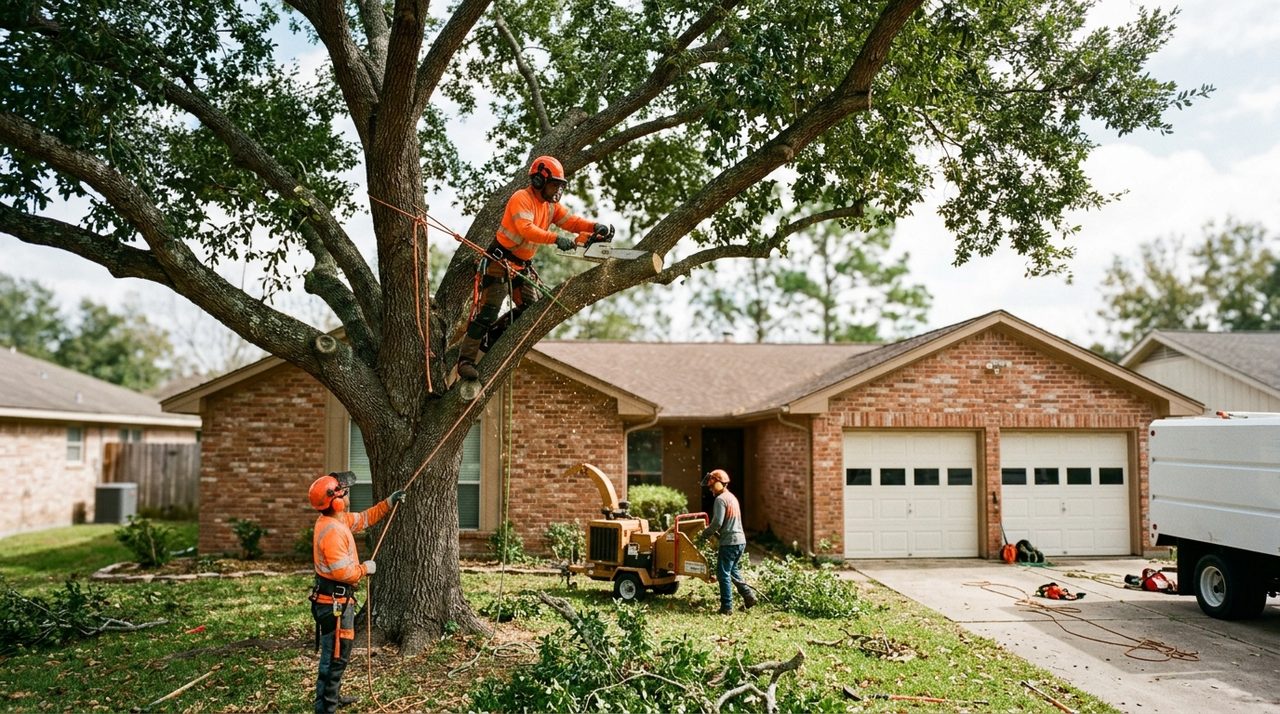
Oak Forest's 1940s–1960s ranch homes sit beneath some of the most mature live oak and water oak canopy in northwest Houston — trees that were saplings when the neighborhood was platted and are now large enough to threaten aging foundations, original cast-iron sewer laterals, and tile rooftops. Because Oak Forest falls entirely within City of Houston limits, there is no municipal tree-removal permit required on private property, but the neighborhood's 18-section patchwork of recorded deed restrictions and the May 2024 derecho's destructive path through NW Houston make tree work here both legally nuanced and physically urgent.
Ranked by verified Google rating × review volume × verification tier. How we rank →
Some highly-rated pros serve Oak Forest from nearby and may not keep a Oak Forest street address. Those are listed under "Also serving Oak Forest" with their real city and distance, so you always know where each business is based.
Highly-rated pros based nearby who cover Oak Forest. Distance shown from the Oak Forest area.
Serving Oak Forest Based in Lazybrook / Timbergrove · 1.5 mi away
Serving Oak Forest Based in Acres Homes · 1.5 mi away
Serving Oak Forest Based in Acres Homes · 2.4 mi away
Serving Oak Forest Based in Brookhollow · 2.5 mi away
Serving Oak Forest Based in Lazybrook / Timbergrove · 2.6 mi away
Serving Oak Forest Based in Lazybrook / Timbergrove · 2.8 mi away
Serving Oak Forest Based in Lazybrook / Timbergrove · 3.4 mi away
Serving Oak Forest Based in Lazybrook / Timbergrove · 3.5 mi away
Serving Oak Forest Based in Lazybrook / Timbergrove · 4.3 mi away
Serving Oak Forest Based in Garden Oaks · 4.3 mi away
Why it matters to you
Oak Forest's original homes — most built between 1945 and 1965 — were constructed with cast-iron or clay sewer laterals that are now at or past their service life. The neighborhood's signature live oaks and water oaks, many now 40–70 feet tall, send shallow surface-feeding roots outward in every direction, and Houston's expansive Black clay soil amplifies the heaving effect as it wets and dries seasonally. Homeowners whose large oaks sit within 20 feet of the house or driveway should treat root intrusion into aging drains as a near-certainty, not a hypothetical.
What a good pro does
Before any removal quote is finalized, a qualified arborist should assess whether stump grinding alone — rather than full root excavation — is sufficient to stop ongoing lateral damage, or whether a plumber should camera-scope the drain line first. Reputable crews working in Oak Forest will price stump grinding separately (typically $150–$400 per stump, estimated) and grind to a depth that disrupts the lateral root plate rather than just the visible crown. Texas has no state license for tree work, so verify ISA Certified Arborist credentials and adequate liability insurance before signing a contract.
Sources: City of Houston Permitting Center, Local HOA / deed restrictions (see area profile)
Why it matters to you
Unlike suburbs with a centralized HOA tree-preservation ordinance, Oak Forest's governance is fragmented: there is no mandatory HOA, but recorded deed restrictions covering most of the neighborhood's 18 sections may include language governing tree removal, setbacks, or landscaping changes — and those restrictions are not uniform. A homeowner in Section 7 may face different covenants than a neighbor three blocks away in Section 12. Removing a tree that violates a section's deed restriction can trigger enforcement actions from neighboring property owners rather than any HOA board, which makes disputes harder to predict and resolve.
What a good pro does
Before any chainsaw work, pull the recorded deed restrictions specific to your block and section through Harris County Clerk records — your arborist or title company can help locate the document. The City of Houston does not require a homeowner permit for private-property tree removal, so the municipal hurdle is low, but the private-covenant layer is real and varies. A contractor experienced in the Oak Forest market will ask about your section's restrictions upfront rather than treating the whole neighborhood as uniform.
Sources: City of Houston Permitting Center, Local HOA / deed restrictions (see area profile)
Why it matters to you
The May 2024 derecho delivered straight-line winds exceeding 100 mph along a corridor that cut directly through northwest Houston — the same corridor Oak Forest occupies. The storm left dozens of split or uprooted live oaks across the neighborhood, and within days every local tree company was booked out for weeks. That demand vacuum drew out-of-state crews with no local insurance verification, unfamiliar with Houston's clay-soil stump conditions, and charging 40–80% above pre-storm rates as estimated benchmarks. Homeowners who acted in panic during the first week often paid premium prices for substandard work.
What a good pro does
If a tree is not posing an immediate structural hazard to the house, waiting two to three weeks post-storm for the surge to ease can meaningfully reduce cost. For genuinely dangerous situations — a leaning trunk bearing on a roofline or a split limb over an entry — prioritize getting a hazard-only cut rather than a full removal quote during the price spike. Always verify that any crew operating in Oak Forest carries general liability insurance with limits adequate for residential work near a home with a current median value around $543,800 — request the certificate of insurance directly from the carrier, not just a photo of the document.
Sources: City of Houston Permitting Center
Why it matters to you
Oak Forest's mature canopy is not just aesthetic — a well-positioned live oak on the west or southwest side of a mid-century ranch home can shade both the roof and the outdoor AC condenser, meaningfully cutting the cooling load during Houston's relentless summer stretch. Homeowners focused on a foundation crack or a storm-damaged limb sometimes authorize full removal without accounting for the energy consequence. The first July electric bill after a large shade tree comes down can add $80–$150 per month to cooling costs, a real and recurring expense on a home that may already have an older or undersized HVAC system.
What a good pro does
Ask the arborist whether strategic crown reduction, a hazard limb removal, or cabling can resolve the immediate problem while preserving the tree's shading geometry. If full removal is genuinely necessary, discuss replanting a fast-establishing native like a cedar elm or Texas red oak in a position that restores southwest shade coverage within five to eight years. A good arborist working in Oak Forest will walk the property at midday to assess shadow patterns before recommending removal over remediation.
Sources: City of Houston Permitting Center
Hiring tree removal in Oak Forest? Oak Forest is a large, deed-restricted neighborhood of 1940s–1960s homes experiencing significant renovation and new construction activity. Homeowners here navigate a mix of aging original systems and modern rebuilds, with no mandatory HOA but recorded deed restrictions that vary by section. Contractors should expect a wide range of project scopes, from updating original mid-century infrastructure to full teardown-and-rebuild jobs.
Building era
1940s–1960s, with ongoing new construction infill.
Typical style
Mid-century ranch-style homes predominate among original stock; newer construction varies in style. Specific architectural breakdown not confirmed in available sources.
Foundations
Not confirmed from available sources. Likely a mix of slab-on-grade and pier-and-beam consistent with the era, but homeowners should verify on a per-property basis.
Common systems
Original homes may have galvanized or cast-iron drain plumbing, older electrical panels (60–100 amp), and window-unit or early central HVAC systems. Updated and rebuilt homes typically feature modern systems.
What that means for repairs
Oak Forest sees heavy renovation activity driven by the desirability of the location and the aging of original 1950s–1960s housing stock. Common projects include full kitchen and bathroom remodels, re-plumbing from galvanized to copper or PEX, electrical panel upgrades, and complete teardown-rebuilds on original lots.
Permit jurisdiction
City of Houston Permitting Center (Oak Forest is within Houston city limits).
HOA & deed restrictions
No mandatory HOA. The Oak Forest Homeowners Association (OFHA) is a voluntary, non-mandatory civic association covering 18 sections. Recorded deed restrictions exist across most sections and vary by block/section.
Historic districts
No City of Houston historic district designation confirmed. HAHC Certificates of Appropriateness are not known to be required.
Contractor note
Contractors should review the applicable section's recorded deed restrictions before beginning exterior work or additions, as restrictions vary across Oak Forest's 18 sections and may govern setbacks, outbuildings, and use. No HAHC review is required, but City of Houston permitting rules apply in full.
FEMA flood zone
FEMA Zone X (low flood risk) per official NFHL data. However, buyers and contractors are advised to verify flood zone status on a per-property basis, especially for lots near bayous or drainage channels.
Hurricane Harvey impact
Specific Harvey 2017 flood impact data for Oak Forest was not confirmed in available sources. Neighborhood guides advise verifying flood zone status near bayous, suggesting some pockets may carry elevated risk, but widespread significant flooding was not documented in the research reviewed.
Heat & humidity load
Original 1950s–1960s homes with aging HVAC systems are particularly vulnerable during Houston's extreme summer heat. Contractors should expect seasonal demand spikes for AC repair, attic insulation upgrades, and weatherization projects. Older pier-and-beam foundations may also see moisture-related issues during humid summer months.
Working with contractors here
Oak Forest's mid-century housing stock drives steady demand for whole-house updates including re-plumbing, electrical upgrades, and HVAC replacement. The neighborhood's popularity and rising property values fuel frequent teardown-rebuild projects, requiring contractors to navigate City of Houston permitting for new construction. Renovation jobs on original homes often uncover outdated wiring, galvanized plumbing, and inadequate insulation, so thorough pre-project inspections are essential for accurate scoping. Contractors should also be aware that deed restrictions vary across Oak Forest's 18 sections, potentially affecting fence heights, accessory structures, and exterior modifications. The voluntary nature of the HOA means enforcement of deed restrictions may be driven by individual neighbors or section-level efforts rather than a centralized authority.
Local Tip
Always ask for a written estimate before work begins. Texas contractors are required to provide one on jobs over $1,000.
Oak Forest is a large, deed-restricted neighborhood of 1940s–1960s homes experiencing significant renovation and new construction activity. Homeowners here navigate a mix of aging original systems and modern rebuilds, with no mandatory HOA but recorded deed restrictions that vary by section. Contractors should expect a wide range of project scopes, from updating original mid-century infrastructure to full teardown-and-rebuild jobs.
Source: U.S. Census Bureau, ACS 5-Year 2023
Most of Oak Forest maps to FEMA Zone X (low mapped flood risk), but Houston's flash-flood reality means even low-risk blocks benefit from smart drainage and storm-hardened installs.
Source: FEMA National Flood Hazard Layer (NFHL). Flood zones vary by parcel — verify your individual FIRM panel.
Wind is the primary tree hazard in lower-risk Oak Forest neighborhoods during a Gulf hurricane, so focus pre-storm efforts on removing dead or structurally weak trees that could reach your roof line or power drop. A TDLR-licensed contractor can perform a hazard assessment and complete removal well before a storm's 72-hour watch window, when crews become unavailable across the Houston metro. Much of the housing stock predates modern wind codes (median build year 1967), so retrofits matter more here. Confirm the current FEMA panel for your Oak Forest parcel — the area maps to Zone X, but adjacent lots can differ.
After any severe thunderstorm drops large limbs in your yard in Oak Forest, have a licensed contractor assess the parent tree for hidden decay before assuming the remaining structure is sound. Snap failures during the May 2024 derecho frequently involved trees that had experienced prior lightning strikes or previous partial limb loss that had gone uninspected. In-city Oak Forest work falls under City of Houston floodplain and permitting rules.
The most actionable winter prep for tree removal in Oak Forest is removing any tree or large limb that hangs directly over a roofline, vehicle parking area, or power service drop before the first freeze advisory. Ice adds weight faster than most homeowners expect, and Houston trees that have never experienced sustained ice loading have no adaptive resilience to that stress. With a median build year of 1967, the older building stock here is more exposed to hard-freeze damage than newer construction. In-city Oak Forest work falls under City of Houston floodplain and permitting rules.
Sources: FEMA National Flood Hazard Layer (NFHL), Ready.gov -- Hurricanes, CenterPoint Energy -- Storm Center, City of Houston -- Emergency Preparedness, Ready.gov -- Winter Weather, Harris County Flood Control District
Houston-specific estimators to plan your project before you call a pro. All results are planning estimates — a licensed local pro confirms the details on site.
Grouped by mature root aggression & water demand.
Trunk center to the nearest exterior wall.
The root zone likely reaches your foundation's soil during Houston's dry summers, when clay shrinks most. Watch for sticking doors and diagonal cracks, keep soil moisture even with a soaker hose during drought, and have a foundation pro evaluate if you see any movement.
Find a Houston foundation pro →This is a planning estimate only — actual requirements depend on an on-site assessment by a licensed Houston pro. Guidance is based on general species root behavior in expansive clay, not a soil test.
Disconnect & drain every outdoor hose bib
Remove hoses, drain the spigots, and cover each with an insulated faucet sock. Un-drained hose bibs are the #1 burst point in a Houston freeze.
Insulate exposed pipes in the attic & garage
Wrap any pipe in an unconditioned space (attic runs, garage walls) with foam sleeves. Houston homes rarely insulate these because they only matter a few nights a year — which is exactly why they burst.
Open cabinet doors & keep a pencil-width drip
On hard-freeze nights, open kitchen/bath cabinets so warm air reaches the pipes and let faucets on exterior walls drip to relieve pressure.
Protect the attic/garage water heater & its lines
An attic or garage tank sits in unconditioned space. Insulate the cold-inlet and hot-outlet lines and confirm the emergency drain pan is clear so a leak doesn't reach the ceiling.
This is a planning estimate only — actual requirements depend on an on-site assessment by a licensed Houston pro. If a pipe has already burst, shut off your main water supply and call a licensed Houston plumber immediately — freeze bursts flood fast.
Sources: City of Houston Permitting CenterLocal HOA / deed restrictions (see area profile)
Sources: Local HOA / deed restrictions (see area profile)
Sources: City of Houston Permitting Center
Sources: FEMA National Flood Hazard Layer (NFHL)Harris County Flood Control District