Open Now
10928 Normeadow Ln, Houston, TX 77076
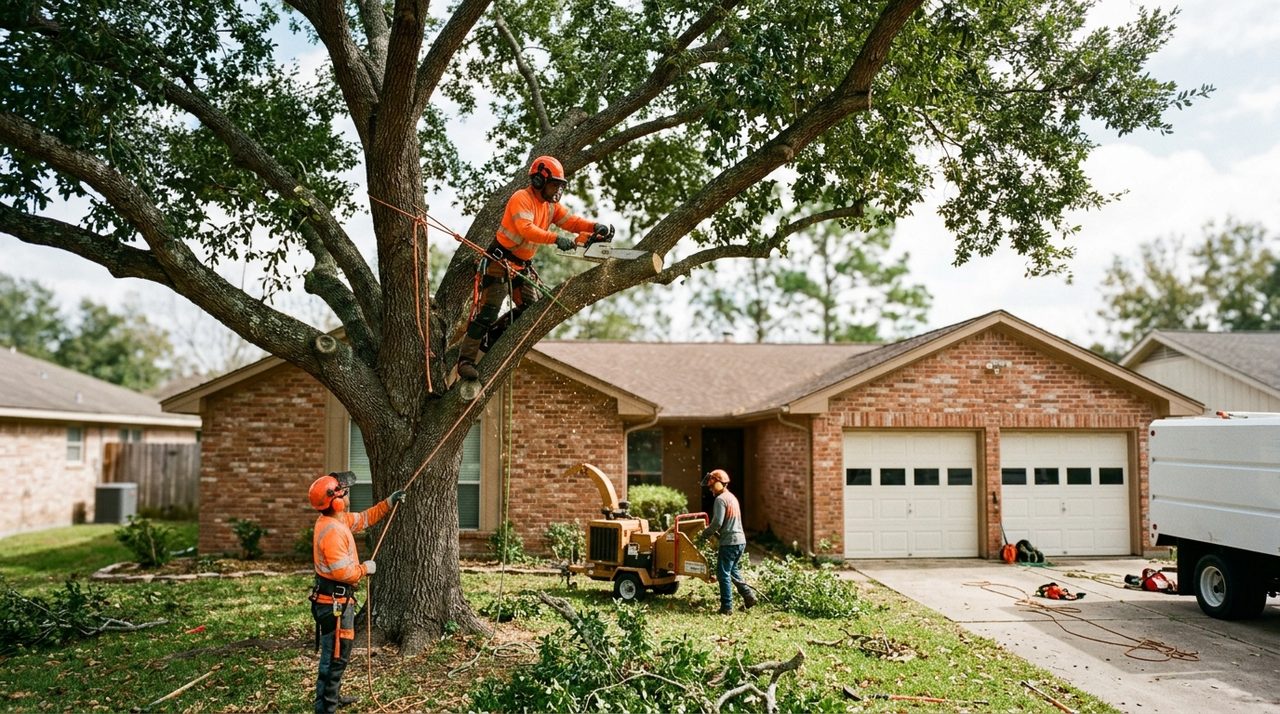
Garden Oaks's wide, mature-canopied lots — many of them 7,000–9,000 square feet on streets that haven't changed much since the 1940s — put large live oaks, water oaks, and fast-volunteering Chinese tallow trees in close quarters with both 80-year-old pier-and-beam bungalows and brand-new slab-on-grade custom builds replacing them. The City of Houston does not require a permit to remove a tree on private property, but the Garden Oaks Civic Club's deed restrictions and the three registered mandatory HOAs covering parts of the neighborhood add a layer of approval that has surprised more than a few homeowners mid-project. Understanding those local rules — and the specific tree hazards tied to Garden Oaks's split housing stock — is what separates a smooth removal from a fine, a root-damaged foundation, or a chainsaw crew that disappears after a derecho.
Ranked by verified Google rating × review volume × verification tier. How we rank →
Some highly-rated pros serve Garden Oaks from nearby and may not keep a Garden Oaks street address. Those are listed under "Also serving Garden Oaks" with their real city and distance, so you always know where each business is based.
10928 Normeadow Ln, Houston, TX 77076
Highly-rated pros based nearby who cover Garden Oaks. Distance shown from the Garden Oaks area.
Serving Garden Oaks Based in Lazybrook / Timbergrove · 0.6 mi away
Serving Garden Oaks Based in Lazybrook / Timbergrove · 1.6 mi away
Serving Garden Oaks Based in Lazybrook / Timbergrove · 1.7 mi away
Serving Garden Oaks Based in Acres Homes · 2.6 mi away
Serving Garden Oaks Based in The Heights · 3.1 mi away
Serving Garden Oaks Based in Independence Heights · 3.2 mi away
Serving Garden Oaks Based in EaDo · 3.6 mi away
Serving Garden Oaks Based in Acres Homes · 3.7 mi away
Serving Garden Oaks Based in Brookhollow · 4 mi away
Why it matters to you
Garden Oaks sits adjacent to drainage swales and has a large number of undeveloped or overgrown back lots that act as tallow seed banks — and the neighborhood's disturbed soils from ongoing teardown-and-rebuild activity create exactly the bare-ground conditions this state-listed invasive loves. On the older bungalow properties, tallow roots push into aging cast-iron or galvanized drain lines and crack the softer clay surrounding them, compounding a plumbing problem that many owners don't connect to the tree until a camera scope reveals root intrusion.
What a good pro does
A qualified arborist on a Garden Oaks job should grind the tallow stump to at least 8–10 inches below grade — not just flush-cut it — and apply a cut-surface herbicide approved under Texas rules to prevent resprouting. Because some recycling facilities refuse tallow wood, confirm chip disposal before signing the contract. Budget $150–$400 per stump for grinding as a separate line item; that cost is almost always worth it on this species.
Sources: Texas Commission on Environmental Quality, Harris County Flood Control District
Why it matters to you
The Garden Oaks Civic Club enforces deed restrictions across most of the neighborhood, and three mandatory HOAs with separate boundaries are registered with the Texas Real Estate Commission — meaning the rules that apply to your specific lot may differ from your next-door neighbor's. Removing a mature tree without the applicable committee's written approval can result in fines and forced-replanting requirements that easily exceed the cost of the removal itself, and neither the City of Houston's permitting office nor the tree crew bears responsibility if you skip that step.
What a good pro does
Before scheduling any work, pull your property's deed restriction section from the Harris County Appraisal District records and contact the Garden Oaks Maintenance Organization (GOMO) directly to confirm whether an architectural or landscape committee review is required for trees above a specified trunk diameter — often 6 to 8 inches DBH in deed-restricted Houston neighborhoods. Get any approval in writing and keep it on file; a reputable local arborist familiar with Garden Oaks will ask to see it before starting.
Sources: Local HOA / deed restrictions (see area profile), City of Houston Permitting Center
Why it matters to you
Garden Oaks is unusual in that the same block can have a 1940s pier-and-beam bungalow next to a 2015 slab-on-grade custom build, and the foundation risk from a large live oak within 15–20 feet is genuinely different for each. On the older pier-and-beam homes, surface-feeding live oak roots are more likely to disturb drainage flow under the crawl space or crack shallow cast-iron sewer laterals; on the newer slab homes, Houston's expansive Black clay soil means roots can exploit moisture differentials at the slab edge and accelerate differential settling. Neither scenario is hypothetical in a neighborhood where oaks planted in the 1950s now have 3-foot trunk diameters.
What a good pro does
Before removal, ask the arborist to walk the property and note root flare direction relative to the foundation and any visible slab cracks or pier settlement. On pier-and-beam homes, a plumbing camera scope of the sewer lateral is worth scheduling concurrently — if roots have already intruded, removal alone doesn't fix the pipe. On slab homes, removing a large oak on one side of the house can shift soil moisture balance enough to cause new movement; a structural engineer consultation is reasonable for oaks within 10 feet of the slab edge.
Sources: Harris County Flood Control District, City of Houston Permitting Center
Why it matters to you
The May 2024 derecho tracked directly through northwest Houston with straight-line winds exceeding 100 mph, and Garden Oaks — with its dense canopy of mature oaks overhanging older rooflines and narrow driveways — saw significant branch failures and whole-tree losses. In the weeks following events like that or Hurricane Beryl 2024, regional demand spikes drive legitimate arborists to six-week backlogs and pricing 40–80 percent above normal, while out-of-state crews with no local insurance or ISA credentials flood the area soliciting cash jobs from storm-stressed homeowners.
What a good pro does
Verify that any crew you hire carries general liability insurance of at least $1 million and workers' compensation — ask for certificates naming you as a certificate holder, not just verbal confirmation. ISA Certified Arborist credentials are the recognized voluntary standard in Texas, since TDLR does not license this trade at the state level. For Garden Oaks's narrow lots and overhanging canopy, insist on a written scope that specifies crane or bucket-truck access routes, because an uninsured crew that damages a neighbor's fence or roof on a tight inner-loop lot leaves you holding the liability.
Sources: City of Houston Permitting Center, Local HOA / deed restrictions (see area profile)
Hiring tree removal in Garden Oaks? Garden Oaks presents a split housing stock of original 1930s–1950s bungalows and modern custom homes, creating two distinct home-service profiles on the same streets. Deed restrictions enforced by the Garden Oaks Civic Club govern exterior modifications, so contractors should verify compliance before starting work. The neighborhood sits in FEMA Zone X with low flood risk, but aging plumbing and electrical in vintage homes drive steady renovation demand.
Building era
1930s–1950s (original stock), with significant contemporary infill from 2000s–present.
Typical style
Craftsman-style bungalows and cottages (original); contemporary and transitional custom builds (newer).
Foundations
Not confirmed from available sources — likely mixed pier-and-beam (older bungalows) and slab-on-grade (newer construction). Verify on a per-property basis.
Common systems
Original homes may have galvanized or cast-iron drain lines, older copper supply lines, 60–100 amp electrical panels, and aging forced-air or window-unit HVAC. Newer builds typically have PEX plumbing, 200-amp panels, and modern high-efficiency HVAC systems.
What that means for repairs
Teardown-and-rebuild activity is very common due to the large lot sizes and high land values. Older bungalows undergo kitchen and bath remodels, electrical panel upgrades, and re-plumbing. Foundation repair on pier-and-beam vintage homes is a recurring need.
Permit jurisdiction
City of Houston — Houston Permitting Center (HPW).
HOA & deed restrictions
Most of Garden Oaks operates under the Garden Oaks Civic Club / Garden Oaks Maintenance Organization (GOMO), which enforces deed restrictions but does not charge a mandatory annual HOA fee. Section 4 specifically has no transfer fee. However, three mandatory HOAs are registered in the Garden Oaks area per Texas Real Estate Commission filings — exact names and boundaries not confirmed.
Historic districts
No City of Houston historic district designation confirmed. No references to HAHC review or Certificates of Appropriateness were found for Garden Oaks, though a formal city historic-district list was not available in research — verify with Houston Planning & Development if exterior changes are planned.
Contractor note
Deed restrictions enforced by the civic club may regulate exterior materials, setbacks, and accessory structures. Contractors should review the applicable section's deed restrictions before beginning exterior work, and confirm whether the specific property falls under one of the three registered mandatory HOAs.
FEMA flood zone
FEMA Zone X (low flood risk) per official NFHL data. Garden Oaks is not immediately adjacent to a major bayou, though Little White Oak Bayou runs to the neighborhood's general south/southeast.
Hurricane Harvey impact
No source in the available research directly addresses Hurricane Harvey flooding specific to Garden Oaks. No quantified damage figures, flooded-street lists, or recurring flood problem areas were identified. Not confirmed — check Harris County Flood Control District records and FEMA claims data for property-level Harvey impact.
Heat & humidity load
Original 1930s bungalows with limited insulation and older HVAC systems face heavy cooling loads during Houston summers, driving frequent AC repair and duct-sealing calls. Mature tree canopy helps shade but produces debris that clogs gutters and stresses roofing. Newer builds with modern insulation and high-efficiency systems fare better but still demand annual HVAC maintenance.
Working with contractors here
Garden Oaks generates two parallel workstreams: full teardown-and-rebuild projects replacing aging bungalows with contemporary custom homes, and deep renovations of vintage 1930s–1950s cottages. Older homes frequently need foundation leveling on pier-and-beam systems, full re-plumbing to replace galvanized lines, and electrical panel upgrades from 60-amp to 200-amp service. The civic club's deed restriction enforcement means exterior remodels — roofing material changes, fence styles, and additions — should be reviewed for compliance before permitting. Large lot sizes and mature landscaping often complicate equipment access and staging, so job scoping should account for tree protection and limited driveway widths on older properties.
Local Tip
Always ask for a written estimate before work begins. Texas contractors are required to provide one on jobs over $1,000.
Garden Oaks presents a split housing stock of original 1930s–1950s bungalows and modern custom homes, creating two distinct home-service profiles on the same streets. Deed restrictions enforced by the Garden Oaks Civic Club govern exterior modifications, so contractors should verify compliance before starting work. The neighborhood sits in FEMA Zone X with low flood risk, but aging plumbing and electrical in vintage homes drive steady renovation demand.
Source: U.S. Census Bureau, ACS 5-Year 2023
Most of Garden Oaks maps to FEMA Zone X (low mapped flood risk), but Houston's flash-flood reality means even low-risk blocks benefit from smart drainage and storm-hardened installs.
Source: FEMA National Flood Hazard Layer (NFHL). Flood zones vary by parcel — verify your individual FIRM panel.
Wind is the primary tree hazard in lower-risk Garden Oaks neighborhoods during a Gulf hurricane, so focus pre-storm efforts on removing dead or structurally weak trees that could reach your roof line or power drop. A TDLR-licensed contractor can perform a hazard assessment and complete removal well before a storm's 72-hour watch window, when crews become unavailable across the Houston metro. Much of the housing stock predates modern wind codes (median build year 1963), so retrofits matter more here. Confirm the current FEMA panel for your Garden Oaks parcel — the area maps to Zone X, but adjacent lots can differ.
After any severe thunderstorm drops large limbs in your yard in Garden Oaks, have a licensed contractor assess the parent tree for hidden decay before assuming the remaining structure is sound. Snap failures during the May 2024 derecho frequently involved trees that had experienced prior lightning strikes or previous partial limb loss that had gone uninspected. In-city Garden Oaks work falls under City of Houston floodplain and permitting rules.
The most actionable winter prep for tree removal in Garden Oaks is removing any tree or large limb that hangs directly over a roofline, vehicle parking area, or power service drop before the first freeze advisory. Ice adds weight faster than most homeowners expect, and Houston trees that have never experienced sustained ice loading have no adaptive resilience to that stress. With a median build year of 1963, the older building stock here is more exposed to hard-freeze damage than newer construction. Confirm the current FEMA panel for your Garden Oaks parcel — the area maps to Zone X, but adjacent lots can differ.
Sources: FEMA National Flood Hazard Layer (NFHL), Ready.gov -- Hurricanes, CenterPoint Energy -- Storm Center, City of Houston -- Emergency Preparedness, Ready.gov -- Winter Weather, Harris County Flood Control District
Houston-specific estimators to plan your project before you call a pro. All results are planning estimates — a licensed local pro confirms the details on site.
Grouped by mature root aggression & water demand.
Trunk center to the nearest exterior wall.
The root zone likely reaches your foundation's soil during Houston's dry summers, when clay shrinks most. Watch for sticking doors and diagonal cracks, keep soil moisture even with a soaker hose during drought, and have a foundation pro evaluate if you see any movement.
Find a Houston foundation pro →This is a planning estimate only — actual requirements depend on an on-site assessment by a licensed Houston pro. Guidance is based on general species root behavior in expansive clay, not a soil test.
Disconnect & drain every outdoor hose bib
Remove hoses, drain the spigots, and cover each with an insulated faucet sock. Un-drained hose bibs are the #1 burst point in a Houston freeze.
Insulate exposed pipes in the attic & garage
Wrap any pipe in an unconditioned space (attic runs, garage walls) with foam sleeves. Houston homes rarely insulate these because they only matter a few nights a year — which is exactly why they burst.
Open cabinet doors & keep a pencil-width drip
On hard-freeze nights, open kitchen/bath cabinets so warm air reaches the pipes and let faucets on exterior walls drip to relieve pressure.
Protect the attic/garage water heater & its lines
An attic or garage tank sits in unconditioned space. Insulate the cold-inlet and hot-outlet lines and confirm the emergency drain pan is clear so a leak doesn't reach the ceiling.
This is a planning estimate only — actual requirements depend on an on-site assessment by a licensed Houston pro. If a pipe has already burst, shut off your main water supply and call a licensed Houston plumber immediately — freeze bursts flood fast.
Sources: City of Houston Permitting CenterLocal HOA / deed restrictions (see area profile)
Sources: Local HOA / deed restrictions (see area profile)