Closed
Serving Westbury Based in Braeswood · 1.6 mi away
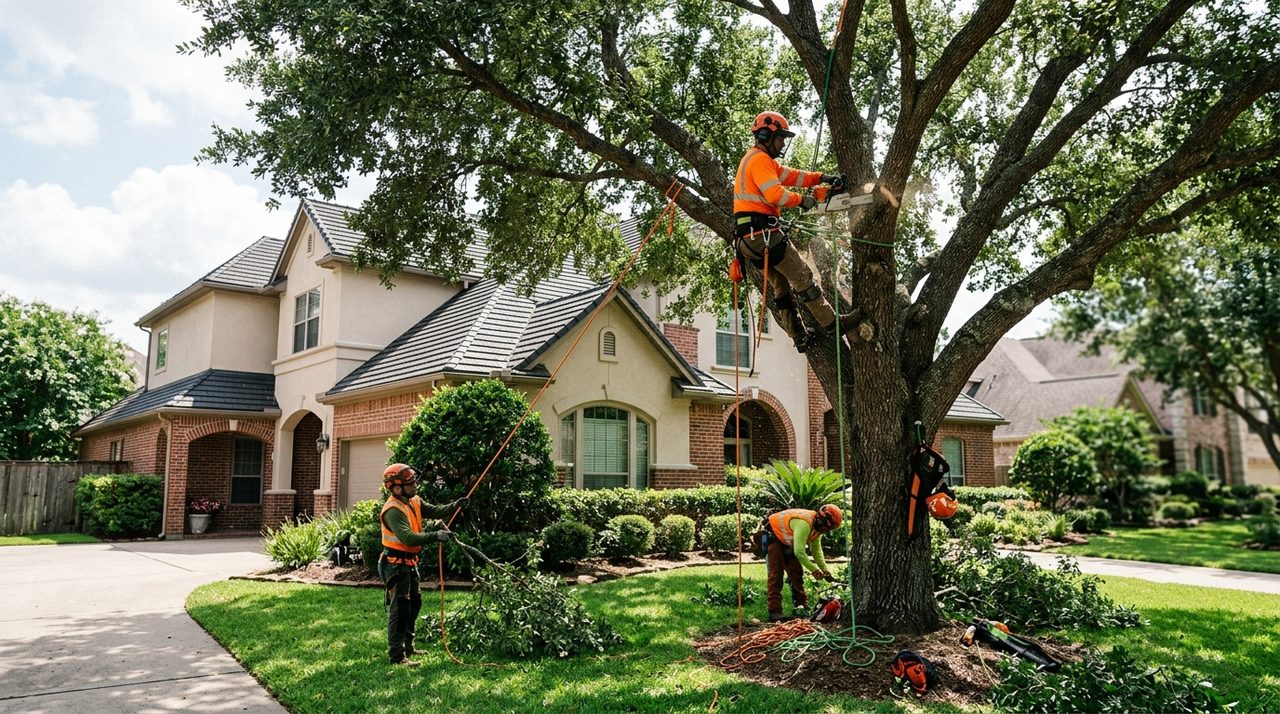
Westbury's wide lots and mid-century planting culture mean many of the subdivision's original 1950s–1960s ranch homes now sit beneath mature live oaks, water oaks, and opportunistic Chinese tallow trees whose root systems are working against cast iron drain lines and aging concrete slabs. Because Westbury falls entirely within Houston city limits, the City of Houston Permitting Center — not a suburban municipality — governs permits, but the Westbury Civic Club's Architectural Review Committee adds a private approval layer that catches many homeowners off guard. This page explains the specific tree-removal realities on these mid-century lots so you can budget accurately, stay in compliance, and protect both your foundation and your summer energy bill.
Ranked by verified Google rating × review volume × verification tier. How we rank →
Some highly-rated pros serve Westbury from nearby and may not keep a Westbury street address. Those are listed under "Also serving Westbury" with their real city and distance, so you always know where each business is based.
Highly-rated pros based nearby who cover Westbury. Distance shown from the Westbury area.
Serving Westbury Based in Braeswood · 1.6 mi away
Serving Westbury Based in Braeswood · 1.9 mi away
Serving Westbury Based in Missouri City · 3.3 mi away
Serving Westbury Based in Missouri City · 3.3 mi away
Serving Westbury Based in Bellaire · 3.6 mi away
Serving Westbury Based in Missouri City · 3.7 mi away
Serving Westbury Based in Missouri City · 4 mi away
Serving Westbury Based in Stafford · 4.4 mi away
Serving Westbury Based in Missouri City · 4.5 mi away
Serving Westbury Based in West University · 5.3 mi away
Why it matters to you
Westbury's original homes were built in the 1950s and 1960s, when cast iron drain lines were standard — and many have never been replaced. Mature live oaks, water oaks, and fast-spreading Chinese tallow trees that have had decades to establish on these wide lots are precisely the species whose surface-feeding roots exploit Houston's expansive Black clay soil to heave slab edges and infiltrate aging clay-jointed or cast iron sewer laterals. A cracked or root-choked drain line on a 60-year-old home can mean a full sewer re-line or replacement on top of the tree bill.
What a good pro does
Before any large tree comes down, a qualified arborist should assess root spread relative to your home's foundation perimeter and, ideally, a plumber should camera-inspect the drain lateral if the tree is within 15–20 feet of the slab edge or cleanout. Stump grinding — not just cutting flush — is essential to interrupt regrowth, especially with Chinese tallow, which resprouts aggressively from any remaining root crown. Ask for documentation that the crew carries liability insurance adequate to cover any incidental underground utility or slab damage discovered during removal.
Sources: City of Houston Permitting Center, Texas Commission on Environmental Quality
Why it matters to you
Westbury operates under deed restrictions enforced by the Westbury Civic Club, Inc. (Super Neighborhood 37), and its Architectural Review Committee has authority over exterior modifications — which includes significant tree removal on your lot. Homeowners who skip ARC review before removing a large tree risk fines and potentially a forced-replanting requirement. Because deed restriction terms vary by section of the subdivision, the legal obligation for your specific lot must be confirmed against Harris County Clerk deed restriction records, not assumed.
What a good pro does
Pull the recorded deed restrictions for your specific lot through the Harris County Clerk's office before scheduling any removal of a tree that could reasonably be considered a landscape feature — generally anything above roughly 6–8 inches in trunk diameter at breast height. Submit the ARC request with a site plan showing the tree's location relative to the home and proposed replacement planting if required. A reputable local tree company familiar with Westbury will build this review window into their project timeline rather than pressure you to skip it.
Sources: Local HOA / deed restrictions (see area profile), City of Houston Permitting Center
Why it matters to you
Westbury sits within Houston city limits, so the City of Houston Permitting Center is the relevant permit authority — not Bellaire, Pearland, or any suburban municipality. The good news is that the City of Houston does not require a homeowner permit for routine tree removal on private residential property. The important caveat: if removal requires work near or under CenterPoint Energy overhead lines, the tree company must coordinate with CenterPoint and carry adequate liability insurance, and any concurrent structural, plumbing, or electrical work disturbed in the process does require City of Houston permits under the appropriate trade category.
What a good pro does
Confirm your address is in Houston city limits (not an enclave jurisdiction) before assuming COH rules apply — Westbury's boundaries are firmly within Houston. For tree work near power lines, verify the crew has coordinated line-clearance protocols with CenterPoint rather than simply working around live conductors. Texas has no state-issued arborist license through TDLR, so ISA Certified Arborist credential is the voluntary industry benchmark worth requesting from any company you consider hiring.
Sources: City of Houston Permitting Center, Municipal permit office (see area profile)
Why it matters to you
The May 2024 derecho with 100-plus mph straight-line winds and Hurricane Beryl in July 2024 generated a regional demand surge that sent tree-removal pricing 40–80% above normal rates across southwest Houston neighborhoods like Westbury, where mature oaks and tallows had decades of crown growth to lose. Out-of-state crews flooded the market, and homeowners on storm-damaged lots faced weeks-long backlogs with limited ability to vet who they were hiring. A large storm-damaged live oak or pine in Westbury — already commanding $2,000–$5,000 or more under normal conditions — can push well past that with hazard premiums for compromised wood.
What a good pro does
Outside of an immediate safety emergency, resist pressure to sign a contract the day a crew shows up uninvited after a storm. Get at least two written estimates, verify the company carries liability insurance and workers' compensation coverage, and pay no more than a small deposit upfront. For a tree that is leaning onto your structure, call your homeowner's insurance carrier first — storm-caused tree removal and associated structural damage is often a covered peril under standard HO-3 policies, and your insurer may require their own adjuster to document the scene before work begins.
Sources: FEMA National Flood Hazard Layer (NFHL), Local HOA / deed restrictions (see area profile)
Hiring tree removal in Westbury? Westbury is a large 1950s-era subdivision of roughly 5,000 single-family homes plus thousands of multifamily units in southwest Houston. Homeowners here contend with aging slab foundations, original-era plumbing and electrical systems, and flood risk in sections near Willow Waterhole and Brays Bayou. Deed restrictions enforced by the Westbury Civic Club/HOA require architectural review for exterior modifications, making pre-project compliance checks essential.
Building era
1950s–1960s (original subdivision), with later multifamily and infill development.
Typical style
One-story mid-century ranch homes with brick veneer, low-sloped or hipped roofs, attached garages or carports, and wide lots.
Foundations
Predominantly concrete slab-on-grade; some pier-and-beam may exist in earliest sections but slab is clearly prevalent in listings.
Common systems
Original homes likely have galvanized steel or early copper supply lines, cast iron drain lines, 100-amp electrical panels, and older forced-air HVAC systems or window units later converted to central air. Many systems are 50–70 years old and approaching or past end of life.
What that means for repairs
Kitchen and bathroom remodels are common as owners update mid-century layouts. Whole-house replumbing (replacing galvanized and cast iron), electrical panel upgrades to 200-amp service, and HVAC replacements are frequent due to system age. Some lots see teardown-rebuild activity as land values support new construction.
Permit jurisdiction
City of Houston Permitting Center (Westbury is within Houston city limits).
HOA & deed restrictions
Westbury Civic Club, Inc. operates as the primary neighborhood association (Super Neighborhood 37). Deed restrictions with an Architectural Review/Control Committee are described as mandatory for compliance. The exact legal status of dues (mandatory vs. voluntary for each section) is not fully verifiable from public sources alone — check Harris County Clerk deed restriction records for your specific lot.
Historic districts
No City of Houston historic district designation confirmed.
Contractor note
Contractors must obtain City of Houston permits for structural, mechanical, electrical, and plumbing work, and should verify Westbury's deed restriction and ARC/ACC requirements before beginning any exterior modifications including fencing, roofing material changes, or additions.
FEMA flood zone
FEMA Zone X (low flood risk) per official NFHL data. However, Westbury is adjacent to Brays Bayou and Willow Waterhole, and portions of the neighborhood — especially lower-lying southern and eastern sections near these drainage features — have documented histories of flooding. Parcel-level flood risk can vary significantly; an elevation certificate and HCFCD inundation maps should be consulted for individual addresses.
Hurricane Harvey impact
Significant flooding occurred in portions of Westbury during Hurricane Harvey (2017), particularly in lower-lying sections closest to Willow Waterhole, Brays Bayou, and drainage corridors near US 90A and South Post Oak. Post-Harvey flood mitigation projects were implemented around Willow Waterhole. Block-by-block impact data is not available in text sources; homeowners should request seller's disclosure, prior flood claim history, and Harris County Flood Control District high-water-mark data for specific addresses.
Heat & humidity load
1950s slab homes with original insulation and single-pane windows put heavy loads on HVAC systems during Houston summers. Aging ductwork in unconditioned attics degrades efficiency. Foundation movement on expansive clay soils accelerates during summer drought cycles, making seasonal watering programs and foundation monitoring important for these older slabs.
Working with contractors here
The dominant work in Westbury involves updating 1950s–1960s building systems: whole-house replumbing from galvanized and cast iron to PEX/PVC, electrical panel upgrades from 100-amp to 200-amp service, and HVAC replacement with modern high-efficiency equipment. Slab foundation repair is common due to the age of the homes and Houston's expansive clay soils. Contractors should be aware that the Westbury Architectural Review Committee requires compliance with deed restrictions for exterior work, so scope proposals for roofing, siding, fencing, or additions should account for review and approval timelines. Flood-damaged properties near Willow Waterhole and Brays Bayou may require remediation work including mold abatement, drywall replacement, and elevated mechanical equipment installation.
Local Tip
Always ask for a written estimate before work begins. Texas contractors are required to provide one on jobs over $1,000.
Westbury is a large 1950s-era subdivision of roughly 5,000 single-family homes plus thousands of multifamily units in southwest Houston. Homeowners here contend with aging slab foundations, original-era plumbing and electrical systems, and flood risk in sections near Willow Waterhole and Brays Bayou. Deed restrictions enforced by the Westbury Civic Club/HOA require architectural review for exterior modifications, making pre-project compliance checks essential.
Source: U.S. Census Bureau, ACS 5-Year 2023
Most of Westbury maps to FEMA Zone X (low mapped flood risk), but Houston's flash-flood reality means even low-risk blocks benefit from smart drainage and storm-hardened installs; risk climbs sharply on blocks nearest Brays Bayou, where it varies parcel to parcel.
Source: FEMA National Flood Hazard Layer (NFHL). Flood zones vary by parcel — verify your individual FIRM panel.
Beryl 2024 left tens of thousands of trees down across the Houston area, and lower-flood-risk zones like Westbury were not spared from wind-throw damage that crushed vehicles, fences, and rooflines. Scheduling removal of any large tree with a cavity, dead crown, or proximity to your home now means you are not competing for post-storm crews when wait times stretch to weeks. Because Westbury drains toward Brays Bayou, block-level runoff can differ sharply from the mapped zone.
Wind and lightning are the dominant tree hazards in Westbury during severe Houston thunderstorms, and the May 2024 derecho proved that low-flood-risk areas are not insulated from widespread tree-on-structure damage when straight-line winds exceed 75 mph. A pre-season inspection by a licensed tree removal contractor focused on dead wood, weak branch attachments, and trees leaning toward structures is the most direct mitigation step available. In-city Westbury work falls under City of Houston floodplain and permitting rules.
Wind loading on ice-coated canopies in Westbury during a hard freeze creates the same failure risk as a severe windstorm, and lower flood-risk areas are just as exposed to ice-storm tree damage as any other part of the Houston metro. Uri 2021 left neighborhoods across the city dealing with fallen trees on homes and vehicles for weeks, primarily because no pre-storm removal of structurally weak specimens had been completed. With a median build year of 1977, the older building stock here is more exposed to hard-freeze damage than newer construction. Confirm the current FEMA panel for your Westbury parcel — the area maps to Zone X, but adjacent lots can differ.
Sources: FEMA National Flood Hazard Layer (NFHL), Ready.gov -- Hurricanes, CenterPoint Energy -- Storm Center, City of Houston -- Emergency Preparedness, Ready.gov -- Winter Weather, Harris County Flood Control District
Houston-specific estimators to plan your project before you call a pro. All results are planning estimates — a licensed local pro confirms the details on site.
Grouped by mature root aggression & water demand.
Trunk center to the nearest exterior wall.
The root zone likely reaches your foundation's soil during Houston's dry summers, when clay shrinks most. Watch for sticking doors and diagonal cracks, keep soil moisture even with a soaker hose during drought, and have a foundation pro evaluate if you see any movement.
Find a Houston foundation pro →This is a planning estimate only — actual requirements depend on an on-site assessment by a licensed Houston pro. Guidance is based on general species root behavior in expansive clay, not a soil test.
Disconnect & drain every outdoor hose bib
Remove hoses, drain the spigots, and cover each with an insulated faucet sock. Un-drained hose bibs are the #1 burst point in a Houston freeze.
Insulate exposed pipes in the attic & garage
Wrap any pipe in an unconditioned space (attic runs, garage walls) with foam sleeves. Houston homes rarely insulate these because they only matter a few nights a year — which is exactly why they burst.
Open cabinet doors & keep a pencil-width drip
On hard-freeze nights, open kitchen/bath cabinets so warm air reaches the pipes and let faucets on exterior walls drip to relieve pressure.
Protect the attic/garage water heater & its lines
An attic or garage tank sits in unconditioned space. Insulate the cold-inlet and hot-outlet lines and confirm the emergency drain pan is clear so a leak doesn't reach the ceiling.
This is a planning estimate only — actual requirements depend on an on-site assessment by a licensed Houston pro. If a pipe has already burst, shut off your main water supply and call a licensed Houston plumber immediately — freeze bursts flood fast.
Sources: City of Houston Permitting CenterLocal HOA / deed restrictions (see area profile)
Sources: FEMA National Flood Hazard Layer (NFHL)Harris County Flood Control District