Open Now
5708 N Shepherd Dr C-3, Houston, TX 77091
Acres Homes' block-by-block mix of 1950s–1970s pier-and-beam cottages and post-2015 slab-on-grade infill creates a uniquely complicated water-damage picture: a single street-flooding event can produce completely different drying and demo scopes on adjacent properties depending on which decade the house was built. Even though most of the neighborhood maps to FEMA Zone X, Houston's intense convective rainfall and Vogel Creek tributary drainage mean flash intrusion events are a documented local reality — and with no mandatory HOA imposing delays, homeowners here can move fast on mitigation if they know the right steps. This page walks through the specific challenges that arise in Acres Homes' mixed housing stock and what a properly credentialed contractor must do differently here than elsewhere in the metro.
Ranked by verified Google rating × review volume × verification tier. How we rank →
Some highly-rated pros serve Acres Homes from nearby and may not keep a Acres Homes street address. Those are listed under "Also serving Acres Homes" with their real city and distance, so you always know where each business is based.
5708 N Shepherd Dr C-3, Houston, TX 77091
1106 Carby Rd, Houston, TX 77037
3527 Mansfield St, Houston, TX 77091
Highly-rated pros based nearby who cover Acres Homes. Distance shown from the Acres Homes area.
Serving Acres Homes Based in Garden Oaks · 2.7 mi away
Serving Acres Homes Based in Garden Oaks · 3.1 mi away
Serving Acres Homes Based in Greenspoint · 3.9 mi away
Serving Acres Homes Based in Lazybrook / Timbergrove · 4 mi away
Serving Acres Homes Based in Independence Heights · 4.5 mi away
Serving Acres Homes Based in Jersey Village · 5.1 mi away
Serving Acres Homes Based in NW Houston · 5.3 mi away
Why it matters to you
Unlike the slab-on-grade infill two doors down, Acres Homes' original mid-century cottages sit on pier-and-beam foundations with a crawl space below the wood subfloor. When flash water enters — even just a few inches from a clogged street drain near a Vogel Creek tributary — it pools in that crawl space, saturates floor joists, bottom plates, and subfloor sheathing, and begins driving moisture upward into wall cavities well after the surface appears dry. With a census median build year of 1979 and significant 1950s–1970s stock in active use, a large share of owner-occupied homes (56.5% of Acres Homes housing units are owner-occupied per ACS data) face this exact scenario.
What a good pro does
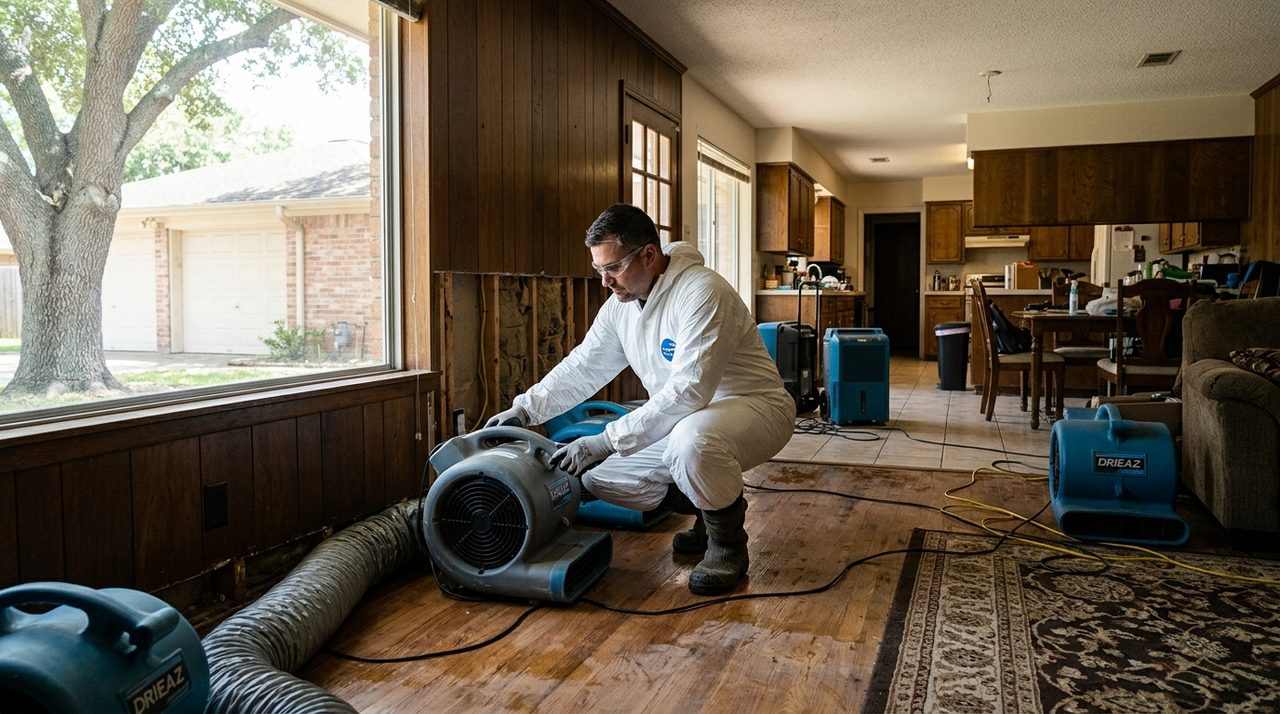
A qualified restoration contractor must physically access the crawl space with a calibrated moisture meter and thermal imaging camera to map saturation extent in joists and subfloor decking — not just check the interior floor surface. IICRC S500 drying protocols call for targeted air movers and dehumidifiers placed in the crawl space itself, not just the living area above; skipping this step routinely leads to mold growth inside the floor assembly within 48–72 hours in Houston's humidity. All structural demo and any plumbing disturbed in the crawl space requires a permit pulled through the City of Houston Houston Permitting Center, which has jurisdiction over the entire Acres Homes neighborhood.
Sources: IICRC (water/mold restoration standards), City of Houston Permitting Center, Harris County Flood Control District
Why it matters to you
Older Acres Homes cottages — particularly those built before the 1970s and not yet touched by the neighborhood's active infill renovation wave — commonly retain original galvanized steel supply lines and cast-iron drain stacks. A water loss event, whether from a burst line, a roof leak, or storm intrusion, frequently strips drywall and exposes these aged pipes for the first time in decades. Restoration contractors regularly find corrosion, pinhole leaks, or structural failure in the exposed sections, meaning a mitigation job that started at $5,000–$8,000 can escalate quickly once the wall cavities are open.
What a good pro does
When wall cavities are opened for drying and demo, have the restoration contractor document all exposed plumbing with photographs before any reconstruction begins. If galvanized lines are found to be compromised, a TSBPE-licensed plumber must pull a separate plumbing permit through the City of Houston Permitting Center to repipe the affected sections — the restoration contractor cannot do this work under a demolition permit alone. Sequencing the plumber before drywall close-in is critical; rushing reconstruction over wet or failing plumbing is the leading cause of repeat water losses in older Acres Homes cottages.
Sources: Texas State Board of Plumbing Examiners, City of Houston Permitting Center, IICRC (water/mold restoration standards)
Why it matters to you
Many pre-2000 homes in Acres Homes still run flex duct through unconditioned attic space, and the neighborhood's older owner-occupied housing stock frequently features aging central HVAC systems that were running during or immediately after a water intrusion event. Houston's average relative humidity of around 74% and summer attic temperatures that can exceed 140°F create textbook Aspergillus and Cladosporium growth conditions inside water-logged flex duct insulation within 48–72 hours. Because newer infill on the same block may have SEER 14+ modern split systems with clean ductwork, contractors cannot assume uniform HVAC conditions — each property must be scoped individually.
What a good pro does
After any water event that reached ceiling height or involved roof intrusion, a restoration contractor should inspect all flex duct runs with a moisture meter and, where saturation is confirmed, the duct system must be replaced rather than dried in place — saturated flex duct insulation does not return to a cleanable state under IICRC S500 standards. Any mold assessment or remediation work in the duct system requires a TDLR-issued Mold Assessment Consultant (MAC) or Mold Remediation Contractor (MRC) license; confirm the firm's TDLR credentials before work begins. The HVAC replacement itself requires a separate mechanical permit from the City of Houston Permitting Center.
Sources: IICRC (water/mold restoration standards), Texas Department of Licensing & Regulation, City of Houston Permitting Center
Why it matters to you
One genuine advantage Acres Homes homeowners have over neighbors in master-planned communities is the absence of a mandatory HOA architectural review process — there is no board to petition for dumpster placement or exterior demo approval, which means mitigation work can begin within the 24–48 hour window that IICRC S500 standards identify as critical for preventing Category 2 losses from escalating. However, some newer infill plats within Acres Homes carry private deed restrictions recorded with Harris County that govern minimum square footage and exterior materials, and these restrictions can technically apply to reconstruction choices even if no HOA enforces them actively.
What a good pro does
Before signing a restoration contract, ask the contractor to confirm whether the property's Harris County Clerk records include any private deed restrictions on the lot — this matters for exterior re-cladding or structural modifications during reconstruction. For the mitigation and demo phase itself, the contractor must pull a demolition permit through the City of Houston Houston Permitting Center; electrical work exposed during demo requires a separate TDLR-licensed electrician pulling their own permit through the same office. Getting permits in hand before work starts protects the homeowner's ability to obtain a Certificate of Completion, which most insurers require to close a restoration claim.
Sources: City of Houston Permitting Center, Local HOA / deed restrictions (see area profile), IICRC (water/mold restoration standards)
Hiring water & flood restoration in Acres Homes? Acres Homes presents a uniquely diverse housing stock ranging from mid-century pier-and-beam cottages to post-2015 slab-on-grade infill homes, often on the same block. Most of the area has no mandatory HOA or formal deed restrictions, giving homeowners wide latitude on repairs and renovations but also creating a patchwork of building conditions. Contractors working here must be comfortable with both legacy wood-frame structural repairs and modern systems found in newer affordable construction.
Building era
1950s–1970s (legacy stock) with significant post-2015 infill construction; secondary wave from 1990s–2000s.
Typical style
Older homes are one-story wood-frame cottages, bungalows, and modest ranch-style houses; newer infill is contemporary traditional single-family with Hardie siding or brick-and-Hardie exteriors.
Foundations
Mixed — older homes are commonly pier-and-beam; newer infill construction is predominantly concrete slab-on-grade.
Common systems
Older homes often have galvanized or cast-iron plumbing, older electrical panels (60–100 amp), and window-unit or aging central HVAC systems. Newer infill homes typically have PEX or CPVC plumbing, 200-amp electrical panels, and modern split-system HVAC with SEER 14+ ratings.
What that means for repairs
Extensive infill and revitalization activity driven by the City of Houston's New Home Development Program (NHDP) and private developers replacing or renovating aging frame houses. Common renovation work includes pier-and-beam leveling, plumbing repipes on older homes, electrical panel upgrades, and full gut-rehabs of mid-century cottages.
Permit jurisdiction
City of Houston — Houston Permitting Center (Acres Homes is within Houston city limits).
HOA & deed restrictions
No mandatory master HOA for most of Acres Homes. Voluntary civic clubs and community organizations exist (e.g., Acres Home Super Neighborhood #6) but do not impose dues or design controls. Some newer small infill plats may carry private deed restrictions governing minimum square footage and use, but these vary lot by lot.
Historic districts
No City of Houston historic district designation confirmed.
Contractor note
With no overarching HOA design review, contractors typically need only City of Houston permits. However, some newer infill plats may have private deed restrictions with architectural standards — confirm with the property owner and check Harris County Clerk records before beginning exterior work.
FEMA flood zone
FEMA Zone X (low flood risk) per official NFHL data. However, portions of Acres Homes adjacent to Vogel Creek and its tributary channels fall within 100-year and 500-year floodplains per Harris County Flood Control District mapping. Flood risk varies significantly by proximity to these waterways and local low points along drainage ditches.
Hurricane Harvey impact
Acres Homes experienced structural flooding during Hurricane Harvey (2017), but it was not among the highest-profile disaster zones like Meyerland or Greenspoint. Areas near Vogel Creek and low-lying drainage channels were most affected. The exact extent of damage is not clearly quantified in public summaries. Harris County Flood Control District has undertaken channel improvement and detention projects along Vogel Creek in this area, indicating recognized recurring drainage issues.
Heat & humidity load
Older pier-and-beam cottages with aging HVAC systems and limited insulation are especially vulnerable to Houston's extreme summer heat and humidity. Condensation under pier-and-beam homes can accelerate subfloor rot and encourage mold growth. Newer slab-on-grade infill homes perform better thermally but still demand regular HVAC maintenance during peak cooling season.
Working with contractors here
The most common contractor work in Acres Homes includes foundation leveling and pier-and-beam repair on mid-century frame houses, full plumbing repipes replacing galvanized lines, and electrical panel upgrades from 60-amp to 200-amp service. The active infill development market also generates steady demand for new construction trades, demolition, and site prep. Because housing stock varies dramatically from block to block — a 1950s cottage may sit next to a 2020 build — contractors must scope each job individually and cannot assume uniform conditions. Drainage and grading work is important near Vogel Creek tributaries, and properties in low-lying areas may need additional moisture mitigation measures.
Local Tip
Always ask for a written estimate before work begins. Texas contractors are required to provide one on jobs over $1,000.
Acres Homes presents a uniquely diverse housing stock ranging from mid-century pier-and-beam cottages to post-2015 slab-on-grade infill homes, often on the same block. Most of the area has no mandatory HOA or formal deed restrictions, giving homeowners wide latitude on repairs and renovations but also creating a patchwork of building conditions. Contractors working here must be comfortable with both legacy wood-frame structural repairs and modern systems found in newer affordable construction.
Source: U.S. Census Bureau, ACS 5-Year 2023
Most of Acres Homes maps to FEMA Zone X (low mapped flood risk), but Houston's flash-flood reality means even low-risk blocks benefit from smart drainage and storm-hardened installs.
Source: FEMA National Flood Hazard Layer (NFHL). Flood zones vary by parcel — verify your individual FIRM panel.
Before hurricane season, commission a moisture baseline scan from an IICRC-certified restoration firm so any post-storm water intrusion in Acres Homes can be quantified and documented for your insurer immediately. Beryl 2024 showed that even low-mapped-risk neighborhoods saw flash flooding that saturated flooring assemblies within hours of peak rainfall. Confirm the current FEMA panel for your Acres Homes parcel — the area maps to Zone X, but adjacent lots can differ.
For homeowners in Acres Homes: the May 2024 derecho caused widespread roof-deck separation across Houston, and the subsequent rainfall introduced water into attic insulation that retained moisture for weeks — a restoration contractor with desiccant drying equipment can address these attic assemblies that conventional fans cannot reach. Documenting the drying process with daily moisture logs also supports insurance claims for wind-and-water combined losses. Confirm the current FEMA panel for your Acres Homes parcel — the area maps to Zone X, but adjacent lots can differ.
A hard freeze in Acres Homes can split a single supply line and deposit 50 or more gallons of water into a ceiling assembly before a homeowner locates the shutoff, and that volume requires more than fans and open windows to dry safely. Texas law under TDLR requires mold assessors and remediators to hold specific licenses, so verify your restoration contractor's credentials before you need them under emergency conditions. With a median build year of 1979, the older building stock here is more exposed to hard-freeze damage than newer construction. Confirm the current FEMA panel for your Acres Homes parcel — the area maps to Zone X, but adjacent lots can differ.
Sources: FEMA National Flood Hazard Layer (NFHL), Ready.gov -- Hurricanes, CenterPoint Energy -- Storm Center, City of Houston -- Emergency Preparedness, Ready.gov -- Winter Weather, Harris County Flood Control District
Houston-specific estimators to plan your project before you call a pro. All results are planning estimates — a licensed local pro confirms the details on site.
Disconnect & drain every outdoor hose bib
Remove hoses, drain the spigots, and cover each with an insulated faucet sock. Un-drained hose bibs are the #1 burst point in a Houston freeze.
Insulate exposed pipes in the attic & garage
Wrap any pipe in an unconditioned space (attic runs, garage walls) with foam sleeves. Houston homes rarely insulate these because they only matter a few nights a year — which is exactly why they burst.
Open cabinet doors & keep a pencil-width drip
On hard-freeze nights, open kitchen/bath cabinets so warm air reaches the pipes and let faucets on exterior walls drip to relieve pressure.
Protect the attic/garage water heater & its lines
An attic or garage tank sits in unconditioned space. Insulate the cold-inlet and hot-outlet lines and confirm the emergency drain pan is clear so a leak doesn't reach the ceiling.
This is a planning estimate only — actual requirements depend on an on-site assessment by a licensed Houston pro. If a pipe has already burst, shut off your main water supply and call a licensed Houston plumber immediately — freeze bursts flood fast.
Sources: City of Houston Permitting CenterFEMA National Flood Hazard Layer (NFHL)
Sources: IICRC (water/mold restoration standards)Texas Commission on Environmental Quality
Sources: IICRC (water/mold restoration standards)Texas Department of Licensing & Regulation