Open Now
606 Rollingbrook Dr Ste 2J, Baytown, TX 77521
Baytown sits where the Houston Ship Channel, Galveston Bay, and decades of industrial coastal humidity converge — a combination that puts its mixed housing stock, from 1950s-era ranch homes with aging galvanized plumbing to 1990s–2010s HOA tract subdivisions, at above-average risk for both flash-flood infiltration and chronic moisture damage. Most of Baytown maps to FEMA Zone X, which misleads homeowners into thinking flood events are rare, while the city's low elevation near the bay means parcel-level risk can spike dramatically and water-related claims hit even outside mapped floodplains. This page explains the specific water and flood restoration challenges Baytown homeowners actually face, the correct permit path through the City of Baytown's own permit office, and what scopes to expect from qualified contractors.
Ranked by verified Google rating × review volume × verification tier. How we rank →
Some highly-rated pros serve Baytown from nearby and may not keep a Baytown street address. Those are listed under "Also serving Baytown" with their real city and distance, so you always know where each business is based.
606 Rollingbrook Dr Ste 2J, Baytown, TX 77521
1920 W Main St, Baytown, TX 77520
126 Rollingwood St, Baytown, TX 77520
4721 Garth Rd Suite D-200, Baytown, TX 77521
1300 Rollingbrook Dr, Baytown, TX 77521
3700 W Baker Rd, Baytown, TX 77521
Highly-rated pros based nearby who cover Baytown. Distance shown from the Baytown area.
Serving Baytown Based in La Porte · 7.6 mi away
Serving Baytown Based in Seabrook · 9.2 mi away
Serving Baytown Based in Deer Park · 9.4 mi away
Serving Baytown Based in Deer Park · 9.5 mi away
Why it matters to you
Baytown's pre-1970s ranch-style and bungalow homes — many built before modern slab waterproofing standards — sit on conventional slab-on-grade foundations surrounded by Harris County's heavy clay soil. When the city's low-lying streets flood during Gulf-driven rain events or stalled fronts, that clay retains water against the slab perimeter for days after surface water recedes, silently wicking moisture into bottom plates and drywall well beyond what a homeowner can see or measure with a hand-held moisture meter. Even in FEMA Zone X, Baytown's proximity to Galveston Bay means parcel-level flooding is a real exposure that standard flood maps can understate.
What a good pro does
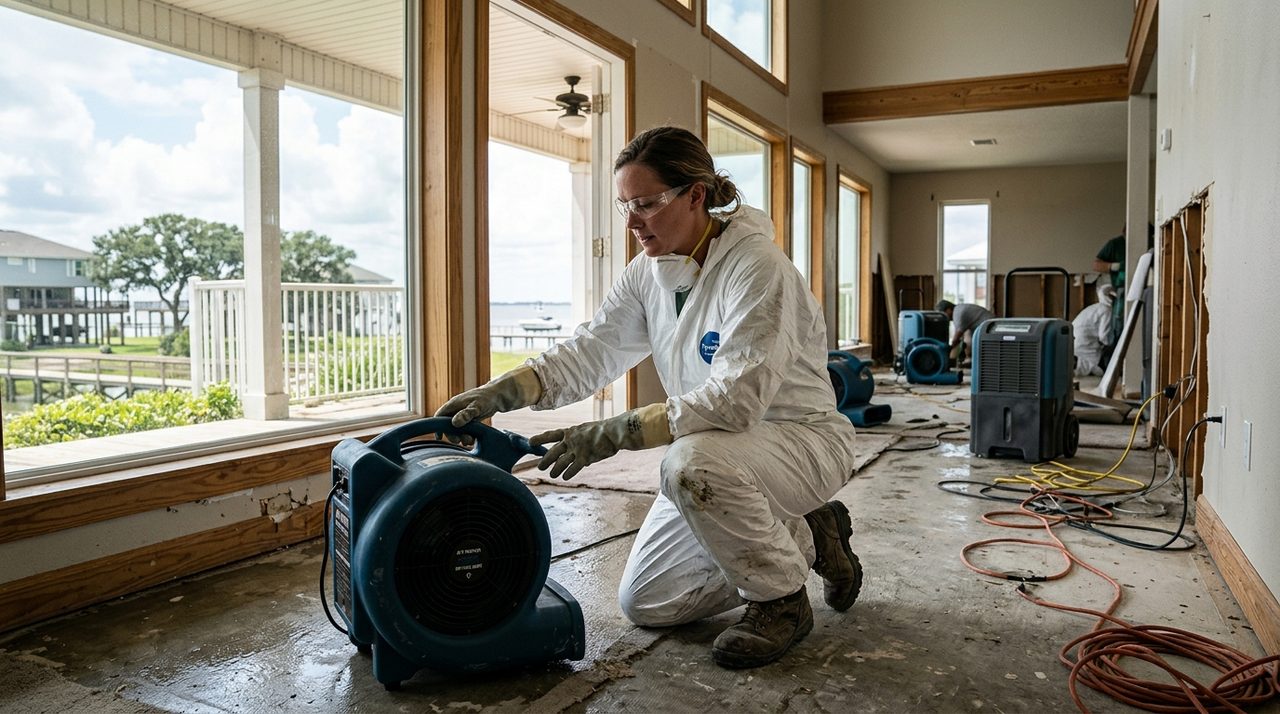
A qualified restoration contractor should deploy calibrated penetrating moisture meters and thermal imaging cameras along every wall base and slab edge — not just the visually wet areas — to map the true drying boundary before setting equipment. Industrial air movers and desiccant dehumidifiers must run long enough to bring wall cavity moisture content below the IICRC S500 drying standard for the material class; given Houston clay soil's water retention, that timeline commonly runs 4–7 days rather than the 2–3 days typical in drier climates. Any contractor touching structural demolition as part of the dry-out must pull a permit through the City of Baytown's own permitting office — not Houston Permitting Center or Harris County.
Sources: IICRC (water/mold restoration standards), FEMA National Flood Hazard Layer (NFHL), Municipal permit office (see area profile)
Why it matters to you
Baytown's large stock of 1990s–2010s HOA subdivision homes — communities like Sterling Point and Independence Bend — typically have attic-mounted air handlers with flex duct insulation that was installed to the era's standard, not to today's flood-resilience expectations. When even minor flooding or significant wind-driven rain from Gulf storms saturates attic decking or causes condensate line backups, the fibrous insulation jacket on flex duct absorbs moisture and holds it in an environment that averages 90°F+ through Houston summers. Aspergillus and Cladosporium can establish colonies within 48–72 hours under those conditions, and a compromised duct system then distributes spores through every supply register in the house.
What a good pro does
Restoration contractors scoping water damage in these homes should include duct inspection as a standard line item, using borescope cameras to check for visible microbial growth and moisture meters on accessible duct sections. If inundation lasted more than 24 hours or HVAC ran during or immediately after water entry, full duct replacement is often the defensible scope under IICRC S500 rather than attempted drying of saturated insulation. Any mold assessment or remediation work must be performed by a firm holding a current TDLR-issued Mold Assessment Consultant or Mold Remediation Contractor license under Texas Occupations Code Chapter 1958.
Sources: IICRC (water/mold restoration standards), Texas Department of Licensing & Regulation
Why it matters to you
Homeowners in Baytown HOA communities such as Sterling Point (managed by Crest Management), Independence Bend, and Eastpoint Subdivision face a critical timing conflict: the IICRC S500 standard calls for drying initiation within 24–48 hours of water entry to prevent a Category 2 gray-water loss from escalating to Category 3 black-water classification, but the recorded CC&Rs in these communities may technically require Architectural Review Committee approval before exterior demo work — dumpster placement, removal of damaged siding, or opening wall cavities visible from the street — can begin. A homeowner who waits for a standard HOA review cycle before authorizing a contractor can find their restoration scope and insurance payout significantly higher by the time work starts.
What a good pro does
Homeowners should notify their HOA management company in writing the same day water damage occurs, explicitly invoking the emergency nature of the work and requesting expedited or waived review for mitigation-phase activities only. Many HOA governing documents contain emergency exception language; verify yours through the Texas Property Code §209 management certificate on file for your subdivision. A restoration contractor experienced in Baytown subdivisions should also pull the required demolition permit from the City of Baytown's permit office immediately — not post-demo — since the permit record protects the homeowner during insurance scope negotiations.
Sources: IICRC (water/mold restoration standards), Local HOA / deed restrictions (see area profile), Municipal permit office (see area profile)
Why it matters to you
Baytown's newer one- and two-story brick-veneer tract homes face a moisture intrusion pathway that most homeowners don't expect: sustained Gulf-origin winds during events like Harvey 2017 and the May 2024 derecho drive rain through brick weep holes, aging window flanges, and soffit vents without producing any visible interior flooding at floor level. Water instead tracks down the interior face of the brick veneer, soaks the sheathing, and saturates wall cavity insulation and bottom plates — damage that can go undetected for weeks while mold establishes behind undisturbed drywall. Because this is top-down envelope intrusion rather than bottom-up flood damage, standard flood policy adjusters sometimes dispute the cause-of-loss classification.
What a good pro does
After any Gulf storm event, even one without visible interior flooding, a qualified restoration contractor should perform a systematic thermal imaging scan of all exterior-facing walls to detect temperature differentials that indicate trapped moisture. Moisture meter readings at window frame perimeters, sill plates, and weep-hole zones are essential before a homeowner accepts an adjuster's scope. Any wall cavity opening, sheathing removal, or structural drying that follows requires a permit from the City of Baytown's independent permit office, and the contractor must document water source and intrusion path in writing to support the insurance claim category.
Sources: IICRC (water/mold restoration standards), Municipal permit office (see area profile), Harris County Flood Control District
Hiring water & flood restoration in Baytown? Baytown is an incorporated city east of Houston with a diverse housing stock ranging from 1950s-era non-HOA neighborhoods to modern master-planned HOA subdivisions. Homeowners should verify their specific subdivision's deed restrictions and HOA status, as governance varies block by block. Proximity to the Houston Ship Channel and coastal waterways means moisture management, corrosion resistance, and flood preparedness are critical home maintenance considerations.
Building era
Mixed: older in-town areas from 1950s–1970s; many HOA-managed subdivisions built 1990s–2010s.
Typical style
One- and two-story traditional brick or brick-veneer tract homes in newer subdivisions; ranch-style and bungalow homes in older non-HOA areas.
Foundations
Predominantly slab-on-grade in post-1970s subdivisions; some older homes may have pier-and-beam — not confirmed in research for specific neighborhoods.
Common systems
Older homes (1950s–1970s): original copper or galvanized plumbing, older electrical panels. Newer subdivisions (1990s–2010s): PEX or CPVC plumbing, 200-amp electrical panels, central HVAC with standard efficiency units.
What that means for repairs
Older non-HOA neighborhoods see plumbing re-pipes, panel upgrades, and foundation leveling. Newer HOA subdivisions focus on cosmetic updates and HVAC replacements as original systems age out of warranty.
Permit jurisdiction
City of Baytown Permitting — Baytown is an incorporated city with its own building codes and permit office, separate from Houston Permitting Center and Harris County Engineering.
HOA & deed restrictions
No single city-wide HOA. Multiple subdivision-level mandatory HOAs exist, including Sterling Point Community Association (managed by Crest Management), The Park at Independence Bend HOA, Eastpoint Subdivision HOA (219 homes), and Baytown Country Club Manor HOA. Older in-town areas may have no HOA or only informal civic clubs. Verify HOA status via Texas Property Code §209 management certificates for any specific address.
Historic districts
No City of Houston historic district designation confirmed. Baytown is an independent incorporated city and does not fall under HAHC jurisdiction.
Contractor note
Contractors must pull permits through the City of Baytown, not Houston or Harris County. HOA Architectural Review Committee approval may be required in subdivisions like Sterling Point or Independence Bend before exterior modifications begin.
FEMA flood zone
FEMA Zone X (low flood risk) per official NFHL API data at the queried point. However, Baytown is a large city and many areas near the San Jacinto River, Goose Creek, and Cedar Bayou carry higher flood designations. Property-specific FEMA lookups are strongly recommended.
Hurricane Harvey impact
Not confirmed from provided research with specific damage figures. Baytown's location near the San Jacinto River and coastal waterways made it vulnerable during Hurricane Harvey in 2017, and the broader region experienced significant flooding. Homeowners should check Harris County Flood Control District records for address-specific Harvey inundation data.
Heat & humidity load
Baytown's coastal proximity produces high humidity and salt-air exposure, accelerating corrosion on HVAC condensers, metal roofing components, and exterior hardware. Summer heat loads on older homes with original insulation and single-pane windows can strain HVAC systems significantly. Moisture intrusion and mold risk are elevated in older pier-and-beam structures.
Working with contractors here
Contractors in Baytown most commonly handle HVAC replacements, plumbing re-pipes, and foundation work — driven by the area's split between aging 1950s–1970s housing and maturing 1990s–2000s tract homes. Corrosion from the industrial and coastal environment creates above-average demand for exterior painting, metal component replacement, and roof maintenance. In HOA-managed subdivisions, contractors should confirm architectural committee requirements before beginning any visible exterior work, as communities like Sterling Point and Independence Bend enforce recorded CC&Rs. The City of Baytown's independent permitting process means contractors familiar only with Houston or unincorporated Harris County codes need to verify local requirements.
Local Tip
Always ask for a written estimate before work begins. Texas contractors are required to provide one on jobs over $1,000.
Baytown is an incorporated city east of Houston with a diverse housing stock ranging from 1950s-era non-HOA neighborhoods to modern master-planned HOA subdivisions. Homeowners should verify their specific subdivision's deed restrictions and HOA status, as governance varies block by block. Proximity to the Houston Ship Channel and coastal waterways means moisture management, corrosion resistance, and flood preparedness are critical home maintenance considerations.
Source: U.S. Census Bureau, ACS 5-Year 2023
Most of Baytown maps to FEMA Zone X (low mapped flood risk), but Houston's flash-flood reality means even low-risk blocks benefit from smart drainage and storm-hardened installs; risk climbs sharply on blocks nearest Galveston Bay and the Houston Ship Channel, where it varies parcel to parcel.
Source: FEMA National Flood Hazard Layer (NFHL). Flood zones vary by parcel — verify your individual FIRM panel.
Water-restoration companies serving Baytown, TX can install or recommend backflow prevention add-ons on floor drains and advise on contents-elevation strategies that limit category-2 water contact during a tropical event. The May 2024 derecho reminded Houston homeowners that extreme rain is not exclusive to named hurricanes, making year-round readiness essential. Because Baytown drains toward Galveston Bay and the Houston Ship Channel, block-level runoff can differ sharply from the mapped zone.
Even in low-flood-mapped areas of Baytown, TX, intense thunderstorm rainfall can overwhelm gutter systems and force water through foundation weep holes or into slab expansion joints, creating sub-floor moisture that feeds mold undetected. An IICRC-certified water-restoration technician can use penetrating moisture meters to confirm whether a post-storm inspection is clear or whether targeted structural drying is needed. Confirm the current FEMA panel for your Baytown parcel — the area maps to Zone X, but adjacent lots can differ.
A hard freeze in Baytown, TX can split a single supply line and deposit 50 or more gallons of water into a ceiling assembly before a homeowner locates the shutoff, and that volume requires more than fans and open windows to dry safely. Texas law under TDLR requires mold assessors and remediators to hold specific licenses, so verify your restoration contractor's credentials before you need them under emergency conditions. With a median build year of 1981, the older building stock here is more exposed to hard-freeze damage than newer construction. Confirm the current FEMA panel for your Baytown parcel — the area maps to Zone X, but adjacent lots can differ.
Sources: FEMA National Flood Hazard Layer (NFHL), Ready.gov -- Hurricanes, CenterPoint Energy -- Storm Center, City of Houston -- Emergency Preparedness, Ready.gov -- Winter Weather, Harris County Flood Control District
Houston-specific estimators to plan your project before you call a pro. All results are planning estimates — a licensed local pro confirms the details on site.
Disconnect & drain every outdoor hose bib
Remove hoses, drain the spigots, and cover each with an insulated faucet sock. Un-drained hose bibs are the #1 burst point in a Houston freeze.
Insulate exposed pipes in the attic & garage
Wrap any pipe in an unconditioned space (attic runs, garage walls) with foam sleeves. Houston homes rarely insulate these because they only matter a few nights a year — which is exactly why they burst.
Open cabinet doors & keep a pencil-width drip
On hard-freeze nights, open kitchen/bath cabinets so warm air reaches the pipes and let faucets on exterior walls drip to relieve pressure.
Protect the attic/garage water heater & its lines
An attic or garage tank sits in unconditioned space. Insulate the cold-inlet and hot-outlet lines and confirm the emergency drain pan is clear so a leak doesn't reach the ceiling.
This is a planning estimate only — actual requirements depend on an on-site assessment by a licensed Houston pro. If a pipe has already burst, shut off your main water supply and call a licensed Houston plumber immediately — freeze bursts flood fast.
Sources: Municipal permit office (see area profile)Texas State Board of Plumbing Examiners
Sources: IICRC (water/mold restoration standards)Texas Commission on Environmental Quality
Sources: Local HOA / deed restrictions (see area profile)
Sources: Texas Department of Licensing & RegulationIICRC (water/mold restoration standards)