303 E Main St #180, League City, TX 77573
Best Water & Flood Restoration in League City, TX
League City's rapid suburban expansion — from 1960s ranch homes near downtown to the 2000s-and-newer master-planned communities of Bay Colony, Tuscan Lakes, and Victory Lakes — sits squarely in Galveston County's coastal humidity belt, where salt-laden Gulf air and flash-flooding from Clear Creek drainage push water damage risk year-round even in FEMA Zone X. The May 2024 derecho and Hurricane Harvey's long rain bands both tested League City's slab-on-grade stock hard, and because this is a fully incorporated city, all restoration demolition, plumbing, and electrical work routes through the City of League City Building & Permits Division — not Harris County or the Houston Permitting Center. This page explains the four restoration challenges that genuinely show up in League City homes and what a qualified crew should do about each.
Verified against Google Business data
Updated 2026
See the 10 Water & Flood Restoration Serving League City 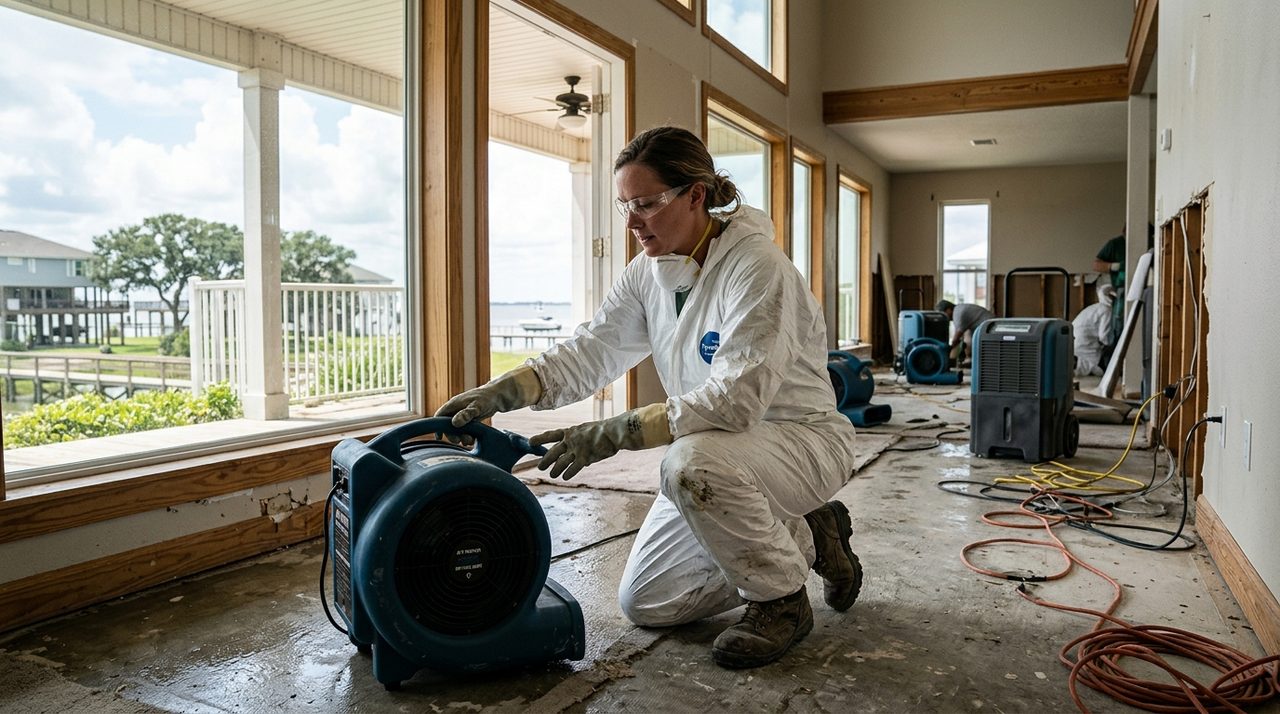
- Median home built
- 2002
- Median home value
- $334,000
- FEMA flood zone
- X (low)
- Typical mitigation cost (est.)
- $3,500–$40,000 depending on water category and scope
- Most common local issue
- Wind-driven rain breaching window flanges and brick weep holes in 1990s–2000s tract homes
Ranked by verified Google rating × review volume × verification tier. How we rank →
Min rating:
10 results Closed
238 S Egret Bay Blvd Ste. 154, League City, TX 77573
1707 State Hwy 3 Suite B, League City, TX 77573
Closed
1898 Louisiana Ave, League City, TX 77573
2338 Brayden Mills Ln, League City, TX 77573
Open Now
102 E Walker St b4, League City, TX 77573
951 FM 646 Rd, League City, TX 77573
Open Now
1851 Gulf Fwy #33, League City, TX 77573
208 E Saunders St, League City, TX 77573
1445 S Egret Bay Blvd unite 241, League City, TX 77573
Water & Flood Restoration in League City: What You Should Know
Wind-Driven Rain Soaking Wall Cavities in 1990s–2000s Tract Homes
Why it matters to you
The majority of League City's housing stock was built between 1990 and 2010 in master-planned subdivisions using brick veneer over wood-frame construction — a combination that works fine in calm weather but becomes a liability when sustained Gulf winds, like those from the May 2024 derecho or Harvey's outer bands, force water through weep holes, aging window flanges, and soffit vents. Because there is no interior flooding in these events, many homeowners don't realize wall cavities are saturated until mold appears weeks later behind undisturbed drywall.
What a good pro does
A qualified restoration crew should use thermal imaging cameras and calibrated moisture meters to trace the intrusion path from the soffit or window flange down through wall sheathing to the bottom plate — a top-down drying strategy that is fundamentally different from floor-up bayou flood work. Structural demolition permits for any wall opening must be pulled through the City of League City Building & Permits Division at 300 W. Walker St., and if mold is discovered, the remediation contractor must hold a TDLR-issued Mold Remediation Contractor (MRC) license before any mold disturbing work begins.
Sources: IICRC (water/mold restoration standards), Texas Department of Licensing & Regulation, Municipal permit office (see area profile)
Slab Edge Saturation Persisting Long After Clear Creek Flash Floods Recede
Why it matters to you
Even though most League City parcels map to FEMA Zone X, blocks closest to Clear Creek and its tributaries experience rapid flash inundation that can pin water against a home's slab perimeter for 12–36 hours — long enough to saturate the slab edge and wick moisture into bottom plates and drywall without producing the dramatic interior flood depths homeowners associate with total losses. League City's Galveston County coastal clay soil holds standing water against the foundation far longer than sandy Gulf Coast soils, extending the hidden drying challenge well past the day the yard dries out.
What a good pro does
After any Clear Creek-area flash event, a restoration professional should use penetrating moisture meters on bottom plates and drywall at floor level throughout the perimeter rooms before concluding no demo is needed — visible dryness at the surface does not mean the assembly is dry. If inundation lasted more than 24 hours, IICRC S500 drying timelines require aggressive dehumidification and air movement initiated within 48 hours to avoid a Category 2 loss escalating to conditions that support microbial growth; mold remediation contractors operating in League City must carry TDLR MRC licensure.
Sources: IICRC (water/mold restoration standards), FEMA National Flood Hazard Layer (NFHL), Texas Department of Licensing & Regulation
HOA Architectural Review Delaying Emergency Demo in Master-Planned Communities
Why it matters to you
Subdivisions like Bay Colony, South Shore Harbour, Tuscan Lakes, and Victory Lakes all operate mandatory HOAs with architectural review committees, and many of those CC&Rs technically require approval before exterior material removal, dumpster placement, or visible structural work begins — even in a declared water emergency. IICRC S500 standards call for drying initiation within 24–48 hours of a water intrusion event; waiting three to five business days for an HOA committee response can push a manageable Category 2 gray-water loss into conditions requiring far more extensive Category 3 demolition protocols and a dramatically larger remediation scope.
What a good pro does
Before storm season, League City homeowners in HOA-governed subdivisions should request a copy of their specific community's emergency repair clause — most well-drafted CC&Rs include a provision allowing immediate protective action with after-the-fact notification. Document everything with timestamped photos from the moment you discover damage, notify the HOA in writing simultaneously with engaging a restoration contractor, and confirm the City of League City Building & Permits Division permit is applied for immediately, since the permit clock runs independently of HOA approval timelines.
Sources: IICRC (water/mold restoration standards), Local HOA / deed restrictions (see area profile), Municipal permit office (see area profile)
Older Downtown-Area Homes Carrying Uri-Era Hidden Moisture and Aging Plumbing Risk
Why it matters to you
League City's 1960s–1980s ranch-style homes near the historic Main Street corridor are precisely the housing profile that suffered highest pipe-burst density during Winter Storm Uri in February 2021 — attic-run supply lines in unconditioned space, original copper or galvanized plumbing with no freeze protection, and 100–150 amp panels that couldn't sustain the heat tape loads many homeowners improvised. Many of these older properties received surface drywall patches in 2021 but never had full cavity drying verified, meaning restoration contractors called for any subsequent water event routinely find residual Uri-era microbial growth behind intact drywall.
What a good pro does
Any restoration scope in a pre-1990 League City home should include a systematic moisture survey of attic-adjacent wall cavities and interior ceilings before new damage is isolated — finding existing elevated moisture readings protects both the homeowner and the contractor from liability disputes over who caused what. If mold is confirmed, work must stop on that assembly until a TDLR-licensed Mold Remediation Contractor scopes the remediation; any plumbing line repairs that are part of the restoration require a TSBPE-licensed plumber, and permits for both trade scopes must be pulled through the City of League City, not Galveston County.
Sources: Texas Department of Licensing & Regulation, Texas State Board of Plumbing Examiners, Municipal permit office (see area profile)
Water & Flood Restoration in League City: What You Should Know
Hiring water & flood restoration in League City? League City is one of the largest and fastest-growing cities in Galveston County, with housing stock spanning from 1960s-era originals near the historic downtown to expansive master-planned communities built from the 1990s through today. Homeowners here contend with coastal humidity, salt air corrosion, and proximity to Clear Creek and Dickinson Bayou watersheds. The city manages its own permitting and code enforcement, making it distinct from unincorporated Galveston County areas.
- Housing era
- 1960s–2020s, with the majority of residential growth occurring from the 1990s onward in master-planned…
- Foundation
- Predominantly slab-on-grade across all eras
- Flood zone
- FEMA Zone X (low flood risk) — source
- Permits
- City of League City Building & Permits Division (300 W
Housing stock & systems
Building era
1960s–2020s, with the majority of residential growth occurring from the 1990s onward in master-planned subdivisions.
Typical style
Single-story and two-story suburban tract homes in newer subdivisions (Bay Colony, South Shore Harbour, Tuscan Lakes, Victory Lakes); older ranch-style and traditional homes near historic League City downtown.
Foundations
Predominantly slab-on-grade across all eras.
Common systems
Newer homes (2000s+) feature high-efficiency central HVAC, PEX or CPVC plumbing, and 200-amp electrical panels. Older 1960s–1980s homes may have original copper or galvanized plumbing, R-22 refrigerant HVAC systems, and 100–150 amp panels.
What that means for repairs
Older homes near downtown League City commonly undergo full HVAC replacement, plumbing re-pipes, and kitchen/bath remodels. Newer master-planned communities see cosmetic upgrades, fence replacements, and outdoor living additions. Coastal proximity drives demand for exterior paint, siding repair, and roof maintenance due to salt air and wind.
Permits & restrictions
Permit jurisdiction
City of League City Building & Permits Division (300 W. Walker St., League City, TX 77573). League City is a fully incorporated municipality with its own permitting, inspections, and code enforcement — not governed by Galveston County engineering or the Houston Permitting Center.
HOA & deed restrictions
Most newer subdivisions (Bay Colony, South Shore Harbour, Tuscan Lakes, Victory Lakes, Magnolia Creek, etc.) have mandatory HOAs with architectural review committees. The City of League City maintains an HOA Alliance program facilitating communication between the city and neighborhood HOAs. Older areas near downtown may lack mandatory HOAs and rely on deed restrictions or voluntary civic organizations. Specific HOA names vary by subdivision — not confirmed for all areas; check Galveston County Clerk records.
Historic districts
No City of Houston historic district designation confirmed. League City has its own local historic preservation efforts centered around the original townsite near Main Street, but these are governed by the City of League City, not HAHC.
Contractor note
Contractors must obtain permits through the City of League City and comply with local building codes, which incorporate wind-resistant construction standards due to coastal proximity. Many HOAs require architectural review committee approval before exterior modifications begin.
Flood & weather
FEMA flood zone
FEMA Zone X (low flood risk) — source: fema_nfhl. However, portions of League City near Clear Creek, Dickinson Bayou, and their tributaries fall within higher-risk flood zones (A and AE). Homeowners should verify their specific parcel, as flood risk varies significantly across this geographically large city.
Hurricane Harvey impact
Hurricane Harvey (2017) brought significant flooding to portions of League City, particularly along Clear Creek and in low-lying areas near Dickinson Bayou. South Shore Harbour, parts of Bay Colony, and neighborhoods adjacent to waterways experienced notable flooding. The city saw widespread damage, though many newer elevated-pad subdivisions fared better. Specific impact varied block by block — homeowners should check individual property flood history through Galveston County and FEMA records.
Heat & humidity load
League City's coastal location brings extreme humidity, salt air exposure, and Gulf storm risk from June through November. HVAC systems run heavily from May to October, driving demand for annual maintenance, refrigerant checks, and ductwork inspections. Exterior materials — especially metal fixtures, fasteners, and painted surfaces — degrade faster due to salt air corrosion. Roofing inspections are critical given wind exposure from tropical weather systems.
Working with contractors here
Contractors in League City most commonly handle HVAC servicing and replacement, roof repair and replacement (especially after storm seasons), and plumbing work ranging from re-pipes in older homes to fixture upgrades in newer builds. The wide range of housing ages means contractors must be prepared for both modern systems in 2010s-era homes and aging infrastructure in 1960s–1980s properties near downtown. Exterior work — painting, siding repair, fence replacement, and window sealing — is in constant demand due to salt air and humidity. Many jobs in master-planned communities require HOA architectural approval before work begins, so contractors should build pre-approval timelines into project scoping. Wind-rated materials and proper hurricane strap installation are important selling points for roofing and structural contractors given the coastal wind exposure.
Local Tip
Always ask for a written estimate before work begins. Texas contractors are required to provide one on jobs over $1,000.
About League City
League City is one of the largest and fastest-growing cities in Galveston County, with housing stock spanning from 1960s-era originals near the historic downtown to expansive master-planned communities built from the 1990s through today. Homeowners here contend with coastal humidity, salt air corrosion, and proximity to Clear Creek and Dickinson Bayou watersheds. The city manages its own permitting and code enforcement, making it distinct from unincorporated Galveston County areas.
- Median year built
- 2002
- Median home value
- $334,000
- Owner-occupied
- 74.4%
- Population
- 114,885
- Housing units
- 44,280
- Median income
- $119,870
Source: U.S. Census Bureau, ACS 5-Year 2023
Flood & storm risk
FEMA Zone XLow flood riskMost of League City maps to FEMA Zone X (low mapped flood risk), but Houston's flash-flood reality means even low-risk blocks benefit from smart drainage and storm-hardened installs; risk climbs sharply on blocks nearest Clear Creek and Galveston Bay, where it varies parcel to parcel.
Source: FEMA National Flood Hazard Layer (NFHL). Flood zones vary by parcel — verify your individual FIRM panel.
Houston Storm Readiness in League City
Hurricane & flooding
Zone X mapping offers no guarantee in Houston's flat topography, so have a water-restoration contractor identify the fastest flood-entry paths into your League City, TX home — typically garage thresholds, HVAC closets, and exterior door sweeps — and pre-stage extraction equipment contacts. Acting in the first 24 hours after inundation is the difference between a dryout and a full mold remediation. Confirm the current FEMA panel for your League City parcel — the area maps to Zone X, but adjacent lots can differ.
Severe storms & hail
Straight-line winds exceeding 80 mph, as recorded during the 2024 derecho, broke seals on sliding glass doors and drove water into flooring assemblies throughout League City, TX neighborhoods with no prior flood history. Contact a licensed Texas restoration firm — TDLR regulates their mold-assessment and remediation work — to inspect and dry any affected areas before summer humidity accelerates microbial growth. As a Galveston County community, League City may follow county rather than City of Houston storm rebuild rules.
Ice storms & freezes
Homes in lower-flood-risk areas of League City, TX are not immune to the interior water losses Uri 2021 caused — burst attic supply lines and failed icemaker connections caused extensive drywall and flooring damage regardless of floodplain designation. A water-restoration contractor can extract standing water, remove wet flooring, and place structural drying equipment within the window that prevents a straightforward dryout from escalating to mold remediation. Because League City drains toward Clear Creek and Galveston Bay, block-level runoff can differ sharply from the mapped zone.
Sources: FEMA National Flood Hazard Layer (NFHL), Ready.gov -- Hurricanes, CenterPoint Energy -- Storm Center, City of Houston -- Emergency Preparedness, Ready.gov -- Winter Weather, Harris County Flood Control District
Free League City Tools & Calculators
Houston-specific estimators to plan your project before you call a pro. All results are planning estimates — a licensed local pro confirms the details on site.
Houston Freeze Prep & Pipe Insulation Checklist
Open full tool & FAQ →Your freeze checklist — 4 tasks
- 1
Disconnect & drain every outdoor hose bib
Remove hoses, drain the spigots, and cover each with an insulated faucet sock. Un-drained hose bibs are the #1 burst point in a Houston freeze.
- 2
Insulate exposed pipes in the attic & garage
Wrap any pipe in an unconditioned space (attic runs, garage walls) with foam sleeves. Houston homes rarely insulate these because they only matter a few nights a year — which is exactly why they burst.
- 3
Open cabinet doors & keep a pencil-width drip
On hard-freeze nights, open kitchen/bath cabinets so warm air reaches the pipes and let faucets on exterior walls drip to relieve pressure.
- 4
Protect the attic/garage water heater & its lines
An attic or garage tank sits in unconditioned space. Insulate the cold-inlet and hot-outlet lines and confirm the emergency drain pan is clear so a leak doesn't reach the ceiling.
This is a planning estimate only — actual requirements depend on an on-site assessment by a licensed Houston pro. If a pipe has already burst, shut off your main water supply and call a licensed Houston plumber immediately — freeze bursts flood fast.
Frequently Asked Questions
Do I need a permit from the City of League City for flood demo work, or does Galveston County handle it?
League City is a fully incorporated municipality and runs its own Building & Permits Division at 300 W. Walker St. — Galveston County has no permitting role inside city limits. Any structural demolition, plumbing repair, or electrical work exposed during a flood restoration project requires permits pulled through the City of League City, not through the Houston Permitting Center or a county office. Your restoration contractor typically pulls the demo permit, while their licensed plumbing and electrical subs pull separate trade permits before that work begins.
Sources: Municipal permit office (see area profile)
My League City home is in FEMA Zone X — does that mean my restoration scope is simpler than a Harvey-flooded AE-zone house?
Zone X means your property is outside the mapped 1-percent-annual-chance floodplain, so you are unlikely to face FEMA Elevation Certificate requirements or mandatory NFIP policy terms tied to AE-zone rules, but the restoration scope itself is driven by water category and duration, not your FEMA designation. Blocks nearest Clear Creek and Galveston Bay in League City can carry parcel-level risk that doesn't show in the broad Zone X mapping, and flash-flood inundation from any source that stays 24-plus hours produces the same slab-edge saturation and Category 2-to-3 escalation risk regardless of flood zone. Have your contractor document water source and conduct testing to establish the correct IICRC category before any scope is agreed with your insurer.
Sources: FEMA National Flood Hazard Layer (NFHL)IICRC (water/mold restoration standards)
How long does a typical League City restoration project take from water extraction through certificate of completion, and what slows it down?
For a standard single-story slab home in a subdivision like Victory Lakes or Tuscan Lakes with moderate Category 2 inundation, the mitigation and structural drying phase alone typically takes 3 to 5 days of active drying equipment, but reaching a dry standard verified by moisture readings and scheduling a City of League City inspection can extend that to 2 to 3 weeks total before reconstruction begins — these are estimates and vary by loss size. The most common delays are HOA architectural review for exterior work, waiting on City of League City inspection slots, and supplemental insurance approvals when moisture mapping reveals damage beyond the initial adjuster scope. Scheduling your restoration contractor and your insurance adjuster site visit on the same day shortens the gap significantly.
Sources: Municipal permit office (see area profile)IICRC (water/mold restoration standards)
My 1970s ranch home near downtown League City had a mold contractor come out — do they need a Texas license to do the remediation, or is any contractor allowed to handle it?
Texas law requires that any firm performing mold remediation hold a TDLR-issued Mold Remediation Contractor (MRC) license, and any firm performing a formal mold assessment must hold a separate Mold Assessment Consultant (MAC) license — these are distinct credentials and the same company generally cannot hold both for the same job. Ask the contractor for their TDLR MRC license number before signing any contract, and verify it is current on the TDLR public license lookup. Older homes near downtown League City built in the 1960s and 1970s are especially likely to have compounding issues — aging galvanized plumbing that was never re-piped after Uri, plus decades of Gulf humidity — that push a routine mold job into a larger scope involving licensed plumbing subs as well.
Sources: Texas Department of Licensing & RegulationTexas State Board of Plumbing Examiners
Does the high salt-air humidity in League City change how long drying equipment needs to run compared to an inland Houston neighborhood?
Yes — League City's coastal position means ambient relative humidity consistently runs high, and contractors should be setting dehumidifiers to hold interior conditions at or below 40 percent relative humidity per IICRC S500 drying standards, which takes more machine-hours than the same job in a drier inland suburb like Katy. During summer months the combination of 90-plus-degree heat and Gulf moisture means equipment left running without monitoring can actually slow drying if exhaust air is not properly managed. Ask your contractor what their target grain-per-pound readings are and how frequently their technicians are logging moisture meter readings on your specific wall assemblies — in a 2000s-era brick-veneer home in Bay Colony, the brick cavity holds salt-laden moisture longer than standard stucco or hardie siding.
If my League City home has lead paint — possible in 1960s or 1970s construction near downtown — does a flood restoration contractor have to follow special rules before demoing drywall and plaster?
Yes. Pre-1978 homes are subject to EPA Renovation, Repair, and Painting (RRP) Rule requirements, which means the contractor performing demolition must be EPA Lead-Safe Certified and follow containment and waste-disposal protocols even in an emergency water damage situation. Homes built in the 1960s and 1970s in the older sections of League City near Main Street are the most likely candidates, and a contractor who skips RRP procedures during demo can expose your family to lead dust and create a liability issue for the project. Ask any restoration contractor working in a pre-1978 League City home to show their EPA RRP certification before they begin cutting drywall.
Sources: EPA Lead Renovation, Repair and Painting (RRP) Rule