Open Now
18214 Upper Bay Rd #58164, Houston, TX 77058
Clear Lake's Johnson Space Center-era subdivisions — most built between 1960 and 1985 on expansive Harris County clay — combine aging galvanized and cast-iron plumbing, original flex-duct HVAC systems, and slab-on-grade construction in a coastal-plain environment where even FEMA Zone X blocks can accumulate standing water during Gulf-stalled rain events like Harvey 2017 and Beryl 2024. When moisture enters these homes, whether through a burst galvanized supply line, wind-driven rain through a 40-year-old brick-veneer weep hole, or neighborhood sheet-flow pooling against a slab edge, the clay soil holds it there far longer than the drywall or insulation can survive. Understanding exactly what restoration work triggers an HOA Architectural Review Committee sign-off and a Houston Permitting Center trade permit — before equipment rolls up — is what separates a clean insurance close from a stop-work order.
Ranked by verified Google rating × review volume × verification tier. How we rank →
Some highly-rated pros serve Clear Lake from nearby and may not keep a Clear Lake street address. Those are listed under "Also serving Clear Lake" with their real city and distance, so you always know where each business is based.
18214 Upper Bay Rd #58164, Houston, TX 77058
811 Rustic Harbor Ct, Houston, TX 77062
1810 Space Park Dr, Houston, TX 77058
Highly-rated pros based nearby who cover Clear Lake. Distance shown from the Clear Lake area.
Serving Clear Lake Based in Seabrook · 2.4 mi away
Serving Clear Lake Based in Webster · 2.7 mi away
Serving Clear Lake Based in Webster · 2.9 mi away
Serving Clear Lake Based in Webster · 3 mi away
Serving Clear Lake Based in Webster · 3.7 mi away
Serving Clear Lake Based in Webster · 3.9 mi away
Serving Clear Lake Based in League City · 4.1 mi away
Why it matters to you
Clear Lake's 1960s–1980s slab-on-grade ranch homes sit directly on Harris County coastal-plain clay that swells and retains water against the slab perimeter for weeks after a flood or a burst galvanized supply line. Because there is no crawl space buffer, moisture migrates into bottom plates and the lower 12–18 inches of drywall while the surface looks and feels dry — a particular problem in the original sections of Clear Lake City and Clear Lake Forest where slab edges have never been waterproofed. Homeowners who dry only what they can see routinely discover mold behind undisturbed baseboards months later.
What a good pro does
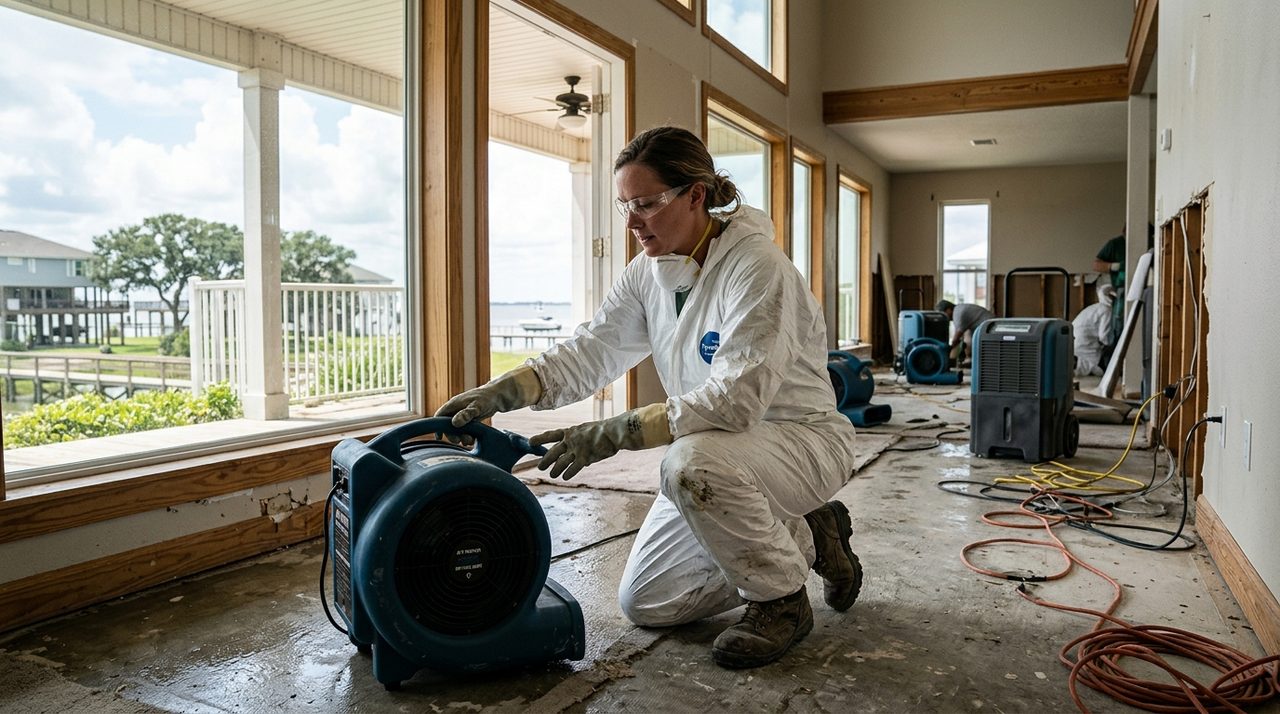
A qualified restoration contractor should deploy calibrated moisture meters and thermal imaging cameras at every exterior wall base and interior partition bottom plate before any drying equipment is staged — not after. Industrial desiccant or LGR dehumidifiers must maintain targeted grain-per-pound readings per IICRC S500 drying protocols until all readings reach equilibrium with dry standard values, which in Clear Lake's humid coastal environment typically extends the drying timeline to seven to ten days minimum. Any structural demo that exposes bottom plates requires a demolition permit from the Houston Permitting Center; mold remediation on affected assemblies requires a TDLR-licensed Mold Remediation Contractor.
Sources: IICRC (water/mold restoration standards), Texas Department of Licensing & Regulation, City of Houston Permitting Center
Why it matters to you
A large share of Clear Lake homes built during the Johnson Space Center boom retain their original attic-mounted air handlers and flex duct runs — systems that were already beyond their design lifespan before Harvey or Beryl arrived. When sheet-flow water contacts the slab edge or a pipe burst saturates a ceiling cavity, flex duct insulation absorbs and holds moisture; with Clear Lake's average summer relative humidity above 70 percent and attic temperatures regularly exceeding 130°F, Cladosporium and Aspergillus colonies can establish within 48 to 72 hours of the initial wetting event. Homeowners who restart a water-logged air handler to 'dry things out' distribute spores through every supply register in the house.
What a good pro does
Restoration contractors should scope a full duct moisture survey — using a borescope or by cutting inspection ports — as a standard line item in any Clear Lake water loss where the system ran during or within 24 hours of flood entry. Wet fiberglass flex duct insulation is not restorable; IICRC S500 and EPA guidance call for replacement rather than cleaning when insulation has been saturated. Duct replacement in a City of Houston jurisdiction requires a mechanical permit pulled through the Houston Permitting Center, and the installing HVAC firm must be registered accordingly; this permit is separate from the restoration demolition permit.
Sources: IICRC (water/mold restoration standards), City of Houston Permitting Center, Texas Commission on Environmental Quality
Why it matters to you
Clear Lake is governed by several distinct mandatory HOAs — the Clear Lake City Community Association, Clear Lake Forest Community Association, Reserve at Clear Lake Community Association, and others — each with its own Architectural Review Committee and separate deed-restriction rulebook. In practice, this means a dumpster staged in a driveway for debris haul-out, or exterior sheathing removed to dry a wind-driven rain intrusion in a brick-veneer wall, may technically require ARC pre-approval before work starts. IICRC S500 standards call for drying initiation within 24–48 hours of a loss; every hour spent waiting on an ARC email reply while wet drywall sits in place increases the likelihood of microbial amplification and reclassification of the water category.
What a good pro does
Before any exterior demolition or visible equipment placement, the homeowner — or the restoration project manager acting on their behalf — should identify which specific HOA governs the property address (CLCCA, CLFCA, Reserve at Clear Lake, or another), contact the ARC directly for emergency-provision language in the governing documents, and obtain written authorization in parallel with pulling the Houston Permitting Center demolition permit. Many Clear Lake HOAs have emergency-work provisions that allow same-day verbal approval with written follow-up; a restoration contractor experienced in these subdivisions should have a documented process for this sequence so drying begins on IICRC schedule rather than ARC schedule.
Sources: Local HOA / deed restrictions (see area profile), IICRC (water/mold restoration standards), City of Houston Permitting Center
Why it matters to you
Winter Storm Uri in February 2021 was especially damaging to Clear Lake's original-era homes because galvanized and copper supply lines running through unconditioned attic space — standard in 1960s–1980s suburban construction — froze and burst at rates far higher than modern PEX in conditioned spaces. Many homeowners had surface repairs completed in 2021 but never addressed the wall cavity and ceiling assembly moisture left behind, particularly in exterior walls where insulation acted as a long-term moisture reservoir. Restoration contractors called into these homes today for an unrelated scope — a dishwasher leak, a slow supply-line drip — routinely find residual Uri-era mold colonies behind undisturbed drywall in attic knee walls and exterior bedroom walls.
What a good pro does
Any restoration contractor working in a pre-2000 Clear Lake home should include a pre-scope inspection with a thermal camera and pin-type moisture meter along exterior wall tops and at attic penetrations as a standard diagnostic step, not an add-on. If Uri-era microbial growth is discovered, work must stop on the presenting claim and a TDLR-licensed Mold Assessment Consultant (MAC) must document the affected area before a licensed Mold Remediation Contractor (MRC) can proceed — Texas Occupations Code Chapter 1958 prohibits the same firm from performing both assessment and remediation. Houston Permitting Center trade permits will be required for any plumbing exposed during the remediation if the original pipe repairs are being corrected at the same time.
Sources: Texas Department of Licensing & Regulation, Texas State Board of Plumbing Examiners, City of Houston Permitting Center
Hiring water & flood restoration in Clear Lake? Clear Lake is a sprawling collection of master-planned subdivisions built primarily from the 1960s through the 1980s during the Johnson Space Center boom. Homeowners face the maintenance demands of aging slab-on-grade ranch and traditional homes—original HVAC, cast-iron drain lines, and galvanized plumbing are common upgrade targets. Multiple mandatory HOAs enforce deed restrictions and architectural review, so contractors and homeowners must account for approval processes before exterior work.
Building era
1960s–1980s (core buildout), with newer infill subdivisions into the 2000s.
Typical style
One- and two-story ranch and traditional brick homes; some Colonial Revival facades in older sections; suburban traditional in 1980s–2000s additions.
Foundations
Predominantly concrete slab-on-grade, consistent with post-1960 Houston suburban construction.
Common systems
Original homes typically have copper or galvanized supply lines, cast-iron drain waste vent, R-22 refrigerant HVAC systems, and older 150–200 amp electrical panels. Homes from the 2000s subdivisions like Reserve at Clear Lake have modern PEX/PVC plumbing and R-410A systems.
What that means for repairs
Kitchen and bathroom remodels are frequent in 1960s–1970s homes. HVAC replacements are common as original systems exceed useful life. Many owners are re-piping from galvanized to PEX and upgrading electrical panels to support modern loads. Slab foundation repair is a recurring need due to expansive clay soils in the coastal plain.
Permit jurisdiction
Houston Permitting Center (City of Houston jurisdiction for most Clear Lake subdivisions within city limits). Some adjacent areas may fall under Harris County Engineering for unincorporated pockets—verify by address.
HOA & deed restrictions
No single area-wide HOA; multiple subdivision-level mandatory HOAs govern most properties. Key associations include Clear Lake City Community Association (CLCCA), Clear Lake Forest Community Association (CLFCA), and Reserve at Clear Lake Community Association. Membership is mandatory within each association's boundaries, with deed-restriction enforcement and architectural review committees.
Historic districts
No City of Houston historic district designation confirmed.
Contractor note
Exterior modifications—roofing materials, fencing, paint colors, and additions—typically require Architectural Review Committee (ARC) approval from the applicable subdivision HOA before permits are pulled. Contractors should confirm which association governs the property and obtain written ARC approval to avoid stop-work orders and violation fines.
FEMA flood zone
FEMA Zone X (low flood risk) per official NFHL data. However, Clear Lake's proximity to Clear Lake (the body of water), Galveston Bay, and local bayou tributaries means localized street-level flooding can occur during extreme rainfall events despite the overall Zone X designation.
Hurricane Harvey impact
Research sources did not document specific Harvey flood impacts for Clear Lake. Broader public reporting indicates parts of Clear Lake experienced significant flooding during Harvey, particularly near bayous and low-lying areas close to the lake and bay, but impact varied street by street. For property-specific Harvey inundation data, check Harris County Flood Control District historical maps and FEMA Harvey inundation records.
Heat & humidity load
Houston's extreme summer heat and humidity stress aging HVAC systems in 1960s–1980s homes, often pushing original or under-capacity units to failure. High humidity also promotes mold in poorly ventilated attics and crawl spaces. The coastal-plain location adds salt air exposure that accelerates corrosion on outdoor HVAC condensers, metal roofing components, and exterior fixtures.
Working with contractors here
The dominant work in Clear Lake involves updating systems in 1960s–1980s slab-on-grade homes: whole-house re-pipes replacing galvanized and cast-iron with PEX and PVC, HVAC changeouts from legacy R-22 systems to modern high-efficiency units, and electrical panel upgrades from 150-amp to 200-amp service. Foundation leveling and mudjacking are steady demand items given the expansive clay soils beneath slabs in this coastal-plain environment. Contractors should expect HOA architectural review requirements on any exterior-facing work—roofing, siding, fencing, and even driveway resurfacing may need pre-approval from the applicable subdivision association. Job scoping should include verifying the specific HOA (CLCCA, CLFCA, Reserve at Clear Lake, etc.) and its current ARC guidelines, as requirements vary by subdivision.
Local Tip
Always ask for a written estimate before work begins. Texas contractors are required to provide one on jobs over $1,000.
Clear Lake is a sprawling collection of master-planned subdivisions built primarily from the 1960s through the 1980s during the Johnson Space Center boom. Homeowners face the maintenance demands of aging slab-on-grade ranch and traditional homes—original HVAC, cast-iron drain lines, and galvanized plumbing are common upgrade targets. Multiple mandatory HOAs enforce deed restrictions and architectural review, so contractors and homeowners must account for approval processes before exterior work.
Source: U.S. Census Bureau, ACS 5-Year 2023
Most of Clear Lake maps to FEMA Zone X (low mapped flood risk), but Houston's flash-flood reality means even low-risk blocks benefit from smart drainage and storm-hardened installs; risk climbs sharply on blocks nearest Clear Lake and Galveston Bay, where it varies parcel to parcel.
Source: FEMA National Flood Hazard Layer (NFHL). Flood zones vary by parcel — verify your individual FIRM panel.
Zone X mapping offers no guarantee in Houston's flat topography, so have a water-restoration contractor identify the fastest flood-entry paths into your Clear Lake, TX home — typically garage thresholds, HVAC closets, and exterior door sweeps — and pre-stage extraction equipment contacts. Acting in the first 24 hours after inundation is the difference between a dryout and a full mold remediation. Confirm the current FEMA panel for your Clear Lake parcel — the area maps to Zone X, but adjacent lots can differ.
For homeowners in Clear Lake, TX: the May 2024 derecho caused widespread roof-deck separation across Houston, and the subsequent rainfall introduced water into attic insulation that retained moisture for weeks — a restoration contractor with desiccant drying equipment can address these attic assemblies that conventional fans cannot reach. Documenting the drying process with daily moisture logs also supports insurance claims for wind-and-water combined losses. Because Clear Lake drains toward Clear Lake and Galveston Bay, block-level runoff can differ sharply from the mapped zone.
Homes in lower-flood-risk areas of Clear Lake, TX are not immune to the interior water losses Uri 2021 caused — burst attic supply lines and failed icemaker connections caused extensive drywall and flooring damage regardless of floodplain designation. A water-restoration contractor can extract standing water, remove wet flooring, and place structural drying equipment within the window that prevents a straightforward dryout from escalating to mold remediation. With a median build year of 1984, the older building stock here is more exposed to hard-freeze damage than newer construction. Because Clear Lake drains toward Clear Lake and Galveston Bay, block-level runoff can differ sharply from the mapped zone.
Sources: FEMA National Flood Hazard Layer (NFHL), Ready.gov -- Hurricanes, CenterPoint Energy -- Storm Center, City of Houston -- Emergency Preparedness, Ready.gov -- Winter Weather, Harris County Flood Control District
Houston-specific estimators to plan your project before you call a pro. All results are planning estimates — a licensed local pro confirms the details on site.
Disconnect & drain every outdoor hose bib
Remove hoses, drain the spigots, and cover each with an insulated faucet sock. Un-drained hose bibs are the #1 burst point in a Houston freeze.
Insulate exposed pipes in the attic & garage
Wrap any pipe in an unconditioned space (attic runs, garage walls) with foam sleeves. Houston homes rarely insulate these because they only matter a few nights a year — which is exactly why they burst.
Open cabinet doors & keep a pencil-width drip
On hard-freeze nights, open kitchen/bath cabinets so warm air reaches the pipes and let faucets on exterior walls drip to relieve pressure.
Protect the attic/garage water heater & its lines
An attic or garage tank sits in unconditioned space. Insulate the cold-inlet and hot-outlet lines and confirm the emergency drain pan is clear so a leak doesn't reach the ceiling.
This is a planning estimate only — actual requirements depend on an on-site assessment by a licensed Houston pro. If a pipe has already burst, shut off your main water supply and call a licensed Houston plumber immediately — freeze bursts flood fast.
Sources: City of Houston Permitting Center
Sources: IICRC (water/mold restoration standards)FEMA National Flood Hazard Layer (NFHL)
Sources: Local HOA / deed restrictions (see area profile)
Sources: IICRC (water/mold restoration standards)Texas Department of Licensing & Regulation