Open Now
3366 FM 528 Rd Unit B5, Friendswood, TX 77546
Friendswood sits along Clear Creek in Galveston County with housing stock ranging from 1960s pier-and-beam ranches to 2000s slab-on-grade production homes in West Ranch — and that wide span of construction eras means water damage looks very different depending on which street you're on. Although most parcels map to FEMA Zone X, the city's lowest-lying blocks near Clear Creek have flooded multiple times in recent decades, and even higher-elevation lots saw interior water intrusion from Harvey's stalled rainfall and Beryl's wind-driven rain in 2024. All restoration permits run through the City of Friendswood Building Inspections Department — not Houston, not Galveston County — and dozens of active subdivision HOAs add an additional approval layer that directly affects how quickly emergency demo can begin.
Ranked by verified Google rating × review volume × verification tier. How we rank →
Some highly-rated pros serve Friendswood from nearby and may not keep a Friendswood street address. Those are listed under "Also serving Friendswood" with their real city and distance, so you always know where each business is based.
3366 FM 528 Rd Unit B5, Friendswood, TX 77546
1506 S Friendswood Dr, Friendswood, TX 77546
122 S Friendswood Dr, Friendswood, TX 77546
5406 Abercreek Ave, Friendswood, TX 77546
Highly-rated pros based nearby who cover Friendswood. Distance shown from the Friendswood area.
Serving Friendswood Based in Pearland · 1.8 mi away
Serving Friendswood Based in Pearland · 3.7 mi away
Serving Friendswood Based in Webster · 3.9 mi away
Serving Friendswood Based in Webster · 4.1 mi away
Serving Friendswood Based in Webster · 4.2 mi away
Serving Friendswood Based in Webster · 4.2 mi away
Why it matters to you
The older subdivisions of Friendswood — think Wilderness Trails and similar 1960s–1970s tracts built before Harris County Flood Control District's modern channelization projects — sit closer to Clear Creek and were platted under drainage assumptions that no longer hold in today's rainfall patterns. Harvey's record rainfall kept water against foundations in these areas for days, and even parcels mapped FEMA Zone X saw inundation that would be classified as a prolonged Category 3 event given Clear Creek's documented sewage overflow history during storm surges.
What a good pro does
A qualified restoration contractor should pull thermal imaging and calibrated moisture meter readings across every slab edge and wall cavity in these older homes — not just where water was visibly standing. Because Friendswood's 1960s stock may include pier-and-beam foundations (verifiable through Galveston CAD records), the drying protocol differs significantly from slab work: the sub-floor void must be independently monitored and mechanically dried. Any structural demolition or plumbing exposure requires a permit from the City of Friendswood Building Inspections Department; the contractor typically pulls the demo permit while TSBPE-licensed plumbers pull their own trade permit.
Sources: Harris County Flood Control District, FEMA National Flood Hazard Layer (NFHL), IICRC (water/mold restoration standards), Municipal permit office (see area profile), Texas State Board of Plumbing Examiners
Why it matters to you
Friendswood's 1990s production-home boom left thousands of houses with attic-mounted air handlers and flex duct runs that are now 25-plus years old — well within the range where insulation batting has degraded and duct seams are vulnerable. When floodwater or wind-driven rain from events like Beryl 2024 elevates interior humidity for even 48–72 hours, Houston's average summer relative humidity of 74% and temperatures above 90°F turn that damp flex duct into an incubator for Cladosporium and Aspergillus. Homeowners in 1990s West Ranch-era homes who ran their HVAC during or immediately after a water event are at particular risk of distributing mold spores before the contamination is visible.
What a good pro does
A thorough restoration scope for any Friendswood home with an inundation event lasting more than 24 hours should include direct duct inspection — not just a visual check at the register. Contractors performing mold assessment or remediation in Texas must hold a TDLR-issued Mold Assessment Consultant (MAC) or Mold Remediation Contractor (MRC) license; confirm credentials before signing any remediation agreement. If duct replacement is warranted, that work requires a mechanical permit through the City of Friendswood, separate from the water damage demo permit.
Sources: Texas Department of Licensing & Regulation, IICRC (water/mold restoration standards), Municipal permit office (see area profile), Texas Commission on Environmental Quality
Why it matters to you
Friendswood has no city-wide mandatory HOA, but dozens of subdivision-level associations — West Ranch managed by RealManage, Wilderness Trails with its own active board, Forest of Friendswood as a registered Texas nonprofit — have architectural review requirements that technically apply to visible exterior work, including dumpster placement, exposed wall sheathing, and re-cladding choices. IICRC S500 standards call for drying initiation within 24–48 hours of water entry; waiting on an HOA architectural committee that meets monthly can push a manageable Category 2 gray-water loss into full Category 3 territory requiring much more extensive demolition.
What a good pro does
Before any exterior demo begins, identify your subdivision's HOA status using the city's published HOA list — some older associations show 'no current contact,' meaning deed restrictions may still exist even if the HOA is inactive. For active HOAs, submit emergency notice in writing immediately upon discovering damage; many HOA governing documents include emergency exception language that allows work to proceed under post-facto review. Document every step with timestamped photos so your insurance carrier can see why the drying timeline moved as fast or as slowly as it did.
Sources: Local HOA / deed restrictions (see area profile), IICRC (water/mold restoration standards), Municipal permit office (see area profile)
Why it matters to you
Friendswood's dominant housing style — brick veneer single-family homes from the 1970s through the 2000s — is particularly vulnerable to wind-driven rain infiltration because brick weep holes and older window flanges can admit water without any visible interior flooding. The May 2024 derecho and 2017 Harvey both delivered sustained wind loads from Gulf vectors directly into Friendswood's southeast-facing elevations, forcing water through soffit vents and window perimeters into wall cavities that never showed a drop of water on the interior floor.
What a good pro does
Restoration professionals working Friendswood jobs after any named storm or derecho should use infrared thermal cameras combined with penetrating moisture meters to map the actual intrusion path through the wall assembly — which typically runs from the roof deck or soffit down through sheathing to the bottom plate, a completely different drying strategy from bottom-up flood work. Because this scope often uncovers damaged window flanges or deteriorated flashing, the restoration contractor may need to coordinate with a TSBPE-licensed trades partner for any exposed plumbing and pull supplemental permits through the City of Friendswood if structural sheathing removal is required.
Sources: IICRC (water/mold restoration standards), Municipal permit office (see area profile), Texas State Board of Plumbing Examiners, Harris County Flood Control District
Hiring water & flood restoration in Friendswood? Friendswood is an incorporated city with housing stock spanning from the 1960s through the 2010s, meaning contractors encounter everything from aging pier-and-beam foundations near Clear Creek to modern slab-on-grade production homes in master-planned communities like West Ranch. The city manages its own permitting, and the patchwork of active HOAs across dozens of subdivisions means architectural review requirements vary block by block. Proximity to Clear Creek creates recurring flood concerns in lower-lying sections despite many parcels mapping outside high-risk FEMA zones.
Building era
1960s–2010s, with major growth phases in the 1970s, 1990s, and 2000s.
Typical style
Suburban traditional brick veneer single-family homes, 1- and 2-story plans with attached garages on moderate to large lots.
Foundations
Predominantly slab-on-grade (post-1970s production housing); some older 1960s-era homes may have pier-and-beam — confirm via Galveston CAD records.
Common systems
Older 1960s–1970s homes: original galvanized or copper plumbing, R-22 HVAC units nearing or past end of life, fuse panels or early breaker panels. 1990s–2010s homes: PVC/PEX plumbing, R-410A HVAC, 200-amp electrical panels. Attic-mounted air handlers are standard across eras.
What that means for repairs
Older subdivisions like Wilderness Trails see frequent HVAC replacements, re-piping from galvanized to PEX, and electrical panel upgrades. Newer master-planned communities like West Ranch focus on cosmetic remodels and outdoor living additions, often requiring HOA architectural review.
Permit jurisdiction
City of Friendswood Building Inspections Department (independent city — does not use Houston or county permitting).
HOA & deed restrictions
No city-wide mandatory HOA. Dozens of subdivision-level HOAs exist, many actively managed (e.g., West Ranch managed by RealManage, Wilderness Trails with its own HOA website, Forest of Friendswood as a formal Texas nonprofit). Some older subdivisions show 'no current contact' on the city's HOA list, indicating defunct or inactive associations. Deed restrictions are common and recorded at the county level.
Historic districts
No historic district designation confirmed. Friendswood is an independent city and not subject to Houston's HAHC jurisdiction.
Contractor note
Contractors must pull permits through the City of Friendswood, not Harris or Galveston County. Many subdivisions require HOA architectural review before exterior work begins — always confirm the specific subdivision's requirements before scheduling.
FEMA flood zone
FEMA Zone X (low flood risk) per official NFHL API. However, areas near Clear Creek and its tributaries carry significantly higher flood exposure. Property-level risk varies widely — always verify individual parcels, especially in older subdivisions closer to the creek.
Hurricane Harvey impact
Friendswood experienced significant flooding during Hurricane Harvey (2017), particularly in neighborhoods near Clear Creek and low-lying drainage channels. Older subdivisions closer to the creek were hit hardest, while newer elevated master-planned sections fared better. Specific repeatedly flooded streets are not confirmed in available sources — check Galveston County flood control mapping and past seller disclosures for property-level history.
Heat & humidity load
Coastal humidity and extended 95°F+ heat stress HVAC systems heavily, especially attic-mounted air handlers in older homes with inadequate insulation. Slab foundations on expansive clay soils experience seasonal movement during summer drought cycles, potentially affecting door frames and drywall. Roofing materials degrade faster due to UV exposure and Gulf moisture.
Working with contractors here
Friendswood's multi-decade housing stock creates a wide range of service demands. In 1960s–1970s subdivisions, contractors frequently handle whole-house re-piping, HVAC system replacements transitioning from R-22, and electrical panel upgrades from 100-amp to 200-amp service. Post-Harvey, flood remediation, foundation repair, and mold mitigation remain ongoing concerns in creek-adjacent areas. In newer master-planned communities like West Ranch, work tends toward kitchen and bath remodels, outdoor living additions, and fence replacements — all of which typically require HOA architectural approval before starting. Contractors should scope jobs with awareness that the City of Friendswood enforces its own building codes and inspection schedules, which differ from Houston's process.
Local Tip
Always ask for a written estimate before work begins. Texas contractors are required to provide one on jobs over $1,000.
Friendswood is an incorporated city with housing stock spanning from the 1960s through the 2010s, meaning contractors encounter everything from aging pier-and-beam foundations near Clear Creek to modern slab-on-grade production homes in master-planned communities like West Ranch. The city manages its own permitting, and the patchwork of active HOAs across dozens of subdivisions means architectural review requirements vary block by block. Proximity to Clear Creek creates recurring flood concerns in lower-lying sections despite many parcels mapping outside high-risk FEMA zones.
Source: U.S. Census Bureau, ACS 5-Year 2023
Most of Friendswood maps to FEMA Zone X (low mapped flood risk), but Houston's flash-flood reality means even low-risk blocks benefit from smart drainage and storm-hardened installs; risk climbs sharply on blocks nearest Clear Creek, where it varies parcel to parcel.
Source: FEMA National Flood Hazard Layer (NFHL). Flood zones vary by parcel — verify your individual FIRM panel.
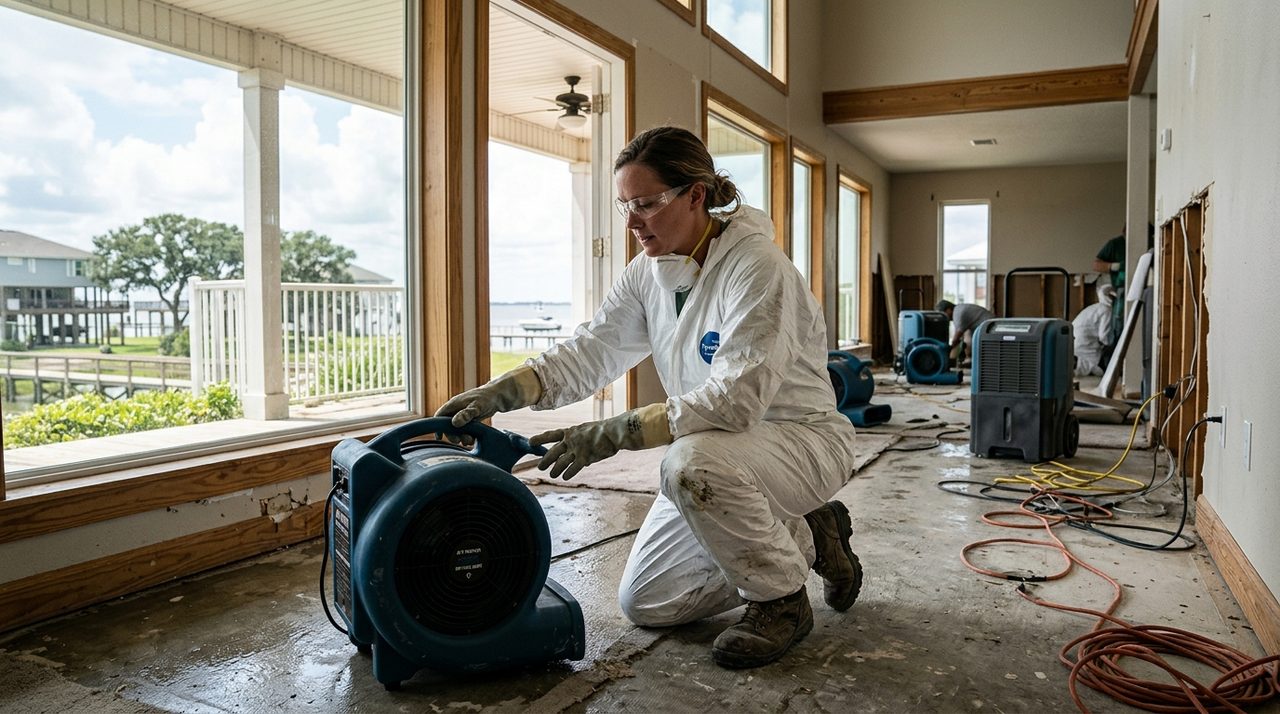
Water-restoration companies serving Friendswood, TX can install or recommend backflow prevention add-ons on floor drains and advise on contents-elevation strategies that limit category-2 water contact during a tropical event. The May 2024 derecho reminded Houston homeowners that extreme rain is not exclusive to named hurricanes, making year-round readiness essential. Confirm the current FEMA panel for your Friendswood parcel — the area maps to Zone X, but adjacent lots can differ.
Straight-line winds exceeding 80 mph, as recorded during the 2024 derecho, broke seals on sliding glass doors and drove water into flooring assemblies throughout Friendswood, TX neighborhoods with no prior flood history. Contact a licensed Texas restoration firm — TDLR regulates their mold-assessment and remediation work — to inspect and dry any affected areas before summer humidity accelerates microbial growth. Because Friendswood drains toward Clear Creek, block-level runoff can differ sharply from the mapped zone.
Homes in lower-flood-risk areas of Friendswood, TX are not immune to the interior water losses Uri 2021 caused — burst attic supply lines and failed icemaker connections caused extensive drywall and flooring damage regardless of floodplain designation. A water-restoration contractor can extract standing water, remove wet flooring, and place structural drying equipment within the window that prevents a straightforward dryout from escalating to mold remediation. As a Galveston County community, Friendswood may follow county rather than City of Houston storm rebuild rules.
Sources: FEMA National Flood Hazard Layer (NFHL), Ready.gov -- Hurricanes, CenterPoint Energy -- Storm Center, City of Houston -- Emergency Preparedness, Ready.gov -- Winter Weather, Harris County Flood Control District
Houston-specific estimators to plan your project before you call a pro. All results are planning estimates — a licensed local pro confirms the details on site.
Disconnect & drain every outdoor hose bib
Remove hoses, drain the spigots, and cover each with an insulated faucet sock. Un-drained hose bibs are the #1 burst point in a Houston freeze.
Insulate exposed pipes in the attic & garage
Wrap any pipe in an unconditioned space (attic runs, garage walls) with foam sleeves. Houston homes rarely insulate these because they only matter a few nights a year — which is exactly why they burst.
Open cabinet doors & keep a pencil-width drip
On hard-freeze nights, open kitchen/bath cabinets so warm air reaches the pipes and let faucets on exterior walls drip to relieve pressure.
Protect the attic/garage water heater & its lines
An attic or garage tank sits in unconditioned space. Insulate the cold-inlet and hot-outlet lines and confirm the emergency drain pan is clear so a leak doesn't reach the ceiling.
This is a planning estimate only — actual requirements depend on an on-site assessment by a licensed Houston pro. If a pipe has already burst, shut off your main water supply and call a licensed Houston plumber immediately — freeze bursts flood fast.
Sources: Municipal permit office (see area profile)
Sources: FEMA National Flood Hazard Layer (NFHL)IICRC (water/mold restoration standards)
Sources: IICRC (water/mold restoration standards)Municipal permit office (see area profile)
Sources: Local HOA / deed restrictions (see area profile)IICRC (water/mold restoration standards)