9809 Harwin Dr. Ste J, Houston, TX 77036
Best Water & Flood Restoration in Sharpstown
Sharpstown's late-1950s and 1960s ranch homes sit on concrete slabs over Houston's expansive Black clay soil, and while most of the neighborhood maps to FEMA Zone X, flash flooding from Houston's intense convective storms still pushes water under slab edges and through aging single-pane aluminum windows — both conditions that the original builders never had to plan for. What makes Sharpstown restoration calls uniquely complicated is the layering of six decades of piecemeal upgrades: original cast-iron drains, early-generation flex ductwork, and galvanized supply lines all interact with floodwater in ways that can extend drying timelines and trigger mold well beyond what surface conditions suggest. This page explains the four water-damage realities that show up most often in Sharpstown's specific housing stock and what a qualified restoration contractor should do about each one.
Verified against Google Business data
Updated 2026
See the 10 Water & Flood Restoration Serving Sharpstown 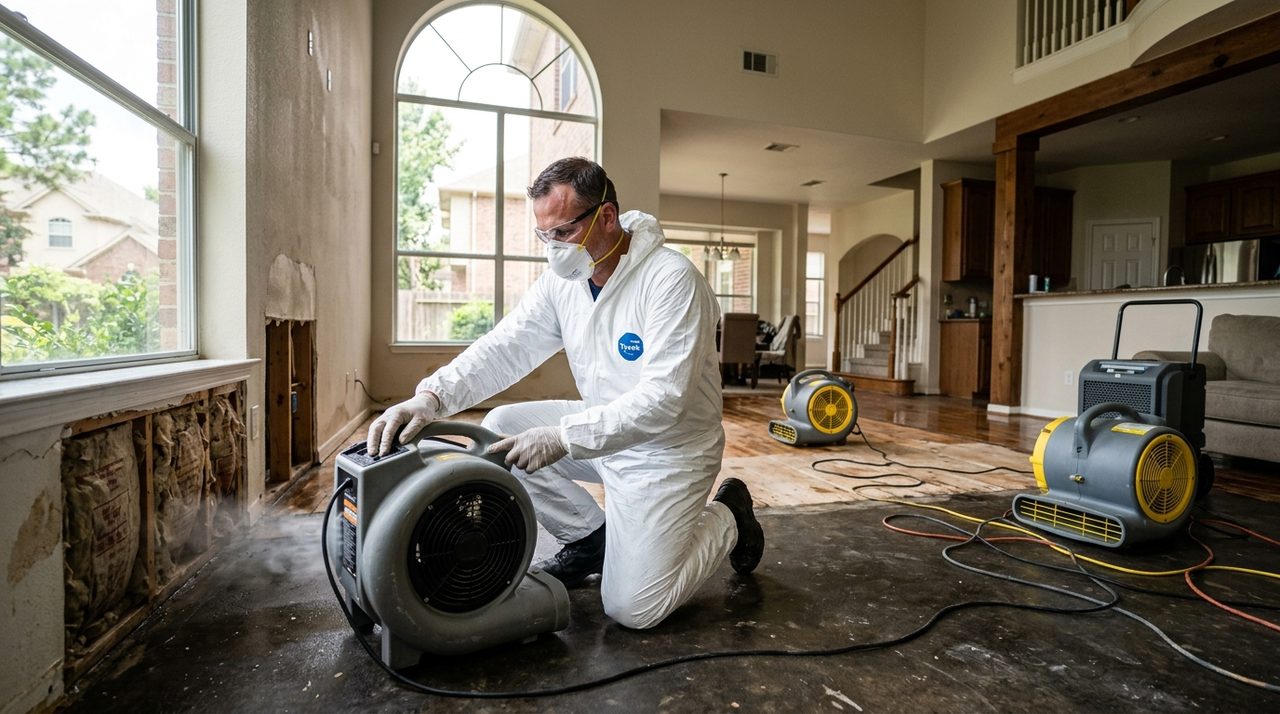
- Median home built
- 1976
- Median home value
- $212,156
- FEMA flood zone
- X (low)
- Typical mitigation cost (est.)
- $3,500–$40,000 depending on Category 2 vs. Category 3 loss
- Most common local issue
- Flash-flood moisture wicking into slab edges and cast-iron drain voids on 1950s–60s ranch homes
Ranked by verified Google rating × review volume × verification tier. How we rank →
Some highly-rated pros serve Sharpstown from nearby and may not keep a Sharpstown street address. Those are listed under "Also serving Sharpstown" with their real city and distance, so you always know where each business is based.
Min rating:
10 resultsBased in Sharpstown
6101 Maple St, Houston, TX 77074
Also serving Sharpstown
Highly-rated pros based nearby who cover Sharpstown. Distance shown from the Sharpstown area.
Serving Sharpstown Based in Meyerland · 2 mi away
Open Now
Serving Sharpstown Based in Bellaire · 2.1 mi away
Open Now
Serving Sharpstown Based in Tanglewood · 2.6 mi away
Open Now
Serving Sharpstown Based in Alief · 3.2 mi away
Open Now
Serving Sharpstown Based in Bellaire · 3.2 mi away
Closed
Serving Sharpstown Based in Tanglewood · 3.5 mi away
Open Now
Serving Sharpstown Based in Alief · 3.8 mi away
Open Now
Serving Sharpstown Based in Tanglewood · 4.5 mi away
Water & Flood Restoration in Sharpstown: What You Should Know
Clay Soil Holds Water Against Your 1960s Slab Long After the Rain Stops
Why it matters to you
Sharpstown's slabs were poured directly on Houston Black clay, which can retain moisture against the slab perimeter for weeks after a flash-flood event recedes. Even though most of Sharpstown sits in FEMA Zone X, concentrated neighborhood runoff regularly saturates the soil around the slab edge, and the original construction used no capillary break between slab and bottom plate — meaning the framing lumber in your exterior walls can stay wet far longer than a moisture meter reading at chest height would suggest.
What a good pro does
A properly scoped restoration job in Sharpstown should include daily psychrometric readings at the slab perimeter, not just wall cavities, and drying equipment positioned at floor level to address upward moisture wicking. IICRC S500 drying standards require documentation of humidity ratios in the structural assembly, not just surface readings; a contractor should provide a written drying log for your insurance file. Any bottom-plate replacement requires a demolition permit pulled through the City of Houston Permitting Center.
Sources: IICRC (water/mold restoration standards), City of Houston Permitting Center, FEMA National Flood Hazard Layer (NFHL)
Cast-Iron Drains and Original Flex Ductwork Are Mold Incubators After a Flood
Why it matters to you
Sharpstown homes built in the late 1950s and 1960s frequently still have original cast-iron drain lines and early flex ductwork. When floodwater enters, cast-iron joints that have already been weeping from corrosion allow contaminated water to pool under the slab and in wall chases, while the fiberglass batt insulation wrapped around older flex duct absorbs moisture and never fully dries on its own. Houston's average 74 percent relative humidity and summer temperatures above 90°F create ideal Cladosporium and Aspergillus growth conditions within 48–72 hours of initial wetting.
What a good pro does
A restoration contractor working in Sharpstown should scope duct inspection with a borescope as a standard line item on any job where inundation lasted more than a few hours, not as an optional add-on. If duct insulation shows moisture absorption, replacement is required rather than drying in place. Any contractor performing mold assessment or remediation in Texas must hold a TDLR-issued Mold Assessment Consultant or Mold Remediation Contractor license under Texas Occupations Code Chapter 1958; ask to see the license number before work begins.
Sources: IICRC (water/mold restoration standards), Texas Department of Licensing & Regulation, Texas Commission on Environmental Quality
Wind-Driven Rain Through Sharpstown's Brick Veneer and Aluminum Windows
Why it matters to you
Sharpstown's signature post-war ranch style — single-story, low-pitch rooflines, brick veneer — looks solid but has a hidden vulnerability: the brick is a cladding, not a structural wall, and the weep holes at the base of the veneer are the only designed drainage path for wind-driven rain that enters behind the brick. The May 2024 derecho and earlier storms like Harvey (2017) forced water through those weep holes and through the flange gaps of Sharpstown's original single-pane aluminum window frames, saturating wall sheathing from the outside in without producing any visible interior flooding until mold appears months later.
What a good pro does
After any major wind event, a restoration contractor should use thermal imaging and calibrated moisture meters to scan Sharpstown exterior walls from inside, tracing the intrusion path from the roof deck downward through sheathing to the bottom plate — a very different diagnostic approach from bottom-up flood work. The drying strategy must also address the brick cavity, which can trap humidity against OSB or plank sheathing. This type of investigation-and-drying scope does not typically require a permit on its own, but any resulting structural or electrical repairs must be permitted through the City of Houston Permitting Center.
Sources: IICRC (water/mold restoration standards), City of Houston Permitting Center, Harris County Flood Control District
Uri-Era Pipe Bursts Left Hidden Moisture Behind Drywall in Sharpstown Attics
Why it matters to you
Winter Storm Uri in February 2021 burst supply lines throughout the Houston metro, and Sharpstown — with its original copper supply lines routed through unconditioned attic space that was never designed for freezing temperatures — was hit hard. Many homeowners patched the burst pipe and repainted, but never had the wall cavity professionally dried or tested for mold. Restoration contractors called to Sharpstown properties for unrelated water events now routinely encounter Uri-era microbial growth hidden behind undisturbed drywall, which must be remediated before any new construction can proceed.
What a good pro does
Before any reconstruction work begins in a Sharpstown home that was occupied during Uri and has not had a post-2021 professional moisture assessment, a restoration contractor should do a targeted thermal and moisture scan of attic-adjacent interior walls and ceiling planes. If active mold is found, a TDLR-licensed Mold Assessment Consultant must issue an independent assessment protocol before a TDLR-licensed Mold Remediation Contractor begins work — the two roles cannot be filled by the same firm on the same project. Post-remediation clearance testing is required before new drywall is installed, and any plumbing repairs to attic supply lines require a TSBPE-licensed plumber pulling a permit through the City of Houston Permitting Center.
Sources: Texas Department of Licensing & Regulation, Texas State Board of Plumbing Examiners, City of Houston Permitting Center
Water & Flood Restoration in Sharpstown: What You Should Know
Hiring water & flood restoration in Sharpstown? Sharpstown is one of Houston's earliest master-planned communities, with most homes dating to the late 1950s and 1960s. Homeowners here face the typical aging-systems trifecta: original cast-iron drain lines approaching or past their useful life, aging HVAC systems struggling with Houston summers, and slab foundations susceptible to differential settlement in expansive clay soils. Deed restrictions enforced by the Sharpstown Civic Association govern exterior modifications, so contractors should verify compliance before beginning visible work.
- Housing era
- Mid-1950s through 1960s (median year built 1959)
- Foundation
- Predominantly concrete slab-on-grade (inferred from era and regional building patterns
- Flood zone
- FEMA Zone X (low flood risk) per official NFHL data
- Permits
- City of Houston Permitting Center (Houston Public Works)
Housing stock & systems
Building era
Mid-1950s through 1960s (median year built 1959).
Typical style
Post-war ranch and mid-century suburban — predominantly single-story, low-pitch rooflines, brick veneer.
Foundations
Predominantly concrete slab-on-grade (inferred from era and regional building patterns; some earliest sections may have pier-and-beam).
Common systems
Original homes likely have galvanized steel or cast-iron drain lines, copper supply lines, R-22 refrigerant HVAC systems (many now replaced), and fuse panels or early breaker panels upgraded over time to 200-amp service. Older homes may still have original single-pane aluminum windows.
What that means for repairs
Kitchen and bathroom remodels are common as homeowners update 60+ year-old layouts. Foundation repair and re-piping (replacing cast-iron drains with PVC) are frequent major projects. Many homes have had incremental upgrades — roof replacements, HVAC conversions to R-410A, and window upgrades — but full gut renovations are also seen as investors enter the market.
Permits & restrictions
Permit jurisdiction
City of Houston Permitting Center (Houston Public Works). Sharpstown is within City of Houston limits, Council Districts F and J.
HOA & deed restrictions
Sharpstown Civic Association serves as the primary neighborhood organization for deed restriction enforcement and architectural control. Membership dues are voluntary (approximately $90/year plus optional security fee), but deed restrictions run with the land and are enforceable regardless of membership. Individual condo and townhome complexes within Sharpstown (e.g., Sharpstown Green Condominium Association) may have separate mandatory HOAs.
Historic districts
No City of Houston historic district designation confirmed. Sharpstown does not appear on HAHC-designated district lists and does not require Certificates of Appropriateness for exterior work.
Contractor note
Contractors must pull permits through the City of Houston Permitting Center. Exterior modifications — fences, paint colors, carport additions — should be checked against Sharpstown deed restrictions enforced by the Sharpstown Civic Association before work begins.
Flood & weather
FEMA flood zone
FEMA Zone X (low flood risk) per official NFHL data. No specific bayou or creek proximity concerns were identified in available research for the core Sharpstown single-family areas.
Hurricane Harvey impact
Sharpstown did not appear among the highest-profile catastrophically flooded neighborhoods during Hurricane Harvey. Localized street ponding and some home flooding may have occurred, but specific street-level impact data for Sharpstown was not confirmed in available sources. Not confirmed at the parcel level — homeowners should check Harris County Flood Control District records for individual property flood history.
Heat & humidity load
1950s–60s homes with original insulation and single-pane windows place heavy loads on HVAC systems during Houston's extended cooling season (May–October). Slab-on-grade foundations are susceptible to differential movement during summer drought cycles as expansive clay soils shrink, which can crack plumbing lines running beneath or through the slab. Contractors should anticipate high demand for HVAC tune-ups, duct sealing, and attic insulation upgrades.
Working with contractors here
The most common service calls in Sharpstown involve foundation evaluation and repair, cast-iron drain line replacement (re-piping to PVC), and HVAC system replacement on homes still running original or second-generation equipment. Roof replacements are frequent given the age of the housing stock and Houston's hail exposure. Because Sharpstown was built as a mass-production subdivision, floor plans repeat across many blocks, which allows experienced contractors to develop efficient scoping templates. However, six decades of piecemeal upgrades mean electrical panels, plumbing materials, and HVAC configurations can vary significantly even between identical floor plans — thorough pre-job inspections are essential. Contractors should also be aware that the Sharpstown Civic Association actively enforces deed restrictions on exterior appearance, so visible work such as siding, fencing, or accessory structures should be verified for compliance before installation.
Local Tip
Always ask for a written estimate before work begins. Texas contractors are required to provide one on jobs over $1,000.
About Sharpstown
Sharpstown is one of Houston's earliest master-planned communities, with most homes dating to the late 1950s and 1960s. Homeowners here face the typical aging-systems trifecta: original cast-iron drain lines approaching or past their useful life, aging HVAC systems struggling with Houston summers, and slab foundations susceptible to differential settlement in expansive clay soils. Deed restrictions enforced by the Sharpstown Civic Association govern exterior modifications, so contractors should verify compliance before beginning visible work.
- Median year built
- 1976
- Median home value
- $212,156
- Owner-occupied
- 22.5%
- Population
- 108,503
- Housing units
- 45,662
- Median income
- $45,033
Source: U.S. Census Bureau, ACS 5-Year 2023
Flood & storm risk
FEMA Zone XLow flood riskMost of Sharpstown maps to FEMA Zone X (low mapped flood risk), but Houston's flash-flood reality means even low-risk blocks benefit from smart drainage and storm-hardened installs.
Source: FEMA National Flood Hazard Layer (NFHL). Flood zones vary by parcel — verify your individual FIRM panel.
Houston Storm Readiness in Sharpstown
Hurricane & flooding
Zone X mapping offers no guarantee in Houston's flat topography, so have a water-restoration contractor identify the fastest flood-entry paths into your Sharpstown home — typically garage thresholds, HVAC closets, and exterior door sweeps — and pre-stage extraction equipment contacts. Acting in the first 24 hours after inundation is the difference between a dryout and a full mold remediation. Confirm the current FEMA panel for your Sharpstown parcel — the area maps to Zone X, but adjacent lots can differ.
Severe storms & hail
Even in low-flood-mapped areas of Sharpstown, intense thunderstorm rainfall can overwhelm gutter systems and force water through foundation weep holes or into slab expansion joints, creating sub-floor moisture that feeds mold undetected. An IICRC-certified water-restoration technician can use penetrating moisture meters to confirm whether a post-storm inspection is clear or whether targeted structural drying is needed. Confirm the current FEMA panel for your Sharpstown parcel — the area maps to Zone X, but adjacent lots can differ.
Ice storms & freezes
Ice accumulation on exterior pipe chases and uninsulated attic runs caused widespread freeze-and-burst events across Sharpstown during Uri 2021, and the resulting water losses required IICRC-trained technicians with commercial dehumidifiers to dry out wall and ceiling cavities that building materials alone could not off-gas. Confirming you have a preferred restoration contractor's number before a freeze forecast arrives eliminates critical delays when crews are in high demand across the metro. With a median build year of 1976, the older building stock here is more exposed to hard-freeze damage than newer construction. Confirm the current FEMA panel for your Sharpstown parcel — the area maps to Zone X, but adjacent lots can differ.
Sources: FEMA National Flood Hazard Layer (NFHL), Ready.gov -- Hurricanes, CenterPoint Energy -- Storm Center, City of Houston -- Emergency Preparedness, Ready.gov -- Winter Weather, Harris County Flood Control District
Free Sharpstown Tools & Calculators
Houston-specific estimators to plan your project before you call a pro. All results are planning estimates — a licensed local pro confirms the details on site.
Houston Freeze Prep & Pipe Insulation Checklist
Open full tool & FAQ →Your freeze checklist — 4 tasks
- 1
Disconnect & drain every outdoor hose bib
Remove hoses, drain the spigots, and cover each with an insulated faucet sock. Un-drained hose bibs are the #1 burst point in a Houston freeze.
- 2
Insulate exposed pipes in the attic & garage
Wrap any pipe in an unconditioned space (attic runs, garage walls) with foam sleeves. Houston homes rarely insulate these because they only matter a few nights a year — which is exactly why they burst.
- 3
Open cabinet doors & keep a pencil-width drip
On hard-freeze nights, open kitchen/bath cabinets so warm air reaches the pipes and let faucets on exterior walls drip to relieve pressure.
- 4
Protect the attic/garage water heater & its lines
An attic or garage tank sits in unconditioned space. Insulate the cold-inlet and hot-outlet lines and confirm the emergency drain pan is clear so a leak doesn't reach the ceiling.
This is a planning estimate only — actual requirements depend on an on-site assessment by a licensed Houston pro. If a pipe has already burst, shut off your main water supply and call a licensed Houston plumber immediately — freeze bursts flood fast.
Frequently Asked Questions
Do I need a permit from the City of Houston to demo flood-damaged drywall and replace electrical outlets in my Sharpstown ranch home?
Yes — because Sharpstown sits within City of Houston limits (Council Districts F and J), all structural demolition, electrical, and plumbing work connected to flood restoration must be permitted through the City of Houston Permitting Center on Houston Public Works. Your restoration contractor typically pulls the demolition permit, while licensed electricians and plumbers pull their own trade permits separately. Skipping permits can delay the Certificate of Completion your insurer needs to close your claim, so confirm permit status before any demo begins.
Sources: City of Houston Permitting Center
My Sharpstown home is in FEMA Zone X — will my insurance company still cover water damage from a flash flood, or am I on my own?
Zone X means your property is outside the high-risk Special Flood Hazard Area, so federal flood insurance is not mandatory for your mortgage, but that does not mean you are immune to loss — Houston's intense convective storms regularly flood Zone X streets as storm drains overwhelm capacity. Standard homeowners policies generally exclude rising groundwater (flood); a separate NFIP or private flood policy is the only way to capture those losses. If your damage originated from a pipe burst or roof breach rather than rising water, that may fall under your homeowners policy's water damage coverage — the source distinction matters enormously when adjusters scope the claim.
How does the Sharpstown Civic Association's deed restriction enforcement affect emergency water damage work — can they delay a dumpster or exterior demo?
The Sharpstown Civic Association enforces deed restrictions on exterior appearance regardless of whether you pay the voluntary dues, so visible work like exterior drywall removal, dumpster placement on driveways or curbside, and re-cladding choices can technically be subject to review. In practice, most civic associations accommodate emergency timelines, but you should notify the Association in writing as soon as possible and document the emergency nature of the work to protect yourself. Time is critical — IICRC S500 standards call for drying to begin within 24–48 hours of a water event, and any delay that allows Category 2 moisture to become Category 3 contamination will significantly expand your remediation scope and cost.
Sources: IICRC (water/mold restoration standards)Local HOA / deed restrictions (see area profile)
Sharpstown homes are mostly from the late 1950s and 1960s — does that mean my restoration crew needs to test for lead paint before tearing out flood-damaged walls?
Yes — homes built before 1978 are presumed to contain lead-based paint under EPA regulations, and Sharpstown's median build year of 1959 puts virtually the entire neighborhood's original housing stock in that category. If your contractor disturbs more than six square feet of painted surface per room during demo, EPA's Renovation, Repair and Painting (RRP) rule requires the firm to be EPA Lead-Safe Certified and to follow lead-safe work practices. Ask any restoration contractor to confirm their RRP certification before demo begins — this applies even to flood-emergency work and protects both occupants and workers.
Sources: EPA Lead Renovation, Repair and Painting (RRP) Rule
What's a realistic timeline for a water restoration project on a 1,800-square-foot Sharpstown ranch home after a flash-flood event, from extraction through reconstruction?
For a typical single-story slab home in Sharpstown with moderate Category 2 inundation, the mitigation phase — extraction, structural drying, and demo — generally runs three to seven days for equipment placement, with total drying time verified by moisture readings before reconstruction can start; expect ten to twenty-one days total for mitigation on a saturated slab sitting on clay soil, which releases moisture slowly. Reconstruction (new drywall, flooring, paint) then adds several additional weeks depending on material lead times and City of Houston permit inspection scheduling. These are estimates and can extend significantly if cast-iron drain damage, mold remediation, or permit delays are discovered mid-project.
Sources: IICRC (water/mold restoration standards)City of Houston Permitting Center
If a mold remediation contractor finds mold behind my Sharpstown walls, do they need a state license to do the work in Texas?
Yes — Texas law requires any firm performing mold remediation to hold a TDLR-issued Mold Remediation Contractor (MRC) license under Texas Occupations Code Chapter 1958, and any firm performing a formal mold assessment must hold a separate Mold Assessment Consultant (MAC) license; the same company cannot legally perform both the assessment and the remediation on the same project. You can verify a contractor's MRC or MAC license status directly through TDLR's online lookup before signing any contract. Given Sharpstown's 1950s–60s housing stock and the likelihood of undisturbed wall cavities with decades of moisture history, budget for the possibility that remediation will be scoped separately from your structural drying contract.