Open Now
6300 N Main St #204, Houston, TX 77009
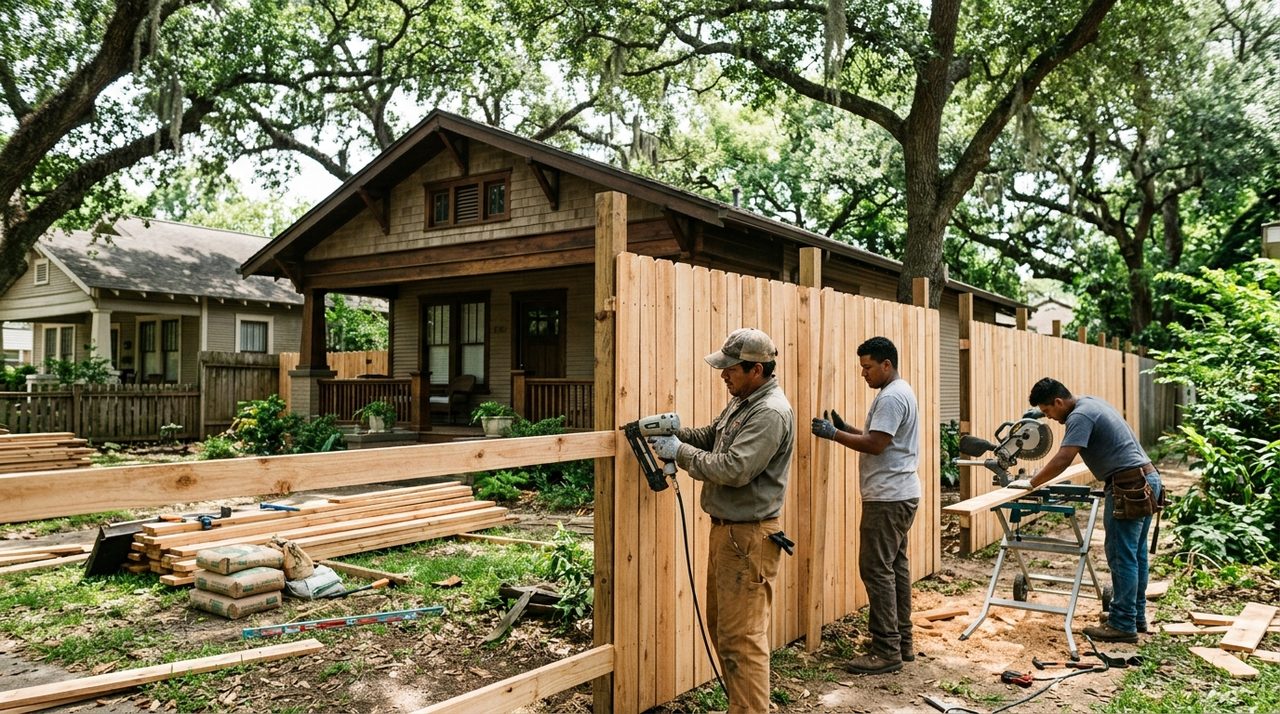
The Heights throws fence builders a curveball that almost no other Houston neighborhood matches: a single block can hold an 1890s pier-and-beam bungalow, a 2010s four-story townhome enclave, and a brand-new single-family infill — each sitting on Houston's native Beaumont clay and each subject to the Houston Permitting Center's rules, but with wildly different deed restrictions and, in some blocks, HAHC historic-district oversight that governs even fence materials and finishes. Getting a fence right here means sorting out which recorded covenants apply to your specific plat, confirming whether your lot falls inside a Heights historic district boundary, and then engineering against clay soil that shrinks and swells enough to topple posts set to standard practice.
Ranked by verified Google rating × review volume × verification tier. How we rank →
Some highly-rated pros serve The Heights from nearby and may not keep a The Heights street address. Those are listed under "Also serving The Heights" with their real city and distance, so you always know where each business is based.
6300 N Main St #204, Houston, TX 77009
3904 Searle Dr, Houston, TX 77009
Highly-rated pros based nearby who cover The Heights. Distance shown from the The Heights area.
Serving The Heights Based in Lazybrook / Timbergrove · 1.8 mi away
Serving The Heights Based in Lazybrook / Timbergrove · 1.9 mi away
Serving The Heights Based in Lazybrook / Timbergrove · 2.8 mi away
Serving The Heights Based in Spring Branch · 2.9 mi away
Serving The Heights Based in Midtown · 3.2 mi away
Serving The Heights Based in Independence Heights · 4.3 mi away
Serving The Heights Based in Garden Oaks · 4.6 mi away
Serving The Heights Based in Independence Heights · 5.1 mi away
Why it matters to you
The Heights sits squarely on Houston's Beaumont/Houston Black clay, and the older lots — many platted in the 1890s through 1920s — have had a century of moisture cycling that creates dramatic seasonal swell-and-shrink patterns. A standard concrete collar poured at 18–24 inches can heave, crack, or pivot within two or three Houston summers, leaving a board-on-board privacy fence leaning noticeably by year three. Corner posts and gate posts, which carry the most lateral load, fail first and most visibly on these deep-clay lots.
What a good pro does
A qualified fence pro on a Heights bungalow lot should set posts at least 36 inches deep — roughly one-third of the total post length — and use tube-form concrete poured slightly above grade and sloped to shed water, not flush or below grade where clay moisture concentrates. Specifying pressure-treated 4x4 or 4x6 posts rated for ground contact (UC4B or better) and using a gravel drainage bed at the bottom of the hole reduces the moisture that fuels clay movement. Post-and-footing replacement for heave damage typically runs $150–$300 per post installed, so getting the depth and drainage right upfront is a real cost-avoidance measure.
Sources: International Residential Code (as adopted by City of Houston)
Why it matters to you
The Heights East, Heights West, and Heights South historic districts — designated by the City of Houston — require a Certificate of Appropriateness from the Houston Archaeological & Historical Commission (HAHC) for exterior modifications, and fencing is explicitly covered. If your bungalow or Victorian sits inside one of these district boundaries, a contractor who installs a fence without HAHC approval can trigger a stop-work order and force you to remove and replace non-compliant materials at your own expense. Most homeowners are unaware the district lines run mid-block in some areas, meaning your neighbor might need HAHC review and you might not — or vice versa.
What a good pro does
Before any fence quote is finalized, confirm your parcel's historic district status directly with the HAHC, since district boundaries are not obvious from street view and online maps lag behind recorded changes. Approved materials in these districts typically favor wood over vinyl or chain-link, and certain post orientations and picket profiles must match neighborhood character guidelines. A fence builder experienced in the Heights should pull the HAHC application as part of project planning — not as an afterthought — because approval lead time adds weeks and material substitutions mid-project are costly.
Sources: City of Houston Permitting Center, Local HOA / deed restrictions (see area profile)
Why it matters to you
The Heights has no single neighborhood-wide HOA, but that does not mean your lot is unrestricted. The original Heights plats carry recorded deed restrictions that have been enforced for decades — the voluntary Houston Heights Association actively monitors covenant compliance — and dozens of newer townhome enclaves (Heights Abbey HOA, Studemont Heights POA, and others) have their own mandatory architectural review boards with specific fence-material, height, and color mandates. A homeowner who installs a chain-link fence facing the street or a 7-foot cedar panel that violates a plat covenant can face legal action from neighbors with standing to enforce recorded restrictions, independent of any city permit.
What a good pro does
Pull your recorded deed restrictions at the Harris County Clerk's office or through a title search before finalizing any fence design — this step costs very little and prevents forced removal later. For townhome enclaves, submit the fence design to the HOA's architectural review committee and get written approval before breaking ground. A Heights-savvy fence contractor will ask for this documentation upfront and flag discrepancies between what you want and what the recorded restrictions allow, rather than leaving the compliance risk entirely on the homeowner.
Sources: Local HOA / deed restrictions (see area profile), City of Houston Permitting Center
Why it matters to you
Houston's year-round humidity — averaging above 70% — combines with the clay soil's poor natural drainage to create near-ideal conditions for fungal wood rot at the ground line. On original Heights lots, where existing grades often slope toward the fence line and century-old soil compaction slows infiltration, untreated or under-treated pine posts in direct ground contact can begin rotting within three to five years. This problem is especially pronounced on lots backing up to alleys, where vehicle runoff and limited sunlight keep the soil damp long after rain events end.
What a good pro does
Specify pressure-treated pine posts graded for ground contact (UC4B minimum) rather than above-ground-rated lumber, which is commonly sold but inadequate here. Cedar pickets are naturally rot-resistant for above-grade components, but the post — the buried anchor — determines the fence's lifespan on a Heights lot. Some contractors also apply a post-base sleeve or gravel collar to improve drainage around the concrete footing. Budgeting for a stain or sealant on the wood above grade every two to three years extends cedar picket life significantly in this climate, keeping a $3,000–$4,500 fence install looking sound for a decade or more.
Sources: International Residential Code (as adopted by City of Houston)
Hiring fence builders in The Heights? The Heights spans housing from the 1890s through brand-new construction, meaning contractors encounter pier-and-beam Craftsman cottages and modern slab-on-grade townhomes on the same block. Deed restrictions are common across most plats, and dozens of small mandatory HOAs govern newer townhome enclaves, so exterior work often requires checking recorded covenants at the Harris County Clerk's office. The mix of century-old galvanized plumbing and modern PEX systems makes thorough pre-job inspections essential.
Building era
Mixed: original 1890s–1930s bungalows, scattered mid-century infill (1940s–1960s), and a dominant wave of townhome and new single-family construction from the late 1990s through the 2010s.
Typical style
Historic Craftsman bungalows, Victorian/Queen Anne–inspired homes, contemporary 2-to-4-story townhomes with rooftop decks, and transitional new-build single-family homes with traditional exteriors and modern interiors.
Foundations
Mixed — older homes (pre-1950s) are predominantly pier-and-beam; newer townhomes and post-1990s construction are typically slab-on-grade.
Common systems
Older homes: original or retrofitted central HVAC, galvanized or cast-iron drain lines, knob-and-tube or cloth-wrapped wiring that may have been partially updated. Newer construction: modern central HVAC with high-efficiency units, PEX or copper plumbing, 200-amp electrical panels. Many renovated older homes have hybrid systems mixing old and new.
What that means for repairs
Tear-down-and-rebuild of older cottages for new single-family or townhome construction is extremely common. Remaining historic homes frequently undergo full gut renovations including foundation leveling, complete re-plumbing from galvanized to PEX, electrical panel upgrades, and HVAC modernization while preserving Craftsman exterior character.
Permit jurisdiction
Houston Permitting Center (City of Houston).
HOA & deed restrictions
No single neighborhood-wide mandatory HOA. The Houston Heights Association (HHA) is a voluntary civic organization focused on deed restriction enforcement and community events. Numerous small mandatory HOAs/POAs exist for specific townhome and gated developments (e.g., Heights Abbey HOA, Studemont Heights POA). Deed restrictions are common across most original Heights plats and recorded with the Harris County Clerk.
Historic districts
Portions of the Heights fall within City of Houston Historic Districts (Heights East, Heights West, Heights South) subject to Houston Archaeological & Historical Commission (HAHC) review for exterior modifications and demolition. Exact boundaries should be confirmed with the HAHC before any exterior work.
Contractor note
Properties in HAHC-designated historic districts require a Certificate of Appropriateness for exterior changes, including roofing material, siding, windows, and fencing. Contractors should verify historic district status before quoting exterior work, as non-compliant modifications can result in stop-work orders and forced remediation.
FEMA flood zone
FEMA Zone X (low flood risk) per the official NFHL API. However, proximity to White Oak Bayou along the southern and eastern edges of the Heights means localized street flooding and bayou overflow can affect properties near the waterway, particularly south of 11th Street.
Hurricane Harvey impact
Not confirmed with specific damage statistics from research. The Heights generally fared better than many Houston neighborhoods during Hurricane Harvey (2017) due to its slightly elevated terrain — the neighborhood was historically marketed as being higher than downtown Houston. However, areas near White Oak Bayou experienced flooding, and some low-lying streets saw significant water intrusion. Specific property impact should be verified through Harris County Flood Control District records.
Heat & humidity load
Pier-and-beam homes with older insulation and single-pane windows place extreme demands on HVAC systems during Houston summers. Crawl space moisture under pier-and-beam foundations promotes mold, wood rot, and pest issues. Newer townhomes with flat or low-slope roofs and rooftop decks require diligent roof drainage maintenance to prevent ponding and leaks during summer storms.
Working with contractors here
The Heights is one of Houston's most active markets for both renovation and new construction. Contractors most commonly handle foundation leveling and repair on pier-and-beam homes, whole-house re-plumbing to replace aging galvanized lines, and electrical upgrades from outdated panels and wiring to modern 200-amp service. Exterior work on historic district properties requires HAHC approval, adding lead time and material specification constraints that must be factored into bids. Townhome work frequently involves rooftop deck waterproofing, stucco repair, and shared-wall considerations that require coordination with adjacent owners or HOA boards. Given the extreme variation in housing age on a single block, contractors should never assume systems or foundation types based on neighboring properties — each home demands its own inspection.
Local Tip
Always ask for a written estimate before work begins. Texas contractors are required to provide one on jobs over $1,000.
The Heights spans housing from the 1890s through brand-new construction, meaning contractors encounter pier-and-beam Craftsman cottages and modern slab-on-grade townhomes on the same block. Deed restrictions are common across most plats, and dozens of small mandatory HOAs govern newer townhome enclaves, so exterior work often requires checking recorded covenants at the Harris County Clerk's office. The mix of century-old galvanized plumbing and modern PEX systems makes thorough pre-job inspections essential.
Source: U.S. Census Bureau, ACS 5-Year 2023
Most of The Heights maps to FEMA Zone X (low mapped flood risk), but Houston's flash-flood reality means even low-risk blocks benefit from smart drainage and storm-hardened installs; risk climbs sharply on blocks nearest White Oak Bayou, where it varies parcel to parcel.
Source: FEMA National Flood Hazard Layer (NFHL). Flood zones vary by parcel — verify your individual FIRM panel.
Sources: City of Houston Permitting CenterMunicipal permit office (see area profile)
Sources: Local HOA / deed restrictions (see area profile)
Sources: City of Houston Permitting CenterLocal HOA / deed restrictions (see area profile)