1415 N Market Loop, Baytown, TX 77521
Best Foundation Repair in Baytown, TX
Baytown's housing stock — split between 1950s–1970s ranch homes near the Ship Channel and 1990s–2000s brick-veneer tract subdivisions — sits on the same expansive Houston Black clay that drives foundation movement across the entire SE Houston metro, but the industrial coastal environment and Baytown's independent permit office add layers most homeowners don't anticipate. With a census median year built of 1981 and a significant share of older in-town homes that predate modern slab design standards, foundation differential movement is one of the most common repair categories local contractors handle. This page covers the specific soil, drainage, plumbing, and permit realities that shape foundation repair decisions in Baytown.
Verified against Google Business data
Updated 2026
See the 10 Foundation Repair Serving Baytown 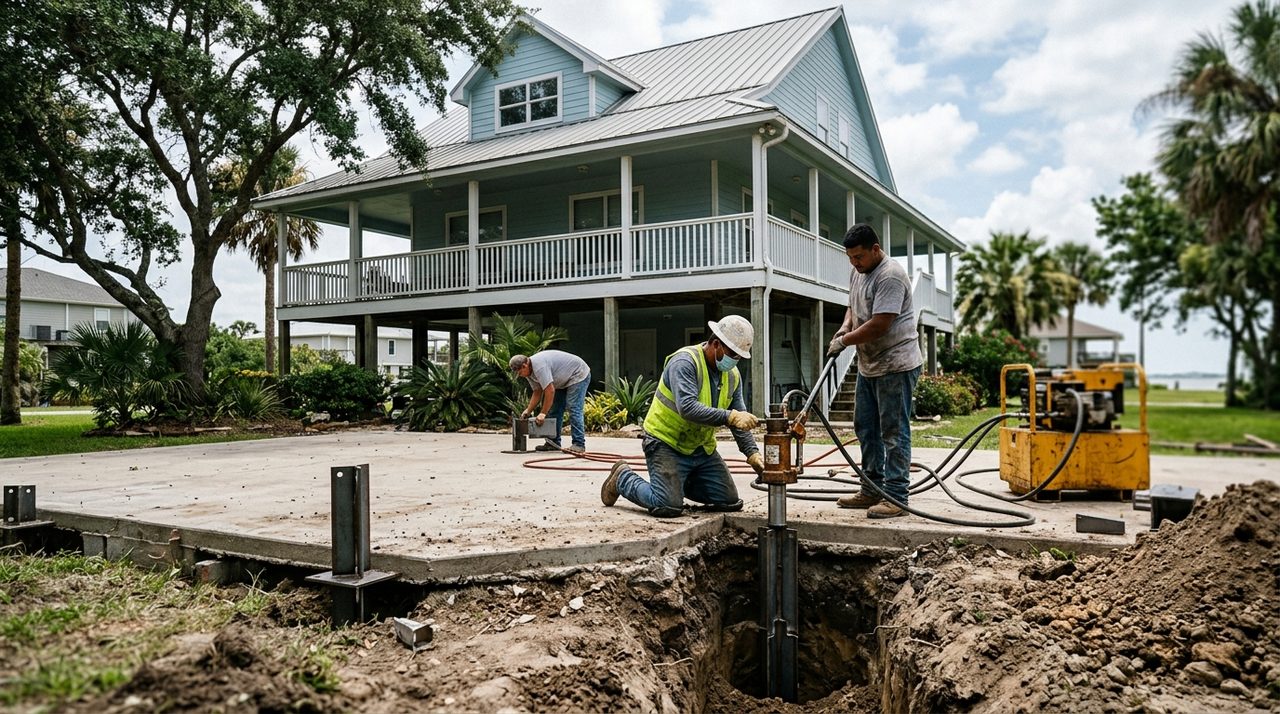
- Median home built
- 1981
- Median home value
- $187,900
- FEMA flood zone
- X (low)
- Typical foundation repair cost (est.)
- $3,500–$25,000 depending on method and pier count
- Most common local issue
- Drought-cycle perimeter void formation on 1990s–2000s slab homes with minimal shade canopy
Ranked by verified Google rating × review volume × verification tier. How we rank →
Some highly-rated pros serve Baytown from nearby and may not keep a Baytown street address. Those are listed under "Also serving Baytown" with their real city and distance, so you always know where each business is based.
Min rating:
10 resultsBased in Baytown
1920 W Main St, Baytown, TX 77520
Closed
1300 Rollingbrook Dr #600, Baytown, TX 77521
Closed
5300 Barkaloo Rd, Baytown, TX 77521
Open Now
1010 W Baker Rd, Baytown, TX 77521
162 Independence Pkwy N, Baytown, TX 77520
Also serving Baytown
Highly-rated pros based nearby who cover Baytown. Distance shown from the Baytown area.
Serving Baytown Based in La Porte · 5.5 mi away
Closed
Serving Baytown Based in Highlands · 7.2 mi away
Serving Baytown Based in La Porte · 7.2 mi away
Serving Baytown Based in Highlands · 9 mi away
Foundation Repair in Baytown: What You Should Know
Clay Soil Swings Hit 1990s–2000s Tract Slabs Hard in Baytown Subdivisions
Why it matters to you
Baytown's newer subdivisions — Sterling Point, Independence Bend, Eastpoint — were built on Houston Black clay during the 1990s and 2000s, when slab design improved but soil behavior did not. These homes typically have modest landscaping and open sunny lots that accelerate moisture loss from the clay perimeter during La Niña drought cycles like 2022–2023, pulling soil away from the slab beam edge and leaving it unsupported. When Gulf rainfall returns, the void fills unevenly, and homeowners start seeing stair-step brick cracks, sticky doors, and sloping floors — classic signs of differential movement.
What a good pro does
A qualified foundation contractor should probe the perimeter for voids before recommending piers, and document current elevations with a zip-level survey across multiple interior points. On Baytown's clay lots with limited canopy, establishing a soaker-hose irrigation schedule along the foundation perimeter during dry months is the most cost-effective prevention measure; re-leveling with pressed concrete pilings (estimated $3,500–$9,000 for a typical 1,800–2,400 sq ft slab) or steel push piers ($1,200–$1,800 per pier) should follow a soil assessment, not precede it. All underpinning work requires a permit through the City of Baytown's own permit office — not Houston's Development Services or Harris County Engineering.
Sources: Municipal permit office (see area profile), International Residential Code (as adopted by City of Houston)
Post-Uri Under-Slab Pipe Leaks Are Still Eroding Foundations in Older Baytown Homes
Why it matters to you
Baytown's in-town neighborhoods — homes built from the 1950s through 1970s along streets near the Ship Channel — frequently have original cast-iron under-slab drain lines that took severe damage during Winter Storm Uri in February 2021. Many owners repaired drywall and interior finishes but never addressed cracked or shifted under-slab pipes, which continue to leak slowly into the clay directly beneath the slab. On Houston Black clay, ongoing subsurface moisture causes localized heave and then settlement as the soil structure degrades, producing foundation movement that looks like soil-driven differential movement but has a plumbing root cause.
What a good pro does
Before signing any foundation repair contract on a Baytown home built before 1985, spend $250–$400 on a hydrostatic plumbing test performed by a licensed plumber (licensed by TSBPE) to confirm whether under-slab lines are holding pressure. If leaks are found, re-piping or spot-repair of the drain system must be completed first — otherwise pier underpinning will not stabilize a slab that continues to be saturated from below. The City of Baytown requires separate plumbing permits for under-slab work, and that scope must be performed or overseen by a TSBPE-licensed plumber.
Sources: Texas State Board of Plumbing Examiners, Municipal permit office (see area profile)
Mature Trees in Baytown's Older Non-HOA Areas Pull Moisture Unevenly and Tilt Slabs
Why it matters to you
The in-town, non-HOA neighborhoods of Baytown — particularly areas with ranch-style homes built in the 1950s and 1960s — have had decades for water oaks and native trees to develop root systems that extend well beyond the canopy. On expansive clay, these roots aggressively extract moisture during dry seasons, causing the foundation to drop on the tree side while the opposite perimeter remains elevated. The asymmetric soil moisture gradient produces the kind of tilt that makes kitchen cabinets pull away from walls and interior doors bind — and it repeats every dry season if the root cause isn't managed alongside any repair work.
What a good pro does
A foundation contractor evaluating an older Baytown ranch home should map which side of the slab is highest versus lowest and ask about tree proximity before recommending a pier layout — because installing piers uniformly around a slab that is being differentially dried by a large oak on one side will not produce a lasting result. Root barrier installation, strategic supplemental irrigation on the tree side, and in some cases selective root pruning (by an arborist, not the foundation contractor) are part of the solution. Since these older Baytown in-town neighborhoods typically have no HOA architectural review, exterior trenching and pier installation can proceed after obtaining the required City of Baytown building permit without additional community approval.
Sources: Municipal permit office (see area profile), Local HOA / deed restrictions (see area profile)
HOA Approval and Permit Sequencing in Baytown's Managed Subdivisions
Why it matters to you
Homeowners in Sterling Point, Independence Bend, or Eastpoint Subdivision face a two-step approval process before any foundation contractor can break ground: the City of Baytown requires a building permit for underpinning work, and the subdivision's Architectural Review Committee — enforcing recorded CC&Rs — may require separate approval for visible exterior modifications like perimeter trenching or pier cap exposure. Contractors who routinely work in unincorporated Harris County or within the City of Houston are sometimes unfamiliar with Baytown's independent permit office and may inadvertently skip the municipal permit step, leaving the homeowner with unpermitted work that surfaces on a buyer's inspection report at resale.
What a good pro does
Before work begins, confirm with the City of Baytown Permitting office that a foundation repair permit has been applied for — and separately check your HOA management certificate (filed under Texas Property Code §209) to identify whether your subdivision's ARC requires a pre-approval submittal with drawings or photos. Texas TREC disclosure requirements obligate sellers to disclose known foundation movement and all prior repairs, so documented, permitted work in Baytown protects resale value; unpermitted repairs create liability. Estimated permit fees in Baytown are modest relative to repair costs, and the inspection step gives homeowners an independent structural review of the contractor's pier count and placement.
Sources: Municipal permit office (see area profile), Local HOA / deed restrictions (see area profile), Texas Department of Licensing & Regulation
Foundation Repair in Baytown: What You Should Know
Hiring foundation repair in Baytown? Baytown is an incorporated city east of Houston with a diverse housing stock ranging from 1950s-era non-HOA neighborhoods to modern master-planned HOA subdivisions. Homeowners should verify their specific subdivision's deed restrictions and HOA status, as governance varies block by block. Proximity to the Houston Ship Channel and coastal waterways means moisture management, corrosion resistance, and flood preparedness are critical home maintenance considerations.
- Housing era
- Mixed
- Foundation
- Predominantly slab-on-grade in post-1970s subdivisions
- Flood zone
- FEMA Zone X (low flood risk) per official NFHL API data at the queried…
- Permits
- City of Baytown Permitting — Baytown is an incorporated city with its own building…
Housing stock & systems
Building era
Mixed: older in-town areas from 1950s–1970s; many HOA-managed subdivisions built 1990s–2010s.
Typical style
One- and two-story traditional brick or brick-veneer tract homes in newer subdivisions; ranch-style and bungalow homes in older non-HOA areas.
Foundations
Predominantly slab-on-grade in post-1970s subdivisions; some older homes may have pier-and-beam — not confirmed in research for specific neighborhoods.
Common systems
Older homes (1950s–1970s): original copper or galvanized plumbing, older electrical panels. Newer subdivisions (1990s–2010s): PEX or CPVC plumbing, 200-amp electrical panels, central HVAC with standard efficiency units.
What that means for repairs
Older non-HOA neighborhoods see plumbing re-pipes, panel upgrades, and foundation leveling. Newer HOA subdivisions focus on cosmetic updates and HVAC replacements as original systems age out of warranty.
Permits & restrictions
Permit jurisdiction
City of Baytown Permitting — Baytown is an incorporated city with its own building codes and permit office, separate from Houston Permitting Center and Harris County Engineering.
HOA & deed restrictions
No single city-wide HOA. Multiple subdivision-level mandatory HOAs exist, including Sterling Point Community Association (managed by Crest Management), The Park at Independence Bend HOA, Eastpoint Subdivision HOA (219 homes), and Baytown Country Club Manor HOA. Older in-town areas may have no HOA or only informal civic clubs. Verify HOA status via Texas Property Code §209 management certificates for any specific address.
Historic districts
No City of Houston historic district designation confirmed. Baytown is an independent incorporated city and does not fall under HAHC jurisdiction.
Contractor note
Contractors must pull permits through the City of Baytown, not Houston or Harris County. HOA Architectural Review Committee approval may be required in subdivisions like Sterling Point or Independence Bend before exterior modifications begin.
Flood & weather
FEMA flood zone
FEMA Zone X (low flood risk) per official NFHL API data at the queried point. However, Baytown is a large city and many areas near the San Jacinto River, Goose Creek, and Cedar Bayou carry higher flood designations. Property-specific FEMA lookups are strongly recommended.
Hurricane Harvey impact
Not confirmed from provided research with specific damage figures. Baytown's location near the San Jacinto River and coastal waterways made it vulnerable during Hurricane Harvey in 2017, and the broader region experienced significant flooding. Homeowners should check Harris County Flood Control District records for address-specific Harvey inundation data.
Heat & humidity load
Baytown's coastal proximity produces high humidity and salt-air exposure, accelerating corrosion on HVAC condensers, metal roofing components, and exterior hardware. Summer heat loads on older homes with original insulation and single-pane windows can strain HVAC systems significantly. Moisture intrusion and mold risk are elevated in older pier-and-beam structures.
Working with contractors here
Contractors in Baytown most commonly handle HVAC replacements, plumbing re-pipes, and foundation work — driven by the area's split between aging 1950s–1970s housing and maturing 1990s–2000s tract homes. Corrosion from the industrial and coastal environment creates above-average demand for exterior painting, metal component replacement, and roof maintenance. In HOA-managed subdivisions, contractors should confirm architectural committee requirements before beginning any visible exterior work, as communities like Sterling Point and Independence Bend enforce recorded CC&Rs. The City of Baytown's independent permitting process means contractors familiar only with Houston or unincorporated Harris County codes need to verify local requirements.
Local Tip
Always ask for a written estimate before work begins. Texas contractors are required to provide one on jobs over $1,000.
About Baytown
Baytown is an incorporated city east of Houston with a diverse housing stock ranging from 1950s-era non-HOA neighborhoods to modern master-planned HOA subdivisions. Homeowners should verify their specific subdivision's deed restrictions and HOA status, as governance varies block by block. Proximity to the Houston Ship Channel and coastal waterways means moisture management, corrosion resistance, and flood preparedness are critical home maintenance considerations.
- Median year built
- 1981
- Median home value
- $187,900
- Owner-occupied
- 53.1%
- Population
- 84,538
- Housing units
- 33,865
- Median income
- $61,699
Source: U.S. Census Bureau, ACS 5-Year 2023
Flood & storm risk
FEMA Zone XLow flood riskMost of Baytown maps to FEMA Zone X (low mapped flood risk), but Houston's flash-flood reality means even low-risk blocks benefit from smart drainage and storm-hardened installs; risk climbs sharply on blocks nearest Galveston Bay and the Houston Ship Channel, where it varies parcel to parcel.
Source: FEMA National Flood Hazard Layer (NFHL). Flood zones vary by parcel — verify your individual FIRM panel.
Houston Storm Readiness in Baytown
Hurricane & flooding
Wind-driven rain during a hurricane can saturate soil on the windward side of your home while the leeward side stays dry, creating differential moisture conditions beneath your slab that show up as sticking doors weeks later in Baytown, TX. Schedule a Zip-Level elevation reading after any named storm passes so a foundation professional can distinguish normal seasonal movement from storm-induced settlement requiring pier work. Because Baytown drains toward Galveston Bay and the Houston Ship Channel, block-level runoff can differ sharply from the mapped zone.
Severe storms & hail
Even with low mapped flood risk, Baytown, TX is not immune to the localized sheet flow that accompanies a Houston severe thunderstorm, and repeated minor inundation at the foundation perimeter sustains the clay moisture that drives slow heave cycles. A pre-storm season inspection confirming that soil grade, splash blocks, and downspout extensions all direct water away from the slab is the most cost-effective foundation repair step you can take. Confirm the current FEMA panel for your Baytown parcel — the area maps to Zone X, but adjacent lots can differ.
Ice storms & freezes
Winter Storm Uri's multi-day freeze caused Houston clay soils to go through freeze-thaw cycling not common in the region, and even low-flood-risk neighborhoods in Baytown, TX saw new door-sticking and brick-step cracking appear in the spring following the storm. A post-winter Zip-Level survey establishes whether that movement is seasonal and self-correcting or progressive and in need of pier work before summer drying amplifies the differential. With a median build year of 1981, the older building stock here is more exposed to hard-freeze damage than newer construction. Confirm the current FEMA panel for your Baytown parcel — the area maps to Zone X, but adjacent lots can differ.
Sources: FEMA National Flood Hazard Layer (NFHL), Ready.gov -- Hurricanes, CenterPoint Energy -- Storm Center, City of Houston -- Emergency Preparedness, Ready.gov -- Winter Weather, Harris County Flood Control District
Free Baytown Tools & Calculators
Houston-specific estimators to plan your project before you call a pro. All results are planning estimates — a licensed local pro confirms the details on site.
Houston Soil & Tree Proximity Risk Calculator
Open full tool & FAQ →Grouped by mature root aggression & water demand.
Trunk center to the nearest exterior wall.
Moderate risk
The root zone likely reaches your foundation's soil during Houston's dry summers, when clay shrinks most. Watch for sticking doors and diagonal cracks, keep soil moisture even with a soaker hose during drought, and have a foundation pro evaluate if you see any movement.
Find a Houston foundation pro →This is a planning estimate only — actual requirements depend on an on-site assessment by a licensed Houston pro. Guidance is based on general species root behavior in expansive clay, not a soil test.
Houston Freeze Prep & Pipe Insulation Checklist
Open full tool & FAQ →Your freeze checklist — 4 tasks
- 1
Disconnect & drain every outdoor hose bib
Remove hoses, drain the spigots, and cover each with an insulated faucet sock. Un-drained hose bibs are the #1 burst point in a Houston freeze.
- 2
Insulate exposed pipes in the attic & garage
Wrap any pipe in an unconditioned space (attic runs, garage walls) with foam sleeves. Houston homes rarely insulate these because they only matter a few nights a year — which is exactly why they burst.
- 3
Open cabinet doors & keep a pencil-width drip
On hard-freeze nights, open kitchen/bath cabinets so warm air reaches the pipes and let faucets on exterior walls drip to relieve pressure.
- 4
Protect the attic/garage water heater & its lines
An attic or garage tank sits in unconditioned space. Insulate the cold-inlet and hot-outlet lines and confirm the emergency drain pan is clear so a leak doesn't reach the ceiling.
This is a planning estimate only — actual requirements depend on an on-site assessment by a licensed Houston pro. If a pipe has already burst, shut off your main water supply and call a licensed Houston plumber immediately — freeze bursts flood fast.
Frequently Asked Questions
Do I need a permit from the City of Baytown for foundation repair, or can my contractor just pull one from Harris County?
Baytown is an incorporated city with its own independent permitting office, so your contractor must pull the foundation repair permit through the City of Baytown — not Harris County Engineering and not the Houston Permitting Center. Contractors who regularly work unincorporated Harris County or the City of Houston sometimes assume their usual process applies here, which can leave you with unpermitted work that flags on a title search at resale. Ask your contractor to provide the Baytown permit number before work begins.
Sources: Municipal permit office (see area profile)
My 1960s ranch home near the Ship Channel area has never had foundation work — should I be worried about the older construction methods used back then?
Homes built in Baytown's older in-town neighborhoods in the 1950s–1970s predate modern post-tensioned slab design standards, meaning the slab may have less reinforcement to resist the differential movement Houston Black clay produces. These homes also more commonly have original cast-iron under-slab drain lines that can crack over time — a slow leak directly under the slab saturates clay and causes localized heave and settlement. Before signing any repair contract, ask your foundation contractor to recommend a hydrostatic plumbing pressure test (estimated $250–$400) to rule out an ongoing pipe leak as a contributing cause.
My home is in Sterling Point or Independence Bend — do I need HOA approval before a foundation crew starts trenching around the perimeter?
Yes, subdivisions like Sterling Point (managed by Crest Management) and Independence Bend enforce recorded CC&Rs that typically require Architectural Review Committee approval before any visible exterior work, which includes perimeter trenching for pier installation. HOA approval and your City of Baytown building permit are separate processes — your contractor should not schedule the crew start date until you have both in hand, since HOA approval alone doesn't substitute for the city permit and vice versa. Check your subdivision's specific CC&Rs or contact the management company directly for the ARC submission timeline, which can add one to three weeks to your project schedule.
Sources: Local HOA / deed restrictions (see area profile)Municipal permit office (see area profile)
Most of Baytown is in FEMA Zone X — does that mean prior flood events like Harvey or Beryl wouldn't affect my foundation?
Zone X reflects mapped riverine flood risk, but it does not eliminate the foundation impact of prolonged soil saturation from events like Harvey (2017) or Beryl (2024), which dumped extraordinary rainfall across the entire SE Houston metro including most of Baytown. Even homes on blocks that never took on standing water can experience post-event settlement weeks after the rain stops, as saturated clay reconsolidates under a slab that may have already been stressed by prior dry cycles. If your home showed new door-sticking or interior drywall cracks in the months following a major storm, that timing is diagnostic and worth noting when you get a foundation inspection.
Sources: FEMA National Flood Hazard Layer (NFHL)Harris County Flood Control District
What time of year is foundation movement typically worst in Baytown, and is there a better season to schedule repairs?
In Baytown and across SE Houston, the most acute differential movement typically occurs in late summer and early fall — after a prolonged dry stretch has caused the clay to shrink and pull away from the slab perimeter — and again after the first heavy rains return and water rushes into those dried-out voids rather than soaking in gradually. Spring is generally the preferred window for repair because soil moisture levels tend to be more uniform, which allows piers to be set while the slab is closer to a stable equilibrium position. That said, active damage should be addressed regardless of season; waiting through a second drought cycle can worsen the void and increase the pier count needed.
A foundation contractor told me Texas doesn't require a license for foundation repair — how do I know if the company working on my Baytown home is legitimate?
The contractor is technically correct: Texas does not have a standalone state license specifically for residential foundation repair through TDLR, so credential-checking works differently here than with HVAC or electrical. What you should verify for any Baytown company is: active general liability and workers' compensation insurance (request certificates naming you as additional insured), a confirmed City of Baytown permit pulled under the contractor's name before work begins, and — if any under-slab plumbing is disturbed or tested — involvement of a plumber licensed through the Texas State Board of Plumbing Examiners. Getting three written proposals that specify pier type, pier count, and depth to load-bearing soil gives you a meaningful basis for comparison.
Sources: Texas Department of Licensing & RegulationTexas State Board of Plumbing ExaminersMunicipal permit office (see area profile)