312 W Main St, La Porte, TX 77571
Best Foundation Repair in La Porte, TX
La Porte sits on Gulf Coast clay soils a few miles inland from Galveston Bay, and its housing stock — spanning 1950s ranch homes near the historic core to 1980s–2000s brick tract houses and newer Morgan's Landing construction — means foundation repair here covers genuinely different problems depending on which block you live on. The combination of expansive Beaumont clay, aging under-slab cast-iron drain lines in pre-1980 homes, and a City of La Porte permit office that operates independently from Houston or Harris County makes local expertise matter more than it might elsewhere. This page explains the specific soil, plumbing, and permitting realities that shape foundation repair decisions for La Porte homeowners.
Verified against Google Business data
Updated 2026
See the 10 Foundation Repair Serving La Porte 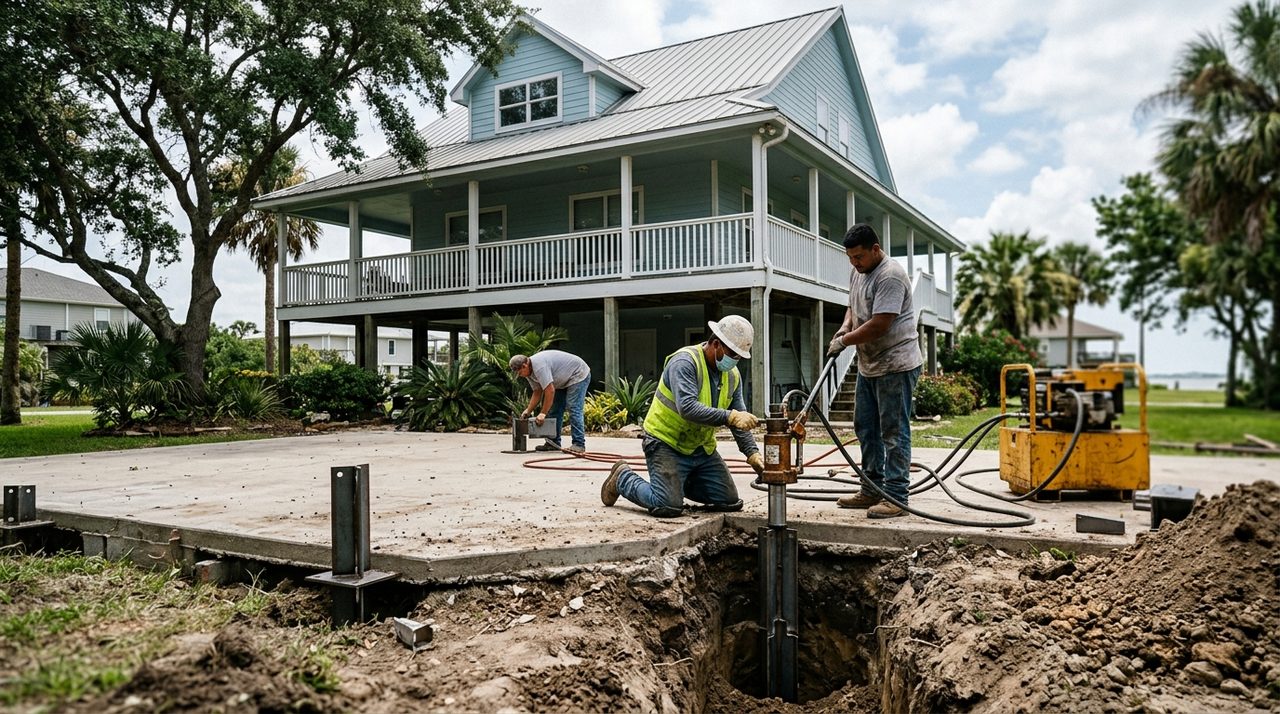
- Median home built
- 1983
- Median home value
- $217,100
- FEMA flood zone
- X (low)
- Typical cost (est.)
- $3,500–$25,000
- Most common local issue
- Expansive clay perimeter void formation on 1970s–1990s slabs during Gulf Coast dry cycles
Ranked by verified Google rating × review volume × verification tier. How we rank →
Some highly-rated pros serve La Porte from nearby and may not keep a La Porte street address. Those are listed under "Also serving La Porte" with their real city and distance, so you always know where each business is based.
Min rating:
10 resultsBased in La Porte
1606 S 16th St, La Porte, TX 77571
Also serving La Porte
Highly-rated pros based nearby who cover La Porte. Distance shown from the La Porte area.
Serving La Porte Based in Baytown · 4.4 mi away
Closed
Serving La Porte Based in Deer Park · 5.7 mi away
Closed
Serving La Porte Based in Deer Park · 6.6 mi away
Closed
Serving La Porte Based in Seabrook · 6.8 mi away
Closed
Serving La Porte Based in Seabrook · 6.9 mi away
Closed
Serving La Porte Based in Baytown · 7.1 mi away
Open Now
Serving La Porte Based in Seabrook · 7.2 mi away
Serving La Porte Based in Seabrook · 7.3 mi away
Foundation Repair in La Porte: What You Should Know
Gulf Coast Clay Shrink-Swell Cycles Stressing La Porte's 1970s–1990s Slabs
Why it matters to you
La Porte's post-1960 housing — the majority of the city, with a Census-reported median year built of 1983 — sits on Beaumont and Houston Black clay formations that swell with Gulf Coast rain and shrink during dry stretches. On typical La Porte lots with limited tree canopy in the 1980s–2000s suburban streets, the perimeter beam loses soil contact during drier La Niña seasons, leaving the slab edge unsupported. Homeowners in these neighborhoods often first notice sticking interior doors or diagonal drywall cracks at window corners — symptoms of differential movement, not a single dramatic event.
What a good pro does
A qualified foundation contractor evaluates the pattern of cracking to distinguish perimeter settlement (the most common La Porte presentation) from interior heave caused by plumbing leaks. If underpinning is warranted, steel push piers are the current industry standard for these slab-on-grade homes — typically 8–16 piers at an estimated $1,200–$1,800 each — driven to load-bearing soil below the active clay layer. The contractor must pull a permit through the City of La Porte Building and Permits Department before work begins; this is not a Houston permit or an unincorporated Harris County application.
Sources: Municipal permit office (see area profile), International Residential Code (as adopted by City of Houston)
Post-Uri Cast-Iron Under-Slab Drain Leaks in La Porte's Older Ranch Homes
Why it matters to you
La Porte's 1950s–1970s ranch homes near the historic core and bayfront areas were built with cast-iron under-slab drain lines that are now 50–70 years old. Winter Storm Uri (February 2021) caused widespread pipe fractures across the Houston metro, and many La Porte homeowners had visible interior damage repaired without anyone testing whether the under-slab lines themselves were compromised. A slow, ongoing drain leak saturates the clay directly beneath the slab, causing localized heave that looks nearly identical to drought-cycle settlement — and misdiagnosing the cause leads to pier installations that fail to fix the underlying problem.
What a good pro does
Before signing any foundation repair contract on a pre-1985 La Porte home, commission a hydrostatic plumbing test — a licensed plumber (licensed through TSBPE) pressurizes the drain system to identify leaks. This test typically costs an estimated $250–$400 and takes a few hours. If under-slab leaks are found, a TSBPE-licensed plumber must perform the repair; only after confirming pipe integrity should foundation underpinning or void fill proceed. Reputable La Porte foundation contractors will recommend this test proactively rather than skipping straight to pier proposals.
Sources: Texas State Board of Plumbing Examiners, Municipal permit office (see area profile)
Choosing the Right Repair Method When Pressed Pilings Already Exist
Why it matters to you
A meaningful share of La Porte's 1980s–1990s tract homes were repaired in the past using pressed concrete pilings — the dominant Houston-area method of that era, typically installed in sets of 10–30. Pressed pilings have a well-documented failure rate on expansive clay because they do not penetrate below the active soil layer. Homeowners in La Porte's older suburban streets (built out between roughly 1975 and 2000) who are seeing renewed cracking may already have pressed pilings that have themselves failed, meaning a second contractor is now proposing to add steel push piers to a slab that was already once 'repaired.' Getting three written proposals with explicit pier counts, depths, and load specifications is the only way to evaluate competing recommendations.
What a good pro does
A thorough pre-repair assessment should document any existing pilings and evaluate whether the current movement is occurring at previously repaired zones or at new perimeter locations. Steel push piers and helical piers both carry significantly higher load capacity than pressed concrete pilings on Houston-area clay and are the preferred method for La Porte's soil conditions. Helical piers (estimated $1,500–$2,200 each) are appropriate where push piers can't develop adequate resistance in the upper soil profile. All underpinning work requires a City of La Porte permit; ask to see the permit number before work starts and confirm inspection scheduling with the city directly.
Sources: Municipal permit office (see area profile), International Residential Code (as adopted by City of Houston)
HOA Approval and Resale Disclosure for Morgan's Landing and Other Planned Communities
Why it matters to you
Newer La Porte subdivisions — Morgan's Landing being the largest active master-planned community — have mandatory HOAs with architectural review committees that may require pre-approval before any visible exterior foundation work, including perimeter trenching or mudjacking equipment access. Separately, Texas TREC disclosure law requires sellers to disclose known foundation movement and completed repairs; undocumented or unpermitted repair work performed without a City of La Porte permit becomes a legal and financial liability when the home sells. La Porte's median home value of $217,100 (ACS 2023) means repair documentation directly affects resale negotiations.
What a good pro does
Homeowners in Morgan's Landing, Pelican Bay, or any La Porte subdivision with recorded deed restrictions should verify HOA architectural committee requirements before scheduling a foundation contractor — some committees require written approval of the scope and equipment access plan. Simultaneously, confirm that the contractor will pull a City of La Porte building permit so that the repair is on public record and can be disclosed accurately on the TREC seller's disclosure notice. Permit records through the city's Building and Permits Department serve as the official documentation chain a future buyer's inspector will look for.
Sources: Local HOA / deed restrictions (see area profile), Municipal permit office (see area profile)
Foundation Repair in La Porte: What You Should Know
Hiring foundation repair in La Porte? La Porte is an incorporated city along Galveston Bay with housing stock ranging from 1950s ranch homes to modern master-planned communities like Morgan's Landing. Homeowners face a mix of coastal humidity challenges, slab foundation maintenance, and subdivision-specific HOA requirements that vary widely across the city. Proximity to petrochemical facilities and the bay means exterior materials and HVAC systems require extra attention to corrosion and salt-air exposure.
- Housing era
- 1950s–1970s in older core neighborhoods
- Foundation
- Predominantly slab-on-grade for post-1960 construction
- Flood zone
- FEMA Zone X (low flood risk) per official NFHL data
- Permits
- City of La Porte Building and Permits Department (incorporated city with its own permitting…
Housing stock & systems
Building era
1950s–1970s in older core neighborhoods; 1980s–2000s suburban expansion; 2010s–present in master-planned communities like Morgan's Landing.
Typical style
Single-story ranch and bungalow styles in older areas; two-story brick-and-siding tract homes from the 1980s–2000s; contemporary Texas traditional brick/stone homes in newer planned communities.
Foundations
Predominantly slab-on-grade for post-1960 construction; some pier-and-beam in pre-1960 homes near the historic core and bayfront areas.
Common systems
Central AC is universal; older homes (1950s–1970s) may have original copper or galvanized plumbing and outdated electrical panels requiring upgrades; newer subdivisions use PEX plumbing and modern 200-amp electrical service.
What that means for repairs
Older ranch homes near the historic core frequently undergo kitchen and bathroom remodels, plumbing re-pipes from galvanized to PEX, and electrical panel upgrades. Exterior hardening against coastal humidity and storm damage is common across all eras. Newer homes in Morgan's Landing and similar communities see relatively little renovation but may need cosmetic updates and landscaping work.
Permits & restrictions
Permit jurisdiction
City of La Porte Building and Permits Department (incorporated city with its own permitting authority).
HOA & deed restrictions
No city-wide HOA. Individual subdivisions vary: Morgan's Landing has a mandatory HOA with assessments, deed restriction enforcement, and community amenities. Pelican Bay also has a mandatory HOA. Older central La Porte neighborhoods may have recorded deed restrictions but no active HOA or only a voluntary civic association. Property-specific verification through the deed and Harris County Clerk records is necessary.
Historic districts
No City of Houston historic district designation confirmed. La Porte is a separate incorporated city and is not subject to HAHC oversight.
Contractor note
Contractors must pull permits through the City of La Porte, not Harris County or Houston. Subdivision-specific HOA architectural review committees (e.g., Morgan's Landing) may require pre-approval for exterior modifications, fencing, and roofing material changes before work begins.
Flood & weather
FEMA flood zone
FEMA Zone X (low flood risk) per official NFHL data. However, La Porte is bay-adjacent and low-lying; individual parcels closer to Galveston Bay, Taylor Bayou, or drainage channels may carry higher flood designations. Property-specific FEMA panel review is recommended.
Hurricane Harvey impact
La Porte experienced flooding during Hurricane Harvey (2017), particularly in low-lying areas near the bay and along drainage channels. Specific street-level flood data for individual La Porte subdivisions was not confirmed in available research; homeowners should consult Harris County Flood Control District records and the city's post-Harvey damage assessments for parcel-level detail. Bay-adjacent properties and older neighborhoods with inadequate drainage infrastructure were generally more affected.
Heat & humidity load
Extreme heat and humidity combined with salt-air proximity to Galveston Bay accelerate exterior paint failure, metal corrosion on HVAC condensers and fasteners, and mold growth in poorly ventilated attics and crawlspaces. HVAC systems run near-continuously from May through October, making seasonal maintenance and refrigerant checks critical. Pier-and-beam homes in older areas are particularly susceptible to moisture-related subfloor and joist deterioration.
Working with contractors here
Contractors in La Porte most commonly handle HVAC maintenance and replacement, re-roofing after storm damage, plumbing re-pipes in 1950s–1970s homes, and foundation repair on slab-on-grade structures affected by expansive Gulf Coast clay soils. Coastal humidity and salt-air exposure drive significant exterior painting, siding repair, and metal corrosion remediation work. In newer communities like Morgan's Landing, work tends toward warranty-era cosmetic items, fence installation, and landscape hardscaping, but HOA architectural committee approval is typically required before starting. For older La Porte homes, electrical panel upgrades from outdated fuse boxes to modern breaker panels are a frequent scope item. Contractors should confirm La Porte city permit requirements early in the bidding process, as turnaround times and inspection schedules differ from Houston and unincorporated Harris County.
Local Tip
Always ask for a written estimate before work begins. Texas contractors are required to provide one on jobs over $1,000.
About La Porte
La Porte is an incorporated city along Galveston Bay with housing stock ranging from 1950s ranch homes to modern master-planned communities like Morgan's Landing. Homeowners face a mix of coastal humidity challenges, slab foundation maintenance, and subdivision-specific HOA requirements that vary widely across the city. Proximity to petrochemical facilities and the bay means exterior materials and HVAC systems require extra attention to corrosion and salt-air exposure.
- Median year built
- 1983
- Median home value
- $217,100
- Owner-occupied
- 72.1%
- Population
- 36,077
- Housing units
- 13,737
- Median income
- $81,801
Source: U.S. Census Bureau, ACS 5-Year 2023
Flood & storm risk
FEMA Zone XLow flood riskMost of La Porte maps to FEMA Zone X (low mapped flood risk), but Houston's flash-flood reality means even low-risk blocks benefit from smart drainage and storm-hardened installs; risk climbs sharply on blocks nearest Galveston Bay, where it varies parcel to parcel.
Source: FEMA National Flood Hazard Layer (NFHL). Flood zones vary by parcel — verify your individual FIRM panel.
Houston Storm Readiness in La Porte
Hurricane & flooding
Beryl 2024 reminded Houston homeowners that even neighborhoods with low FEMA flood designations experience localized ponding when storm-sewer inlets back up, and that standing water against a foundation for even 12 hours can trigger clay heave in La Porte, TX. Before the season, confirm your gutters discharge at least five feet from the foundation and that splash blocks direct water toward the street, keeping clay moisture content consistent beneath the slab. As a Harris County community, La Porte may follow county rather than City of Houston storm rebuild rules.
Severe storms & hail
Hail itself does not crack a concrete foundation, but the insurance repair process — contractors dropping equipment, vibrating compactors near the structure — can disturb marginally stable piers in La Porte, TX. Coordinate a brief foundation check with a TDLR-licensed contractor before and after any major roof or exterior repair project that involves heavy equipment operating near your home. As a Harris County community, La Porte may follow county rather than City of Houston storm rebuild rules.
Ice storms & freezes
In La Porte, TX, where mapped flood risk is low, the primary post-freeze foundation threat is not surface water but slab-leak-driven soil saturation — Uri 2021 caused widespread pipe failures that fed water silently under slabs for days before homeowners noticed. After any hard freeze, have a plumber pressure-test your lines first, then schedule a foundation elevation check if any under-slab leak is confirmed. With a median build year of 1983, the older building stock here is more exposed to hard-freeze damage than newer construction. Confirm the current FEMA panel for your La Porte parcel — the area maps to Zone X, but adjacent lots can differ.
Sources: FEMA National Flood Hazard Layer (NFHL), Ready.gov -- Hurricanes, CenterPoint Energy -- Storm Center, City of Houston -- Emergency Preparedness, Ready.gov -- Winter Weather, Harris County Flood Control District
Free La Porte Tools & Calculators
Houston-specific estimators to plan your project before you call a pro. All results are planning estimates — a licensed local pro confirms the details on site.
Houston Soil & Tree Proximity Risk Calculator
Open full tool & FAQ →Grouped by mature root aggression & water demand.
Trunk center to the nearest exterior wall.
Moderate risk
The root zone likely reaches your foundation's soil during Houston's dry summers, when clay shrinks most. Watch for sticking doors and diagonal cracks, keep soil moisture even with a soaker hose during drought, and have a foundation pro evaluate if you see any movement.
Find a Houston foundation pro →This is a planning estimate only — actual requirements depend on an on-site assessment by a licensed Houston pro. Guidance is based on general species root behavior in expansive clay, not a soil test.
Houston Freeze Prep & Pipe Insulation Checklist
Open full tool & FAQ →Your freeze checklist — 4 tasks
- 1
Disconnect & drain every outdoor hose bib
Remove hoses, drain the spigots, and cover each with an insulated faucet sock. Un-drained hose bibs are the #1 burst point in a Houston freeze.
- 2
Insulate exposed pipes in the attic & garage
Wrap any pipe in an unconditioned space (attic runs, garage walls) with foam sleeves. Houston homes rarely insulate these because they only matter a few nights a year — which is exactly why they burst.
- 3
Open cabinet doors & keep a pencil-width drip
On hard-freeze nights, open kitchen/bath cabinets so warm air reaches the pipes and let faucets on exterior walls drip to relieve pressure.
- 4
Protect the attic/garage water heater & its lines
An attic or garage tank sits in unconditioned space. Insulate the cold-inlet and hot-outlet lines and confirm the emergency drain pan is clear so a leak doesn't reach the ceiling.
This is a planning estimate only — actual requirements depend on an on-site assessment by a licensed Houston pro. If a pipe has already burst, shut off your main water supply and call a licensed Houston plumber immediately — freeze bursts flood fast.
Frequently Asked Questions
Do I need a permit from the City of La Porte for foundation repair, or can the contractor just do the work?
For underpinning work such as steel push piers or helical piers, you will need a permit from the City of La Porte Building and Permits Department — not Harris County, not the City of Houston. La Porte operates its own permit office with its own inspection schedule, so contractors who routinely pull permits in Houston or unincorporated Harris County will need to confirm La Porte's specific submittal requirements and inspection timing before starting work. Ask your contractor to show you the actual permit number once it is issued; unpermitted foundation work can create liability when you sell.
Sources: Municipal permit office (see area profile)
My La Porte home was built in the late 1950s and has a pier-and-beam foundation near the bayfront. Do foundation repair companies here handle that differently than a standard slab?
Yes — pre-1960 homes near La Porte's historic core and bayfront areas are among the minority in Harris County with pier-and-beam construction, and the repair approach is fundamentally different from the slab-on-grade underpinning that dominates most La Porte work. Pier-and-beam homes have a crawl space, so contractors can access beams, shims, and wood piers directly; the main concerns are wood rot from the area's coastal humidity, settling due to Gulf Coast clay movement, and corrosion on any metal hardware from salt-air exposure. When getting quotes, confirm the contractor has specific pier-and-beam experience, not just the slab pier underpinning background common for the area's 1980s–2000s tract home stock.
La Porte is listed as FEMA Zone X, so am I really at risk of flood-related foundation settlement?
FEMA Zone X means the mapped flood risk is low, but that designation reflects long-term inundation risk, not the short-duration flash flooding and soil saturation that Gulf Coast storms routinely deliver to La Porte's clay soils. Events like Hurricane Harvey and Hurricane Beryl produced prolonged soil saturation that weakened bearing capacity even on parcels that never took on interior water, and blocks nearest Galveston Bay can vary significantly from the broad Zone X designation. The practical takeaway is that even if your home is Zone X and you skipped flood insurance, post-storm foundation monitoring still makes sense — watch for new door-frame binding or diagonal drywall cracks appearing two to six weeks after a major rain event.
What time of year is foundation movement most noticeable in La Porte, and is there a better or worse time to schedule repairs?
In La Porte and the broader Gulf Coast clay zone, the most visible foundation movement typically happens in late summer through early fall, when the prolonged dry season hits its peak and clay soils have shrunk their maximum amount — creating perimeter voids and causing the most obvious door-sticking and diagonal crack patterns. A second round of movement can appear in late winter after extended wet spells cause the soil to re-expand unevenly. Most foundation contractors can work year-round, but scheduling an inspection in late summer lets the contractor see the slab at its worst differential position; scheduling in early spring after heavy rains may mask how significant the void formation actually is during dry cycles.
If I need both foundation repair and under-slab plumbing work in my 1970s La Porte ranch home, can the same contractor handle everything?
Not legally, for the plumbing portion. Texas requires that any under-slab plumbing work — including the hydrostatic pressure test to detect leaks, and any pipe repairs or re-routing found underneath — be performed or directly overseen by a licensed plumber credentialed through the Texas State Board of Plumbing Examiners. Foundation repair contractors are not separately licensed by TDLR for structural foundation work, but they cannot legally do the plumbing scope themselves. The practical approach for a 1970s La Porte ranch home is to have the hydrostatic test (estimated $250–$400) completed first by a licensed plumber, share those results with your foundation contractor, and then sequence the repairs so no new piers are placed over a line that will need to be dug up and fixed.
Sources: Texas State Board of Plumbing ExaminersTexas Department of Licensing & Regulation
I'm selling my La Porte home and had pier work done three years ago. What do I have to disclose, and does the Morgan's Landing HOA factor in at all?
Texas law requires sellers to disclose known foundation movement and any prior repairs on the TREC Seller's Disclosure Notice — omitting documented pier work when you are aware of it creates legal exposure that can surface after closing. If your home is in Morgan's Landing or another La Porte subdivision with a mandatory HOA, you should also confirm that the original repair received any required architectural committee approval; an HOA that finds unpermitted exterior trenching or underpinning work from a prior owner can create a title complication. Keep your City of La Porte permit documentation and any warranty paperwork from the foundation contractor organized in your closing file — buyers' inspectors in the Harris County market routinely call the permit office to verify pull history.
Sources: Municipal permit office (see area profile)Local HOA / deed restrictions (see area profile)