8522 Coolidge St, Houston, TX 77012
Best Foundation Repair in Galena Park, TX
Galena Park's mid-century bungalows and ranch homes — most built between 1940 and 1965 for ship channel workers — sit on Houston Black clay and carry a median build year of 1956, meaning many foundations predate modern pier design standards and harbor decades of soil movement history. The city sits inside FEMA Zone X500, placing it outside the 100-year floodplain but squarely within the 500-year boundary, so prolonged rain events from storms like Harvey (2017) and Beryl (2024) still drive soil saturation cycles that stress older foundations. Because Galena Park is its own incorporated city, all foundation repair permits go through the City of Galena Park's permit office — not the City of Houston Permitting Center — a detail that catches many regional contractors off guard and can leave homeowners holding unpermitted work.
Verified against Google Business data
Updated 2026
See the 10 Foundation Repair Serving Galena Park 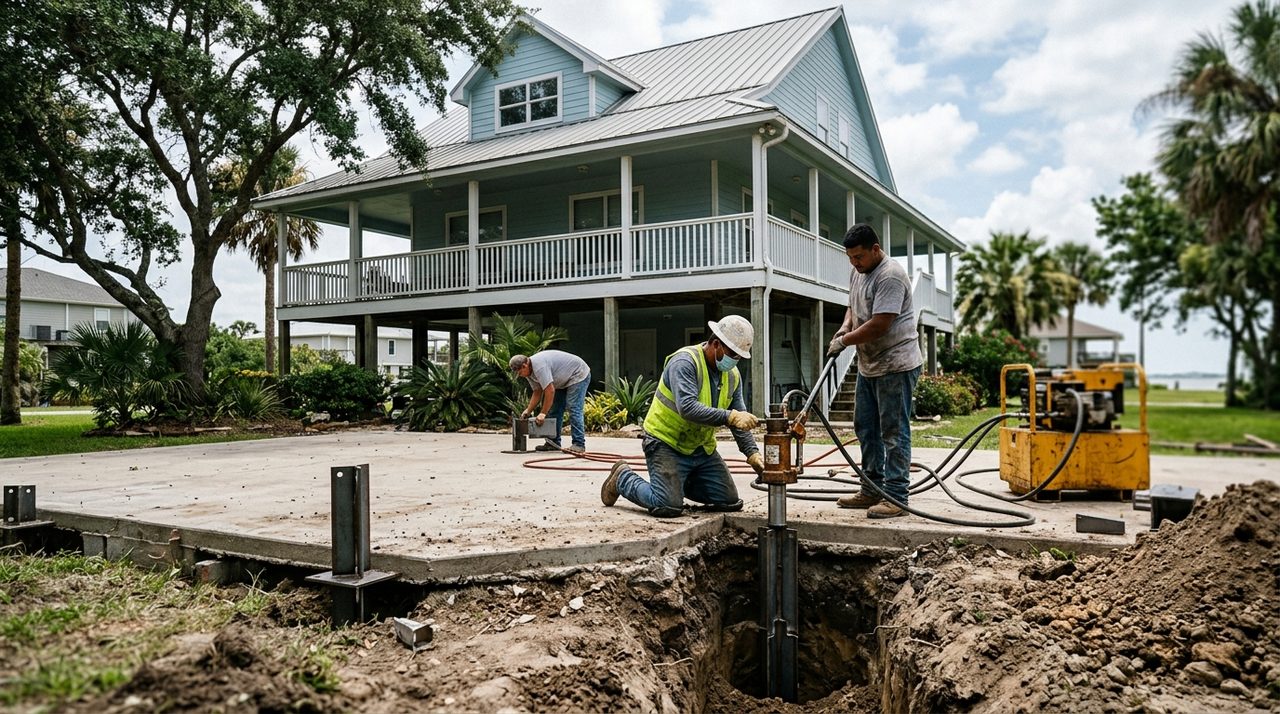
- Median home built
- 1956
- Median home value
- $116,400
- FEMA flood zone
- X500 (moderate)
- Typical foundation repair cost (est.)
- $3,500–$25,000 depending on method and scope
- Most common local issue
- Pier-and-beam leveling on 1940s–1950s bungalows with decayed wood piers
Ranked by verified Google rating × review volume × verification tier. How we rank →
Some highly-rated pros serve Galena Park from nearby and may not keep a Galena Park street address. Those are listed under "Also serving Galena Park" with their real city and distance, so you always know where each business is based.
Min rating:
10 resultsBased in Galena Park
14900 Market St, Houston, TX 77015
Also serving Galena Park
Highly-rated pros based nearby who cover Galena Park. Distance shown from the Galena Park area.
Closed
Serving Galena Park Based in Pasadena · 2.6 mi away
Closed
Serving Galena Park Based in Pasadena · 2.6 mi away
Closed
Serving Galena Park Based in Pasadena · 3.3 mi away
Serving Galena Park Based in EaDo · 3.6 mi away
Open Now
Serving Galena Park Based in Pasadena · 3.7 mi away
Closed
Serving Galena Park Based in Pasadena · 3.9 mi away
Serving Galena Park Based in Pasadena · 4.1 mi away
Foundation Repair in Galena Park: What You Should Know
Decayed Wood Piers Under 1940s–1950s Pier-and-Beam Bungalows
Why it matters to you
A meaningful share of Galena Park's oldest homes — those built in the 1940s and early 1950s for ship channel workers — rest on pier-and-beam foundations rather than slabs. Original wood piers and sill beams in these homes are now 65 to 80 years old. Houston's humidity, periodic groundwater fluctuations near Buffalo Bayou, and the clay soil's tendency to hold moisture against wood members accelerate rot and insect damage, causing floors to sag and interior doors to rack. Because the median home value in Galena Park is approximately $116,400 (ACS 2023), homeowners face repair costs that can represent a substantial fraction of the property's market value.
What a good pro does
A qualified contractor should perform a full crawl-space inspection using a moisture meter and probe to document every pier condition before quoting — not just a visual walk-around. Failing wood piers are replaced with concrete or steel adjustable piers; the crawl space should also be assessed for vapor barrier condition and cross-ventilation. Any associated structural work requires a permit through the City of Galena Park permit office, and homeowners should confirm the contractor is familiar with Galena Park's inspection scheduling process, which differs from Houston's Development Services workflow.
Sources: Municipal permit office (see area profile), International Residential Code (as adopted by City of Houston)
Post-Uri Under-Slab Pipe Leaks Compounding Settlement in 1960s Slab Homes
Why it matters to you
Galena Park's slab-on-grade homes dating from the 1960s were typically plumbed with cast-iron drain lines run beneath the slab. Winter Storm Uri (February 2021) froze and fractured many of these lines across the Houston metro; in Galena Park, where deferred maintenance is common given the aging housing stock, numerous repairs addressed only the visible interior damage while leaving cracked under-slab lines intact. A slow ongoing leak saturates the clay directly under the beam, first causing localized heave and then settlement as the soil structure deteriorates — symptoms that can be misread as purely soil-driven movement.
What a good pro does
Before signing any foundation repair contract on a 1960s or earlier slab home in Galena Park, insist on a hydrostatic plumbing test (estimated $250–$400) to pressure-check under-slab drain lines. If a leak is confirmed, a plumber licensed through the Texas State Board of Plumbing Examiners must perform or oversee the pipe repair before any pier work proceeds — sequencing matters because re-saturating freshly stabilized soil will undo the repair. The plumbing scope requires its own permit through the City of Galena Park, separate from the foundation permit.
Sources: Texas State Board of Plumbing Examiners, Municipal permit office (see area profile)
Expansive Clay Differential Movement on Slab Perimeters Aggravated by Zone X500 Rain Events
Why it matters to you
Even though Galena Park's FEMA Zone X500 designation means most parcels sit outside the 100-year floodplain, heavy Gulf rainfall events — Beryl's 2024 deluge being the most recent — still deliver enough surface water to produce rapid wet-dry swings in Houston Black clay. These swings swell one side of a slab while the opposite perimeter, shaded by a structure or lacking irrigation, stays drier and lower, producing the diagonal stair-step cracks in brick veneer and the jammed interior doors that Galena Park homeowners frequently chalk up to the house simply being old. The pattern tends to repeat seasonally rather than resolve on its own.
What a good pro does
A foundation contractor working a Galena Park slab should document crack patterns across multiple visits to distinguish active differential movement from historic settled cracking before recommending pier underpinning. For active perimeter movement driven by moisture imbalance, a controlled soaker-hose program along the drier foundation edges — run during dry stretches — is often the first intervention. Where underpinning is warranted, steel push piers (estimated $1,200–$1,800 per pier, 8–16 piers typical) reach deeper stable soil than pressed concrete pilings and are the current industry preference for expansive-clay slabs. The permit application goes to the City of Galena Park, not Harris County or Houston.
Sources: FEMA National Flood Hazard Layer (NFHL), Harris County Flood Control District, Municipal permit office (see area profile)
Navigating the City of Galena Park Permit Office for Foundation Work
Why it matters to you
Galena Park is an independent incorporated city, and its permit office operates separately from the City of Houston Permitting Center and from unincorporated Harris County. Regional foundation contractors who regularly pull permits in Houston or Sugar Land may be unfamiliar with Galena Park's specific application forms, inspection scheduling procedures, and code-enforcement contacts. Homeowners who allow a contractor to begin work without a permit — or who hire a contractor who pulls the wrong jurisdiction's permit — can face stop-work orders and disclosure complications at resale, a real concern given that approximately 70 percent of Galena Park homes are owner-occupied (ACS 2023) and long-term equity matters to this community.
What a good pro does
Before work begins, ask your contractor to show you the actual Galena Park permit application and confirm they have pulled permits in the city previously — not just in Houston proper. Texas has no standalone state license for foundation repair contractors (TDLR does not separately credential this trade for residential work), so the permit and inspection process through the City of Galena Park is the primary quality check available to homeowners. Verify permit status directly with the City of Galena Park's permit office rather than relying solely on the contractor's confirmation.
Sources: Municipal permit office (see area profile), Texas Department of Licensing & Regulation
Foundation Repair in Galena Park: What You Should Know
Hiring foundation repair in Galena Park? Galena Park is an incorporated city in Harris County with aging mid-century housing stock built primarily for ship channel workers. Homeowners here contend with older plumbing, mixed foundation types, and proximity to Buffalo Bayou and industrial infrastructure. Permits go through the City of Galena Park rather than Houston, and HOA presence varies by subdivision.
- Housing era
- 1940s–1960s, with scattered later infill
- Foundation
- Mixed — pier-and-beam common in 1940s–1950s builds, slab-on-grade more common from 1960s onward
- Flood zone
- FEMA Zone X500 (moderate flood risk) — source
- Permits
- City of Galena Park permit office (independent incorporated city — not City of Houston…
Housing stock & systems
Building era
1940s–1960s, with scattered later infill.
Typical style
Small one-story bungalows, ranch-style homes, and cottages on traditional street grids with modest lot sizes.
Foundations
Mixed — pier-and-beam common in 1940s–1950s builds, slab-on-grade more common from 1960s onward. Precise split not publicly documented; verify on individual parcels.
Common systems
Older galvanized or cast-iron plumbing in pre-1960s homes; window units or aging central HVAC retrofits; original 60–100 amp electrical panels in many older homes, often needing upgrades to modern 200 amp service.
What that means for repairs
Plumbing replacements (galvanized-to-PEX or copper), electrical panel upgrades, and foundation leveling on pier-and-beam homes are the most common renovation drivers. Many homes are candidates for full gut renovations given age and modest original construction quality.
Permits & restrictions
Permit jurisdiction
City of Galena Park permit office (independent incorporated city — not City of Houston Permitting Center). Harris County may have jurisdiction over floodplain and certain regional permits.
HOA & deed restrictions
No single mandatory master HOA covers all of Galena Park. HOA presence is subdivision-by-subdivision. Galena Oaks Property Owners Association serves that specific subdivision; other areas such as the Woodland subdivision have no mandatory HOA. City code enforcement handles property maintenance standards citywide.
Historic districts
No City of Houston historic district designation — Galena Park is a separate incorporated city. No local historic district designation confirmed.
Contractor note
Contractors must permit through the City of Galena Park, not Houston. Familiarity with Galena Park's code of ordinances and inspection processes is essential, as procedures differ from both Houston and unincorporated Harris County.
Flood & weather
FEMA flood zone
FEMA Zone X500 (moderate flood risk) — source: fema_nfhl. Galena Park sits north of the Houston Ship Channel along Buffalo Bayou, with low-lying and drainage-adjacent parcels carrying higher localized risk. Property-level flood zone verification is recommended.
Hurricane Harvey impact
Harvey brought extreme rainfall across east Harris County, and low-lying or drainage-adjacent properties in and around Galena Park experienced flooding. However, specific citable evidence of widespread or unique devastation in Galena Park's residential neighborhoods compared to other east-side areas was not located. Scattered flood claims exist near bayou and drainage ditch areas. Individual property flood-loss history should be checked through FEMA and Harris County Flood Control District records.
Heat & humidity load
Older homes with original insulation and aging HVAC systems face extreme cooling loads during Houston summers. Pier-and-beam crawl spaces can trap moisture, promoting mold and pest issues. Galvanized plumbing in pre-1960s homes is vulnerable to corrosion accelerated by heat and humidity.
Working with contractors here
Contractors in Galena Park most commonly handle foundation leveling on pier-and-beam homes, full plumbing re-pipes replacing galvanized lines, and electrical panel upgrades from outdated 60-amp service. The aging 1940s–1960s housing stock means whole-house renovation and weatherization projects are frequent, often including HVAC replacement with modern central systems. Proximity to industrial facilities and Buffalo Bayou means drainage improvements and moisture mitigation are recurring job scopes. Contractors should note that Galena Park is its own incorporated city with a separate permitting process, and job scoping should account for the possibility of encountering original mid-century materials including lead paint and outdated wiring.
Local Tip
Always ask for a written estimate before work begins. Texas contractors are required to provide one on jobs over $1,000.
About Galena Park
Galena Park is an incorporated city in Harris County with aging mid-century housing stock built primarily for ship channel workers. Homeowners here contend with older plumbing, mixed foundation types, and proximity to Buffalo Bayou and industrial infrastructure. Permits go through the City of Galena Park rather than Houston, and HOA presence varies by subdivision.
- Median year built
- 1956
- Median home value
- $116,400
- Owner-occupied
- 70.1%
- Population
- 10,527
- Housing units
- 3,292
- Median income
- $54,167
Source: U.S. Census Bureau, ACS 5-Year 2023
Flood & storm risk
FEMA Zone X500Moderate flood riskGalena Park carries FEMA Zone X500 (moderate flood risk): outside the 100-year floodplain but inside the 500-year, so heavy-rain events still reach homes and flood-aware work pays off.
Source: FEMA National Flood Hazard Layer (NFHL). Flood zones vary by parcel — verify your individual FIRM panel.
Houston Storm Readiness in Galena Park
Hurricane & flooding
Confirm that your foundation's exterior grade has not eroded over the past year, because even moderate inundation in Galena Park, TX accelerates clay shrink-swell cycles that loosen interior piers from their bell-bottom footings. A licensed foundation repair specialist can re-grout or re-drive piers that have lost contact with stable soil before a tropical system turns residual soft spots into visible floor slopes. Much of the housing stock predates modern wind codes (median build year 1956), so retrofits matter more here. Confirm the current FEMA panel for your Galena Park parcel — the area maps to Zone X500, but adjacent lots can differ.
Severe storms & hail
The May 2024 derecho generated pressure differentials across Houston structures that cracked brick veneer at foundation-to-wall transitions in neighborhoods far outside the 100-year floodplain. If you see new step cracks in your brick or fresh separation at the base of your exterior wall in Galena Park, TX, have a TDLR-licensed foundation repair professional evaluate whether the crack originated in the wall or in foundation movement before waterproofing or tuckpointing the brick. As a Harris County community, Galena Park may follow county rather than City of Houston storm rebuild rules.
Ice storms & freezes
Hard-freeze conditions do not require flooding to affect foundations in Galena Park, TX — even moderate soil moisture combined with multi-day sub-freezing temperatures causes near-surface clay to expand slightly, then settle differentially on thaw. Ask your TDLR-licensed foundation repair specialist whether your current pier configuration includes enough piers at exterior corners, which are the first areas to show freeze-thaw movement on Houston slab homes. With a median build year of 1956, the older building stock here is more exposed to hard-freeze damage than newer construction. Confirm the current FEMA panel for your Galena Park parcel — the area maps to Zone X500, but adjacent lots can differ.
Sources: FEMA National Flood Hazard Layer (NFHL), Ready.gov -- Hurricanes, CenterPoint Energy -- Storm Center, City of Houston -- Emergency Preparedness, Ready.gov -- Winter Weather, Harris County Flood Control District
Free Galena Park Tools & Calculators
Houston-specific estimators to plan your project before you call a pro. All results are planning estimates — a licensed local pro confirms the details on site.
Houston Soil & Tree Proximity Risk Calculator
Open full tool & FAQ →Grouped by mature root aggression & water demand.
Trunk center to the nearest exterior wall.
Moderate risk
The root zone likely reaches your foundation's soil during Houston's dry summers, when clay shrinks most. Watch for sticking doors and diagonal cracks, keep soil moisture even with a soaker hose during drought, and have a foundation pro evaluate if you see any movement.
Find a Houston foundation pro →This is a planning estimate only — actual requirements depend on an on-site assessment by a licensed Houston pro. Guidance is based on general species root behavior in expansive clay, not a soil test.
Houston Freeze Prep & Pipe Insulation Checklist
Open full tool & FAQ →Your freeze checklist — 4 tasks
- 1
Disconnect & drain every outdoor hose bib
Remove hoses, drain the spigots, and cover each with an insulated faucet sock. Un-drained hose bibs are the #1 burst point in a Houston freeze.
- 2
Insulate exposed pipes in the attic & garage
Wrap any pipe in an unconditioned space (attic runs, garage walls) with foam sleeves. Houston homes rarely insulate these because they only matter a few nights a year — which is exactly why they burst.
- 3
Open cabinet doors & keep a pencil-width drip
On hard-freeze nights, open kitchen/bath cabinets so warm air reaches the pipes and let faucets on exterior walls drip to relieve pressure.
- 4
Protect the attic/garage water heater & its lines
An attic or garage tank sits in unconditioned space. Insulate the cold-inlet and hot-outlet lines and confirm the emergency drain pan is clear so a leak doesn't reach the ceiling.
This is a planning estimate only — actual requirements depend on an on-site assessment by a licensed Houston pro. If a pipe has already burst, shut off your main water supply and call a licensed Houston plumber immediately — freeze bursts flood fast.
Frequently Asked Questions
Does the City of Galena Park require a permit for pier-and-beam leveling, and who issues it?
Yes, foundation repair work in Galena Park goes through the City of Galena Park's own permit office — not the City of Houston Permitting Center, and not unincorporated Harris County. Contractors who routinely work Houston proper may be unfamiliar with Galena Park's inspection scheduling and code of ordinances, so confirm your contractor has actually pulled permits in Galena Park before, not just in the surrounding metro. Unpermitted foundation work can surface as a liability on a resale inspection and may require costly re-inspection or remediation.
Sources: Municipal permit office (see area profile)
My Galena Park home was built in 1952 and still has the original wood piers — are steel or concrete replacement piers always better, or can wood piers be repaired?
Seventy-year-old wood piers in a humid, near-bayou environment like Galena Park are frequently rotted at or just below grade, and spot-replacement with new wood is typically a short-term fix that repeats the same moisture exposure problem. Most foundation contractors leveling 1940s–1950s pier-and-beam homes here convert to adjustable steel piers or concrete block-and-shim systems, which are more durable in high-humidity conditions and easier to re-level if the clay shifts again. Ask any contractor for a written scope that specifies the pier material, spacing, and what is being done with deteriorated sill beams, since beam rot often accompanies bad piers in homes this age.
How does Galena Park's FEMA Zone X500 flood status actually affect foundation repair — do I need anything special for flood zone compliance?
Zone X500 means your property is outside the 100-year floodplain but inside the 500-year boundary, so FEMA does not require an elevation certificate or flood-zone-specific structural upgrades as a condition of repair the way AE-zone properties do. However, the saturation cycles that come with being inside the 500-year boundary — heavy rains from events like Harvey and Beryl still reached many Galena Park blocks — mean a foundation contractor should assess drainage and grading around the perimeter as part of any repair scope, not just the piers or slab. If your lender requires updated flood documentation at refinance after a repair, check with Harris County and your insurer rather than assuming X500 status eliminates all documentation requirements.
Sources: FEMA National Flood Hazard Layer (NFHL)Harris County Flood Control District
Is there an HOA in Galena Park that has to approve foundation work before I start?
Galena Park does not have a single mandatory master HOA covering the whole city — HOA presence depends entirely on your specific subdivision. Galena Oaks Property Owners Association covers that subdivision, while many other Galena Park streets such as the Woodland area have no HOA at all. If you are in a subdivision with an active HOA, check its governing documents before any contractor trenches around your perimeter or does visible exterior work, since some require architectural approval even for structural repairs. City code enforcement handles property maintenance standards citywide regardless of HOA status.
Sources: Local HOA / deed restrictions (see area profile)
Before signing a foundation repair contract in Galena Park, should I get a hydrostatic plumbing test first — and what does that cost?
Yes, especially in Galena Park's pre-1960s slab homes, which frequently have original cast-iron under-slab drain lines that were stressed by Winter Storm Uri in 2021. A slow leak from a cracked drain line can saturate the clay directly under the slab, mimicking or worsening soil-movement settlement, and fixing the foundation without finding the leak means the problem recurs. A hydrostatic plumbing test typically runs an estimated $250–$400 and must be performed or overseen by a plumber licensed through the Texas State Board of Plumbing Examiners. Insist any foundation contractor include this recommendation in writing before attributing all movement to soil conditions.
What time of year is worst for foundation movement in Galena Park, and when should I schedule an inspection?
In Galena Park's Houston Black clay environment, the highest-risk period for differential movement is late summer through early fall — after the long dry stretch from June through September bakes and shrinks the clay, then the first heavy rains of fall rush in unevenly. That seasonal transition often triggers the most visible cracking in door frames and brick veneer in homes dating from the 1940s and 1950s. The best time to schedule a professional inspection is early spring, when soil moisture is more uniform and a contractor can assess the foundation closer to its most stable baseline, giving you a cleaner read on actual settlement versus seasonal movement. If you wait until cracks appear in August, you may be reacting to a symptom rather than diagnosing the underlying pattern.