Closed
Serving Galleria Based in Tanglewood · 1.4 mi away
Foundation repair in the Galleria looks nothing like a typical Houston slab job: the area's housing stock splits sharply between engineered deep pier/caisson high-rises built from the 1980s onward and a dwindling supply of 1960s–1970s slab-on-grade ranch homes and 2000s-era townhome clusters sitting directly on Houston Black clay. Knowing which category your property falls into — and which permit, HOA, or condo association governs any repair — is the first real decision here, because the answers are completely different for a unit owner on the 14th floor versus a homeowner in an older Westheimer-corridor single-family pocket. This page breaks down the specific foundation challenges that actually affect Galleria properties and tells you what to ask before signing anything.
Ranked by verified Google rating × review volume × verification tier. How we rank →
Some highly-rated pros serve Galleria from nearby and may not keep a Galleria street address. Those are listed under "Also serving Galleria" with their real city and distance, so you always know where each business is based.
Highly-rated pros based nearby who cover Galleria. Distance shown from the Galleria area.
Serving Galleria Based in Tanglewood · 1.4 mi away
Serving Galleria Based in Bellaire · 1.4 mi away
Serving Galleria Based in Bellaire · 1.7 mi away
Serving Galleria Based in Tanglewood · 2 mi away
Serving Galleria Based in Bellaire · 2.4 mi away
Serving Galleria Based in Upper Kirby · 2.6 mi away
Serving Galleria Based in Bellaire · 2.6 mi away
Serving Galleria Based in Upper Kirby · 3.1 mi away
Serving Galleria Based in Lazybrook / Timbergrove · 3.5 mi away
Serving Galleria Based in Lazybrook / Timbergrove · 3.7 mi away
Why it matters to you
The 1960s–1970s ranch-style homes and early 2000s townhome clusters scattered through the Galleria corridor sit on slab-on-grade foundations bearing directly on Houston Black clay — among the most expansive soils in North America. With a Census median year built of 2003 and a significant slice of the stock predating 1990, many of these slabs have already experienced multiple wet/dry cycles that produce the characteristic stair-step brick cracks and out-of-square door frames. Because renovation activity in the Galleria is intense (aging 1980s–1990s finishes driving constant remodels), surface cosmetic updates frequently mask progressive differential movement that has never been addressed structurally.
What a good pro does
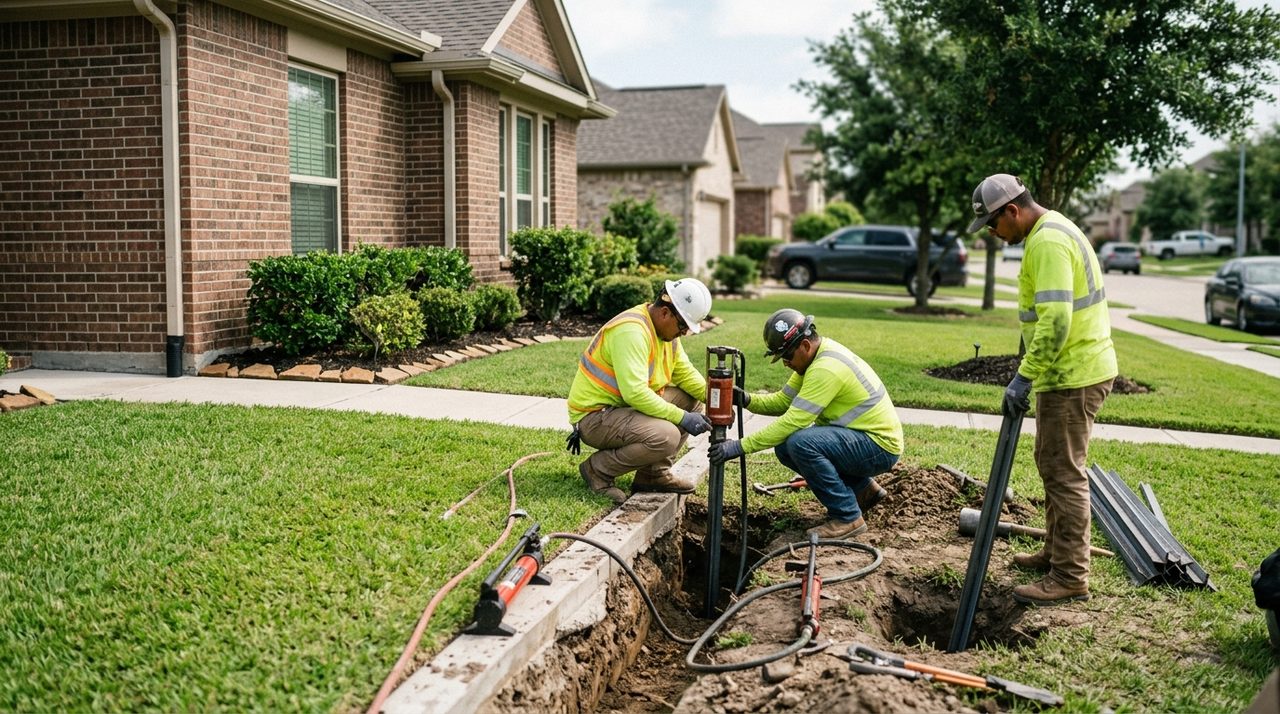
A qualified foundation contractor should document movement with a floor-elevation survey — not just a visual walk-through — before proposing any repair. For typical Galleria slab-on-grade homes in the 1,800–2,400 sq ft range, steel push pier underpinning (estimated $1,200–$1,800 per pier, 8–16 piers typical) or pressed concrete pilings are the most common options; the right choice depends on depth to load-bearing soil, not contractor preference alone. Any repair requiring underpinning work in the City of Houston requires a permit through the Houston Permitting Center — homeowners should confirm permit status in writing before work begins.
Sources: City of Houston Permitting Center, Municipal permit office (see area profile)
Why it matters to you
High-rises built in the Galleria from the 1980s onward use engineered deep pier and caisson systems tied to podium slabs — the building's structural engineer of record, not a residential foundation contractor, is the right first call if you notice cracking in your unit. The complication is that the Galleria has no single HOA: every tower and townhome community operates under its own recorded condo declaration and association rules, each with independent architectural review, insurance minimums, and work-hour restrictions (commonly 9 AM–5 PM weekdays only). A unit owner who hires a residential foundation contractor without first confirming with building management whether the issue is a common-element structural concern versus an interior cosmetic one risks paying for unnecessary work — or triggering a work stoppage and fines for bypassing the required approval process.
What a good pro does
Before spending anything, request the relevant sections of your condo declaration that define structural element responsibility, then get written confirmation from the association's property manager on whether the observed cracking falls under common-element maintenance. If the concern is genuinely within your unit's scope (interior slab-on-grade finish, for example), any contractor accessing the building must provide proof of liability and workers' comp insurance meeting that specific building's requirements — not a generic certificate. Document all approvals in writing; Texas TREC disclosure rules require sellers to disclose known foundation issues, and incomplete HOA records can complicate resale.
Sources: Local HOA / deed restrictions (see area profile), City of Houston Permitting Center
Why it matters to you
Winter Storm Uri (February 2021) burst under-slab cast-iron and early PVC drain lines throughout Houston, and older Galleria-area buildings — including 1980s high-rises that may still carry original galvanized or early CPVC supply lines and cast-iron drain runs — were not exempt. Many repairs were limited to visible interior damage: walls patched, finishes replaced, but cracked under-slab pipes left in place. Slow ongoing leaks from those lines saturate the clay directly beneath a slab, causing localized heave followed by settlement as the soil structure degrades — a pattern that can look identical to drought-driven differential movement and is frequently misdiagnosed.
What a good pro does
Any foundation contractor evaluating movement in a Galleria property built before 1990 — whether a single-family home, townhome, or condo slab — should recommend a hydrostatic plumbing test before attributing settlement to soil alone. This test, typically estimated at $250–$400, must be performed or overseen by a plumber licensed through the Texas State Board of Plumbing Examiners (TSBPE). If a leak is confirmed, the plumbing repair must be completed and verified before any foundation underpinning is installed; otherwise the repair is being built on a substrate that will continue to change.
Sources: Texas State Board of Plumbing Examiners, City of Houston Permitting Center
Why it matters to you
The Galleria's townhome communities and remaining single-family lots tend toward manicured, relatively compact landscaping — decorative beds, turf, and spray irrigation rather than deep-rooted mature tree canopy. During the La Niña-driven drought years of 2022–2023, Houston's clay soils baked and pulled away from slab edges across the metro, and these smaller lots with spray systems that cycle on timers — not soaker hoses targeting the foundation perimeter — are especially vulnerable to the resulting voids. When Gulf rains returned, water entered those perimeter gaps faster than the clay could absorb it, accelerating erosion under the beam. Homeowners in Galleria townhome clusters often don't realize their landscaping irrigation schedule is a direct variable in foundation performance.
What a good pro does
A thorough foundation inspection on a Galleria townhome should include a check of the perimeter grade and an assessment of whether the irrigation system delivers moisture consistently to the slab edge — not just to turf and ornamental beds. Mudjacking (estimated $800–$2,500 per section) or polyurethane foam injection (estimated $2,000–$5,000 for a moderate job) can fill existing voids, but without adjusting irrigation habits and grading, voids will reform. If the townhome is governed by a community HOA that controls common-area landscaping, the homeowner should confirm in writing which party is responsible for perimeter irrigation maintenance before committing to any repair scope.
Sources: Local HOA / deed restrictions (see area profile), Municipal permit office (see area profile)
Hiring foundation repair in Galleria? The Galleria/Uptown area is dominated by high-rise and mid-rise condominiums, townhome communities, and a small number of older single-family pockets, creating a uniquely diverse home services landscape. Each building and community has its own HOA or condo association with distinct rules governing contractor access, work hours, and architectural approvals. Homeowners must coordinate closely with building management for any interior or exterior work, especially in high-rise settings where logistics, freight elevators, and insurance requirements add complexity.
Building era
1980s–2010s, with ongoing new construction; some surrounding single-family pockets date to 1960s–1970s.
Typical style
High-rise and mid-rise condominiums (contemporary and modern-traditional glass/stucco), townhome clusters (Mediterranean, traditional brick, transitional contemporary), and a few remaining 1960s–1970s ranch-style single-family homes.
Foundations
High-rises utilize engineered deep pier/caisson systems with podium slabs; townhomes and single-family homes are predominantly slab-on-grade. Not confirmed with Galleria-specific engineering records — verify per building.
Common systems
Central HVAC with individual units in condos (often fan coil or split systems); copper and CPVC plumbing in newer towers, galvanized possible in older 1980s buildings; modern electrical panels in towers with dedicated metering per unit.
What that means for repairs
Condo interior renovations (kitchen and bath remodels, flooring upgrades) are the most common projects, driven by aging 1980s–1990s finishes in older towers. Older single-family pockets see teardown-and-rebuild or conversion to townhome developments.
Permit jurisdiction
Houston Permitting Center (City of Houston).
HOA & deed restrictions
No single mandatory HOA covers the entire Galleria area. Each condo building, townhome community, and gated subdivision has its own mandatory HOA or condo association with independent rules, fees, and architectural review processes. Some older single-family pockets may have only civic clubs or no formal HOA. Status is property-specific — review recorded condo declarations and deed restrictions for each property.
Historic districts
No City of Houston historic district designation confirmed.
Contractor note
Contractors must obtain individual building HOA/condo association approval before beginning work, as each high-rise and community has its own rules on work hours, freight elevator scheduling, insurance requirements, and construction debris removal. Failure to secure approval can result in work stoppages and fines.
FEMA flood zone
FEMA Zone X (low flood risk) — source: fema_nfhl. The Galleria/Uptown core sits west of central bayou channels, with Buffalo Bayou to the south and substantial commercial drainage infrastructure in the area.
Hurricane Harvey impact
The Galleria/Uptown area was not among the worst-publicized residential devastation zones during Hurricane Harvey (2017). Some commercial buildings and parking structures reported street flooding and water intrusion, but large-scale residential flood damage was limited compared to nearby neighborhoods like Meyerland and Memorial. Specific building-level impact should be verified through individual condo association records and seller disclosures.
Heat & humidity load
High-rise HVAC systems face heavy demand during Houston's extreme summer heat and humidity; aging fan coil units in 1980s–1990s towers are prone to condensate drain clogs and mold issues. Flat-roof townhomes and podium-level units require regular roof membrane and drainage inspections to prevent heat-related deterioration and water intrusion.
Working with contractors here
The Galleria area's contractor workload is heavily weighted toward condo interior remodels — kitchen and bath renovations, flooring replacement, and HVAC unit upgrades in aging 1980s and 1990s high-rises. Plumbing repipes are increasingly common in older towers transitioning from original galvanized or early CPVC systems. Townhome communities generate steady demand for exterior stucco repair, roof replacement, and fence/gate maintenance. Contractors must plan for high-rise logistics including freight elevator scheduling, limited staging areas, and strict building-imposed work hours, often 9 AM–5 PM weekdays only. Obtaining proof of insurance meeting each building's specific requirements is essential before mobilizing to any job site in this area.
Local Tip
Always ask for a written estimate before work begins. Texas contractors are required to provide one on jobs over $1,000.
The Galleria/Uptown area is dominated by high-rise and mid-rise condominiums, townhome communities, and a small number of older single-family pockets, creating a uniquely diverse home services landscape. Each building and community has its own HOA or condo association with distinct rules governing contractor access, work hours, and architectural approvals. Homeowners must coordinate closely with building management for any interior or exterior work, especially in high-rise settings where logistics, freight elevators, and insurance requirements add complexity.
Source: U.S. Census Bureau, ACS 5-Year 2023
Most of Galleria maps to FEMA Zone X (low mapped flood risk), but Houston's flash-flood reality means even low-risk blocks benefit from smart drainage and storm-hardened installs.
Source: FEMA National Flood Hazard Layer (NFHL). Flood zones vary by parcel — verify your individual FIRM panel.
Wind-driven rain during a hurricane can saturate soil on the windward side of your home while the leeward side stays dry, creating differential moisture conditions beneath your slab that show up as sticking doors weeks later in Galleria. Schedule a Zip-Level elevation reading after any named storm passes so a foundation professional can distinguish normal seasonal movement from storm-induced settlement requiring pier work. In-city Galleria work falls under City of Houston floodplain and permitting rules.
Hail itself does not crack a concrete foundation, but the insurance repair process — contractors dropping equipment, vibrating compactors near the structure — can disturb marginally stable piers in Galleria. Coordinate a brief foundation check with a TDLR-licensed contractor before and after any major roof or exterior repair project that involves heavy equipment operating near your home. Confirm the current FEMA panel for your Galleria parcel — the area maps to Zone X, but adjacent lots can differ.
Winter Storm Uri's multi-day freeze caused Houston clay soils to go through freeze-thaw cycling not common in the region, and even low-flood-risk neighborhoods in Galleria saw new door-sticking and brick-step cracking appear in the spring following the storm. A post-winter Zip-Level survey establishes whether that movement is seasonal and self-correcting or progressive and in need of pier work before summer drying amplifies the differential. In-city Galleria work falls under City of Houston floodplain and permitting rules.
Sources: FEMA National Flood Hazard Layer (NFHL), Ready.gov -- Hurricanes, CenterPoint Energy -- Storm Center, City of Houston -- Emergency Preparedness, Ready.gov -- Winter Weather, Harris County Flood Control District
Houston-specific estimators to plan your project before you call a pro. All results are planning estimates — a licensed local pro confirms the details on site.
Grouped by mature root aggression & water demand.
Trunk center to the nearest exterior wall.
The root zone likely reaches your foundation's soil during Houston's dry summers, when clay shrinks most. Watch for sticking doors and diagonal cracks, keep soil moisture even with a soaker hose during drought, and have a foundation pro evaluate if you see any movement.
Find a Houston foundation pro →This is a planning estimate only — actual requirements depend on an on-site assessment by a licensed Houston pro. Guidance is based on general species root behavior in expansive clay, not a soil test.
Disconnect & drain every outdoor hose bib
Remove hoses, drain the spigots, and cover each with an insulated faucet sock. Un-drained hose bibs are the #1 burst point in a Houston freeze.
Insulate exposed pipes in the attic & garage
Wrap any pipe in an unconditioned space (attic runs, garage walls) with foam sleeves. Houston homes rarely insulate these because they only matter a few nights a year — which is exactly why they burst.
Open cabinet doors & keep a pencil-width drip
On hard-freeze nights, open kitchen/bath cabinets so warm air reaches the pipes and let faucets on exterior walls drip to relieve pressure.
Protect the attic/garage water heater & its lines
An attic or garage tank sits in unconditioned space. Insulate the cold-inlet and hot-outlet lines and confirm the emergency drain pan is clear so a leak doesn't reach the ceiling.
This is a planning estimate only — actual requirements depend on an on-site assessment by a licensed Houston pro. If a pipe has already burst, shut off your main water supply and call a licensed Houston plumber immediately — freeze bursts flood fast.
Sources: City of Houston Permitting CenterMunicipal permit office (see area profile)
Sources: Local HOA / deed restrictions (see area profile)
Sources: Local HOA / deed restrictions (see area profile)City of Houston Permitting Center