Closed
235 Ishmeal St, Houston, TX 77076
Garden Oaks sits on Houston's expansive Beaumont clay, but its split housing stock — 1930s–1950s pier-and-beam bungalows alongside post-2000s slab-on-grade custom homes — means foundation repair here rarely looks the same from one driveway to the next. Before any contractor drives a pier or levels a beam, they need to know which structural system is under your specific house, whether aging cast-iron drain lines are silently soaking the subgrade, and that all structural work requires a permit through the City of Houston's Houston Permitting Center. This page explains the real risks for both housing eras on Garden Oaks streets.
Ranked by verified Google rating × review volume × verification tier. How we rank →
Some highly-rated pros serve Garden Oaks from nearby and may not keep a Garden Oaks street address. Those are listed under "Also serving Garden Oaks" with their real city and distance, so you always know where each business is based.
235 Ishmeal St, Houston, TX 77076
Highly-rated pros based nearby who cover Garden Oaks. Distance shown from the Garden Oaks area.
Serving Garden Oaks Based in Lazybrook / Timbergrove · 0.4 mi away
Serving Garden Oaks Based in Independence Heights · 0.9 mi away
Serving Garden Oaks Based in Lazybrook / Timbergrove · 1 mi away
Serving Garden Oaks Based in Independence Heights · 2.2 mi away
Serving Garden Oaks Based in Lazybrook / Timbergrove · 2.7 mi away
Serving Garden Oaks Based in Brookhollow · 3.3 mi away
Serving Garden Oaks Based in Lazybrook / Timbergrove · 3.4 mi away
Serving Garden Oaks Based in Lazybrook / Timbergrove · 3.5 mi away
Serving Garden Oaks Based in Independence Heights · 3.6 mi away
Why it matters to you
Garden Oaks's census median year built of 1963 masks a true bimodal split: pre-1960 bungalows almost certainly sit on pier-and-beam foundations, while the wave of teardown-and-rebuild custom homes erected from the 2000s onward are slab-on-grade. The repair strategy, cost, and crew expertise required are completely different for each — a company that excels at pressing concrete pilings under a slab may have little experience sistering rotted wood beam caps under a 1940s cottage. Getting the wrong contractor for your system type is one of the most common and costly mistakes Garden Oaks homeowners make.
What a good pro does
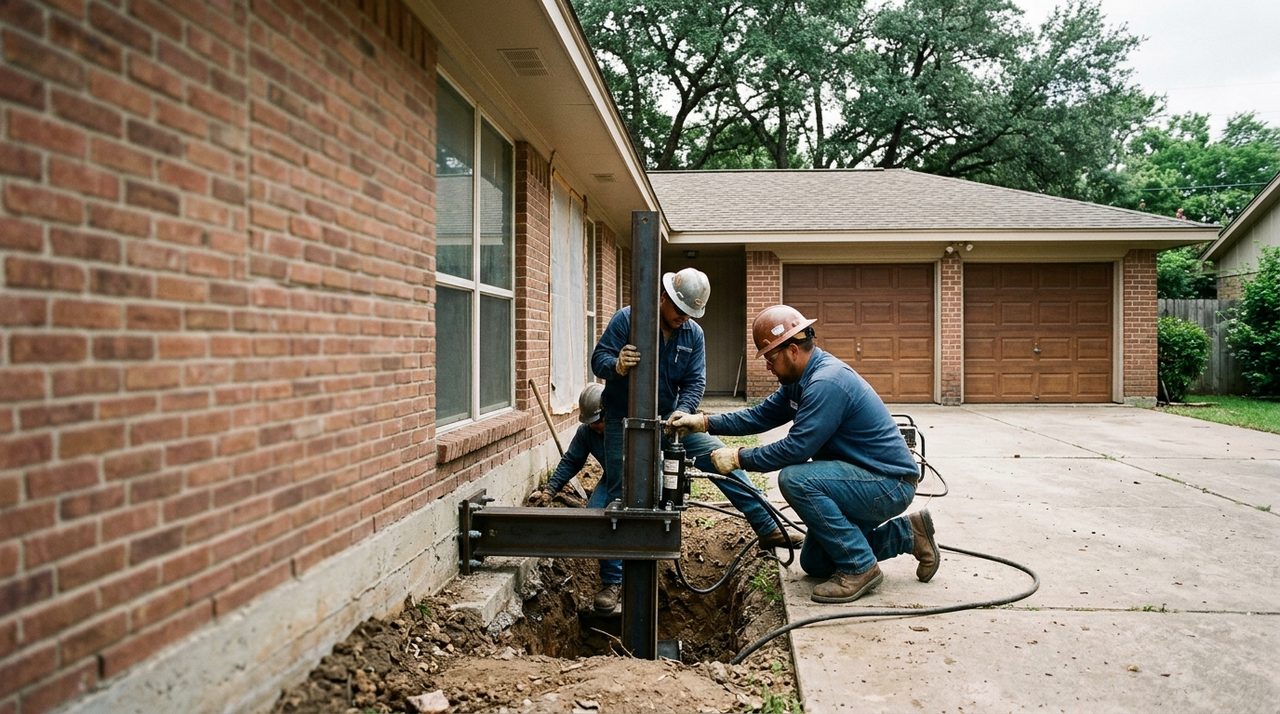
Before signing anything, confirm in writing which foundation type your home has — a reputable contractor will crawl the perimeter or access the crawl space before quoting. For pier-and-beam homes, the repair scope typically involves replacing deteriorated wood piers and shims or adding concrete block supports; for slab-on-grade infill homes on Garden Oaks's clay, pressed concrete pilings or steel push piers are the relevant comparison. Get three written proposals that explicitly name the foundation type, the repair method, and the pier count or beam count so you can compare apples to apples.
Sources: City of Houston Permitting Center, International Residential Code (as adopted by City of Houston)
Why it matters to you
Garden Oaks's original bungalows commonly have cast-iron or galvanized drain lines — the same pipe type that fractured in enormous numbers across Houston during Winter Storm Uri in February 2021. Many 2021 repairs addressed visible interior damage but left cracked under-floor drain lines in place. A slow, chronic leak from a compromised drain doesn't announce itself; it saturates the soil beneath the house, softening clay bearing capacity under a pier-and-beam home or creating localized heave-then-settlement cycles. If your 1940s or 1950s cottage has shown new floor sag or sticking doors since 2021, a plumbing leak — not just soil movement — may be driving it.
What a good pro does
A responsible foundation contractor working on a pre-1990 Garden Oaks bungalow should recommend a hydrostatic plumbing test before attributing movement purely to soil or wood degradation. That test runs an estimated $250–$400 and is performed or overseen by a licensed plumber under Texas State Board of Plumbing Examiners rules. Identifying and repairing an under-floor leak first prevents re-leveling the same home a second time in three years.
Sources: Texas State Board of Plumbing Examiners, City of Houston Permitting Center
Why it matters to you
The post-2000s custom homes built on Garden Oaks's large lots sit on slab-on-grade foundations over the same Beaumont clay that covers much of northwest Houston — some of the most expansive soil in North America. Many of these lots retained or added large water oaks and live oaks during or after construction; root systems on a mature oak extend two to three times the canopy radius and aggressively pull moisture from clay during dry summers, causing localized shrinkage and corner drop on the tree side. The 2022–2023 La Niña drought cycle was severe enough to open visible perimeter gaps along slabs across the metro, and Garden Oaks's shaded lots are not immune.
What a good pro does
For slab homes on Garden Oaks infill lots, a foundation contractor should assess tree proximity and canopy coverage as part of the inspection — not just crack patterns. Maintaining a soaker hose around the slab perimeter during dry stretches is the most cost-effective prevention. If underpinning is warranted, steel push piers or helical piers — estimated at $1,200–$2,200 per pier installed — are generally more appropriate than legacy pressed concrete pilings for clay soils exhibiting ongoing seasonal movement. Any underpinning project on a City of Houston lot requires a permit through the Houston Permitting Center.
Sources: City of Houston Permitting Center, International Residential Code (as adopted by City of Houston), Harris County Flood Control District
Why it matters to you
Garden Oaks operates under deed restrictions enforced by the Garden Oaks Civic Club and the Garden Oaks Maintenance Organization (GOMO), and Texas Real Estate Commission filings identify three registered mandatory HOAs within the neighborhood's boundaries — though exact lot coverage is not publicly mapped in a single document. Exterior foundation repair work — trenching around a slab perimeter, exposing piers, or any visible excavation — can trigger civic club review even when the City of Houston has already issued a permit. Skipping that review can result in a stop-work notice from the civic club and complications at resale, since Texas requires sellers to disclose known foundation repairs on the TREC disclosure form.
What a good pro does
Before scheduling any exterior work, pull the deed restrictions for your specific Garden Oaks section from Harris County Clerk records and confirm whether your lot falls under one of the three registered mandatory HOAs. Submit the scope of work to the Garden Oaks Civic Club for review in parallel with — not after — the City of Houston permit application through the Houston Permitting Center. Keeping both approvals documented protects you at future resale and ensures the repair history is transparently disclosed rather than discovered.
Sources: Local HOA / deed restrictions (see area profile), City of Houston Permitting Center, Municipal permit office (see area profile)
Hiring foundation repair in Garden Oaks? Garden Oaks presents a split housing stock of original 1930s–1950s bungalows and modern custom homes, creating two distinct home-service profiles on the same streets. Deed restrictions enforced by the Garden Oaks Civic Club govern exterior modifications, so contractors should verify compliance before starting work. The neighborhood sits in FEMA Zone X with low flood risk, but aging plumbing and electrical in vintage homes drive steady renovation demand.
Building era
1930s–1950s (original stock), with significant contemporary infill from 2000s–present.
Typical style
Craftsman-style bungalows and cottages (original); contemporary and transitional custom builds (newer).
Foundations
Not confirmed from available sources — likely mixed pier-and-beam (older bungalows) and slab-on-grade (newer construction). Verify on a per-property basis.
Common systems
Original homes may have galvanized or cast-iron drain lines, older copper supply lines, 60–100 amp electrical panels, and aging forced-air or window-unit HVAC. Newer builds typically have PEX plumbing, 200-amp panels, and modern high-efficiency HVAC systems.
What that means for repairs
Teardown-and-rebuild activity is very common due to the large lot sizes and high land values. Older bungalows undergo kitchen and bath remodels, electrical panel upgrades, and re-plumbing. Foundation repair on pier-and-beam vintage homes is a recurring need.
Permit jurisdiction
City of Houston — Houston Permitting Center (HPW).
HOA & deed restrictions
Most of Garden Oaks operates under the Garden Oaks Civic Club / Garden Oaks Maintenance Organization (GOMO), which enforces deed restrictions but does not charge a mandatory annual HOA fee. Section 4 specifically has no transfer fee. However, three mandatory HOAs are registered in the Garden Oaks area per Texas Real Estate Commission filings — exact names and boundaries not confirmed.
Historic districts
No City of Houston historic district designation confirmed. No references to HAHC review or Certificates of Appropriateness were found for Garden Oaks, though a formal city historic-district list was not available in research — verify with Houston Planning & Development if exterior changes are planned.
Contractor note
Deed restrictions enforced by the civic club may regulate exterior materials, setbacks, and accessory structures. Contractors should review the applicable section's deed restrictions before beginning exterior work, and confirm whether the specific property falls under one of the three registered mandatory HOAs.
FEMA flood zone
FEMA Zone X (low flood risk) per official NFHL data. Garden Oaks is not immediately adjacent to a major bayou, though Little White Oak Bayou runs to the neighborhood's general south/southeast.
Hurricane Harvey impact
No source in the available research directly addresses Hurricane Harvey flooding specific to Garden Oaks. No quantified damage figures, flooded-street lists, or recurring flood problem areas were identified. Not confirmed — check Harris County Flood Control District records and FEMA claims data for property-level Harvey impact.
Heat & humidity load
Original 1930s bungalows with limited insulation and older HVAC systems face heavy cooling loads during Houston summers, driving frequent AC repair and duct-sealing calls. Mature tree canopy helps shade but produces debris that clogs gutters and stresses roofing. Newer builds with modern insulation and high-efficiency systems fare better but still demand annual HVAC maintenance.
Working with contractors here
Garden Oaks generates two parallel workstreams: full teardown-and-rebuild projects replacing aging bungalows with contemporary custom homes, and deep renovations of vintage 1930s–1950s cottages. Older homes frequently need foundation leveling on pier-and-beam systems, full re-plumbing to replace galvanized lines, and electrical panel upgrades from 60-amp to 200-amp service. The civic club's deed restriction enforcement means exterior remodels — roofing material changes, fence styles, and additions — should be reviewed for compliance before permitting. Large lot sizes and mature landscaping often complicate equipment access and staging, so job scoping should account for tree protection and limited driveway widths on older properties.
Local Tip
Always ask for a written estimate before work begins. Texas contractors are required to provide one on jobs over $1,000.
Garden Oaks presents a split housing stock of original 1930s–1950s bungalows and modern custom homes, creating two distinct home-service profiles on the same streets. Deed restrictions enforced by the Garden Oaks Civic Club govern exterior modifications, so contractors should verify compliance before starting work. The neighborhood sits in FEMA Zone X with low flood risk, but aging plumbing and electrical in vintage homes drive steady renovation demand.
Source: U.S. Census Bureau, ACS 5-Year 2023
Most of Garden Oaks maps to FEMA Zone X (low mapped flood risk), but Houston's flash-flood reality means even low-risk blocks benefit from smart drainage and storm-hardened installs.
Source: FEMA National Flood Hazard Layer (NFHL). Flood zones vary by parcel — verify your individual FIRM panel.
Wind-driven rain during a hurricane can saturate soil on the windward side of your home while the leeward side stays dry, creating differential moisture conditions beneath your slab that show up as sticking doors weeks later in Garden Oaks. Schedule a Zip-Level elevation reading after any named storm passes so a foundation professional can distinguish normal seasonal movement from storm-induced settlement requiring pier work. Much of the housing stock predates modern wind codes (median build year 1963), so retrofits matter more here. Confirm the current FEMA panel for your Garden Oaks parcel — the area maps to Zone X, but adjacent lots can differ.
Even with low mapped flood risk, Garden Oaks is not immune to the localized sheet flow that accompanies a Houston severe thunderstorm, and repeated minor inundation at the foundation perimeter sustains the clay moisture that drives slow heave cycles. A pre-storm season inspection confirming that soil grade, splash blocks, and downspout extensions all direct water away from the slab is the most cost-effective foundation repair step you can take. In-city Garden Oaks work falls under City of Houston floodplain and permitting rules.
In Garden Oaks, where mapped flood risk is low, the primary post-freeze foundation threat is not surface water but slab-leak-driven soil saturation — Uri 2021 caused widespread pipe failures that fed water silently under slabs for days before homeowners noticed. After any hard freeze, have a plumber pressure-test your lines first, then schedule a foundation elevation check if any under-slab leak is confirmed. With a median build year of 1963, the older building stock here is more exposed to hard-freeze damage than newer construction. Confirm the current FEMA panel for your Garden Oaks parcel — the area maps to Zone X, but adjacent lots can differ.
Sources: FEMA National Flood Hazard Layer (NFHL), Ready.gov -- Hurricanes, CenterPoint Energy -- Storm Center, City of Houston -- Emergency Preparedness, Ready.gov -- Winter Weather, Harris County Flood Control District
Houston-specific estimators to plan your project before you call a pro. All results are planning estimates — a licensed local pro confirms the details on site.
Grouped by mature root aggression & water demand.
Trunk center to the nearest exterior wall.
The root zone likely reaches your foundation's soil during Houston's dry summers, when clay shrinks most. Watch for sticking doors and diagonal cracks, keep soil moisture even with a soaker hose during drought, and have a foundation pro evaluate if you see any movement.
Find a Houston foundation pro →This is a planning estimate only — actual requirements depend on an on-site assessment by a licensed Houston pro. Guidance is based on general species root behavior in expansive clay, not a soil test.
Disconnect & drain every outdoor hose bib
Remove hoses, drain the spigots, and cover each with an insulated faucet sock. Un-drained hose bibs are the #1 burst point in a Houston freeze.
Insulate exposed pipes in the attic & garage
Wrap any pipe in an unconditioned space (attic runs, garage walls) with foam sleeves. Houston homes rarely insulate these because they only matter a few nights a year — which is exactly why they burst.
Open cabinet doors & keep a pencil-width drip
On hard-freeze nights, open kitchen/bath cabinets so warm air reaches the pipes and let faucets on exterior walls drip to relieve pressure.
Protect the attic/garage water heater & its lines
An attic or garage tank sits in unconditioned space. Insulate the cold-inlet and hot-outlet lines and confirm the emergency drain pan is clear so a leak doesn't reach the ceiling.
This is a planning estimate only — actual requirements depend on an on-site assessment by a licensed Houston pro. If a pipe has already burst, shut off your main water supply and call a licensed Houston plumber immediately — freeze bursts flood fast.
Sources: City of Houston Permitting CenterMunicipal permit office (see area profile)
Sources: FEMA National Flood Hazard Layer (NFHL)Harris County Flood Control District
Sources: Local HOA / deed restrictions (see area profile)
Sources: City of Houston Permitting Center
Sources: City of Houston Permitting CenterTexas State Board of Plumbing Examiners