Closed
617 8th Ave N, Texas City, TX 77590
Texas City's foundation picture is split by housing era: older neighborhoods near the historic core and bay sit on mid-20th-century slabs that have weathered decades of Gulf Coast humidity, salt-air exposure, and expansive Galveston County clay, while newer master-planned communities like Lago Mar feature 2010s–2020s production-builder construction whose slabs are still going through their first cycles of drought-induced movement. All permitting runs through the City of Texas City Permits and Inspections Department — not Houston's Development Services Department — so any contractor who quotes you 'standard Houston permit' timelines is already working from the wrong playbook. Understanding which era your home belongs to, and which soil and regulatory conditions apply, is the starting point for any legitimate repair conversation.
Ranked by verified Google rating × review volume × verification tier. How we rank →
Some highly-rated pros serve Texas City from nearby and may not keep a Texas City street address. Those are listed under "Also serving Texas City" with their real city and distance, so you always know where each business is based.
617 8th Ave N, Texas City, TX 77590
Highly-rated pros based nearby who cover Texas City. Distance shown from the Texas City area.
Serving Texas City Based in La Marque · 5 mi away
Serving Texas City Based in Dickinson · 7.3 mi away
Serving Texas City Based in Galveston · 8.2 mi away
Serving Texas City Based in Galveston · 8.3 mi away
Serving Texas City Based in Galveston · 8.4 mi away
Serving Texas City Based in Galveston · 8.6 mi away
Serving Texas City Based in Galveston · 8.6 mi away
Serving Texas City Based in Galveston · 8.7 mi away
Serving Texas City Based in Galveston · 9.3 mi away
Why it matters to you
Texas City's master-planned communities — Lago Mar and Park Place South — are primarily 2010s–2020s construction on Galveston County clay, which shares the same expansive mineral composition as Houston's Beaumont and Houston Black formations. La Niña-driven drought cycles, most recently 2022–2023, bake this clay in summer and pull it away from slab edges faster than many homeowners expect from a relatively new home. Spray-irrigation systems in these HOA communities are typically zoned for turf and landscaping, not foundation-perimeter saturation, leaving the beam edge unsupported exactly where perimeter voids form first.
What a good pro does
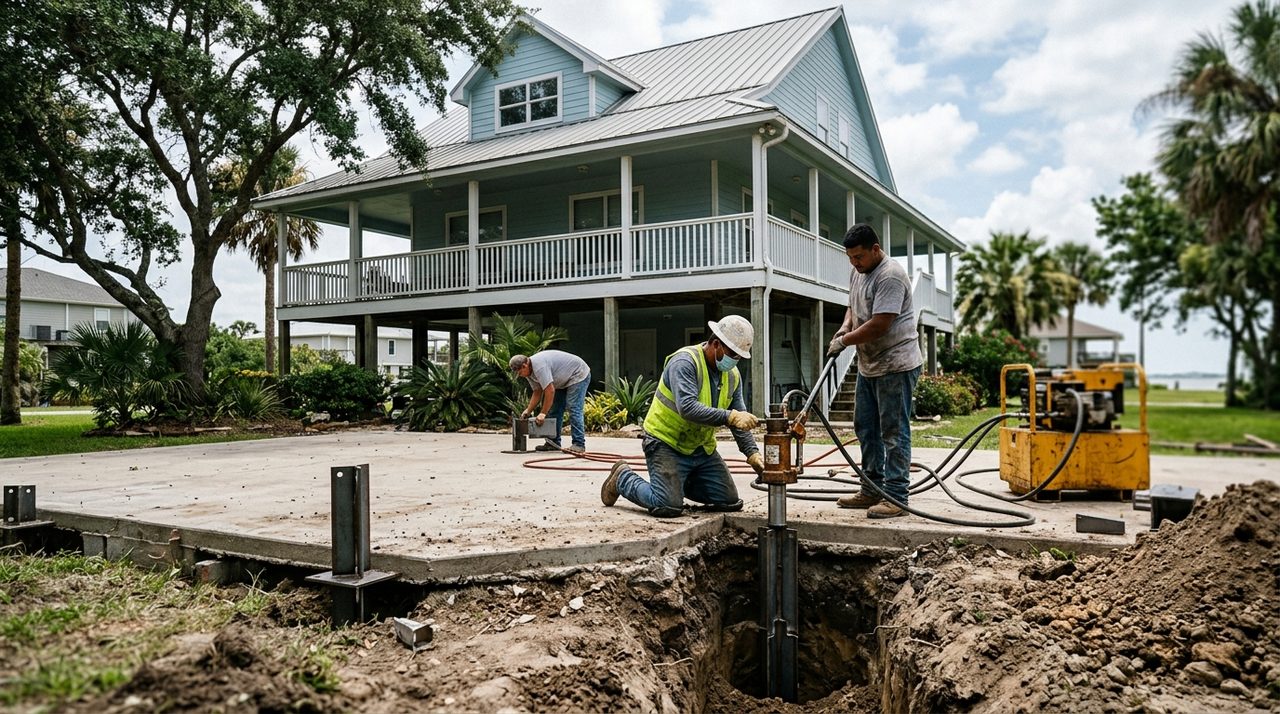
A thorough inspection should include probing the perimeter for gap depth and evaluating grading and downspout discharge before any piering is proposed. If voids are the primary issue and the slab is otherwise level, mudjacking or polyurethane foam injection (estimated $800–$5,000 depending on section count) can refill voids without underpinning — a far less invasive option than premature pier installation. Any repair involving underpinning requires a permit from the City of Texas City Permits and Inspections Department; confirm inspection scheduling directly with that office, not via a contractor's blanket assurance.
Sources: Municipal permit office (see area profile), Local HOA / deed restrictions (see area profile)
Why it matters to you
Texas City's older neighborhoods — those dating to the mid-20th century, with a census median year built of 1981 across the city — frequently have cast-iron under-slab drain lines that were put under significant stress during Winter Storm Uri in February 2021. Many homes in this stock had visible pipe repairs completed after Uri, but cracked under-slab segments were left in place behind freshly patched walls. Ongoing slow leaks from these lines saturate the clay directly beneath the slab, producing localized heave followed by settlement as the soil structure deteriorates — a failure pattern that can look identical to ordinary differential movement on a visual inspection.
What a good pro does
Before signing any foundation repair contract on a pre-1990 Texas City home, commission a hydrostatic plumbing test (typically $250–$400) performed or overseen by a plumber licensed through the Texas State Board of Plumbing Examiners. If the test reveals under-slab leaks, those must be resolved first — piering a slab with an active leak beneath it is money spent on a moving target. Document both the plumbing repair and the subsequent foundation work with City of Texas City permits so the record is clean for future resale disclosure on the TREC form.
Sources: Texas State Board of Plumbing Examiners, Municipal permit office (see area profile)
Why it matters to you
Older Texas City neighborhoods near the bay and historic core carry mature live oaks and water oaks whose root systems can extend two to three times the canopy radius into the surrounding clay. During dry summers — common in a Gulf Coast city with strong seasonal temperature swings — these roots aggressively extract soil moisture on the tree side of the foundation, causing localized clay shrinkage and slab drop that can crack brick veneer and interior drywall in a recurring seasonal pattern. Post-Harvey and post-Beryl replanting of large trees on residential lots has added a wave of future root liability that may not manifest for another decade.
What a good pro does
A qualified inspector should map tree locations relative to crack patterns before attributing differential movement to soil alone. Maintaining consistent perimeter moisture during dry months — either with a soaker hose on a timer or verified sprinkler coverage within 18 inches of the slab edge — is the primary prevention. Where root intrusion is confirmed, steel push piers (estimated $1,200–$1,800 per pier, with a typical job requiring 8–16 piers) can stabilize the affected side while root management options are assessed; note that any exterior trenching around the perimeter in an HOA-governed subdivision like Lago Mar requires prior architectural approval from the HOA management company before work begins.
Sources: Local HOA / deed restrictions (see area profile), Municipal permit office (see area profile)
Why it matters to you
Lago Mar and Park Place South both operate mandatory HOAs managed by professional management companies, and both require architectural committee approval before any visible exterior work — including perimeter trenching for pier installation or mudjacking access. Texas City homeowners with a median home value of $190,600 (ACS 5-Year 2023) are making a significant investment in repair, and skipping the HOA approval step can result in stop-work orders, fines, or a required restoration of landscaping at the homeowner's expense. Separately, Texas requires sellers to disclose known foundation movement and all prior repairs on the TREC disclosure form; undocumented or unpermitted work becomes a legal and financial liability at resale.
What a good pro does
Submit an architectural approval request with contractor drawings to the relevant HOA management company before any excavation begins — confirm whether Lago Mar Owners Association or Park Place South HOA administers your lot via the Galveston County Clerk or hoa.texas.gov. Simultaneously pull the required permit from the City of Texas City Permits and Inspections Department so the repair record is documented in municipal files, not just on a contractor invoice. Keep all inspection reports, pier logs, and permit closure documents in a dedicated home file; this packet is what satisfies the TREC disclosure requirement and protects your equity.
Sources: Local HOA / deed restrictions (see area profile), Municipal permit office (see area profile)
Hiring foundation repair in Texas City? Texas City is an incorporated Galveston County city with a wide range of housing stock, from newer master-planned communities like Lago Mar to older neighborhoods near the historic core and refineries. Homeowners here face coastal weather exposure, salt-air corrosion, and varying flood risk depending on elevation and proximity to the bay. Permitting runs through the City of Texas City, not Houston, and HOA requirements vary significantly by subdivision.
Building era
Mixed — older core neighborhoods date to the mid-20th century; master-planned communities like Lago Mar and Park Place South are primarily 2010s–2020s construction.
Typical style
Modern production-builder suburban homes (brick and stone, one- and two-story) in newer subdivisions; older areas feature more varied Gulf Coast residential styles.
Foundations
Predominantly slab-on-grade in modern subdivisions; some older coastal and bay-adjacent homes may be pier-and-beam or raised construction — confirm via Galveston County Appraisal District records.
Common systems
Newer homes feature modern central HVAC, PEX or CPVC plumbing, and 200-amp electrical panels; older homes may have original ductwork, galvanized or copper plumbing, and smaller electrical services requiring upgrades.
What that means for repairs
Older homes near the historic core often need HVAC modernization, electrical panel upgrades, and corrosion-related exterior repairs due to salt air and industrial proximity. Newer HOA communities focus on cosmetic upgrades and energy efficiency improvements.
Permit jurisdiction
City of Texas City Permits and Inspections Department (independent municipality, not Houston Permitting Center).
HOA & deed restrictions
Mixed — mandatory HOAs govern newer subdivisions including Lago Mar Owners Association (managed by Principle Management Group) and Park Place South Homeowners Association. Older neighborhoods may have only recorded deed restrictions with no active HOA. HOA status must be confirmed lot-by-lot via deed records, Galveston County Clerk, or hoa.texas.gov.
Historic districts
No City of Houston historic district designation confirmed. Texas City is a separate incorporated municipality; any local historic designations would be administered by the City of Texas City.
Contractor note
Contractors must pull permits through the City of Texas City, not Harris County or the City of Houston. HOA-governed subdivisions like Lago Mar and Park Place South require architectural approval before exterior work begins; confirm requirements with the specific HOA management company.
FEMA flood zone
FEMA Zone X (low flood risk) per official NFHL data. However, Texas City is a low-lying coastal community along Galveston Bay, and localized flooding can occur in areas near Dickinson Bayou, Moses Lake, and the bay shoreline. Flood risk varies significantly by subdivision and elevation.
Hurricane Harvey impact
Specific Harvey 2017 flood depths and damage data for Texas City subdivisions were not confirmed in available research. As a low-lying coastal community in Galveston County, Texas City likely experienced storm surge and rainfall impacts, but street-level or subdivision-specific flood data should be verified through FEMA claims records, the Galveston County Appraisal District, or the Texas General Land Office.
Heat & humidity load
Extreme humidity and salt air from Galveston Bay accelerate exterior corrosion on HVAC condensers, metal roofing components, and fasteners. Older homes without adequate insulation or modern HVAC systems face heavy cooling loads. Mold risk is elevated in poorly ventilated homes, especially those with pier-and-beam foundations near the coast.
Working with contractors here
Texas City's dual housing stock creates two distinct contractor markets. In newer master-planned communities like Lago Mar and Park Place South, work centers on warranty-period punch lists, fence and patio additions within HOA guidelines, and energy-efficiency upgrades. In older neighborhoods, contractors commonly handle HVAC system replacements, electrical panel upgrades from 100-amp to 200-amp service, re-piping from galvanized to PEX, and exterior repairs driven by salt-air corrosion. Coastal proximity means roofing contractors must account for wind uplift ratings and corrosion-resistant fasteners. All work requires City of Texas City permits, and contractors unfamiliar with the local permitting process should budget additional time compared to Houston-area jurisdictions.
Local Tip
Always ask for a written estimate before work begins. Texas contractors are required to provide one on jobs over $1,000.
Texas City is an incorporated Galveston County city with a wide range of housing stock, from newer master-planned communities like Lago Mar to older neighborhoods near the historic core and refineries. Homeowners here face coastal weather exposure, salt-air corrosion, and varying flood risk depending on elevation and proximity to the bay. Permitting runs through the City of Texas City, not Houston, and HOA requirements vary significantly by subdivision.
Source: U.S. Census Bureau, ACS 5-Year 2023
Most of Texas City maps to FEMA Zone X (low mapped flood risk), but Houston's flash-flood reality means even low-risk blocks benefit from smart drainage and storm-hardened installs; as a Galveston County coastal community, tropical surge and wind add a layer generic guidance misses.
Source: FEMA National Flood Hazard Layer (NFHL). Flood zones vary by parcel — verify your individual FIRM panel.
Wind-driven rain during a hurricane can saturate soil on the windward side of your home while the leeward side stays dry, creating differential moisture conditions beneath your slab that show up as sticking doors weeks later in Texas City, TX. Schedule a Zip-Level elevation reading after any named storm passes so a foundation professional can distinguish normal seasonal movement from storm-induced settlement requiring pier work. As a Galveston County community, Texas City may follow county rather than City of Houston storm rebuild rules.
Hail itself does not crack a concrete foundation, but the insurance repair process — contractors dropping equipment, vibrating compactors near the structure — can disturb marginally stable piers in Texas City, TX. Coordinate a brief foundation check with a TDLR-licensed contractor before and after any major roof or exterior repair project that involves heavy equipment operating near your home. Confirm the current FEMA panel for your Texas City parcel — the area maps to Zone X, but adjacent lots can differ.
Ice loading from roof accumulation during a hard freeze transfers compressive stress to your foundation corners, and in Texas City, TX that added load on clay subgrade that has stiffened from cold can create corner settlement that persists after the thaw. A TDLR-licensed foundation contractor should inspect visible brick-to-foundation transitions and interior door frames after any multi-day freeze event, even if no pipe damage occurred. With a median build year of 1981, the older building stock here is more exposed to hard-freeze damage than newer construction. As a Galveston County community, Texas City may follow county rather than City of Houston storm rebuild rules.
Sources: FEMA National Flood Hazard Layer (NFHL), Ready.gov -- Hurricanes, CenterPoint Energy -- Storm Center, City of Houston -- Emergency Preparedness, Ready.gov -- Winter Weather, Harris County Flood Control District
Houston-specific estimators to plan your project before you call a pro. All results are planning estimates — a licensed local pro confirms the details on site.
Grouped by mature root aggression & water demand.
Trunk center to the nearest exterior wall.
The root zone likely reaches your foundation's soil during Houston's dry summers, when clay shrinks most. Watch for sticking doors and diagonal cracks, keep soil moisture even with a soaker hose during drought, and have a foundation pro evaluate if you see any movement.
Find a Houston foundation pro →This is a planning estimate only — actual requirements depend on an on-site assessment by a licensed Houston pro. Guidance is based on general species root behavior in expansive clay, not a soil test.
Disconnect & drain every outdoor hose bib
Remove hoses, drain the spigots, and cover each with an insulated faucet sock. Un-drained hose bibs are the #1 burst point in a Houston freeze.
Insulate exposed pipes in the attic & garage
Wrap any pipe in an unconditioned space (attic runs, garage walls) with foam sleeves. Houston homes rarely insulate these because they only matter a few nights a year — which is exactly why they burst.
Open cabinet doors & keep a pencil-width drip
On hard-freeze nights, open kitchen/bath cabinets so warm air reaches the pipes and let faucets on exterior walls drip to relieve pressure.
Protect the attic/garage water heater & its lines
An attic or garage tank sits in unconditioned space. Insulate the cold-inlet and hot-outlet lines and confirm the emergency drain pan is clear so a leak doesn't reach the ceiling.
This is a planning estimate only — actual requirements depend on an on-site assessment by a licensed Houston pro. If a pipe has already burst, shut off your main water supply and call a licensed Houston plumber immediately — freeze bursts flood fast.
Sources: Municipal permit office (see area profile)
Sources: Local HOA / deed restrictions (see area profile)Municipal permit office (see area profile)