2525 Robinhood St suit 314, Houston, TX 77005
Best Garage Door Repair in West University
West University Place's garage doors span nearly a century of construction: surviving 1930s–1950s bungalows on pier-and-beam foundations share streets with 2000s custom teardown-rebuilds on slab-on-grade, each generation carrying different structural tolerances, hardware specs, and code histories. Because West University is an independent municipality, permits for full door replacements run through the City of West University Place's own permit office — not Houston's Permitting Center — and its inspectors enforce local codes on their own schedule. Understanding which era your home belongs to, and which permit desk to call, is the starting point for any garage door project here.
Verified against Google Business data
Updated 2026
See the 10 Garage Door Repair Serving West University 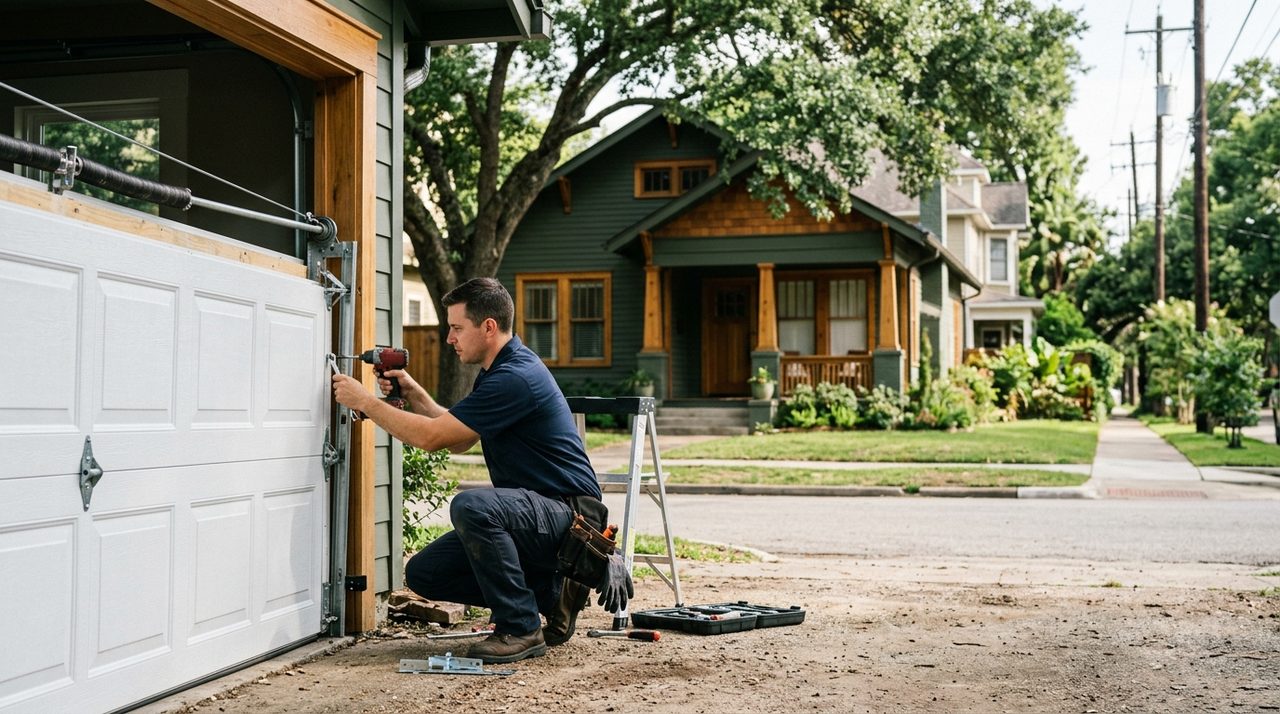
- Median home built
- 1993
- Median home value
- $1,354,300
- FEMA flood zone
- X500 (moderate)
- Typical replacement cost (est.)
- $1,200–$2,400 (double-car, insulated steel)
- Most common local issue
- Frame racking on slab-on-grade rebuilds from Houston Black clay soil movement
Ranked by verified Google rating × review volume × verification tier. How we rank →
Some highly-rated pros serve West University from nearby and may not keep a West University street address. Those are listed under "Also serving West University" with their real city and distance, so you always know where each business is based.
Min rating:
10 resultsBased in West University
Also serving West University
Highly-rated pros based nearby who cover West University. Distance shown from the West University area.
Open Now
Serving West University Based in Bellaire · 1.8 mi away
Open Now
Serving West University Based in Medical Center · 2.1 mi away
Open Now
Serving West University Based in Galleria · 2.3 mi away
Closed
Serving West University Based in Bellaire · 2.4 mi away
Open Now
Serving West University Based in Galleria · 2.5 mi away
Closed
Serving West University Based in Bellaire · 2.5 mi away
Closed
Serving West University Based in Bellaire · 2.6 mi away
Serving West University Based in Lazybrook / Timbergrove · 3.9 mi away
Open Now
Serving West University Based in Sharpstown · 4.1 mi away
Garage Door Repair in West University: What You Should Know
Clay-Soil Frame Racking on West U's Slab-on-Grade Rebuilds
Why it matters to you
The dominant housing stock in West University today is the teardown-rebuild custom home constructed from the 1980s onward on slab-on-grade foundations sitting atop Harris County's Beaumont/Houston Black clay. That clay expands and contracts with every rain-and-drought cycle, and the resulting differential movement distorts the rough opening around a garage door — throwing tracks out of plumb, binding rollers on one side, and creating bottom-corner gaps that defeat weathersealing. On a home with a median census year-built of 1993, cumulative soil movement over 30-plus years of Houston summers and wet winters is substantial and visible.
What a good pro does
A qualified installer should measure the rough opening diagonally (corner-to-corner) before ordering a replacement door to detect any out-of-square condition; differences greater than ¼ inch typically require a framing carpenter to reset the header or jambs before the door is hung. Track hardware should be fastened with lag bolts into solid framing — not just drywall anchors — and bottom weatherseal should be the dual-bulb or T-style type that can flex to accommodate minor seasonal floor movement. City of West University Place building permits are required for structural alterations to the opening; pull the permit through West U's own office, not Houston's Permitting Center.
Sources: Municipal permit office (see area profile), International Residential Code (as adopted by City of Houston)
Accelerated Spring and Hardware Corrosion in a High-Humidity Inner-Loop Garage
Why it matters to you
Houston averages 65–70% relative humidity year-round, spiking well above 90% on summer afternoons, and West University's dense tree canopy — one of the neighborhood's most valued features — keeps garage exteriors shaded and damp for hours after rain. Torsion springs, cables, bottom brackets, and roller stems corrode at two to three times the rate seen in drier Texas climates; an oil-tempered spring rated for 10,000 cycles under normal conditions may fail in five to seven years in an unconditioned West U garage. The oldest surviving bungalows, some still in use as ADUs or awaiting teardown, often have extension-spring systems installed decades ago with no maintenance record.
What a good pro does
Ask installers to specify galvanized or zinc-coated torsion springs rather than standard oil-tempered steel, and confirm that all cables are aircraft-grade galvanized. A corrosion-inhibiting lubricant (not WD-40, which attracts dust) applied to springs, hinges, and roller stems every six months extends hardware life measurably in this climate. Spring replacement alone — typically $200–$350 estimated for a two-spring system — does not require a City of West University Place building permit, but the work should still be documented for home-sale disclosures given West U's high resale turnover.
Sources: Municipal permit office (see area profile)
Uninsulated Original Doors Driving Cooling Loads in Attached Garages
Why it matters to you
A meaningful share of West University's remaining 1930s–1950s homes, and even some 1980s-era rebuilds, still carry single-layer steel or hollow-core doors with an effective R-value near zero. On a west- or south-facing garage — common in the neighborhood's grid-street layout — radiant heat gain through that door in a Houston summer (150-plus hours above 95°F annually) pushes into the living space above or beside the garage, adding directly to a cooling load that already accounts for roughly half of a Houston home's summer electric bill. At West U's median home value of $1,354,300, energy efficiency is both a comfort issue and a resale-disclosure item buyers scrutinize.
What a good pro does
Upgrading to an insulated steel door rated R-13 to R-18 is one of the highest-ROI envelope moves for an attached West U garage; the installed cost for a double-car insulated replacement typically runs $1,200–$2,400 estimated. Look for doors that carry an ENERGY STAR certification and check whether the panel pattern meets any applicable deed restrictions on individual plats — Harris County Clerk records are the right place to confirm those restrictions before ordering. A City of West University Place building permit is required for a full door replacement; the city's own inspectors will verify the installation.
Sources: ENERGY STAR / U.S. Dept. of Energy, Municipal permit office (see area profile), Local HOA / deed restrictions (see area profile)
West U's Independent Permit Office: A Deadline Risk Contractors Often Miss
Why it matters to you
Because West University Place is an independent municipality entirely separate from the City of Houston, contractors who routinely pull permits through Houston's Permitting Center or Harris County cannot simply extend those workflows here. West U runs its own building department with its own inspection schedule, and turnaround times and documentation requirements can differ from what a Houston-focused garage door company expects. A full door replacement that alters the structural opening — extremely common in the neighborhood's ongoing teardown-rebuild cycle — requires a local building permit; beginning work without one puts the homeowner at risk of a stop-work order and complicates title at resale.
What a good pro does
Before signing any contract for a door replacement that involves framing changes, confirm in writing that the installer has pulled — or will pull — a permit specifically through the City of West University Place's permit office, not Houston's or Harris County's. Ask for the permit number before installation begins and keep the approved inspection card; West U's inspectors enforce local codes independently, and that documentation is material at closing in a market where homes routinely transact at seven figures. Purely mechanical repairs such as spring, cable, or opener replacement generally do not require a permit, but verify current thresholds with West U's building department directly as local rules can be updated.
Sources: Municipal permit office (see area profile), Texas Department of Licensing & Regulation
Garage Door Repair in West University: What You Should Know
Hiring garage door repair in West University? West University Place is an independent municipality within the Inner Loop featuring a mix of original 1930s–1950s bungalows and larger custom homes built from the 1980s onward as teardown-rebuild cycles reshaped the neighborhood. Homeowners here navigate the city's own permitting process—separate from Houston's—and must account for aging systems in older homes alongside modern construction standards in newer builds. The tree-lined streets and high property values drive demand for premium finishes and careful code compliance.
- Housing era
- Mixed
- Foundation
- Not confirmed from available sources - likely mixed pier-and-beam on older pre-1950s homes and…
- Flood zone
- FEMA Zone X500 (moderate flood risk) per official NFHL data
- Permits
- City of West University Place (independent municipality - own permit office, not City of…
Housing stock & systems
Building era
Mixed: original homes from 1930s–1950s with significant infill and teardown-rebuild construction from the 1980s–2000s and continuing today.
Typical style
Traditional brick, Georgian/Colonial-influenced, neo-traditional custom homes (2-story), with some remaining early-20th-century bungalows and cottages.
Foundations
Not confirmed from available sources - likely mixed pier-and-beam on older pre-1950s homes and slab-on-grade on newer construction. Verify on a per-property basis.
Common systems
Older homes (1930s–1950s) may have original galvanized or cast-iron plumbing, outdated electrical panels, and window AC or early central HVAC. Newer construction (1980s–present) typically features copper or PEX plumbing, modern electrical, and high-efficiency central HVAC systems.
What that means for repairs
Teardown-and-rebuild activity has been the dominant renovation pattern for decades, replacing smaller original cottages with larger custom homes. Remaining older homes frequently undergo full-gut renovations including electrical rewiring, plumbing replacement, foundation repair, and HVAC modernization to meet current standards and market expectations.
Permits & restrictions
Permit jurisdiction
City of West University Place (independent municipality - own permit office, not City of Houston Permitting Center and not Harris County).
HOA & deed restrictions
No mandatory city-wide master HOA. West U functions as an independent municipality with its own zoning and code enforcement. Individual condo and townhome associations exist (e.g., The Oaks at West University Condominium Association), but most single-family homes have no HOA. Deed restrictions may exist on individual plats—check Harris County Clerk records for specific lots.
Historic districts
No City of Houston historic district designation applies. West University Place is an independent municipality outside Houston city limits, so HAHC Certificates of Appropriateness are not required. West U may have its own local design or zoning controls—check with the City of West University Place directly.
Contractor note
Contractors must pull permits through the City of West University Place, not through Houston or Harris County. West U's own inspectors enforce local codes, and the city's zoning and building requirements may differ from Houston's, so contractors unfamiliar with the jurisdiction should review local ordinances before bidding.
Flood & weather
FEMA flood zone
FEMA Zone X500 (moderate flood risk) per official NFHL data. West University Place sits between Brays Bayou to the south and Rice University to the east, with drainage flowing into Harris County Flood Control District channels.
Hurricane Harvey impact
Specific Harvey 2017 flood impact data for West University Place streets was not available in the research provided. The moderate flood risk zone designation and proximity to Brays Bayou suggest potential vulnerability, but confirmed street-level flooding details and repetitive-loss areas should be verified through HCFCD inundation maps and City of West University Place floodplain reports.
Heat & humidity load
Houston's extreme summer heat and humidity stress HVAC systems across all housing eras. Older pier-and-beam homes may experience moisture-related subfloor issues, while the mature tree canopy—a signature feature of West U—creates ongoing gutter maintenance demands and potential root intrusion into aging sewer lines.
Working with contractors here
Contractors in West University most commonly handle full-home renovations and teardown-rebuilds, driven by buyers acquiring older cottages on valuable lots and replacing them with larger custom homes. For surviving 1930s–1950s homes, foundation repair, whole-house repiping (replacing galvanized with copper or PEX), electrical panel upgrades, and HVAC replacement are frequent scopes. Newer 1990s–2000s homes generate demand for roof replacements, exterior paint, and kitchen/bath remodels as they reach their first major maintenance cycles. Job scoping must account for West University Place's independent permitting process, which can differ from Houston's in turnaround times and inspection requirements. The high-end market expectations in West U mean contractors should budget for premium materials and meticulous finish work.
Local Tip
Always ask for a written estimate before work begins. Texas contractors are required to provide one on jobs over $1,000.
About West University
West University Place is an independent municipality within the Inner Loop featuring a mix of original 1930s–1950s bungalows and larger custom homes built from the 1980s onward as teardown-rebuild cycles reshaped the neighborhood. Homeowners here navigate the city's own permitting process—separate from Houston's—and must account for aging systems in older homes alongside modern construction standards in newer builds. The tree-lined streets and high property values drive demand for premium finishes and careful code compliance.
- Median year built
- 1993
- Median home value
- $1,354,300
- Owner-occupied
- 72.4%
- Population
- 28,231
- Housing units
- 10,564
- Median income
- $215,708
Source: U.S. Census Bureau, ACS 5-Year 2023
Flood & storm risk
FEMA Zone X500Moderate flood riskWest University carries FEMA Zone X500 (moderate flood risk): outside the 100-year floodplain but inside the 500-year, so heavy-rain events still reach homes and flood-aware work pays off.
Source: FEMA National Flood Hazard Layer (NFHL). Flood zones vary by parcel — verify your individual FIRM panel.
Houston Storm Readiness in West University
Hurricane & flooding
Confirm your garage door opener has a battery-backup module before hurricane season, since CenterPoint outages in West University during past Gulf storms have stranded homeowners without grid power for days. While flooding is a secondary concern in this zone, a door with full horizontal wind-bracing bars prevents the panel failure that can cascade into structural roof damage when sustained tropical winds arrive. Confirm the current FEMA panel for your West University parcel — the area maps to Zone X500, but adjacent lots can differ.
Severe storms & hail
For homeowners in West University: straight-line winds from the May 2024 derecho routinely exceeded 80 mph across Houston's moderate-flood suburbs, enough to bow untested garage-door panels inward and bend tracks permanently — confirm your door carries a current wind-load label and add horizontal bracing if it does not. A battery-backup opener also keeps you from being locked out when severe thunderstorms knock out CenterPoint power mid-afternoon. In-city West University work falls under City of Houston floodplain and permitting rules.
Ice storms & freezes
Freezing rain weighs down garage-door panels and can crack weatherstripping in West University when temperatures fall below 20°F, as they did during Uri 2021 across the Houston metro — inspect the bottom and side seals before each winter and replace any sections showing brittleness or cracking. A steel door with polyurethane insulation retains heat in the garage and reduces the thermal shock that accelerates seal degradation in repeated freeze-thaw cycles. In-city West University work falls under City of Houston floodplain and permitting rules.
Sources: FEMA National Flood Hazard Layer (NFHL), Ready.gov -- Hurricanes, CenterPoint Energy -- Storm Center, City of Houston -- Emergency Preparedness, Ready.gov -- Winter Weather, Harris County Flood Control District
Free West University Tools & Calculators
Houston-specific estimators to plan your project before you call a pro. All results are planning estimates — a licensed local pro confirms the details on site.
Houston Freeze Prep & Pipe Insulation Checklist
Open full tool & FAQ →Your freeze checklist — 4 tasks
- 1
Disconnect & drain every outdoor hose bib
Remove hoses, drain the spigots, and cover each with an insulated faucet sock. Un-drained hose bibs are the #1 burst point in a Houston freeze.
- 2
Insulate exposed pipes in the attic & garage
Wrap any pipe in an unconditioned space (attic runs, garage walls) with foam sleeves. Houston homes rarely insulate these because they only matter a few nights a year — which is exactly why they burst.
- 3
Open cabinet doors & keep a pencil-width drip
On hard-freeze nights, open kitchen/bath cabinets so warm air reaches the pipes and let faucets on exterior walls drip to relieve pressure.
- 4
Protect the attic/garage water heater & its lines
An attic or garage tank sits in unconditioned space. Insulate the cold-inlet and hot-outlet lines and confirm the emergency drain pan is clear so a leak doesn't reach the ceiling.
This is a planning estimate only — actual requirements depend on an on-site assessment by a licensed Houston pro. If a pipe has already burst, shut off your main water supply and call a licensed Houston plumber immediately — freeze bursts flood fast.
Frequently Asked Questions
Do I need a permit from the City of West University Place to replace my garage door, or can I just swap it out?
If the replacement involves a full door and frame — not just a spring or opener repair — you'll need a permit from the City of West University Place's own building department, which is completely separate from the City of Houston Permitting Center. West U's inspectors review and approve the work on their own schedule, and turnaround times can differ from what contractors used to Houston jobs expect. Purely mechanical repairs like springs, cables, or opener swaps generally don't require a permit, but confirm with West U's permit office before any structural opening work begins.
Sources: Municipal permit office (see area profile)
My 1940s bungalow in West U has a pier-and-beam foundation — does that change how a garage door contractor should approach framing and adjustment?
Yes, meaningfully so. Pier-and-beam foundations move differently than slab-on-grade: seasonal shifting can cause the rough opening to go out of square in ways that torsion-spring tension alone can't fix, and older wood framing around the opening may have accumulated decades of racking. A contractor bidding on a surviving 1930s–1950s West U home should inspect the header and side jambs for squareness before ordering a door, because a door ordered to a distorted opening will never seal or track correctly regardless of how it's adjusted.
We're in FEMA Zone X500 — should I be doing anything differently to protect the bottom of my garage door from flooding?
Zone X500 means West University sits outside the 100-year floodplain but inside the 500-year boundary, so heavy-rain events like Harvey still reached garages throughout the neighborhood. A threshold seal rated for water intrusion — not just a standard rubber bottom seal — combined with a steel or aluminum bottom section (rather than wood or composite) meaningfully reduces flood damage to door hardware at floor level. Ask your installer specifically about threshold seals and corrosion-resistant track hardware at floor height, since standard residential kits aren't designed with standing water in mind.
What's a realistic timeline and cost estimate for replacing a double-car garage door on a West U teardown-rebuild, including permitting?
Material and installation for a double-car insulated steel door (16×7 or 18×7) typically runs an estimated $1,200–$2,400 in the Houston metro; premium panel styles or custom sizing common on West U's larger custom homes can push that higher. Permitting through the City of West University Place adds time that varies by workload at their office — budget at least one to two weeks for permit approval before scheduling installation, and confirm with your contractor that they've pulled West U permits before rather than assuming Houston Permitting Center timelines. Factor in that inspectors must sign off before the door is put into full service.
Sources: Municipal permit office (see area profile)
Is late summer the worst time to schedule garage door work in West University, given the heat and humidity?
Scheduling-wise, late spring through early fall is actually the highest-demand window for service calls in the Houston metro, because heat accelerates spring fatigue and humidity drives seal failures, so wait times for technicians stretch longest between June and September. For a planned replacement rather than an emergency, late fall or winter — roughly November through January — typically means faster scheduling and less humidity stress on newly installed hardware and lubricants during the break-in period. If a spring or opener fails during a peak summer stretch, expect an emergency dispatch fee estimated at $100–$175 on top of parts and labor.
Most of West U doesn't have an HOA — does that mean I can install any door style or color I want on my single-family home?
For most West University Place single-family lots there is no master HOA restricting door appearance, but individual plats may carry deed restrictions recorded separately with the Harris County Clerk — those run with the land regardless of whether any association actively enforces them. West University Place also has its own zoning and building codes as an independent municipality, which can include design or setback requirements that differ from Houston's, so check directly with the City of West University Place before choosing a highly non-traditional material or garage configuration. Confirming via a Harris County Clerk deed-restriction search before ordering is a 15-minute step that avoids a costly re-installation.
Sources: Local HOA / deed restrictions (see area profile)