Closed
23552 FM1314 Ste. 106, Porter, TX 77365
Porter's sprawling mix of 1970s acreage lots and brand-new production homes in communities like Valley Ranch means gutters here face a wide range of debris loads — from decades-old pine stands shading older brick ranches to freshly installed aluminum gutters on homes that haven't had their first full hurricane season yet. Montgomery County's unincorporated status means no city permit office oversees gutter work, but subdivision HOAs like Valley Ranch's mandatory association can still issue violation notices for visible overflow staining on fascia. With a census median year built of 2001 and steady new construction pushing into the East Texas Piney Woods edge, understanding which challenges apply to your specific Porter address — and which subdivision rules govern your exterior — is the practical starting point.
Ranked by verified Google rating × review volume × verification tier. How we rank →
Some highly-rated pros serve Porter from nearby and may not keep a Porter street address. Those are listed under "Also serving Porter" with their real city and distance, so you always know where each business is based.
23552 FM1314 Ste. 106, Porter, TX 77365
24816 Wayne Rd STE B, Porter, TX 77365
21436 Magnolia Dr, New Caney, TX 77357
23619 US-59, Porter, TX 77365
Highly-rated pros based nearby who cover Porter. Distance shown from the Porter area.
Serving Porter Based in Kingwood · 2.9 mi away
Serving Porter Based in Humble · 3.9 mi away
Serving Porter Based in Kingwood · 4.8 mi away
Why it matters to you
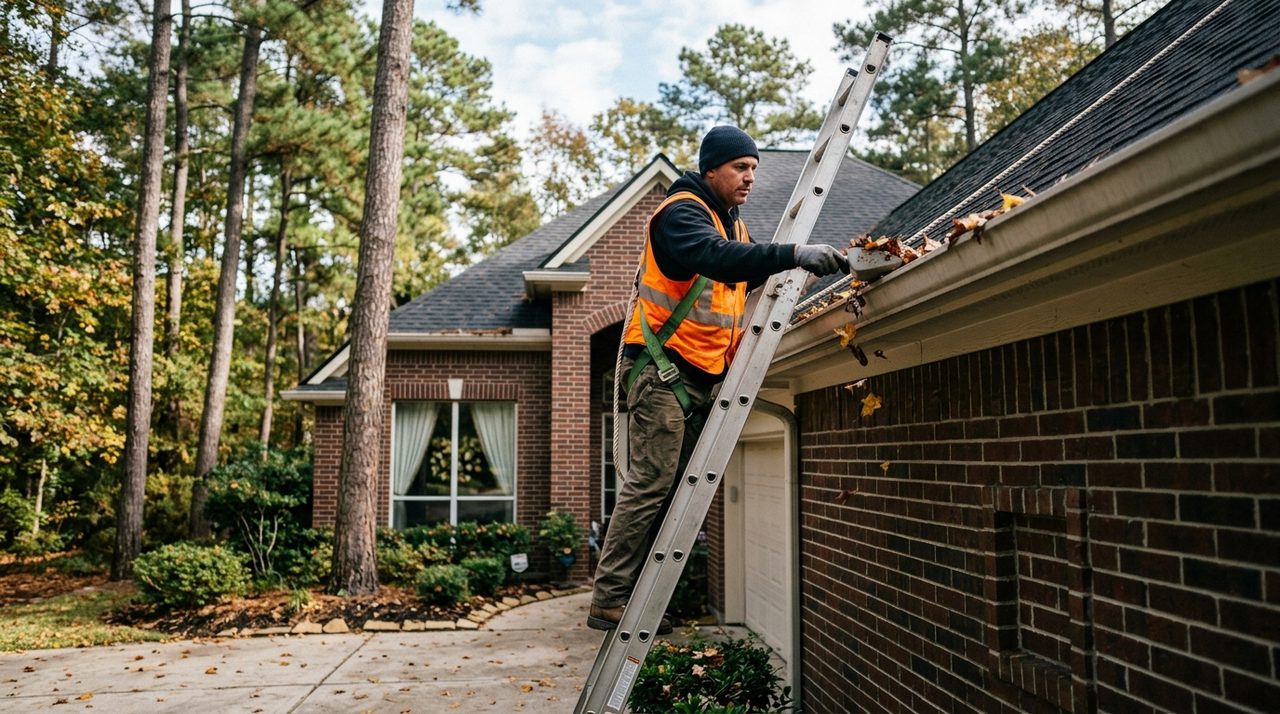
Porter's older subdivisions from the 1970s through 1990s sit within the East Texas Piney Woods fringe, and mature loblolly pines on those acreage lots shed needles, pollen catkins, and small cones year-round rather than in a single autumn flush. Unlike broad leaves that blow out easily, pine needles interlace into dense, moisture-holding mats that can fully block a standard 3-inch residential gutter in weeks, not months. On the slab-on-grade homes that dominate post-1960 Porter construction, water overflowing from a pine-needle-plugged gutter lands directly against the foundation perimeter, repeatedly saturating the Houston Black clay soil and promoting the differential heave and settlement that plagues the region.
What a good pro does
A qualified pro on these older Porter lots should hand-remove needle mats rather than relying solely on leaf blowers, which redistribute fine debris into downspout elbows. Downspouts should be flushed from above with a garden hose or low-pressure water feed to clear compacted material at the elbow bends. Because gutter cleaning in Porter falls outside any city permit jurisdiction — Montgomery County does not require a permit for routine cleaning or minor repairs — there is no permit to pull, but homeowners should confirm the pro carries general liability insurance before work begins.
Sources: Harris County Flood Control District, International Residential Code (as adopted by City of Houston)
Why it matters to you
The May 2024 derecho and Hurricane Beryl in July 2024 both tracked through the greater Houston-north metro corridor, depositing bark strips, Spanish moss, small branches, and shingle granules into gutters across Montgomery County in single events. Porter's ongoing construction boom means the area's housing stock includes aging 1990s and early-2000s dimensional shingle roofs that were already shedding granules; a major wind event accelerates that granule loss dramatically. Those granules compact into concrete-hard plugs at downspout top elbows, which standard post-storm leaf blowing cannot dislodge.
What a good pro does
After a named storm, schedule a gutter clean that specifically includes downspout flush-out, not just surface debris removal, since granule plugs sit below what's visible from a ladder. Expect a 2–6 week booking backlog immediately following a named storm as demand spikes across the metro; contacting providers within the first 48–72 hours gives better odds of a timely appointment. Post-storm cleans with heavy debris loads and full downspout clearing on a two-story Porter home can run $300–$450 (estimate), so get a written scope before authorizing work.
Sources: FEMA National Flood Hazard Layer (NFHL), International Residential Code (as adopted by City of Houston)
Why it matters to you
Valley Ranch and other master-planned Porter communities with mandatory HOAs actively monitor exterior conditions, and overflowing gutters leave organic staining on fascia boards and soffits that is plainly visible from the street — exactly the kind of appearance violation that triggers written notices from an architectural control committee. Porter's newer production homes in these communities often feature white or light-colored fascia trim that makes algae and dark tannin streaks from pine debris especially prominent. Because Porter has no city zoning or single permit authority, deed restriction enforcement through the HOA is often the primary regulatory pressure a homeowner actually feels.
What a good pro does
A thorough cleaning that includes a soft-rinse of the fascia face and gutter exterior — not just the channel interior — addresses both the functional clog and the visible staining that could generate an HOA notice. Confirm with your specific subdivision's HOA whether exterior cleaning work requires prior ACC notification; Valley Ranch's mandatory HOA structure means some exterior projects require approval even when no county permit is involved. Keep a dated service receipt as documentation if a violation notice arrives after the fact.
Sources: Local HOA / deed restrictions (see area profile), City of Houston Permitting Center
Why it matters to you
Even though most of Porter maps to FEMA Zone X, the area sits near Spring Creek and its tributaries, and standing water in debris-clogged gutters creates local mosquito breeding habitat independent of flood zone status. Harris County Mosquito Control District identifies residential gutters as a primary Aedes aegypti breeding site, and while Porter lies in Montgomery County, the same biological reality applies: a debris dam holding just two to four inches of stagnant water can produce a mosquito brood in 7–10 days during the May–October peak season. Older Porter lots with heavy pine canopy keep gutters shaded and damp between rain events, extending the window when standing water persists.
What a good pro does
A cleaning schedule of at least twice yearly — once in late spring before peak mosquito season and once after the primary fall needle-drop — is a practical minimum for shaded older lots; quarterly cleaning is worth considering on heavily treed acreage properties. Confirm downspouts drain completely and do not terminate against debris piles or in low spots that hold water. No permit is required in unincorporated Montgomery County for this maintenance, so frequency is a homeowner decision unencumbered by regulatory minimums.
Sources: Harris County Flood Control District, FEMA National Flood Hazard Layer (NFHL)
Hiring gutter cleaning in Porter? Porter is a sprawling, unincorporated Montgomery County area composed of dozens of individual subdivisions—some master-planned with mandatory HOAs, others completely unrestricted rural tracts. Housing ranges from 1970s-era homes on acreage to brand-new production builds in communities like Valley Ranch. Homeowners must navigate county-level permitting and widely varying deed restrictions, making it essential to verify rules at the subdivision level before any project.
Building era
1970s–2020s, with significant growth from the 1990s through 2010s and ongoing new construction.
Typical style
Mix of traditional single-family brick and frame homes in older plats, and newer production-style traditional homes in master-planned communities.
Foundations
Predominantly concrete slab-on-grade for post-1960 construction; some pier-and-beam in older or custom rural builds — specific subdivision data not confirmed.
Common systems
Newer homes typically feature central HVAC with high-SEER units, PEX or copper plumbing, and 200-amp electrical panels; older 1970s–1990s homes may have original R-22 HVAC systems, galvanized or CPVC plumbing, and 100–150-amp panels.
What that means for repairs
Older subdivisions see HVAC replacements, re-plumbing from galvanized to PEX, and kitchen/bath remodels. Unrestricted acreage tracts attract new construction, additions, and outbuilding projects. Master-planned communities focus on cosmetic updates and energy efficiency upgrades.
Permit jurisdiction
Montgomery County Engineering and applicable special utility districts (MUDs). Not within City of Houston or any incorporated city permit jurisdiction.
HOA & deed restrictions
Varies widely by subdivision. Valley Ranch HOA is mandatory for all property owners. North Country Homeowners Association, Inc. operates as a subdivision HOA. The Highlands is governed by a mandatory HOA. Many properties in broader Porter have no HOA at all. Confirm for any specific property via deed records or TREC HOA management-certificate database.
Historic districts
No historic district designation confirmed. Porter is in unincorporated Montgomery County with no City of Houston HAHC jurisdiction.
Contractor note
Contractors must obtain permits through Montgomery County rather than a city permit office. Additionally, many subdivisions require separate HOA architectural review committee (ACC) approval before exterior work begins, so contractors should verify both county and private-covenant requirements for each job.
FEMA flood zone
FEMA Zone X (low flood risk) per official NFHL data. However, properties near the East Fork of the San Jacinto River and its tributaries may carry higher risk; confirm flood zone at the parcel level as conditions vary across this large unincorporated area.
Hurricane Harvey impact
Parts of Montgomery County, including areas along the San Jacinto River and its tributaries, experienced flooding during Hurricane Harvey. Subdivision-specific or street-level Harvey impact data for the broader Porter area was not confirmed in available sources. Property-specific flood history should be verified through FEMA NFIP records and the Montgomery County floodplain administrator.
Heat & humidity load
Extreme summer heat and humidity drive heavy HVAC demand; older 1970s–1990s systems may struggle with efficiency. Slab foundations on expansive clay soils can shift during prolonged dry spells, and homes on rural lots with septic systems face additional stress during saturated-soil conditions in late summer storms.
Working with contractors here
Porter's wide range of housing ages means contractors encounter everything from 1970s-era galvanized re-pipes and aging R-22 HVAC changeouts to warranty work in brand-new master-planned communities. Unrestricted acreage properties frequently generate new-build, barndominium, and accessory-structure projects that require Montgomery County permitting and septic coordination. In HOA-governed subdivisions like Valley Ranch and North Country, exterior projects require ACC approval in addition to county permits, and contractors should budget time for that review process. The area's rapid growth means utility infrastructure varies—some neighborhoods are served by MUDs with specific tap and connection standards that affect plumbing and site work. Job scoping should always include verifying the specific subdivision's HOA status, applicable deed restrictions, and whether the property is on municipal water/sewer or septic.
Local Tip
Always ask for a written estimate before work begins. Texas contractors are required to provide one on jobs over $1,000.
Porter is a sprawling, unincorporated Montgomery County area composed of dozens of individual subdivisions—some master-planned with mandatory HOAs, others completely unrestricted rural tracts. Housing ranges from 1970s-era homes on acreage to brand-new production builds in communities like Valley Ranch. Homeowners must navigate county-level permitting and widely varying deed restrictions, making it essential to verify rules at the subdivision level before any project.
Source: U.S. Census Bureau, ACS 5-Year 2023
Most of Porter maps to FEMA Zone X (low mapped flood risk), but Houston's flash-flood reality means even low-risk blocks benefit from smart drainage and storm-hardened installs.
Source: FEMA National Flood Hazard Layer (NFHL). Flood zones vary by parcel — verify your individual FIRM panel.
Wind-driven rain during a hurricane pushes water horizontally into trough seams and end caps — have a gutter technician reseal any open joints and clear debris before storm season so the system functions as designed. In Porter, TX, the bigger post-storm threat is often structural damage from overflowing gutters undermining window sills and door frames rather than direct flooding. As a Montgomery County community, Porter may follow county rather than City of Houston storm rebuild rules.
The May 2024 derecho demonstrated that Porter, TX isn't immune to structural gutter damage even without flooding; wind-lifted sections land on HVAC equipment, cars, and windows. Replacing standard gutter spikes with hex screws and adding hangers every 18 inches is the most cost-effective pre-storm hardening a gutter cleaning professional can perform. Confirm the current FEMA panel for your Porter parcel — the area maps to Zone X, but adjacent lots can differ.
In Porter, TX, hard freezes are infrequent but severe when they arrive — Uri 2021 left gutters across the metro cracked at end caps and separated at seams because standing debris water froze and expanded. A pre-freeze cleaning in November removes that moisture reservoir and keeps the system intact through thaw and the spring severe-storm season that follows. As a Montgomery County community, Porter may follow county rather than City of Houston storm rebuild rules.
Sources: FEMA National Flood Hazard Layer (NFHL), Ready.gov -- Hurricanes, CenterPoint Energy -- Storm Center, City of Houston -- Emergency Preparedness, Ready.gov -- Winter Weather, Harris County Flood Control District
Houston-specific estimators to plan your project before you call a pro. All results are planning estimates — a licensed local pro confirms the details on site.
Disconnect & drain every outdoor hose bib
Remove hoses, drain the spigots, and cover each with an insulated faucet sock. Un-drained hose bibs are the #1 burst point in a Houston freeze.
Insulate exposed pipes in the attic & garage
Wrap any pipe in an unconditioned space (attic runs, garage walls) with foam sleeves. Houston homes rarely insulate these because they only matter a few nights a year — which is exactly why they burst.
Open cabinet doors & keep a pencil-width drip
On hard-freeze nights, open kitchen/bath cabinets so warm air reaches the pipes and let faucets on exterior walls drip to relieve pressure.
Protect the attic/garage water heater & its lines
An attic or garage tank sits in unconditioned space. Insulate the cold-inlet and hot-outlet lines and confirm the emergency drain pan is clear so a leak doesn't reach the ceiling.
This is a planning estimate only — actual requirements depend on an on-site assessment by a licensed Houston pro. If a pipe has already burst, shut off your main water supply and call a licensed Houston plumber immediately — freeze bursts flood fast.
Sources: Local HOA / deed restrictions (see area profile)
Sources: Local HOA / deed restrictions (see area profile)