Closed
2617 Bissonnet St #462, Houston, TX 77005
West University Place's mature canopy of live oaks and loblolly pines — shading some of the Inner Loop's most valuable real estate — drops debris year-round into gutters that span everything from 1930s pier-and-beam cottages to 5,000-square-foot teardown-rebuilds on the same block. Because West U is an independent municipality with its own permit office and code enforcement, contractors and homeowners operate under local rules separate from Houston's, and even minor gutter-related repairs that touch fascia or roofing should be confirmed with the City of West University Place before work begins. This page focuses on the specific debris patterns, soil dynamics, and post-storm realities that make gutter maintenance in West U meaningfully different from the surrounding Inner Loop.
Ranked by verified Google rating × review volume × verification tier. How we rank →
Some highly-rated pros serve West University from nearby and may not keep a West University street address. Those are listed under "Also serving West University" with their real city and distance, so you always know where each business is based.
2617 Bissonnet St #462, Houston, TX 77005
Highly-rated pros based nearby who cover West University. Distance shown from the West University area.
Serving West University Based in Upper Kirby · 1.3 mi away
Serving West University Based in Tanglewood · 2.5 mi away
Serving West University Based in Medical Center · 3.3 mi away
Serving West University Based in Midtown · 3.8 mi away
Serving West University Based in Medical Center · 4 mi away
Serving West University Based in Lazybrook / Timbergrove · 4.5 mi away
Serving West University Based in Meyerland · 4.7 mi away
Serving West University Based in Lazybrook / Timbergrove · 4.7 mi away
Serving West University Based in Midtown · 4.9 mi away
Why it matters to you
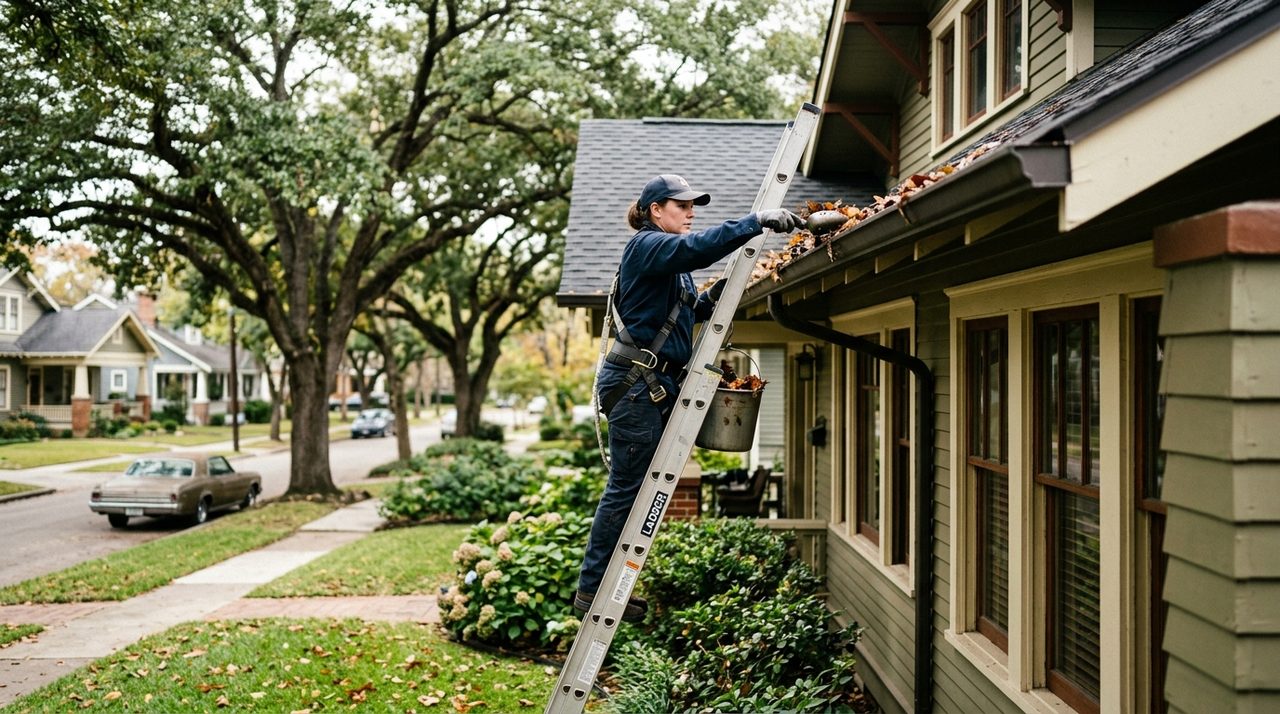
West University's tree-lined streets — particularly along Bellaire Boulevard and the interior blocks near Rice University — feature decades-old live oaks and loblolly pines that shed continuously rather than in a single fall flush. Two-story Georgian and neo-traditional custom homes rebuilt since the 1980s often have complex rooflines with multiple valleys, and those geometry changes act as collection points where pine needles mat into moisture-retaining plugs well before a homeowner notices overflow. Because many lots have shaded north- or east-facing roof planes with limited sun exposure, these plugs stay damp for days after rain, accelerating biological film formation inside gutter channels.
What a good pro does
A thorough clean on a West U two-story custom home — typically carrying 150 to 200 linear feet of gutter — should include hand-removal of matted needle plugs from every valley and elbow, not just a leaf-blower pass across open runs. Estimates for this scope run $175–$275 (estimated) for two-story homes depending on debris load and access. No permit is required by the City of West University Place for routine cleaning, but any fascia board replacement discovered during the job should be confirmed with the city's own permit office before repair work proceeds.
Sources: City of Houston Permitting Center, International Residential Code (as adopted by City of Houston)
Why it matters to you
West University's housing stock is genuinely mixed: pre-1950s cottages that survived teardown cycles likely sit on original pier-and-beam foundations, while the neighborhood's large-footprint custom rebuilds from the 1980s onward are overwhelmingly slab-on-grade. Houston's Beaumont/Houston Black clay soil underlies both foundation types, and a clogged gutter that spills water against a foundation perimeter repeatedly saturates that clay, causing it to expand and then shrink unevenly as it dries. On slab homes, that differential moisture cycle accelerates heave and settlement; on surviving pier-and-beam originals, chronic saturation around perimeter piers promotes wood rot and undermines beam bearing.
What a good pro does
During a cleaning visit, a competent crew should confirm that all downspouts discharge at least four feet from the foundation and that splash blocks or extensions are directing water away from the perimeter grade. West U's FEMA Zone X500 designation means the neighborhood sits outside the 100-year floodplain but inside the 500-year boundary, so heavy-rain events do reach these properties and the soil saturation risk from gutter overflow is real, not theoretical. Foundation-conscious homeowners should schedule cleanings at minimum twice yearly — late spring and late fall — with an additional check after any significant storm.
Sources: FEMA National Flood Hazard Layer (NFHL), Harris County Flood Control District, International Residential Code (as adopted by City of Houston)
Why it matters to you
West University's teardown-rebuild wave peaked in the late 1990s and early 2000s, meaning a large share of the custom homes here now carry 20-to-30-year-old asphalt shingle roofs that are actively shedding granules — a process accelerated by Beryl's July 2024 winds and the May 2024 derecho that swept the Inner Loop. Granules collect at gutter seams and at the top elbows of downspouts and compact into plugs that a standard leaf-blower cleaning cannot dislodge. Unlike pine needle debris, granule buildup is invisible from the ground and is often missed on cursory cleaning visits, leaving downspouts that appear clear but drain at a fraction of their designed capacity.
What a good pro does
Homeowners with 1990s–2000s custom homes should ask any cleaning crew to run water at volume through each downspout and observe the discharge rate at ground level — a partially granule-blocked elbow will drain noticeably slower than a clear one. Dislodging compacted granule plugs requires a pressure flush or a hand auger, not just air. Costs for post-storm cleans with heavy debris and downspout clearing on West U two-story homes can reach $300–$450 (estimated) for larger properties. If the cleaning crew identifies granule loss significant enough to suggest roof replacement, that roofing scope would require a permit through the City of West University Place's own building department, not Houston's Permitting Center.
Sources: City of Houston Permitting Center, International Residential Code (as adopted by City of Houston), Harris County Flood Control District
Why it matters to you
Harris County Mosquito Control District identifies clogged residential gutters as a primary Aedes aegypti and Culex quinquefasciatus breeding site across the metro, and West University's heavily shaded gutters — kept damp by the same canopy that makes the neighborhood desirable — are particularly susceptible. Even a modest debris dam holding two to four inches of standing water can produce a mosquito brood within seven to ten days under Houston's year-round warmth. For West U homeowners whose outdoor living spaces represent significant investment, a single clogged gutter run adjacent to a back patio creates a breeding source that no amount of yard spraying fully offsets.
What a good pro does
The most effective mitigation is keeping gutters free of debris dams throughout the peak mosquito season, which runs roughly May through October. For West U's heavily canopied lots, that typically means a spring cleaning before peak season and a midsummer inspection after the heaviest live oak catkin drop in late spring. No license is required of gutter cleaners in Texas as a standalone trade, but homeowners should ask any operator for proof of general liability insurance — a reasonable standard given the ladder-work involved on West U's taller custom homes.
Sources: Harris County Flood Control District, International Residential Code (as adopted by City of Houston)
Hiring gutter cleaning in West University? West University Place is an independent municipality within the Inner Loop featuring a mix of original 1930s–1950s bungalows and larger custom homes built from the 1980s onward as teardown-rebuild cycles reshaped the neighborhood. Homeowners here navigate the city's own permitting process—separate from Houston's—and must account for aging systems in older homes alongside modern construction standards in newer builds. The tree-lined streets and high property values drive demand for premium finishes and careful code compliance.
Building era
Mixed: original homes from 1930s–1950s with significant infill and teardown-rebuild construction from the 1980s–2000s and continuing today.
Typical style
Traditional brick, Georgian/Colonial-influenced, neo-traditional custom homes (2-story), with some remaining early-20th-century bungalows and cottages.
Foundations
Not confirmed from available sources - likely mixed pier-and-beam on older pre-1950s homes and slab-on-grade on newer construction. Verify on a per-property basis.
Common systems
Older homes (1930s–1950s) may have original galvanized or cast-iron plumbing, outdated electrical panels, and window AC or early central HVAC. Newer construction (1980s–present) typically features copper or PEX plumbing, modern electrical, and high-efficiency central HVAC systems.
What that means for repairs
Teardown-and-rebuild activity has been the dominant renovation pattern for decades, replacing smaller original cottages with larger custom homes. Remaining older homes frequently undergo full-gut renovations including electrical rewiring, plumbing replacement, foundation repair, and HVAC modernization to meet current standards and market expectations.
Permit jurisdiction
City of West University Place (independent municipality - own permit office, not City of Houston Permitting Center and not Harris County).
HOA & deed restrictions
No mandatory city-wide master HOA. West U functions as an independent municipality with its own zoning and code enforcement. Individual condo and townhome associations exist (e.g., The Oaks at West University Condominium Association), but most single-family homes have no HOA. Deed restrictions may exist on individual plats—check Harris County Clerk records for specific lots.
Historic districts
No City of Houston historic district designation applies. West University Place is an independent municipality outside Houston city limits, so HAHC Certificates of Appropriateness are not required. West U may have its own local design or zoning controls—check with the City of West University Place directly.
Contractor note
Contractors must pull permits through the City of West University Place, not through Houston or Harris County. West U's own inspectors enforce local codes, and the city's zoning and building requirements may differ from Houston's, so contractors unfamiliar with the jurisdiction should review local ordinances before bidding.
FEMA flood zone
FEMA Zone X500 (moderate flood risk) per official NFHL data. West University Place sits between Brays Bayou to the south and Rice University to the east, with drainage flowing into Harris County Flood Control District channels.
Hurricane Harvey impact
Specific Harvey 2017 flood impact data for West University Place streets was not available in the research provided. The moderate flood risk zone designation and proximity to Brays Bayou suggest potential vulnerability, but confirmed street-level flooding details and repetitive-loss areas should be verified through HCFCD inundation maps and City of West University Place floodplain reports.
Heat & humidity load
Houston's extreme summer heat and humidity stress HVAC systems across all housing eras. Older pier-and-beam homes may experience moisture-related subfloor issues, while the mature tree canopy—a signature feature of West U—creates ongoing gutter maintenance demands and potential root intrusion into aging sewer lines.
Working with contractors here
Contractors in West University most commonly handle full-home renovations and teardown-rebuilds, driven by buyers acquiring older cottages on valuable lots and replacing them with larger custom homes. For surviving 1930s–1950s homes, foundation repair, whole-house repiping (replacing galvanized with copper or PEX), electrical panel upgrades, and HVAC replacement are frequent scopes. Newer 1990s–2000s homes generate demand for roof replacements, exterior paint, and kitchen/bath remodels as they reach their first major maintenance cycles. Job scoping must account for West University Place's independent permitting process, which can differ from Houston's in turnaround times and inspection requirements. The high-end market expectations in West U mean contractors should budget for premium materials and meticulous finish work.
Local Tip
Always ask for a written estimate before work begins. Texas contractors are required to provide one on jobs over $1,000.
West University Place is an independent municipality within the Inner Loop featuring a mix of original 1930s–1950s bungalows and larger custom homes built from the 1980s onward as teardown-rebuild cycles reshaped the neighborhood. Homeowners here navigate the city's own permitting process—separate from Houston's—and must account for aging systems in older homes alongside modern construction standards in newer builds. The tree-lined streets and high property values drive demand for premium finishes and careful code compliance.
Source: U.S. Census Bureau, ACS 5-Year 2023
West University carries FEMA Zone X500 (moderate flood risk): outside the 100-year floodplain but inside the 500-year, so heavy-rain events still reach homes and flood-aware work pays off.
Source: FEMA National Flood Hazard Layer (NFHL). Flood zones vary by parcel — verify your individual FIRM panel.
Before a Gulf storm reaches West University, have gutters cleared of compacted leaf and shingle-grit debris so the full capacity of the system handles FEMA Zone X500 in the 500-year floodplain without cascading over the fascia. A technician should also confirm that all downspout elbows are tight, because loose joints shed water at the foundation rather than routing it to the street. Confirm the current FEMA panel for your West University parcel — the area maps to Zone X500, but adjacent lots can differ.
Straight-line winds load gutters with lateral force they aren't designed for, so a technician should walk your roofline after any severe event in West University and refasten hangers that have pulled away from the fascia. Keeping the trough clear before the storm ensures that if a section does fail, water cascades off the edge rather than pooling behind a debris dam and soaking the soffit. In-city West University work falls under City of Houston floodplain and permitting rules.
Winter Storm Uri 2021 showed that even Houston neighborhoods outside the 100-year floodplain can see significant meltwater runoff when three days of ice release simultaneously — clear gutters in late fall so the full trough capacity handles that surge without overflowing at the fascia. In West University, a quick November cleaning and downspout flush is the most efficient single step to protect the structure through both the freeze and the thaw. In-city West University work falls under City of Houston floodplain and permitting rules.
Sources: FEMA National Flood Hazard Layer (NFHL), Ready.gov -- Hurricanes, CenterPoint Energy -- Storm Center, City of Houston -- Emergency Preparedness, Ready.gov -- Winter Weather, Harris County Flood Control District
Houston-specific estimators to plan your project before you call a pro. All results are planning estimates — a licensed local pro confirms the details on site.
Disconnect & drain every outdoor hose bib
Remove hoses, drain the spigots, and cover each with an insulated faucet sock. Un-drained hose bibs are the #1 burst point in a Houston freeze.
Insulate exposed pipes in the attic & garage
Wrap any pipe in an unconditioned space (attic runs, garage walls) with foam sleeves. Houston homes rarely insulate these because they only matter a few nights a year — which is exactly why they burst.
Open cabinet doors & keep a pencil-width drip
On hard-freeze nights, open kitchen/bath cabinets so warm air reaches the pipes and let faucets on exterior walls drip to relieve pressure.
Protect the attic/garage water heater & its lines
An attic or garage tank sits in unconditioned space. Insulate the cold-inlet and hot-outlet lines and confirm the emergency drain pan is clear so a leak doesn't reach the ceiling.
This is a planning estimate only — actual requirements depend on an on-site assessment by a licensed Houston pro. If a pipe has already burst, shut off your main water supply and call a licensed Houston plumber immediately — freeze bursts flood fast.
Sources: City of Houston Permitting Center
Sources: Harris County Flood Control District