Closed
2310 Lord Nelson Dr, Seabrook, TX 77586
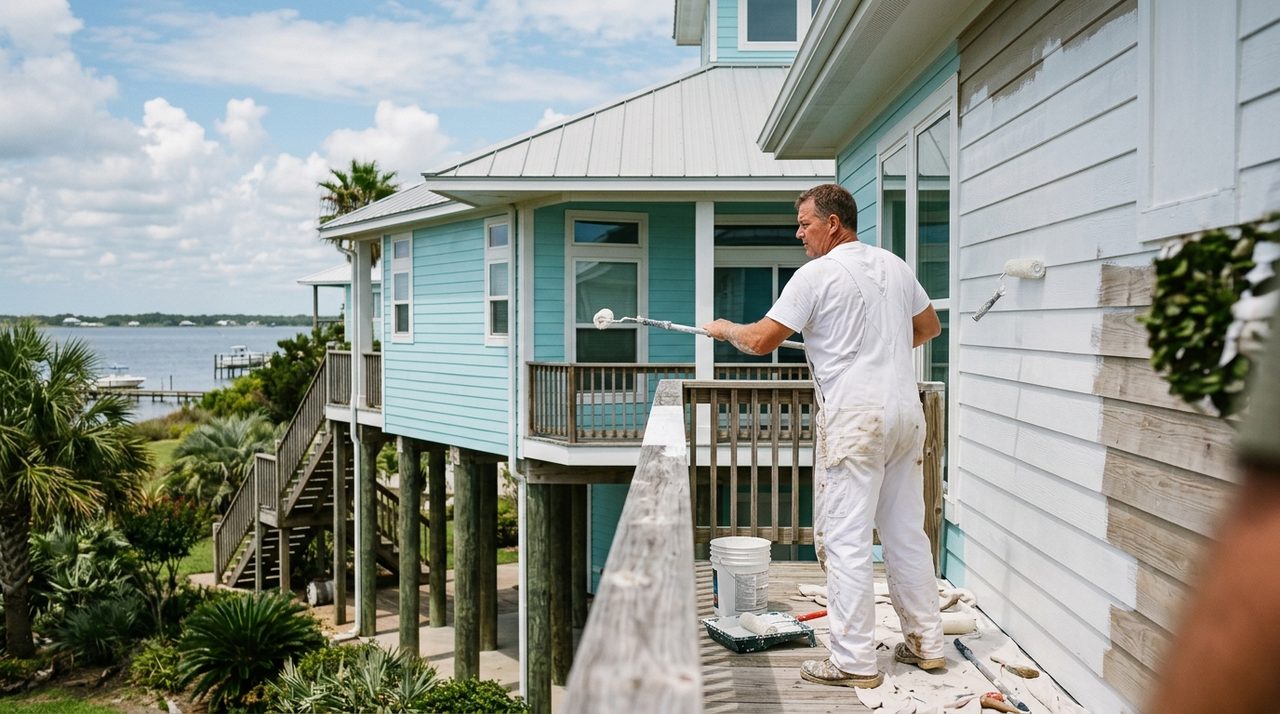
Seabrook sits on Galveston Bay's western shore inside FEMA Zone AE, where salt-laden Gulf air, repeated storm flooding from Harvey through Beryl, and a housing stock spanning 1960s waterfront cottages to 2000s slab subdivisions create painting challenges unlike anything inland Houston homeowners face. Salt-air accelerates coating breakdown on every exposed surface, post-flood repaint missteps are endemic in this watershed, and Seabrook's own Building/Permits Department — not Houston Permitting Center — controls the approval process for any exterior work that bundles repairs with painting. Read on to understand what actually goes wrong with paint in Seabrook and how to avoid paying for the same job twice.
Ranked by verified Google rating × review volume × verification tier. How we rank →
Some highly-rated pros serve Seabrook from nearby and may not keep a Seabrook street address. Those are listed under "Also serving Seabrook" with their real city and distance, so you always know where each business is based.
2310 Lord Nelson Dr, Seabrook, TX 77586
Highly-rated pros based nearby who cover Seabrook. Distance shown from the Seabrook area.
Serving Seabrook Based in League City · 2.8 mi away
Serving Seabrook Based in League City · 2.8 mi away
Serving Seabrook Based in League City · 4.1 mi away
Serving Seabrook Based in League City · 4.1 mi away
Serving Seabrook Based in League City · 4.2 mi away
Serving Seabrook Based in League City · 4.4 mi away
Serving Seabrook Based in League City · 4.8 mi away
Serving Seabrook Based in Clear Lake · 5.2 mi away
Serving Seabrook Based in League City · 5.4 mi away
Why it matters to you
Seabrook's position on Galveston Bay means airborne sodium chloride deposits on every west- and south-facing surface year-round, not just during storm events. On the 1960s–1980s waterfront and canal-front homes — many of which have wood fascia, wood trim, or older Masonite siding — that salt penetrates microscopic coating imperfections and accelerates osmotic blistering that can destroy a fresh paint job within 18 months. Standard latex exterior formulas marketed with 10–15 year fade warranties were validated in inland climates, not at tidewater.
What a good pro does
A qualified painter working in Seabrook's waterfront zones should strip failing coatings to bare substrate, rinse with a mild TSP solution to neutralize chloride contamination, and prime with a high-build moisture-barrier primer before applying a 100% acrylic topcoat rated for coastal or marine environments. West- and south-facing elevations should receive a third finish coat. Budget estimates for this level of prep on a 1,600–2,000 sq ft waterfront home typically run $5,500–$7,500, toward the top of the Houston metro exterior repaint range.
Sources: FEMA National Flood Hazard Layer (NFHL), Municipal permit office (see area profile)
Why it matters to you
Large portions of Seabrook's neighborhood fabric — including subdivisions along Clear Creek and the low-lying blocks closest to Galveston Bay — experienced interior flooding during Harvey (2017) and again during Beryl (2024). The characteristic brown tide line left by receding floodwater is mineral bleed-through that will reappear through any number of latex finish coats unless the underlying drywall is treated first. More critically, drywall paper facing that was wet for more than 24–48 hours often carries embedded mold even after it appears dry, and painting over it without encapsulant primer documents a failure pattern that Houston restoration contractors have reproduced at scale since 2017.
What a good pro does
Before any repaint following a documented flood event in Seabrook's AE zone, the painter should require a moisture meter reading of all wall cavities — anything above 16% MC in drywall signals incomplete drying. Affected surfaces should be primed with a shellac-based or proprietary mold-encapsulant primer (Zinsser BIN, Kilz Restoration, or equivalent) rather than standard latex primer, and the topcoat should follow within the manufacturer's recoat window to prevent moisture reabsorption. Post-flood encapsulant treatment typically adds $4–$8 per square foot of treated wall surface on top of finish coat labor.
Sources: FEMA National Flood Hazard Layer (NFHL), International Residential Code (as adopted by City of Houston)
Why it matters to you
Seabrook's oldest waterfront and near-bay housing stock — the 1960s and early 1970s cottages and bungalows concentrated along the bay-front and older streets — predates the 1978 federal ban on residential lead paint. Under EPA's Renovation, Repair, and Painting Rule (40 CFR 745), any firm sanding, scraping, or otherwise disturbing painted surfaces in these pre-1978 homes must be EPA Lead-Safe Certified, and individual workers must carry EPA RRP Renovator certification. This is not optional even for a straightforward repaint involving scraping peeling trim, and it applies regardless of whether the homeowner believes lead paint is present.
What a good pro does
Before contracting any painter for a pre-1978 Seabrook home, ask specifically for the firm's EPA Lead-Safe Certification number, which is publicly searchable on the EPA's contractor database. Texas does not license painters as a standalone trade through TDLR, so RRP certification is the primary credential distinguishing compliant firms from non-compliant ones on these older properties. Certified firms will conduct a visual assessment, set containment sheeting, and bag all waste for proper disposal — this adds real cost (roughly $300–$600 on a typical job), but skipping it exposes the homeowner to liability, especially with children or pregnant occupants in the home.
Sources: EPA Lead Renovation, Repair and Painting (RRP) Rule, Texas Department of Licensing & Regulation
Why it matters to you
Seabrook is not governed by the City of Houston and has no citywide zoning, but many of its subdivisions — including Seabrook Island HOA, Lake Cove Community Association (managed by Goodwin & Company), Seascape POA, and Searidge — maintain mandatory architectural review processes for exterior color changes. Approximately 16 HOA and condo communities are registered within Seabrook's city limits, and review timelines typically run two to six weeks from submission. Scheduling an exterior paint crew before receiving written HOA approval risks having to stop work mid-project or repaint an unapproved color at your expense.
What a good pro does
Before scheduling any exterior paint job in a Seabrook subdivision, confirm with your HOA or POA whether a color-change submittal is required, request the approved palette or color range in writing, and submit physical paint chip samples if the governing documents require them rather than digital swatches. Additionally, any exterior painting job in Seabrook that is bundled with repair work — patching stucco, replacing trim boards, or repairing storm-damaged fascia — must be permitted through the City of Seabrook Building/Permits Department, not the Houston Permitting Center or Harris County, as Seabrook is an incorporated municipality that administers its own permit desk.
Sources: Local HOA / deed restrictions (see area profile), Municipal permit office (see area profile)
Hiring painters in Seabrook? Seabrook is an incorporated city on Galveston Bay with housing ranging from 1960s waterfront homes to 2000s subdivision development, creating a wide spectrum of home service needs. The coastal location and FEMA AE flood zone designation mean that flood mitigation, elevation considerations, and storm-hardening are central to nearly every major home project. Homeowners should expect subdivision-level HOA requirements that vary block by block and plan for salt-air corrosion on exterior systems.
Building era
1970s–2000s, with some 1960s waterfront homes and ongoing infill.
Typical style
Production suburban traditional (one- and two-story brick or brick-and-siding) with coastal/contemporary elevated homes along waterfront and canal-front areas.
Foundations
Mixed — predominantly slab-on-grade in newer subdivisions; pier-and-beam or pier-and-pile construction common in older waterfront and canal-front homes due to floodplain and storm-surge requirements.
Common systems
Central HVAC systems typical of 1980s–2000s construction (aging units in older homes); copper and CPVC plumbing in newer builds, galvanized possible in 1960s–1970s stock; standard 200-amp electrical panels in newer homes, potential 100-amp in older homes.
What that means for repairs
Flood damage repair and mitigation retrofits are common drivers of renovation activity. Waterfront homes frequently undergo elevation projects, foundation reinforcement, and storm-resistant window/door upgrades. Older homes often need full plumbing repipes and HVAC replacements due to age and salt-air corrosion.
Permit jurisdiction
City of Seabrook Building/Permits Department (incorporated city — not Houston Permitting Center or Harris County).
HOA & deed restrictions
Subdivision-by-subdivision. Many subdivisions have mandatory HOAs/POAs including Seabrook Island HOA, Lake Cove Community Association (managed by Goodwin & Company), Seascape POA, and Searidge. Approximately 16 HOA/condo communities are registered in Seabrook. Some older or fringe areas may have no active HOA but may still have recorded deed restrictions.
Historic districts
No City of Houston historic district designation confirmed. Seabrook is an independent incorporated city and not subject to HAHC oversight.
Contractor note
Contractors must pull permits through the City of Seabrook and should verify subdivision-specific HOA architectural review requirements before starting exterior work. Coastal building codes and floodplain management regulations apply and may require elevation certificates.
FEMA flood zone
FEMA Zone AE (high flood risk) — source: fema_nfhl. Seabrook sits directly on Galveston Bay and is subject to both riverine flooding and coastal storm surge, contributing to its very high hazard risk rating.
Hurricane Harvey impact
The Clear Lake/Bay area of southeast Harris County experienced significant flooding during Hurricane Harvey. Seabrook-specific community hazard data rates overall risk as 'Very High.' However, no publicly available subdivision-level or street-level Harvey flood-extent map for Seabrook was identified. Exact street-by-street impact should be verified through Harris County Flood Control District records and individual property seller's disclosures.
Heat & humidity load
Extreme humidity and salt-air proximity accelerate corrosion on HVAC condensers, metal roofing components, and exterior hardware. HVAC systems run at near-continuous capacity May through September, shortening equipment lifespan. Mold and moisture intrusion in slab-on-grade and pier-and-beam homes require proactive dehumidification and ventilation strategies.
Working with contractors here
Contractors working in Seabrook most commonly handle flood damage restoration, foundation repairs (especially on older pier-and-beam waterfront homes), and HVAC replacements accelerated by salt-air corrosion and heavy summer usage. Roofing and exterior siding projects require wind-rated materials compliant with coastal building codes, and many jobs trigger City of Seabrook floodplain management requirements including elevation certificates. The wide range of housing ages — from 1960s waterfront cottages to 2000s subdivision homes — means scoping should always begin with a thorough assessment of existing systems, as plumbing and electrical standards vary significantly across eras. HOA architectural review adds a layer of approval in many subdivisions, so contractors should confirm HOA requirements before beginning visible exterior modifications.
Local Tip
Always ask for a written estimate before work begins. Texas contractors are required to provide one on jobs over $1,000.
Seabrook is an incorporated city on Galveston Bay with housing ranging from 1960s waterfront homes to 2000s subdivision development, creating a wide spectrum of home service needs. The coastal location and FEMA AE flood zone designation mean that flood mitigation, elevation considerations, and storm-hardening are central to nearly every major home project. Homeowners should expect subdivision-level HOA requirements that vary block by block and plan for salt-air corrosion on exterior systems.
Source: U.S. Census Bureau, ACS 5-Year 2023
Much of Seabrook maps to FEMA Zone AE (high flood risk), so flood-resilient detailing -- elevated equipment, water-tolerant materials, and drainage-first thinking -- is essential here, not optional; risk climbs sharply on blocks nearest Galveston Bay, where it varies parcel to parcel.
Source: FEMA National Flood Hazard Layer (NFHL). Flood zones vary by parcel — verify your individual FIRM panel.
Sources: Municipal permit office (see area profile)FEMA National Flood Hazard Layer (NFHL)
Sources: EPA Lead Renovation, Repair and Painting (RRP) Rule
Sources: Local HOA / deed restrictions (see area profile)
Sources: Local HOA / deed restrictions (see area profile)