Closed
6505 Sprigg St, Fulshear, TX 77441
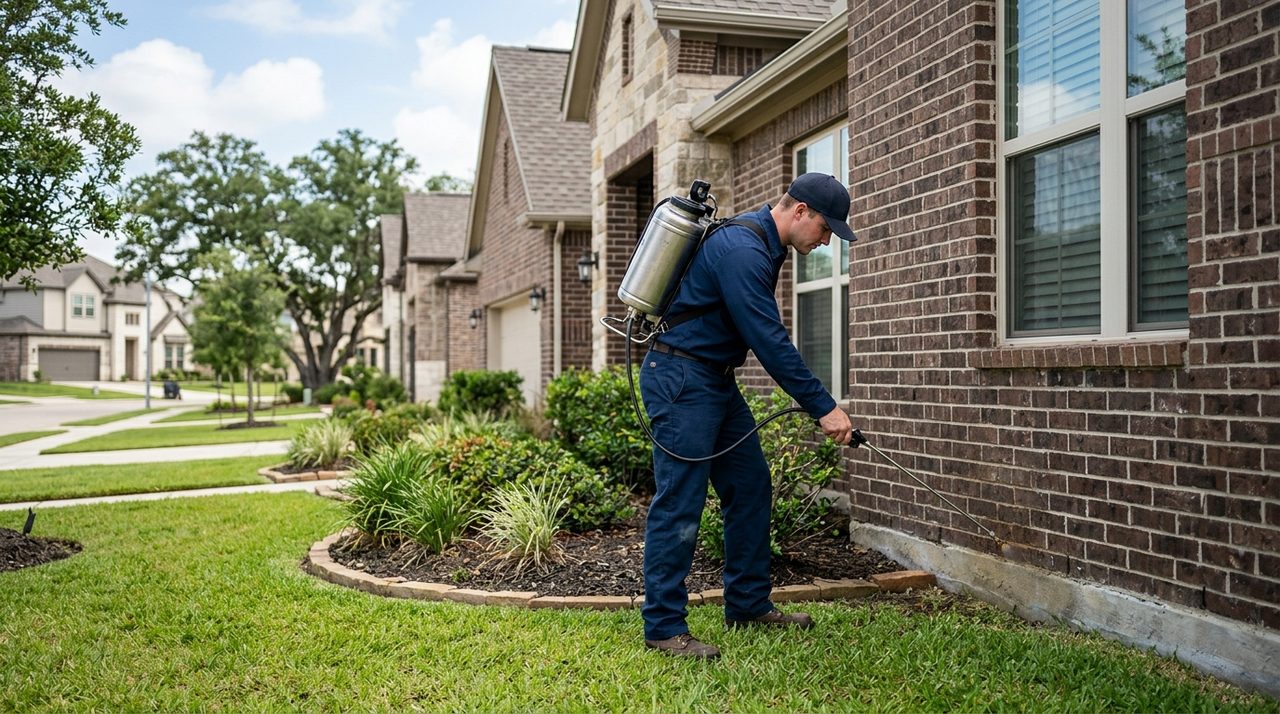
Fulshear's rapid growth since the early 2000s has blanketed Fort Bend County's heavy clay soils with thousands of slab-on-grade production homes in master-planned subdivisions — a combination that creates very specific pest pressure even in new construction. Because virtually every subdivision here (Weston Lakes, Fulshear Lakes, Pecan Ridge, Polo Ranch) operates under mandatory HOAs with architectural review boards, exterior pest-control treatments, bait station placement, and mound treatments on common turf all require coordination with your HOA before a technician schedules service. This page explains the four pest challenges that actually matter in Fulshear's post-2000 suburban context and what a licensed Texas pest control operator can do about each one.
Ranked by verified Google rating × review volume × verification tier. How we rank →
Some highly-rated pros serve Fulshear from nearby and may not keep a Fulshear street address. Those are listed under "Also serving Fulshear" with their real city and distance, so you always know where each business is based.
6505 Sprigg St, Fulshear, TX 77441
Highly-rated pros based nearby who cover Fulshear. Distance shown from the Fulshear area.
Serving Fulshear Based in Richmond · 4.8 mi away
Serving Fulshear Based in Katy · 7 mi away
Why it matters to you
TAMU Extension classifies all of Fort Bend County as high-density red imported fire ant territory, and Fulshear's master-planned subdivisions provide ideal conditions: clay soil with slow drainage, irrigated St. Augustine turf, and shared greenspace where colonies migrate freely between lots. Fire ant colonies routinely nest against foundation edges and inside electrical junction boxes for irrigation controllers — a known risk in neighborhoods with automated irrigation systems standard in production homes built after 2005. The problem compounds because HOA-managed common areas may receive separate community pest treatments that don't cover your private lot, leaving a gap right at your property line.
What a good pro does
A TDLR-licensed pest control operator (look for the Structural Pest Control license with the appropriate category endorsement, as required by the Texas Department of Licensing and Regulation) should apply a two-step broadcast bait program to your yard perimeter and follow up with individual mound treatments at plumbing and irrigation entry points. Before scheduling any broadcast treatment on shared turf or near community amenities, confirm in writing with your HOA's architectural review committee — Fulshear Lakes and similar HOAs specify approval windows for visible exterior treatments. Seasonal re-treatment in spring and fall is the realistic expectation given constant re-infestation pressure from neighboring lots.
Sources: Texas Department of Licensing & Regulation, Local HOA / deed restrictions (see area profile)
Why it matters to you
Even though Fulshear's homes are overwhelmingly modern — a census median year built of 2015 means most slabs went down within the past two decades — Houston sits in USDA Zone 5, the highest subterranean termite pressure zone in the continental U.S., and Formosan and Reticulitermes termites do not respect construction vintage. Slab-on-grade homes in Fort Bend County rely on concrete expansion joints, plumbing sleeve penetrations, and post-tension cable conduits as the only soil-to-wood interfaces, and those joints are the primary highway termites use. Homes built during the 2000s–2010s boom may have had soil pre-treatment at construction, but that termiticide barrier degrades over 10–15 years — meaning many Fulshear homes are now reaching the window where original pre-treatment protection is expiring.
What a good pro does
A TDLR-licensed termite operator should perform a full slab perimeter inspection focusing on plumbing penetrations and expansion joint locations, then present you with two options: a liquid termiticide barrier (Termidor-type applications run an estimated $800–$1,800 for a slab home at current Houston market rates) or a bait station monitoring program (estimated $1,200–$2,000 installed, plus $300–$500/year for annual monitoring contracts). Bait stations are the more HOA-friendly choice in Fulshear subdivisions since stations sit flush with the lawn surface and are less visually intrusive than perimeter trench-and-treat work — but confirm placement locations with your HOA's architectural committee before installation.
Sources: Texas Department of Licensing & Regulation, Local HOA / deed restrictions (see area profile)
Why it matters to you
Fort Bend County's expansive Beaumont/Houston Black clay soil causes measurable seasonal slab movement that cyclically opens and tightens gaps around garage door sweeps, brick veneer weep holes, and plumbing utility chases — the same entry points Rattus norvegicus and Mus musculus exploit. In Fulshear's production homes, the brick-and-stone façades that dominate the streetscape (standard across subdivisions like Polo Ranch and Pecan Ridge) have weep holes built into the brick course at ground level specifically for moisture drainage — but those openings are large enough for a juvenile roof rat. Active construction throughout Fulshear's still-expanding western edge continuously displaces rodent populations from cleared lots into adjacent finished neighborhoods.
What a good pro does
Effective rodent control in Fulshear requires a two-phase approach: exclusion work to seal slab penetrations and install stainless-steel mesh at weep holes, followed by interior and exterior baiting by a TDLR-licensed operator with the rodent control category endorsement. Estimated costs for professional exclusion plus treatment run $400–$900 depending on linear footage of the foundation perimeter and number of penetration points. Note that exclusion materials attached to the exterior brick or foundation face are technically a modification to the home's exterior — check with your HOA architectural committee before scheduling, particularly if you are in a subdivision with active deed-restriction enforcement.
Sources: Texas Department of Licensing & Regulation, Local HOA / deed restrictions (see area profile)
Why it matters to you
Fulshear took measurable wind damage from both Hurricane Beryl's July 2024 landfall and the May 2024 derecho that brought 100+ mph gusts across West Houston, stripping soffit panels and ridge cap shingles from production homes throughout the subdivisions. Even a single displaced soffit panel creates immediate attic access for roof rats, Virginia opossums, and — critically — Mexican free-tailed bats, which are protected under Texas Parks and Wildlife Department protocols and cannot be removed during maternity season (March 15–August 15) without specific handling procedures. Many Fulshear homeowners discovered damage months after the storms when AC efficiency dropped or scratching sounds began in the attic.
What a good pro does
If you suspect wildlife entry following 2024 storm damage, have a TDLR-licensed pest control operator with a wildlife exclusion capability inspect the roofline and attic before any soffit repair is scheduled. Bat presence requires coordination with a TPWD-compliant wildlife operator, and the timing of exclusion must account for maternity season restrictions. Your TWIA or homeowner's insurance policy may cover attic remediation costs if wildlife entry is documented as a direct result of storm damage — get the pest inspection report in writing before filing a claim, as insurers will ask for evidence of the entry point.
Sources: Texas Department of Licensing & Regulation, Texas Windstorm Insurance Association (TWIA)
Hiring pest control in Fulshear? Fulshear is one of the fastest-growing communities in the Houston metro, dominated by post-2000 master-planned subdivisions with mandatory HOAs and rigorous deed restrictions. Homeowners here typically deal with newer construction systems but face strict architectural review for any exterior modifications. The mix of production homes and rural acreage tracts means service needs range from standard warranty-era maintenance to custom work on larger estate properties.
Building era
2000s–2020s (bulk of inventory); limited older housing in original town of Fulshear.
Typical style
Contemporary suburban production homes — brick and stone façades, 1- and 2-story detached single-family, mix of traditional, Texas Hill Country-inspired, and transitional elevations.
Foundations
Slab-on-grade (standard for post-2000 Fort Bend County production homes; older farmhouses or custom acreage homes may use pier-and-beam but are a small minority).
Common systems
Modern high-efficiency HVAC systems (14+ SEER), PEX or copper plumbing, 200-amp electrical panels, tankless or high-efficiency water heaters common in newer builds.
What that means for repairs
Most homes are under 20 years old, so major renovation is limited. Common projects include patio covers, outdoor kitchens, pool installations, and garage conversions — all typically requiring HOA architectural review and approval before work begins.
Permit jurisdiction
City of Fulshear Building Department for properties within city limits; Fort Bend County Engineering for unincorporated ETJ areas. Jurisdiction depends on exact property location.
HOA & deed restrictions
Most master-planned subdivisions (Weston Lakes, Fulshear Lakes, Pecan Ridge, Polo Ranch, and others) have mandatory HOAs with formal architectural review, deed restriction enforcement, and annual assessments (e.g., Fulshear Lakes charges ~$1,850/year including front yard maintenance). Non-HOA parcels exist on acreage tracts and older rural roads but are the minority of housing units.
Historic districts
No historic district designation confirmed. Fulshear is a rapidly growing area with almost entirely modern construction.
Contractor note
Contractors must verify whether a property falls within Fulshear city limits or unincorporated Fort Bend County, as permitting requirements and inspection processes differ. Nearly all subdivision work also requires prior HOA architectural committee approval before permits are pulled.
FEMA flood zone
FEMA Zone X (low flood risk) per official NFHL data. However, the broader Fulshear area sits between bayous and the Brazos River, so flood risk is highly location-specific — some parcels closer to waterways may carry different designations. Always verify FEMA FIRM panels for specific addresses.
Hurricane Harvey impact
No area-wide documentation confirms broad Harvey flooding across Fulshear subdivisions. Regional Harvey impact reports focus on Brazos River flooding near Simonton and Richmond rather than Fulshear master-planned communities. Marketing materials for major Fulshear subdivisions do not disclose Harvey flooding. However, no authoritative source definitively confirms zero impact for all Fulshear properties — for a specific address, check FEMA claims data and Fort Bend County floodplain records.
Heat & humidity load
New slab-on-grade construction on expansive Fort Bend County clay soils is subject to significant seasonal soil movement. Extended summer heat and drought cause soil shrinkage that can stress slab foundations and exterior hardscape. Proper irrigation of foundation perimeters is critical. High-efficiency HVAC systems in these larger homes (many 2,500–4,000+ sq ft) face heavy summer loads and benefit from annual pre-season maintenance.
Working with contractors here
Contractors in Fulshear primarily handle new-home warranty work, HVAC maintenance on modern high-efficiency systems, and outdoor living additions such as pools, covered patios, and outdoor kitchens. Because most homes are under 20 years old, major system replacements are uncommon, but foundation monitoring and minor slab repair due to expansive clay soils is a recurring need. HOA architectural review is a significant factor — contractors should advise homeowners to secure written HOA approval before scheduling exterior work, as non-compliant modifications can result in forced removal. The mix of production subdivisions and rural acreage means job scoping varies widely: subdivision work follows tight lot-line and setback constraints, while acreage properties may involve well/septic systems and longer material delivery logistics.
Local Tip
Always ask for a written estimate before work begins. Texas contractors are required to provide one on jobs over $1,000.
Fulshear is one of the fastest-growing communities in the Houston metro, dominated by post-2000 master-planned subdivisions with mandatory HOAs and rigorous deed restrictions. Homeowners here typically deal with newer construction systems but face strict architectural review for any exterior modifications. The mix of production homes and rural acreage tracts means service needs range from standard warranty-era maintenance to custom work on larger estate properties.
Source: U.S. Census Bureau, ACS 5-Year 2023
Most of Fulshear maps to FEMA Zone X (low mapped flood risk), but Houston's flash-flood reality means even low-risk blocks benefit from smart drainage and storm-hardened installs; risk climbs sharply on blocks nearest the Brazos River, where it varies parcel to parcel.
Source: FEMA National Flood Hazard Layer (NFHL). Flood zones vary by parcel — verify your individual FIRM panel.
Houston-specific estimators to plan your project before you call a pro. All results are planning estimates — a licensed local pro confirms the details on site.
| Pest | Cadence | Active window |
|---|---|---|
Mosquito control A standard 4-week barrier treatment holds a typical suburban lot through Houston's core mosquito season. | Every 28 days | April – October |
Termite (subterranean) A once-a-year spring inspection is the baseline for a drier, sunnier Houston lot — catch mud tubes and swarmer wings before damage compounds. | Annual inspection | Spring |
General pest guard (roaches, ants, spiders) Houston's year-round warmth means general pests never fully die off — a quarterly perimeter treatment is the standard maintenance rhythm. | Quarterly | Mar · Jun · Sep · Dec |
This is a planning estimate only — actual requirements depend on an on-site assessment by a licensed Houston pro. Texas requires an SPCB-licensed applicator for chemical treatment — ask for the technician's license number.
Sources: Texas Department of Licensing & RegulationLocal HOA / deed restrictions (see area profile)
Sources: FEMA National Flood Hazard Layer (NFHL)Harris County Flood Control District
Sources: Local HOA / deed restrictions (see area profile)